
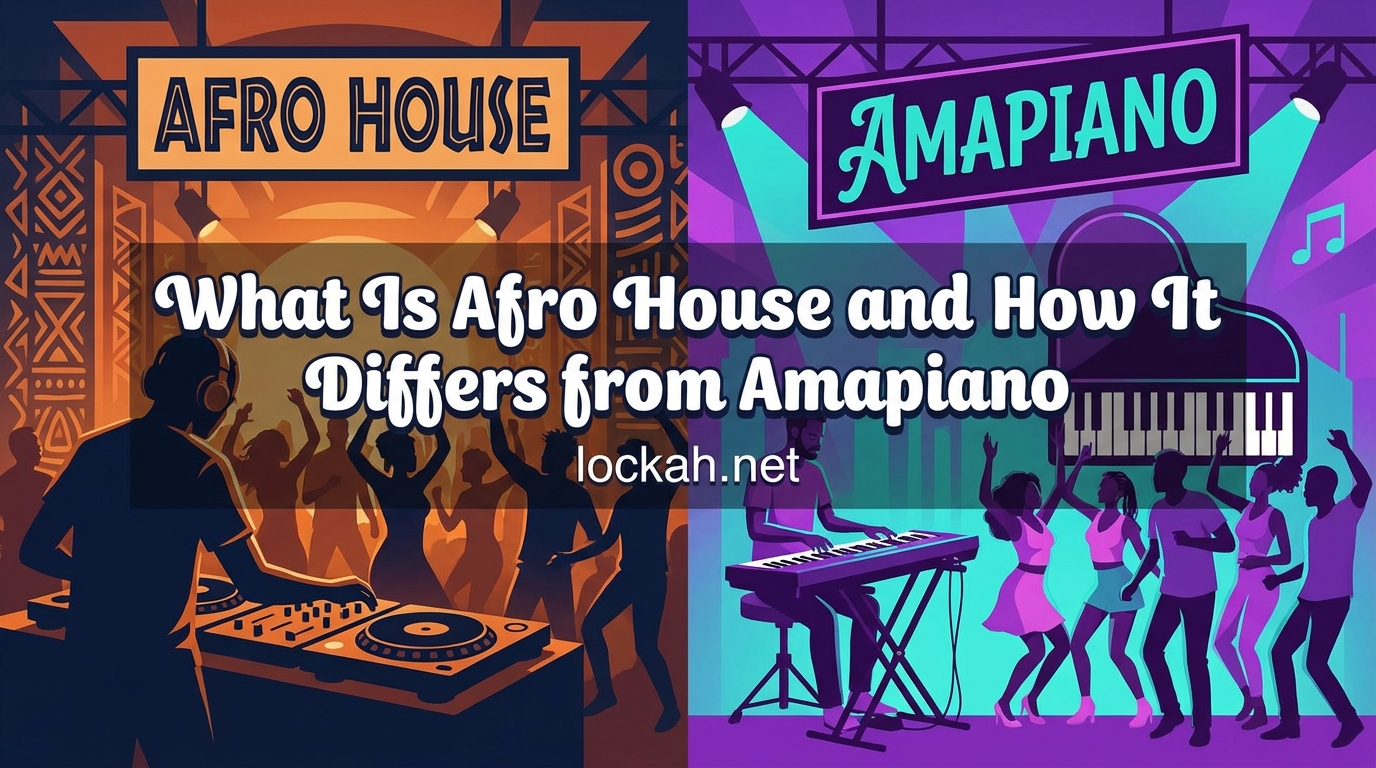
Have you ever found yourself scrolling through a playlist wondering whether that infectious track with the deep bass is Afro House or Amapiano? You are not alone. I have spent countless nights in clubs and production studios trying to explain the difference to friends who just want to know what to search for on Spotify next.
The confusion makes sense. Both genres emerged from South Africa, both dominate dance floors worldwide in 2026, and both share that hypnotic quality that keeps you moving without realizing it. But dig into the technical details, and you will discover two distinct musical identities with different origins, production approaches, and cultural stories.
In this guide, I will break down exactly what separates Afro House from Amapiano. By the end, you will know which BPM range to expect, which instruments define each sound, and why producers like Black Coffee and Kabza De Small represent two different musical philosophies.
Table of Contents
What Is Afro House?
Afro House is a subgenre of house music that took root in South Africa during the 1990s. It blends traditional four-on-the-floor house rhythms with African percussion, deep basslines, and soulful melodic elements.
The genre carries heavy DNA from Kwaito, South Africa’s earlier electronic music movement that emerged after apartheid. Where Kwaito slowed house music down and added local vocal styles and slower grooves, Afro House maintained the tempo and structure of international house while injecting distinctly African rhythmic patterns.
Key Characteristics of Afro House
The heartbeat of Afro House is the four-on-the-floor kick drum pattern. This steady pulse locks the track at tempos typically ranging from 115 to 125 BPM, creating that driving energy perfect for extended DJ sets.
Around that foundation, producers layer polyrhythmic percussion. Think shakers, congas, bongos, and layered drum patterns that create complexity without clutter. The basslines run deep and melodic, often carrying as much musical information as the lead elements.
Vocals in Afro House tend toward soulful, often featuring call-and-response patterns or chant-like phrases that lock into the groove. Some tracks remain entirely instrumental, letting the percussion and bass carry the emotional weight.
Pioneer Artists in Afro House
When I think of Afro House, Black Coffee immediately comes to mind. His track “Superman” featuring Bucie became an anthem that introduced countless international listeners to the genre’s emotional depth. Culoe De Song, another pioneer, brought a more meditative, almost spiritual quality to the sound with tracks like “Make You Move.”
Other essential names include Ralf GUM, who bridges European and South African house sensibilities, and Timmy Regisford, whose productions helped define the soulful side of the genre. These artists built the foundation that today’s Afro House producers continue expanding.
What Is Amapiano?
Amapiano emerged in South Africa around the mid-2010s, making it significantly younger than Afro House. The name itself comes from the Zulu word for “the pianos,” which immediately tells you what instrument sits at the center of this sound.
The genre developed primarily in the townships of Pretoria and Johannesburg, where producers began experimenting with slower tempos, jazz-influenced piano chords, and a distinctive bass sound that would become the genre’s signature. Unlike Afro House’s steady club energy, Amapiano feels more laid-back, more suited to daytime social gatherings and chilled outdoor parties.
The Log Drum: Amapiano’s Defining Sound
If you hear one element that instantly identifies a track as Amapiano, it is the log drum. This percussive bass sound mimics the tonal qualities of traditional African drums, creating a bouncy, rhythmic foundation that feels both electronic and organic.
The log drum typically plays syncopated patterns that interlock with the piano melodies, creating that signature Amapiano bounce. Producers achieve this sound through specific synthesis techniques or sampling, and it has become so iconic that its absence in a track immediately raises questions about whether the song truly belongs to the genre.
Beyond the log drum, Amapiano features prominent piano work. Producers use Rhodes emulations, jazz chords, and melodic progressions that borrow heavily from South African jazz and gospel traditions. The result feels warmer and more harmonically rich than many electronic genres.
Amapiano’s Tempo and Structure
Amapiano typically runs between 110 and 115 BPM, noticeably slower than Afro House. This relaxed tempo contributes to the genre’s social, conversational atmosphere.
The percussion focuses less on four-on-the-floor drive and more on intricate hi-hat patterns, signature shakers, and off-beat accents. Many Amapiano tracks feature extended instrumental sections where the piano and log drum trade melodic phrases, creating hypnotic loops that can stretch for minutes.
Key Artists Driving Amapiano
Kabza De Small stands as arguably the most influential Amapiano producer, earning the nickname “King of Amapiano” from fans and fellow artists alike. His prolific output and consistent quality have shaped the genre’s sound more than any single artist.
DJ Maphorisa represents a bridge between worlds. He moves fluidly between Amapiano, Afro House, and Gqom production, bringing commercial sensibilities that helped break Amapiano into mainstream markets. Other essential names include Vigro Deep, who pioneered a darker, bass-heavier variant, and MFR Souls, who helped define the genre’s early sound.
Afro House vs Amapiano: Key Differences (2026)
Now that we have explored both genres individually, let me put them side by side. Understanding these distinctions will help you identify tracks correctly and appreciate why they create different moods on the dance floor.
| Feature | Afro House | Amapiano |
|---|---|---|
| Tempo (BPM) | 115-125 BPM | 110-115 BPM |
| Drum Pattern | Four-on-the-floor kick | Syncopated, less rigid |
| Signature Instrument | African percussion layers | Log drum bass |
| Melodic Focus | Synths, vocals, percussion | Piano chords, jazz progressions |
| Bass Style | Deep, sustained sub-bass | Pitched, percussive log drum |
| Vocals | Soulful, often instrumental | Chants, conversational, sparse |
| Energy Level | High, driving, club-focused | Relaxed, social, daytime feel |
| Origins | 1990s South Africa | Mid-2010s Pretoria/Johannesburg |
| Key Artists | Black Coffee, Culoe De Song | Kabza De Small, DJ Maphorisa |
Tempo and Energy Differences
The BPM gap might seem small, but those 5 to 10 beats per minute create completely different physical responses. Afro House at 122 BPM pushes you into that sweat-inducing, continuous-movement zone. Amapiano at 112 BPM lets you groove while still holding a conversation.
This tempo difference also affects DJ mixing. Transitioning between the two genres requires careful key matching and energy management. Many DJs treat them as separate blocks in a set rather than freely mixing between them.
Production Philosophy Contrasts
From a producer’s perspective, the workflow differs significantly. Afro House production often starts with the kick drum and bassline, building percussion layers on that foundation. Amapiano frequently begins with piano chords, with the log drum added to accent the harmonic rhythm.
The sound design priorities diverge too. Afro House producers spend hours crafting the perfect kick and bass relationship for club systems. Amapiano producers obsess over piano tone, log drum pitch, and the interplay between melodic elements.
Where the Genres Overlap
Despite these differences, the genres share South African DNA. Both use African rhythmic concepts. Both have roots in township culture. Both have exploded onto the global stage in 2026, influencing producers from London to Lagos to Los Angeles.
Some producers intentionally blur the lines. DJ Maphorisa releases tracks that sit right between the genres, taking Afro House’s energy and applying Amapiano’s log drum and piano approach. This has spawned hybrid subgenres like 3step, which one Reddit user perfectly described as “amapiano and afrohouse had a baby.”
Cultural Origins and Global Impact
Understanding where these sounds came from helps explain why they feel different. Both genres emerged from South Africa’s complex cultural landscape, but from different moments in the country’s history.
The Township Connection
Afro House grew from the post-apartheid optimism of the 1990s, when South African artists first gained broad access to international electronic music. It represents a generation claiming house music as their own, adding local identity to a global format.
Amapiano emerged from a different moment, the social media age of the 2010s. Its spread was turbocharged by platforms like TikTok and YouTube, where its visual culture of stylish dancing and social gathering spread faster than traditional media could have managed.
Geographic Nuances
Afro House developed broadly across South Africa’s major cities, absorbing influences from Durban’s kwaito scene, Cape Town’s deep house community, and Johannesburg’s club culture. It feels national rather than regional.
Amapiano carries a more specific geographic fingerprint. Pretoria township producers pioneered the sound before Johannesburg artists commercialized and globalized it. This Pretoria-Johannesburg dynamic still shapes the genre’s evolution today.
Global Reception in 2026
Both genres have transcended South African borders. Afro House found early adoption in European deep house circles, particularly in Germany and the UK. Amapiano took a more viral route, exploding through social media challenges and influencer adoption before establishing itself in clubs.
Today, you will hear Amapiano influences in mainstream pop production and Afro House sounds in underground dance music worldwide. Nigerian artists like Burna Boy have incorporated Amapiano elements into Afrobeats hits. European techno producers sample log drum patterns. The exchange flows both ways.
Frequently Asked Questions
What is the difference between Afrohouse and Amapiano?
Afro House features faster tempos (115-125 BPM) with four-on-the-floor kick drums and African percussion. Amapiano runs slower (110-115 BPM) and is defined by its log drum bass sound and prominent piano melodies. Afro House feels club-driven while Amapiano has a more relaxed, social atmosphere.
Is Amapiano a subgenre of house music?
Yes, Amapiano is a subgenre of house music that emerged in South Africa during the mid-2010s. It incorporates jazz-influenced piano chords, log drum bass patterns, and slower tempos than traditional house music, creating its own distinct identity within the broader house music family.
Who is the king of Amapiano?
Kabza De Small is widely regarded as the king of Amapiano. His prolific production output, consistent quality, and influential sound design have shaped the genre more than any other artist. He has released hundreds of tracks and collaborative projects that define what Amapiano sounds like today.
What does afro house music mean?
Afro House refers to a subgenre of house music that originated in South Africa in the 1990s. It combines traditional four-on-the-floor house rhythms with African percussion, deep basslines, and soulful vocals. The genre carries influences from Kwaito and represents South Africa’s adaptation of international house music.
What is the log drum in Amapiano?
The log drum is a distinctive bass sound in Amapiano that mimics the tonal qualities of traditional African drums. It plays syncopated, melodic patterns that interlock with piano chords to create the genre’s signature bouncing rhythm. Producers create this sound through synthesis or sampling techniques.
What is 3step music?
3step is a hybrid genre that blends elements of Amapiano and Afro House. It sits between the two genres tempo-wise and combines Afro House’s driving energy with Amapiano’s log drum and piano elements. The genre emerged as producers began intentionally blurring the lines between these South African sounds.
Conclusion
Afro House and Amapiano represent two distinct expressions of South African electronic music. Afro House delivers driving club energy with its 115-125 BPM four-on-the-floor rhythms and African percussion layers. Amapiano offers a more relaxed, piano-driven experience defined by its signature log drum and jazz-influenced harmonies.
Understanding these differences matters whether you are a DJ building sets, a producer exploring new sounds, or simply a listener who wants to know what playlist to choose. Both genres continue evolving and influencing global electronic music in 2026, and their shared South African heritage ensures they will remain connected even as they grow apart.
Next time you hear a track with that bouncing log drum, you will know it is Amapiano. When the four-on-the-floor kick drives harder and the tempo pushes upward, you are in Afro House territory. Either way, you are experiencing some of the most exciting electronic music to emerge from Africa in decades.