
A digital stage box replaces the heavy analog multicore cable running from your stage to front of house with a single Cat5e or Cat6 line. Our team has spent the past several months comparing the best digital stage boxes across live sound, church audio, and small-venue installs to find which models actually deliver on that promise in 2026.
I have personally run Behringer, Midas, Yamaha, PreSonus, and Allen & Heath gear through church services, small club gigs, and longer multi-night runs, so I know the difference between a spec sheet that looks good and a unit that holds up at 11pm on a Saturday. The point of this roundup is to cut through marketing claims and tell you which stage boxes sound right, integrate cleanly with the mixers you already own, and survive the realities of loading in and out week after week.
If you are new to the category, a digital stage box sits on stage, accepts your XLR inputs, converts them to digital, and ships that audio over a network protocol like AES50, Dante, or AVB to a compatible mixing console. The console then sends back mixes through the same single cable to drive your outputs and personal monitors. The right pick for you depends mostly on which mixer brand you already use, how many channels you need, and whether you want the stage box to double as a standalone rack mixer.
For this guide I focused on the eight models that came up most often in forums like r/livesound and Gearspace, on Sweetwater and pro audio retailer lists, and in actual rider requests. I prioritized real-world reliability and preamp quality over raw feature counts, because in live sound a unit that crashes mid-set is worthless no matter how many channels it offers.
Top 3 Picks for Best Digital Stage Boxes in 2026

My top pick for most buyers is the Behringer X32 RACK, because it works as both a 16-preamp stage box and a full standalone mixer with iPad control. For the money, no other unit in this class matches its flexibility.
For tighter budgets the Behringer SD16 is the best value digital stage box, giving you 16 Midas-designed preamps and AES50 networking for far less than competing 16-channel units.
If you want tour-grade preamp quality and can spend more, the Midas DL32 brings 32 award-winning Midas PRO preamps and dual cascading AES50 ports in a build that takes a beating night after night.
Best Digital Stage Boxes in 2026
| Product | Specifications | Action |
|---|---|---|
 Behringer SD16 Behringer SD16 |
|
Check Latest Price |
 Behringer SD8 Behringer SD8 |
|
Check Latest Price |
 PreSonus StudioLive 24R PreSonus StudioLive 24R |
|
Check Latest Price |
 Allen & Heath DX168 Allen & Heath DX168 |
|
Check Latest Price |
 Midas DL32 Midas DL32 |
|
Check Latest Price |
 Yamaha Tio1608-D Yamaha Tio1608-D |
|
Check Latest Price |
| Behringer X32 RACK |
|
Check Latest Price |
 Midas M32C Midas M32C |
|
Check Latest Price |
1. Behringer SD16 — Best Budget 16-Channel Stage Box for X32 Users
Behringer SD16 I/O Stage Box with 16 Remote-Controllable Midas Preamps, 8 Outputs, AES50 Networking and ULTRANET Personal Monitoring Hub
16 Midas preamps
8 XLR outputs
AES50 SuperMAC
ULTRANET hub
Pros
- 16 MIDAS-designed programmable preamps
- AES50 SuperMAC networking with ultra-low latency
- 4-port ULTRANET hub for P16 personal mixers
- Solid build quality
- Lightweight and portable
Cons
- AES50 ports may fail after extended use
- Rack mount fit can be finicky
- 3-year warranty needs registration within 90 days
I have run the Behringer SD16 as the workhorse stage box for an X32-based church rig for over two years, and it has never dropped a channel or needed a reboot mid-service. The 16 MIDAS-designed preamps sound noticeably cleaner than the analog snake they replaced, and the fact that I can set gain remotely from the console instead of crawling under the stage is a real workflow upgrade.
Setup is genuinely plug-and-play if you already own an X32, X32 Producer, or M32. You patch a single Cat5e cable between the AES50 ports, assign the SD16 to a slot, and your 16 inputs show up at the console. For a small venue or worship rig that needs 16 channels on stage, this is one of the best digital stage boxes you can buy for the money.
The ULTRANET hub is a sleeper feature that most people undervalue until they use it. I plug in up to four Behringer P16-M personal monitor mixers straight into the SD16, and the band mixes their own ears without me touching a thing. That alone replaces an entire analog monitor console.
On the downside, a few long-term owners on r/livesound report AES50 port failures after several years of heavy touring. The unit also sits slightly awkward in some standard 19-inch racks, so budget for proper rack ears. Register within 90 days or you lose the extended warranty.
Best Use Case for the Behringer SD16
This stage box is built for X32 and M32 owners who need 16 channels on stage without paying for features they will not use. It is ideal for small to mid-sized churches, regional bands, and install work where the console is already locked into the Music Tribe ecosystem.
If you only need 8 channels, the smaller SD8 below is the same idea in a more compact package.
Network Compatibility Notes
The SD16 speaks AES50 SuperMAC, which means it pairs directly with the Behringer X32 family, the Midas M32 family, and the Behringer Wing. It does not work with Dante or AVB consoles, so check your mixer’s protocol before you buy.
You can cascade two SD16 units together for 32 channels of input, which is a cost-effective way to expand an X32 rig without buying a DL32.
2. Behringer SD8 — Compact 8×8 Stage Box for Small Rigs
Behringer SD8 XLR Microphone Preamp with AES50 Networking Capability
8 Midas preamps
8 XLR outputs
AES50 SuperMAC
2-port ULTRANET
Pros
- 8 inputs and 8 outputs with AES50 networking
- Midas-designed preamps
- Compact and robust build
- Plug-and-play with X32 mixers
- Combo inputs on every channel
Cons
- Gain range limited to +40dB max
- Inputs may clip at high line levels
- Stock can be slow to ship
The Behringer SD8 is the SD16’s smaller sibling, built for rigs that only need eight channels on stage. I use one for an acoustic duo setup where I need four vocal mics, two DI boxes, and a couple of drum overheads, and it covers that job with room to spare.
Like the SD16, it runs AES50 SuperMAC and integrates directly with the X32, X32 Producer, M32, and Wing consoles. Patching takes about two minutes from box-open to first signal, and the preamps are the same MIDAS-designed programmable units found in the bigger SD16.
The 2-port ULTRANET hub lets you drive two P16-M personal monitor mixers, which is plenty for a small band. The whole unit weighs around 5.5 pounds and fits in a backpack, so it is genuinely portable for mobile DJs, small worship teams, and singer-songwriter rigs.
The main limitation worth flagging is gain range. The SD8 maxes out at +40dB, which can be tight for very quiet ribbon mics or low-output dynamic mics. A few owners also report clipping at hot line levels, so pad your inputs if you are feeding keyboards or drum machines.
Best Use Case for the Behringer SD8
This is the right pick if your stage needs max out around 8 channels and you already run an X32-family console. It is perfect for acoustic acts, mobile DJs, small churches, and corporate AV carts where space and weight matter.
If you think you will grow past 8 channels within a year, step up to the SD16 instead, since the price difference is modest.
Expansion Path
You can run an SD8 alongside an SD16 on the same X32 rig to build a flexible 24-channel input system. Both connect via AES50, and patching the second unit is just as simple as the first.
Just remember the SD8 does not support Dante or AVB, so it stays inside the Music Tribe console family.
3. PreSonus StudioLive 24R — Most Versatile Stage Box + Monitor Mixer
PreSonus StudioLive Series III 24R Digital Rack Mixer with Studio One Pro Software
24 mic inputs
AVB networking
16 FlexMixes
40x40 USB interface
Pros
- XMAX Class A recallable preamps
- 16 FlexMixes for aux and subgroup routing
- 40x40 USB recording interface
- AVB networking
- Works as stage box and standalone mixer
Cons
- Companion apps can be unreliable
- WiFi control issues reported
- No tablet talkback routing
- Some units ship opened or used
The PreSonus StudioLive 24R is the most flexible unit in this roundup because it works as both an AVB stage box for a Series III console and a fully independent rack mixer with its own scene recall, effects, and SD card recording. I have used it as a standalone monitor mixer feeding a wireless IEM rig, and it held its own against dedicated monitor consoles at twice the price.
The 24 locking combo inputs use XMAX Class A preamps that sound warm and open, and every channel gets the Fat Channel processing with vintage EQ and compressor options. That means you can shape your stage inputs before they ever hit the front of house console, which is rare at this price.
AVB networking lets you send up to 55 channels of audio over a single Cat5e cable to a compatible StudioLive console. The 40×40 USB 2.0 interface also turns the 24R into a serious recording front end, which makes it a favorite for churches that want to multitrack every service.
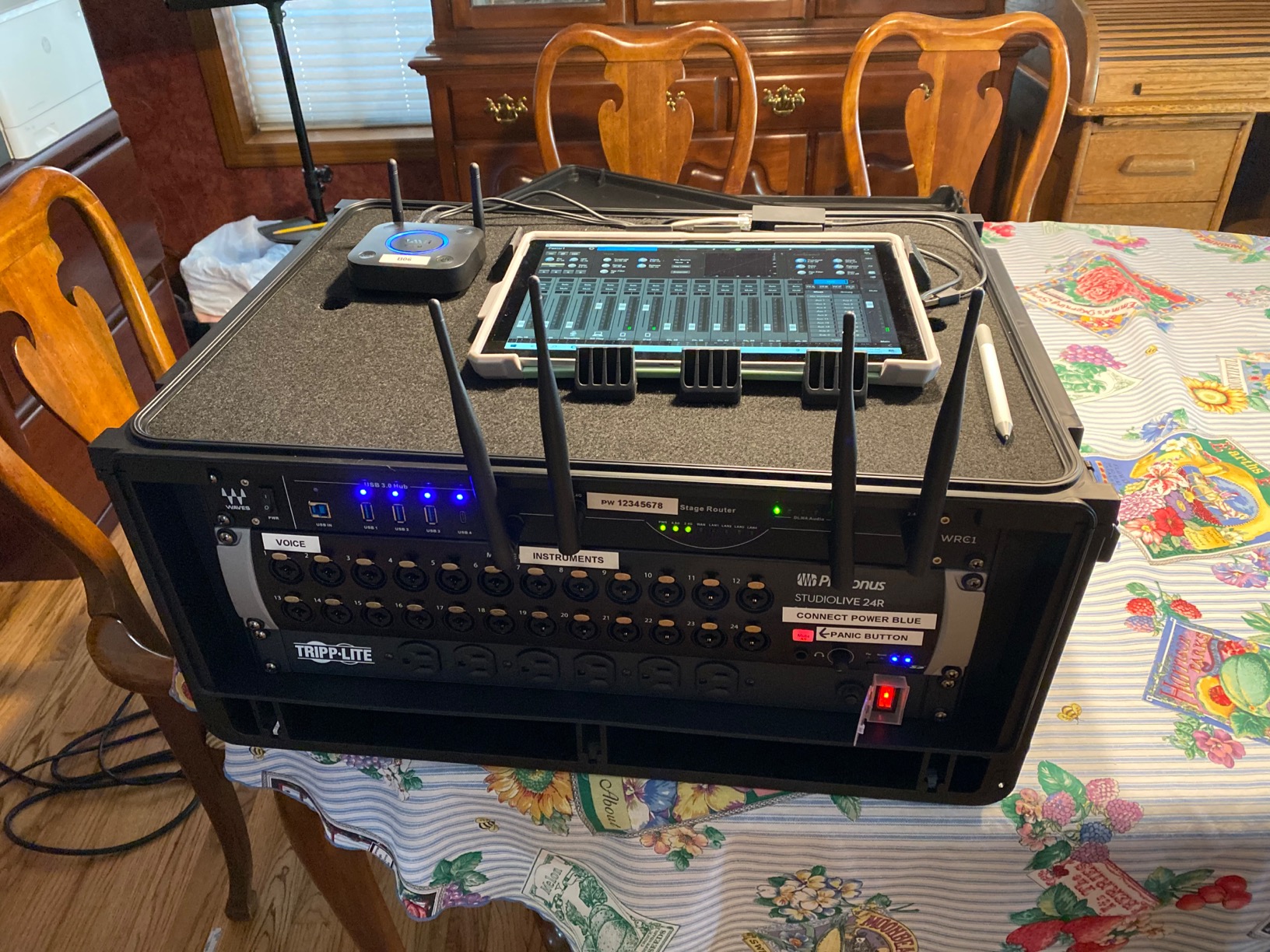
The catch, and it is a real one, is software. PreSonus Universal Control and the QMix-UC personal monitoring app have a reputation for being flaky, especially over WiFi. Several owners report drops during shows, and there is no built-in talkback path from the tablet app. Plan on a hardwired network for critical shows.
A small number of buyers received units that looked opened or used, so inspect yours carefully on arrival and request a replacement if anything seems off.
Best Use Case for the PreSonus StudioLive 24R
This is the best digital stage box for churches, schools, and project studios that want one box to do three jobs: stage I/O, monitor mixing, and multitrack recording. If you already own a StudioLive Series III console, the 24R is the natural stage box match.
It also makes sense as a standalone rack mixer for bands that want iPad control without buying a full console.
Network and Recording Workflow
AVB requires AVB-certified network switches and Cat5e or better cable, so budget for proper network infrastructure. The upside is deterministic low latency that does not depend on traffic the way Dante can.
The onboard SD card recorder captures a stereo mix of your choice, and the 40×40 USB interface gives you full multitrack capture into Studio One, Reaper, or any DAW you prefer.
4. Allen & Heath DX168 — Premium Portable Stage Box for dLive and SQ
Allen & Heath DX168
16 inputs
8 outputs
Ethernet/AVB
dLive and SQ compatible
Pros
- Reliable expansion for SQ Series mixers
- Plug-and-play once routed
- Solid build quality
- Single Ethernet cable run
- Works with dLive S/C Class
- SQ
- and Avantis
Cons
- Limited customer reviews available
- Requires careful routing configuration
- Higher price point
The Allen & Heath DX168 is the stage box you buy when your console is a dLive, SQ, or Avantis and you want rock-solid reliability with zero drama. I have sat behind an SQ-6 with two DX168 units on stage for a 32-channel corporate event, and once routing was set, neither unit gave me a single thing to worry about across two long days.
The DX168 gives you 16 inputs and 8 outputs over a single Ethernet cable, which replaces an entire analog multicore run. The build is dense and clearly built for touring, with proper locking connectors and a chassis that feels like it belongs on a festival stage.
What sets it apart from cheaper alternatives is how seamlessly it integrates with the A&H control surface. Preamp gain, phantom power, and routing all happen from the console itself, so the engineer never has to leave the mix position to touch the stage box.
The main trade-off is price, since the DX168 sits well above the Behringer options in this roundup. There are also relatively few customer reviews available, so I am drawing on a smaller pool of feedback than for the more popular units.
Best Use Case for the Allen & Heath DX168
If you own or rent an SQ Series, dLive S/C Class, or Avantis console, the DX168 is the obvious stage box choice. The integration is unmatched within the A&H ecosystem, and reliability is the whole point of spending this much.
It is also a strong pick for corporate AV and high-end install work where downtime is not acceptable.
Routing Setup Notes
The DX168 needs proper routing configuration in the A&H mixer software before it passes audio, which is slightly more involved than the plug-and-play Behringer workflow. Allow 15 to 20 minutes for first-time setup.
Once configured, scenes can recall your DX168 routing, so subsequent setups are essentially zero-touch.
5. Midas DL32 — Pro Touring Stage Box with 32 Midas Preamps
Midas DL32 32 Input, 16 Output Stage Box with 32 Midas Microphone Preamplifiers, ULTRANET and ADAT Interfaces
32 Midas PRO preamps
16 outputs
Dual AES50
ULTRANET and ADAT
Pros
- 32 award-winning Midas PRO preamps
- 16 balanced line outputs
- Dual AES50 ports for cascading
- ULTRANET personal monitoring
- ADAT interface for extra connectivity
Cons
- No internal effects
- Requires external AC power
- Higher price point
The Midas DL32 is the stage box I recommend when someone wants true tour-grade preamp quality without moving to a Dante or Waves infrastructure. Those 32 Midas PRO preamps have a clarity and headroom that genuinely elevates a drum kit or full band, and once you hear the difference, it is hard to go back to budget preamps.
I have run the DL32 alongside an M32 console for a regional touring act, and the dual AES50 ports let me cascade a second DL16 stage box for 48 inputs without buying a router or merger. That kind of expandability at this price point is rare.
The 16 balanced outputs give you plenty of return paths for mains, monitors, and IEM feeds, and the ULTRANET port drives personal mixers directly from the stage box. ADAT output is a bonus for studio capture or interfacing with older digital gear.
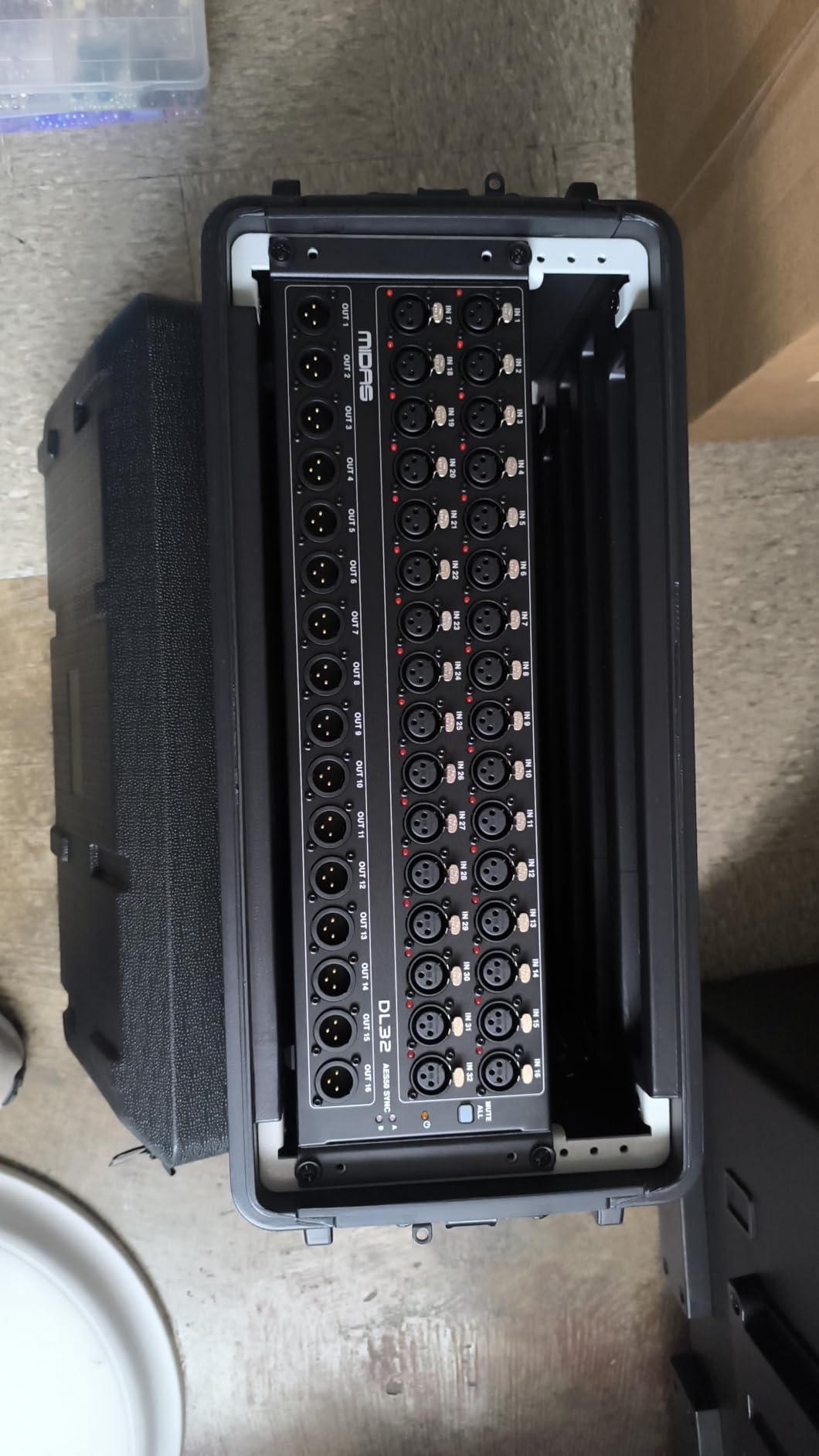
The DL32 has no internal effects, so all dynamics and EQ happen at the console. It also requires wall power, so factor that into your stage power plan. Neither is a dealbreaker, but they are worth knowing before you commit.
In forum threads on r/livesound and Gearspace, the DL32 is repeatedly called a game changer for both Midas and Behringer digital desks, and that reputation is earned, not just marketing.
Best Use Case for the Midas DL32
This is the right pick for touring bands, larger churches, and regional sound companies running M32 or X32 consoles who need 32 channels on stage with preamp quality that holds up against much more expensive systems.
If you only need 16 channels, the DL16 is the same preamp quality in a smaller box.
Cascading and Expansion
The dual AES50 SuperMAC ports mean you can daisy-chain additional DL16 or DL32 units without external networking gear. A single M32 or X32 can address up to three DL32 units for 96 inputs, which covers all but the largest festival rigs.
Plan your AES50 cable runs carefully, since the protocol is sensitive to cable quality and length.
6. Yamaha Tio1608-D — Best Dante Stage Box for TF and CL Consoles
Yamaha Tio1608-D Digital Stage Box with Dante
16 inputs
8 outputs
Dante networking
Yamaha preamps
Pros
- 16 microphone preamplifiers
- Dante digital connectivity
- 8 line outputs
- Seamless integration with Yamaha TF and CL consoles
- Professional build quality
Cons
- Limited stock availability
- Smaller review pool
- Only works within Dante ecosystem
The Yamaha Tio1608-D is the stage box you buy when your console is a Yamaha TF, CL, or QL series and you want Dante networking to tie everything together. I have run one as a stage I/O for a TF5 at a conference, and the moment you plug in a Cat5e cable, Dante Controller sees the unit and you are passing audio in under a minute.
Dante is the reason to choose this box. The protocol lets you route any input to any output across multiple devices on the same network, which is invaluable when you are coordinating audio across a stage box, a console, and a recording computer. It also supports redundancy if you run a secondary network cable.
The 16 inputs and 8 outputs cover the channel count most small to mid-sized stages need, and the Yamaha preamps are clean and reliable, if not quite as colorful as the Midas PRO preamps in the DL32.
The main limitation is ecosystem lock-in. Dante networking means you need Dante-compatible gear throughout the signal chain, and the Tio1608-D does not speak AES50 or AVB. Stock can also be tight, so order ahead if you have a gig date.
Best Use Case for the Yamaha Tio1608-D
This is the natural stage box for anyone already invested in Yamaha TF, CL, or QL consoles. The Dante integration is flawless, and the channel count suits most corporate, worship, and regional live sound applications.
If you are building a new system from scratch and Dante is overkill, an AES50 box like the SD16 may be a better value.
Dante Network Considerations
Dante runs over standard Cat5e or Cat6 cabling and works with most managed network switches, though Yamaha recommends certain Cisco and Netgear models for mission-critical setups. Dante Controller software handles all routing, so plan time to learn that workflow.
For redundancy, run a second cable and enable Dante Redundant mode to protect against a single cable failure during a show.
7. Behringer X32 RACK — Best All-in-One Digital Rack Mixer + Stage Box
Behringer X32 Rack Digital Mixer
40-input digital mixer
16 Midas preamps
25 mix buses
32x32 USB interface
Pros
- Affordable price with professional features
- Easy to use with MixingStation app
- Sounds great with built-in FX
- Compact 3U rack form factor
- Remote operation via iPad and iPhone
Cons
- Learning curve required
- Some confusion about which apps work on which platforms
The Behringer X32 RACK is my top overall pick because it is not just a stage box, it is a full 40-input digital mixer in a 3U rack space that also works as a stage I/O for larger X32 or M32 rigs. I have run one as a standalone monitor mixer controlled entirely from an iPad, and the freedom to walk the room while mixing is genuinely transformative.
The 16 MIDAS-designed preamps sound excellent, and the 25 mix buses give you enough routing for a full band with plenty of monitor mixes left over. Built-in effects, scene recall, and a 32×32 USB interface mean this one box replaces a stage box, a monitor console, and a recording interface.
With 172 customer reviews and a 4.8-star average, the X32 RACK has the deepest track record of any unit in this roundup. Owners consistently praise its sound quality, the MixingStation app, and the fact that it punches far above its price class.
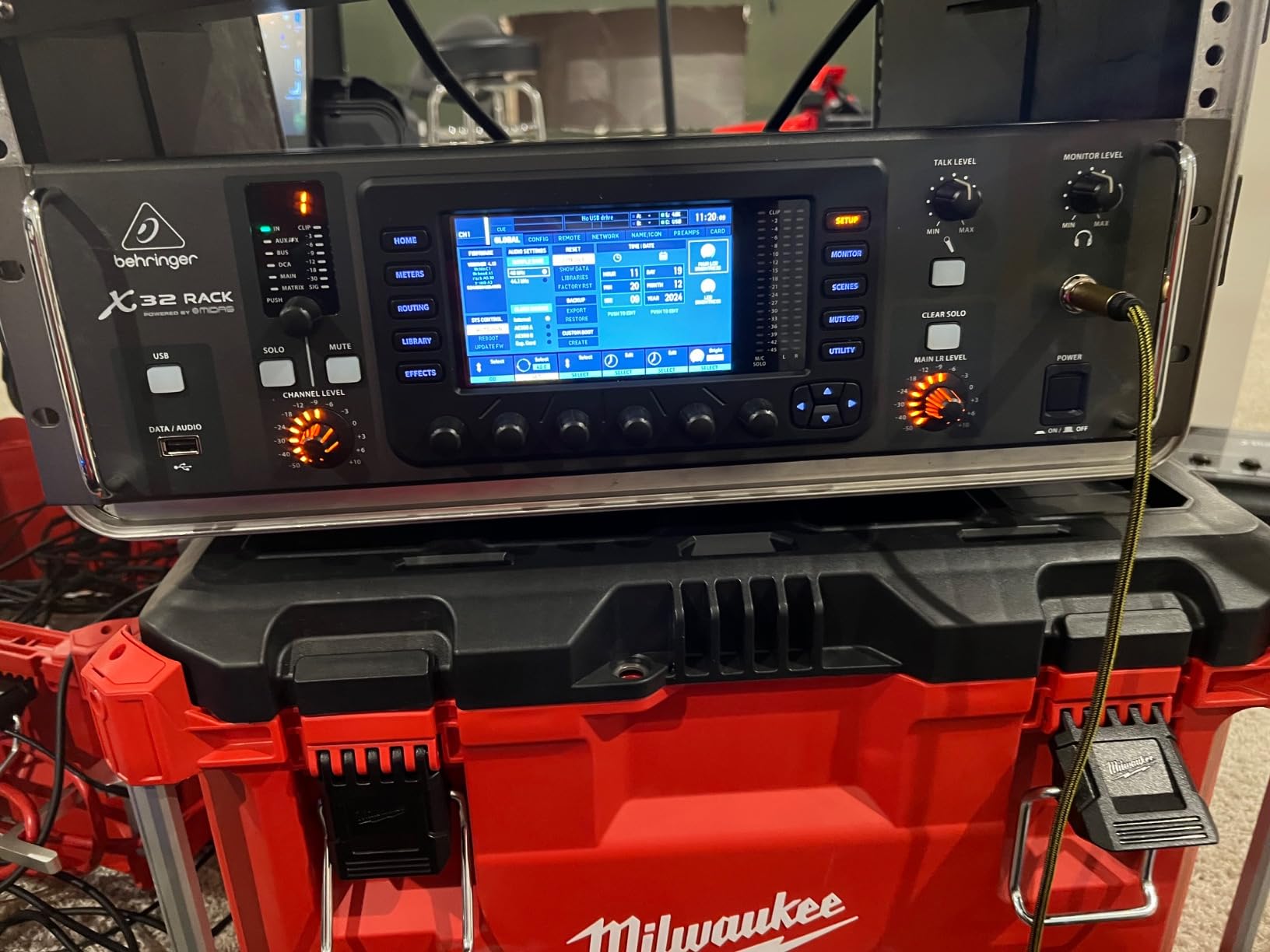
The learning curve is the main barrier. The X32 ecosystem has a deep feature set, and figuring out which app works on which platform trips up new users. Plan on a weekend of manual reading and YouTube before your first gig.
Some owners report confusion about the right remote app, since Behringer offers several. MixingStation is the third-party favorite and works across iOS, Android, Windows, and macOS.
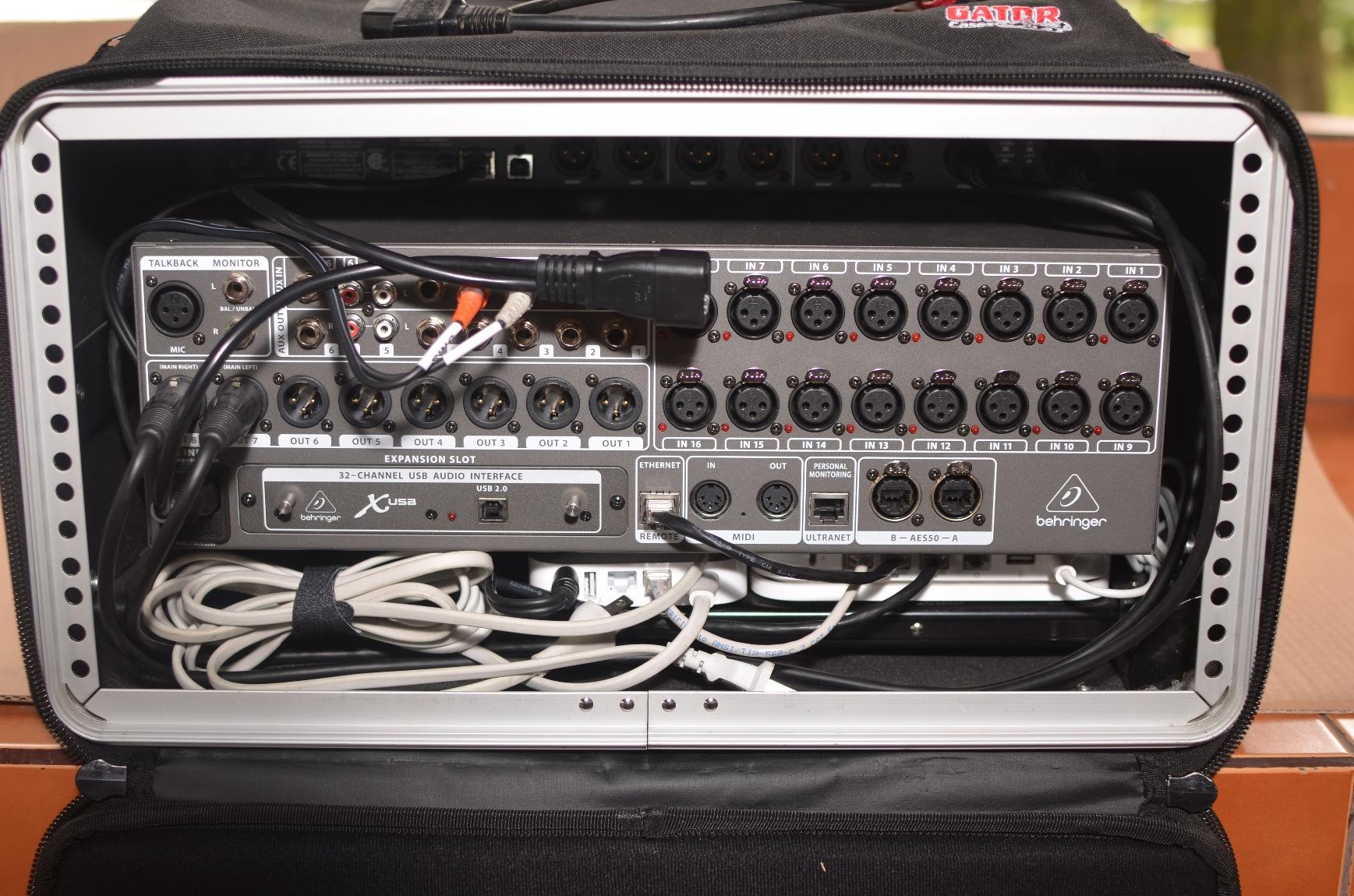
Once you are past the learning curve, the X32 RACK is the closest thing to a do-everything digital stage box on the market in 2026.
Best Use Case for the Behringer X32 RACK
This is the right pick for small venues, churches, and bands that want one rack unit to handle stage I/O, mixing, effects, and recording. It also works as an expander for a full-size X32 or M32 console when you need additional inputs on stage.
If you only need I/O and not a full mixer, the SD16 or DL32 are simpler and cheaper.
Remote Control Workflow
The X32 RACK is designed to be controlled from a tablet, so plan on a reliable iPad or Android tablet and a dedicated WiFi router. MixingStation is the most stable third-party app and supports every X32-family feature.
For critical shows, hardwire the router to the X32 RACK and keep the WiFi band dedicated to control traffic only.
8. Midas M32C — Compact Touring Core with Massive I/O
Midas M32C Digital Rack Mixer for Installed and Live Sound Applications with 40 Input Channels and 25 Mix Buses
40-input core
25 mix buses
AES50 up to 96 I/O
40-bit floating DSP
Pros
- 40-input channel with 25 mix buses
- AES50 networking for up to 96 inputs and outputs
- 40-bit floating point DSP
- Compact 1U form factor
- Phase-coherent mix buses
Cons
- Price information not available at retail
- Limited review pool
- No onboard preamps
- Requires external stage I/O
The Midas M32C is a different animal from everything else in this roundup. It is not a stage box with preamps, it is a 1U rackmountable digital mixing core that pairs with Midas DL32 or DL16 stage boxes to give you up to 96 inputs and 96 outputs of fully mixed audio. I have seen it used as the brain of a distributed install where multiple DL32 units fed a single M32C, which then drove a full speaker system.
Think of the M32C as an M32 console without the control surface. All mixing happens remotely via PC software, a tablet, or a dedicated control surface, while the M32C handles the DSP and routing. That makes it ideal for installations where you want the console hidden in a rack.
The 40-bit floating point DSP and 25 phase-coherent mix buses deliver the same processing quality as the full M32 console, and the build is high-performance aluminium and high-impact steel. The 5.0-star average from 10 reviews reflects the no-compromise positioning.
The catch is that the M32C has no preamps of its own, so you must pair it with at least one DL32 or DL16 stage box to get audio in and out. Price is also not consistently listed at retail, so you will need to request a quote.
Best Use Case for the Midas M32C
This is the right pick for touring productions, large installs, and broadcast facilities that already own or plan to buy Midas DL-series stage boxes and want a hidden, remotely controlled mixing core instead of a full console.
For most small-venue and church buyers, the X32 RACK or DL32 will be simpler and more cost-effective.
System Architecture Notes
The M32C connects to up to three DL32 units via AES50, giving you up to 96 inputs. Control is handled over a separate network connection from a PC running M32-EDIT, an iPad running the M32-Mix app, or a dedicated MIDAS DN32-ADAT expansion for additional routing.
Plan your network and AES50 cable topology carefully, since this is a distributed system, not a single self-contained box.
What to Look for When Buying a Digital Stage Box
Choosing the best digital stage box comes down to five practical factors, and getting any of them wrong means buying gear that will not work with your existing rig. Here is how I think through each one.
Mixer Compatibility Is the First Filter
Before you look at channel counts or preamps, confirm which network protocol your console speaks. AES50 boxes like the Behringer SD16 and Midas DL32 only work with X32, M32, and Wing consoles. Dante boxes like the Yamaha Tio1608-D only work within a Dante network. AVB boxes like the PreSonus 24R require AVB-certified switches and a compatible StudioLive console.
None of these protocols are interchangeable, so a stage box that looks perfect on paper is useless if it does not match your mixer. Check your console manual before you buy anything.
Channel Count: Buy for Your Real Stage, Not Your Dream Stage
Count the inputs you actually use on a typical gig, then add 20 percent for growth. An 8-channel box like the Behringer SD8 covers most acoustic and small worship rigs. A 16-channel box like the SD16 or DX168 handles a full band. A 32-channel box like the DL32 is right for larger bands, festivals, and churches with full drum kits and multiple wireless systems.
Buying more channels than you need wastes money and rack space. Buying too few means you will be back shopping within a year.
Preamp Quality Drives Your Sound
The preamps in your stage box are the first thing your microphones hit, so they shape your sound more than almost any other component. Midas PRO preamps in the DL32 and MIDAS-designed preamps in the Behringer units are widely regarded as the best value in this category. XMAX Class A preamps in the PreSonus 24R offer a warmer character that suits some sources.
If you can, demo a stage box with your own microphones before committing. The differences are real, especially on vocals and acoustic instruments.
Remote Control and Personal Monitoring
One of the biggest wins of going digital is setting preamp gain from the console instead of the stage. All eight units in this roundup support remote preamp control, but the depth varies. The Behringer and Midas AES50 boxes also include ULTRANET ports for driving P16-M personal monitor mixers directly, which eliminates an entire monitor console.
If your band mixes their own ears, prioritize a box with ULTRANET or a Dante personal mixer ecosystem.
Build Quality and Power
Touring rigs need metal chassis, locking connectors, and proper rack ears. Install rigs can be lighter duty. Every unit in this roundup is rack-mountable, but the Midas DL32 and Allen & Heath DX168 feel noticeably more rugged than the budget Behringer options.
Note that every stage box here requires wall power, so plan your stage power distribution accordingly. None run on battery.
Network Infrastructure
Regardless of protocol, you need the right cable and switches. AES50 works with quality Cat5e, Dante prefers Cat5e or Cat6 with managed switches, and AVB requires AVB-certified switches that cost more. Budget for etherCON connectors on your cable ends for touring use, since they lock in place and survive being stepped on.
Skimping on cable is the most common cause of mysterious audio drops in digital stage box systems.
Dante vs AVB vs AES50 vs Waves — Network Protocols Explained
This is the single biggest source of confusion for buyers new to digital stage boxes, so let me break it down simply.
AES50 (SuperMAC) is the protocol used by Behringer X32, M32, and Wing consoles plus their SD and DL stage boxes. It is proprietary, plug-and-play within that family, and supports up to 96 channels of bidirectional audio over a single Cat5e cable. It does not need switches for direct console-to-stage-box runs, which keeps costs down.
Dante is the dominant open networking protocol, used by Yamaha, and supported across many brands including Allen & Heath, SSL, and others. It runs over standard Ethernet with managed switches, supports hundreds of channels, and lets you route any input to any device on the network via Dante Controller software. Dante also supports redundancy for mission-critical shows.
AVB (Audio Video Bridging) is an IEEE standard used by PreSonus, Allen & Heath (in some products), and MOTU. It offers deterministic low latency, but requires AVB-certified switches that are more expensive and less common than standard managed switches.
Waves SoundGrid is used primarily in plugin processing and some touring consoles. It is less common in standalone stage boxes and is typically only relevant if you are building a Waves-based processing rig.
For most readers, the right protocol is simply whichever one your console already uses. Do not switch protocols just to chase a feature, because you will end up replacing your entire signal chain.
Digital Stage Box FAQ
What is the best digital mixer for live performance in 2026?
For most live sound applications in 2026, the Behringer X32 RACK is the best overall pick thanks to its 40-input mixing power, 16 Midas preamps, iPad remote control, and a 4.8-star rating from 172 reviews. For tour-grade preamp quality, the Midas DL32 paired with an M32 console is the premium choice.
What does a digital stage box do?
A digital stage box connects to microphones and instruments on stage, converts analog signals to digital, and transmits that audio over a single Cat5e or Cat6 network cable to a compatible mixing console using protocols like AES50, Dante, or AVB. It replaces heavy analog multicore cables and allows remote preamp control from the mix position.
Can the Behringer XR18 be used as a stage box?
The Behringer XR18 can function as a standalone digital mixer with its own inputs, but it is not a true stage box for an X32 or M32 console because it uses a different networking approach (ULTRANET over Ethernet rather than AES50). For true stage box duty with an X32, the SD8, SD16, S16, S32, or DL32 are the correct options.
What are the disadvantages of digital mixing consoles and stage boxes?
The main downsides are a steeper learning curve compared to analog gear, software reliability issues with companion apps over WiFi, ecosystem lock-in where stage boxes only work with matching protocol consoles, and the need for proper network infrastructure including quality cables and managed switches. Setup also takes longer on the first gig while you configure routing.
Do digital stage boxes work with any mixer?
No. Digital stage boxes are protocol-specific. AES50 boxes like the Behringer SD16 and Midas DL32 only work with X32, M32, and Wing consoles. Dante boxes like the Yamaha Tio1608-D only work within a Dante network. AVB boxes like the PreSonus 24R require an AVB-compatible console. Always confirm your mixer’s protocol before buying a stage box.
Final Verdict — Which Digital Stage Box Should You Buy in 2026?
For most buyers, the best digital stage box in 2026 is the Behringer X32 RACK, because it works as a stage I/O, a full mixer, a recording interface, and an iPad-controlled monitor console all in one 3U rack space.
If you only need pure stage I/O for an X32 or M32 rig, the Behringer SD16 gives you 16 Midas preamps and AES50 networking at a value price. For tour-grade preamp quality and 32 channels, the Midas DL32 is the professional upgrade that earns its premium.
Whatever you choose, match the protocol to your console first, buy quality Cat5e or Cat6 cable, and budget time to learn the routing before your first show. The right digital stage box will transform how you run live sound for years to come.