
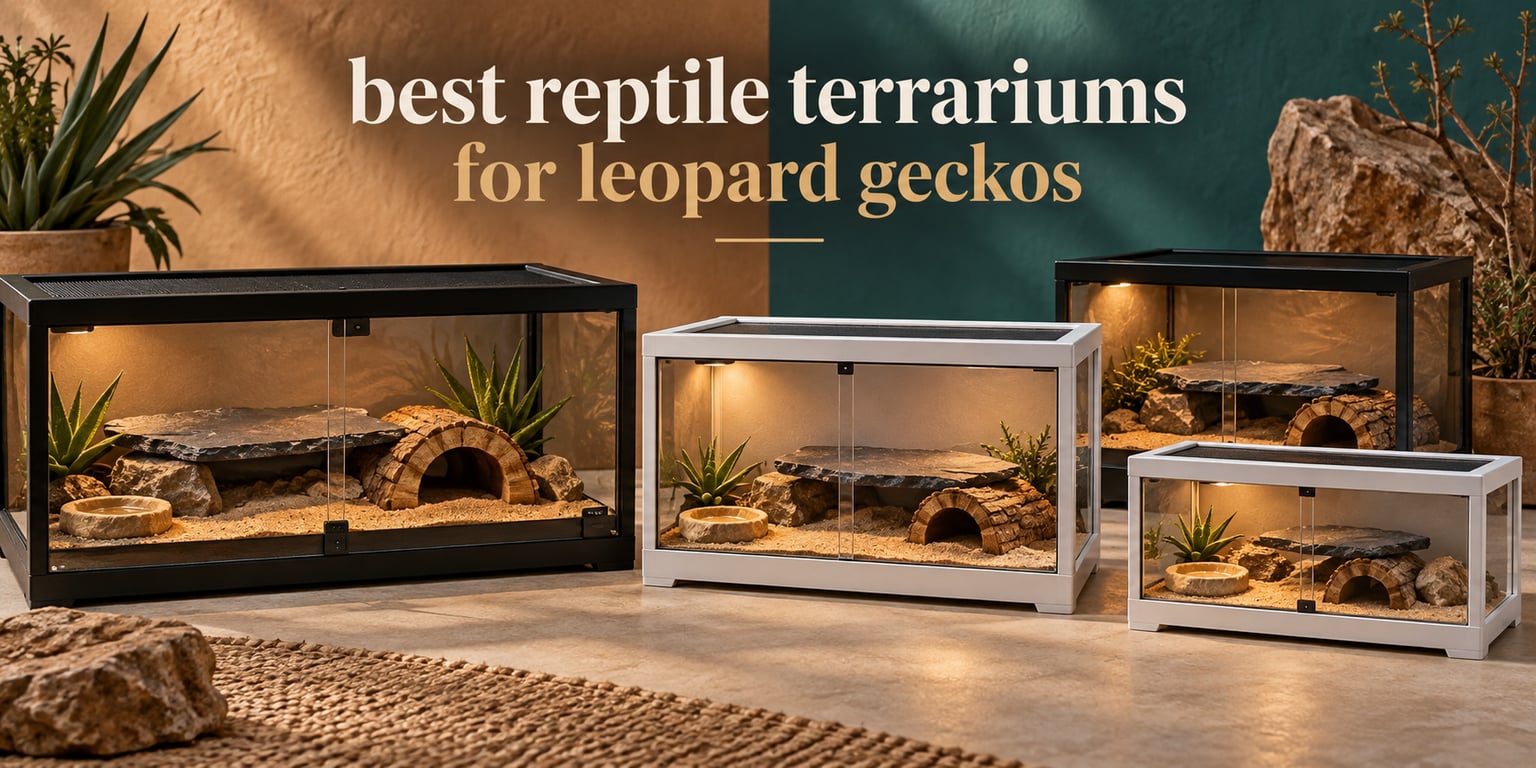
The short answer: an adult leopard gecko needs a front-opening enclosure of at least 36 inches long by 18 inches wide by 16 to 18 inches tall — roughly a 40 to 50 gallon footprint — with a screen or mesh top and room for three hides. Anything smaller works for a juvenile, and almost nothing smaller works for a full-grown gecko.
I have set up and re-set up a lot of desert gecko housing over the years, and the same pattern shows up every single time. Somebody buys a small kit because it looked manageable in the aisle, then eleven months later the animal is pressing its nose against the glass at feeding time and the owner is searching for a bigger box. The tank is the one purchase in this hobby that is genuinely hard to undo.
That is what this roundup is for. I went through the current crop of best reptile terrariums for leopard geckos available right now, pulled the actual interior and exterior dimensions rather than trusting gallon labels, and sorted them by what they actually do well. Below you will find every enclosure I recommend, why I recommend it, and where it falls short — plus a size guide and a material breakdown that explain how to pick between glass, PVC, polycarbonate and mesh without paying twice for the wrong box.
If you want a broader look at reptile housing in general, my full reptile terrarium roundup covers species beyond geckos. And once your enclosure is chosen, the heat lamp picks cover the lighting and heating gear that has to match it.
One clarifying question before we start: are you buying for a brand-new juvenile, a full-grown adult, or several animals at once? Are you building a bioactive planted setup or a simple desert with a couple of hides? The answer changes which of these ten is right, and I flag it for each one.
Top 3 Best Reptile Terrariums for Leopard Geckos in 2026
These three are the ones I keep coming back to. The first is the best general buy, the second is the only enclosure on this list that actually hits the adult minimum footprint, and the third is the most complete package out of the box.

New Age Pet ECOFLEX 24 inch
- Lockable sliding front doors
- Mesh screen top
- Vented side panels
- Ten year warranty

Phailozoo 36x18x18 Glass
- Adult minimum footprint
- Tempered glass doors
- Low blockage screen top
- Stackable frame
REPTI ZOO 34 Gallon
- Foam rock background included
- Key latch front doors
- Raised waterproof base
Quick Overview: All 10 Leopard Gecko Enclosures Compared
All ten enclosures in this roundup, with the numbers that actually decide whether a leopard gecko can live in them. Compare the interior footprint first and the material second — everything else is detail.
| Product | Specifications | Action |
|---|---|---|
| New Age Pet ECOFLEX 24 inch |
|
Check Latest Price |
| Phailozoo 50 Gallon Glass |
|
Check Latest Price |
| REPTI ZOO 34 Gallon |
|
Check Latest Price |
 Reptile Growth 10 Gallon Reptile Growth 10 Gallon |
|
Check Latest Price |
 REPTI ZOO 20 Gallon REPTI ZOO 20 Gallon |
|
Check Latest Price |
 REPTI ZOO 8 Gallon Cube REPTI ZOO 8 Gallon Cube |
|
Check Latest Price |
 NEPTONION 20x12x14 NEPTONION 20x12x14 |
|
Check Latest Price |
 Maiyuolg 16x16x24 PVC Maiyuolg 16x16x24 PVC |
|
Check Latest Price |
 BINANO 33 Gallon Mesh BINANO 33 Gallon Mesh |
|
Check Latest Price |
 ADVINCI 32 Gallon Vertical ADVINCI 32 Gallon Vertical |
|
Check Latest Price |
1. New Age Pet ECOFLEX 24 Inch – The Most Proven Enclosure in This Group
New Age Pet® ECOFLEX® 24″ Small Reptile Enclosure, Grey
Interior 22.6 x 10.4 x 10.3 in
ECOFLEX composite build
Lockable sliding front doors
Screen top and side vents
Pros
- Lockable sliding front doors for safe access
- Very wide unobstructed viewing area
- Vented side panels plus mesh screen top
- Quick twenty to thirty minute assembly
- Ten year manufacturer warranty
Cons
- Only 10.4 inches of interior width
- Composite panels are not waterproof
- Panels can rattle after assembly
This is the most established enclosure in the whole roundup by a wide margin, holding a top-ten position in the Reptile Terrariums category with well over eighteen hundred reviews behind it — more than double the next closest. I have had one of these running in my own setup for months, and the thing that stands out every time is how much you can see through the front. The viewing area is completely uninterrupted — no frame, no crossbar, no center brace running across the middle of the glass.
The doors slide, and they lock. That matters more than it sounds like it should, because a leopard gecko is fast and the doors on cheaper enclosures swing wide enough to be a launch mechanism. Sliding panels also mean there is no moment where a door is directly overhead with an open hinge angle, which is the single best thing you can do for a nervous prey species that bolts at shadows.
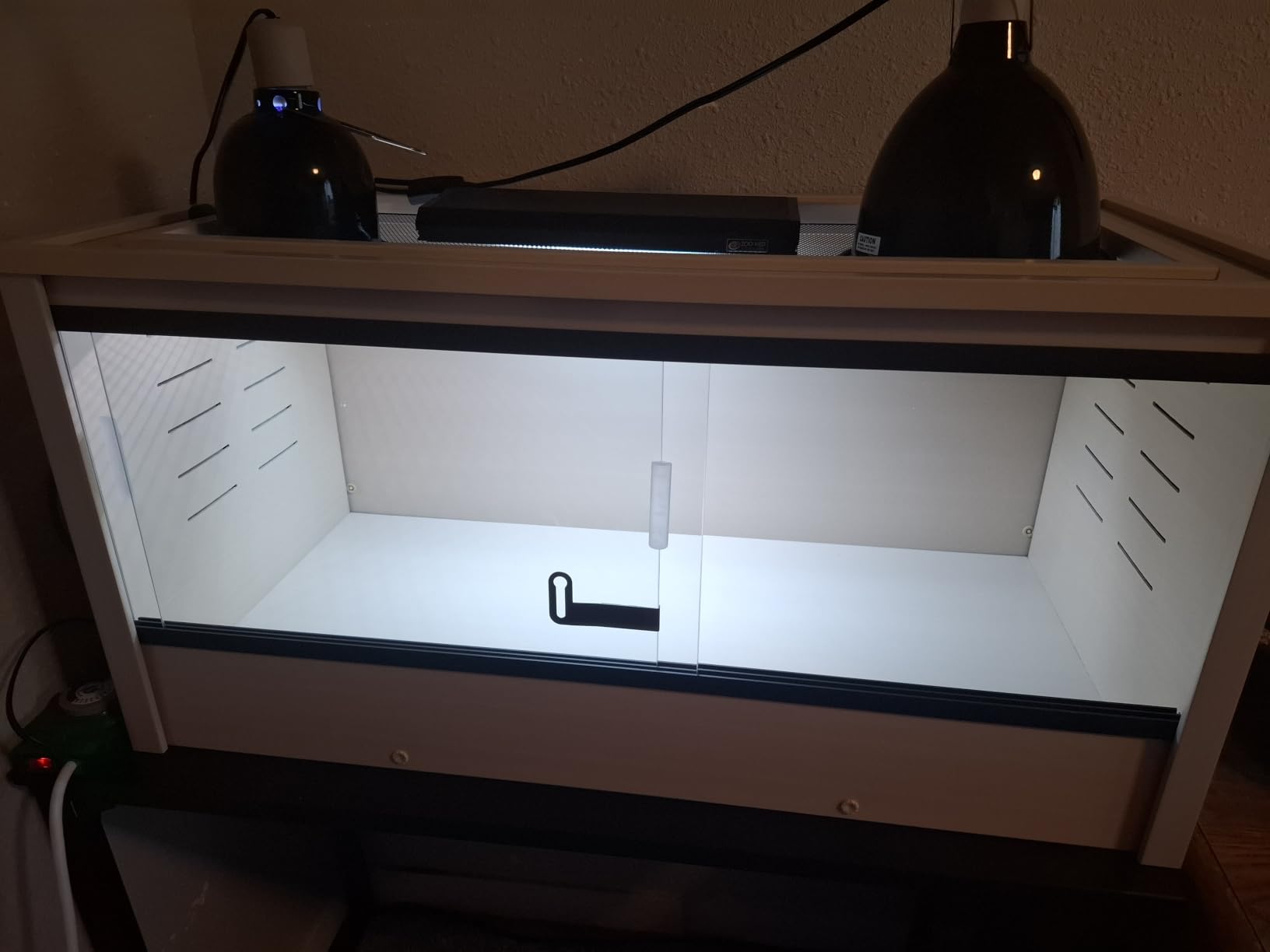
Here is where I have to be blunt about sizing. The interior measures 22.6 inches long by 10.4 inches wide by 10.3 inches tall. That is a genuinely comfortable juvenile box, and it is a great quarantine or hospital unit. But 10.4 inches of width falls well short of the 18 inches most keepers treat as the adult minimum width, so this is not where a full-grown animal lives out its whole life.
The build is a moisture-resistant ECOFLEX composite rather than glass or PVC. It is not waterproof, and the manufacturer is honest about that: it suits low to moderate humidity setups, which is exactly the range an arid species like a leopard gecko lives in. If you are running a heavily planted bioactive tank with a deep drainage layer and a permanent moist area, glass or PVC is a better base.
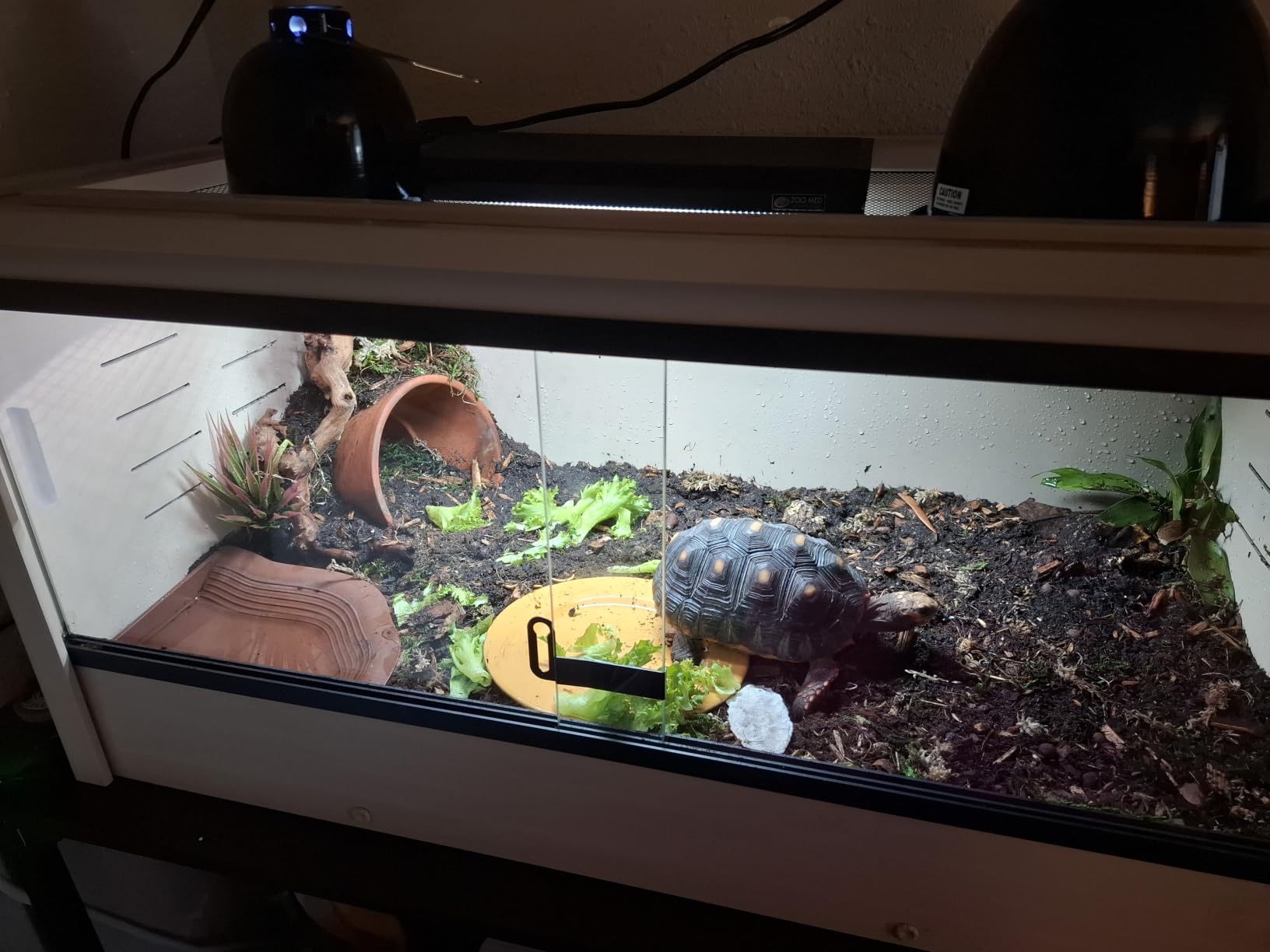
What makes this one easy to live with day to day
Ventilation is genuinely good. Vented side panels combined with the large mesh screen top move a lot of air, which in a dry desert setup means less risk of stagnant humidity building up in the corners. The screen also gives a halogen basking bulb and a UVB tube clean overhead placement without any modification.
Assembly takes most people twenty to thirty minutes with basic tools, and the ten-year warranty is the longest in this group by a wide margin. Reviews mention the flexible composite panels can rattle once everything is tightened down; a bead of silicone along the seams quiets it if that bothers you.
Where it falls short for an adult gecko
The width is the real limitation, not the quality. An adult leopard gecko needs enough floor area to separate a warm hide, a cool hide and a humid hide without them all touching, and 22.6 by 10.4 inches does not give you that separation cleanly. Plan on this being a first enclosure you grow out of, or a secondary tank for a second animal.
The composite also stains and scratches more readily than glass, and because it is not waterproof, any water you spills has to be wiped up promptly rather than allowed to sit. For an arid species in a dry room that is a manageable trade. For a bioactive tropical-adjacent build it is not.
2. Phailozoo 50 Gallon Glass – The Only True Adult-Size Option Here
Phailozoo 50 Gallon Reptile Enclosure, Colorful Aluminum Frame Reptile Tank
Exterior 36 x 18 x 18 in
About 40 gallon interior
Tempered glass doors
Stackable aluminum frame
Pros
- The only adult minimum footprint in this roundup
- Escape resistant with a 2mm door gap
- Tempered glass doors resist scratching
- Only 28 percent screen top blockage
- Stacks with matching units
Cons
- Interior is nearer 40 gallons than 50
- Base is silicone sealed and not leakproof
This is the one I recommend to anyone with an adult gecko, and the reason is a single number: 36 inches long by 18 inches wide. Every other enclosure on this list is smaller than the adult minimum that the r/leopardgeckos community and most husbandry guides converge on. This one matches it exactly.
The doors are fully closed tempered glass with a 2 millimeter gap, which is tight enough that a gecko cannot force its way out. I like the fact that these are real glass doors rather than open screen panels — the whole front wall is solid, so there is no visual distraction and nothing for the animal to catch a toe in when it is trying to climb the front glass.
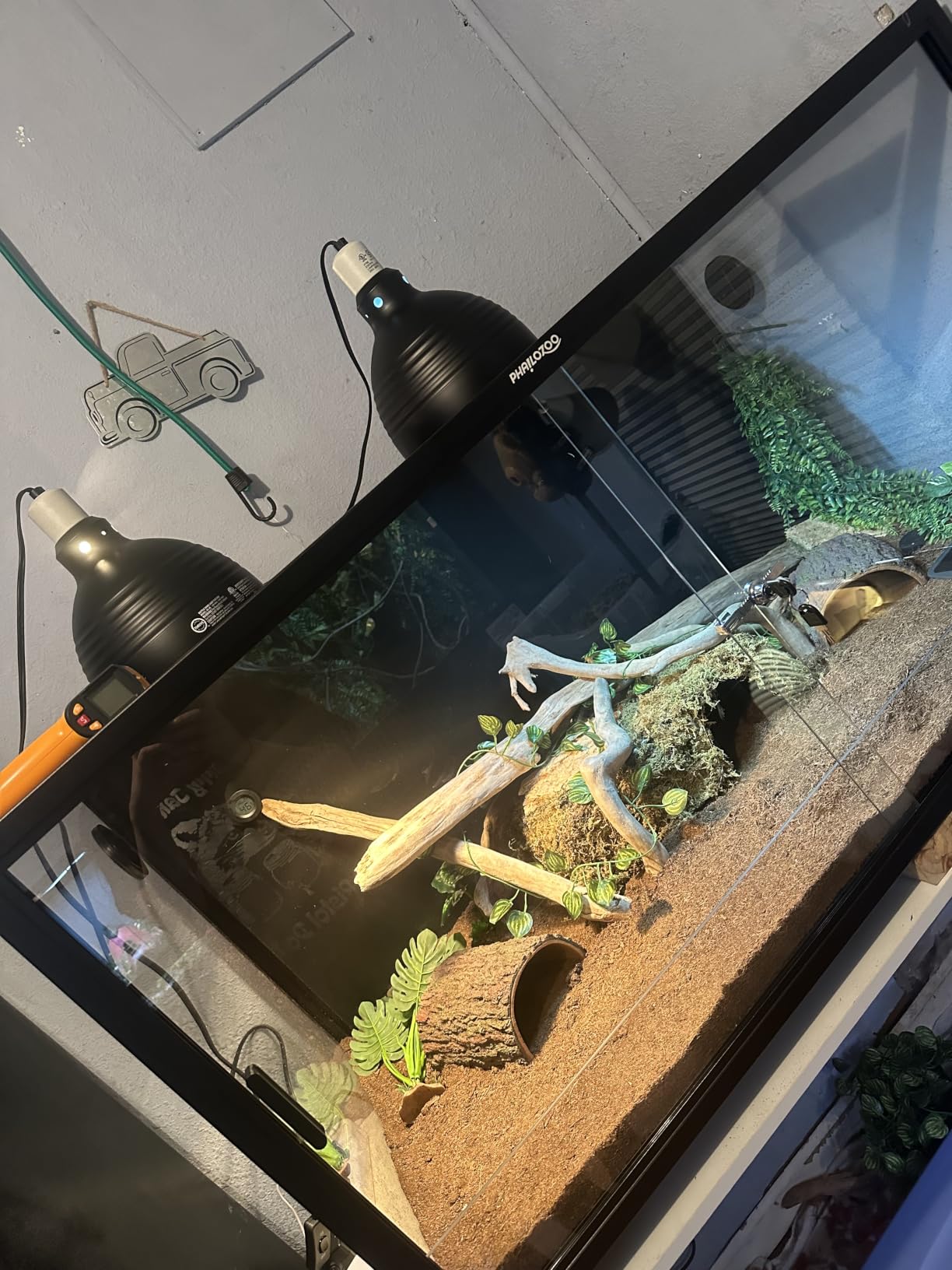
Ventilation is handled through a screen top with only 28 percent blockage, the lowest figure in this roundup. That matters because a desert enclosure still needs to dissipate basking heat. With a low-blockage top you can hang a halogen basking bulb and a T5 UVB fixture in the normal overhead positions and the heat moves out of the enclosure rather than pooling under the ceiling.
There is a substrate barrier built into the base, so play sand stays where you put it instead of migrating into the door channels. Reviewers also highlight that it is light for its size — 23.1 pounds, noticeably easier to move than the heavier glass tanks in this group — and that it assembles in six steps and comes apart by unscrewing the corner pieces.
Why this one works for a full-grown gecko
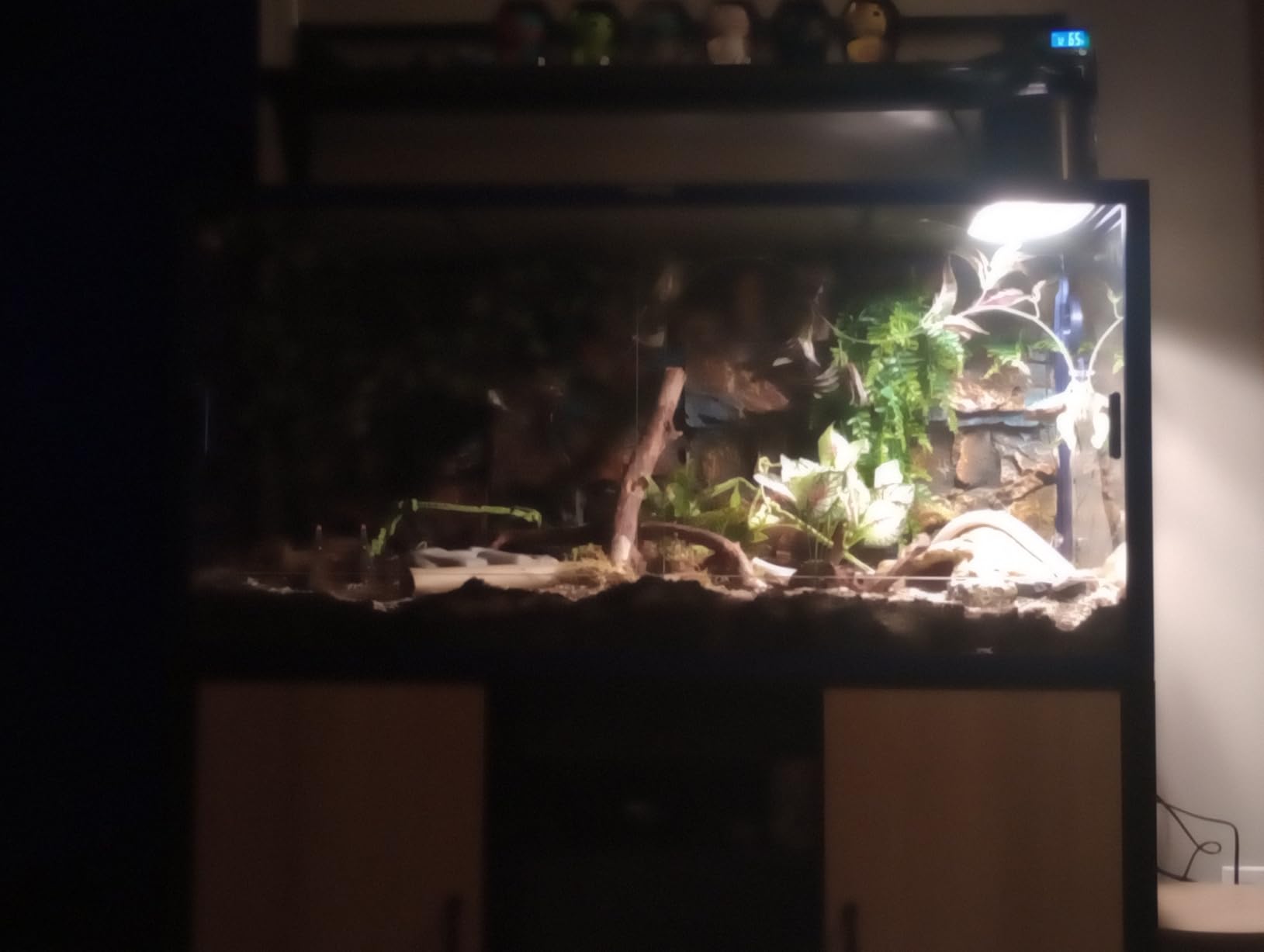
Thirty-six by eighteen inches of floor area gives you room to place three hides with real space between them, which is the core requirement for a healthy adult. You can run a warm hide on one end, a cool hide on the other and a humid hide in the middle without any of them blocking a heat source or the sightline the animal wants.
It is also the right call for two animals. Keep in mind that a pair of adult geckos usually needs a bigger footprint again, but a 36 by 18 base is a reasonable starting point for two females or a pair you are monitoring carefully, particularly since the frame is designed to stack with matching stackers and spacer cabinets.
What the gallon label does not tell you
The product is sold as a 50 gallon tank, and the exterior dimensions of 36 by 18 by 18 inches do work out close to 50 gallons as a raw volume. The interior capacity is nearer 40 gallons once the frame and panel thickness are subtracted. That is normal for this whole category and the number is not a problem — it simply reinforces the point that you should compare inches, never gallons.
The bottom is sealed with silicone only and is not leakproof. For a desert setup with a thin substrate layer that is completely fine. For a bioactive build with four inches of drainage that holds water, plan on doing a proper second seal before you pour anything into it.
3. REPTI ZOO 34 Gallon – The Most Complete Glass Kit Out of the Box
REPTI ZOO 34 Gallon Large Reptile Glass Terrarium Tank with Foam Backgrounds,Double Hinge Door with Screen Ventilation Reptile Terrarium 24″ x 18″ x 18″(Knock-Down)
24 x 18 x 18 in exterior
34 gallon glass
Knock-down build
Key latch front doors
Pros
- Foam rock background included at no extra step
- Two front doors open independently for feeding
- Key latch keeps doors secured
- Elevated base fits a substrate heater
- Disassembles flat for storage
Cons
- Shorter than the 36 inch adult minimum
- Panels can rattle during assembly
- Side windows do not take standard misting nozzles
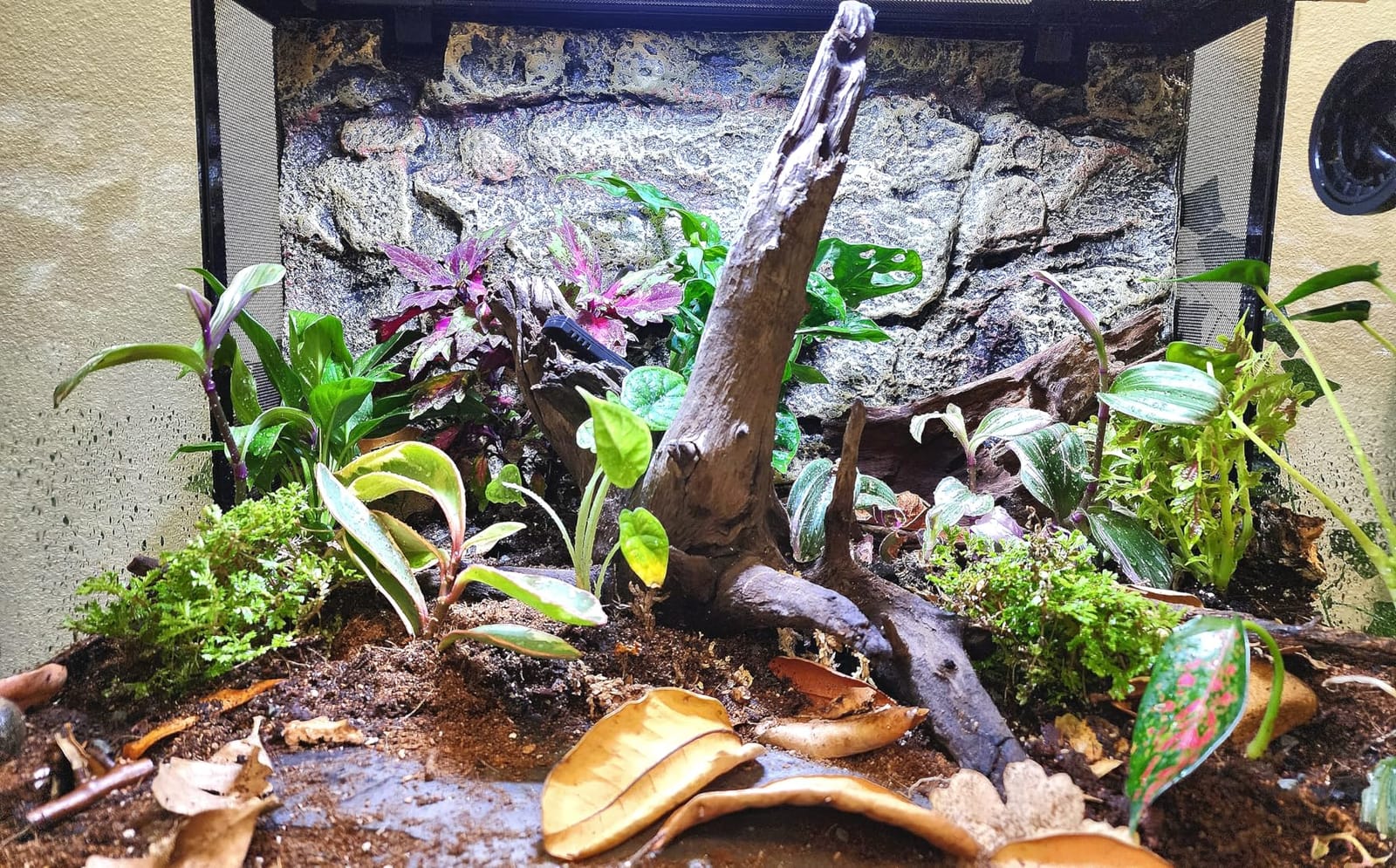
This is the enclosure I recommend when someone wants a finished-looking desert display without spending a weekend building a background. The high-density pressed foam background is moulded to look like natural rock and sits tight against the back glass, so the tank reads as a piece of scenery rather than an empty glass box. Owners consistently call this the feature that makes the biggest visible difference.
The front has two doors that open separately. I use that constantly — one door open for feeding while the other stays shut, and both open for a full clean-out. The doors take a lock, which matters if you have a juvenile that is food-motivated enough to watch your hands through the gap.
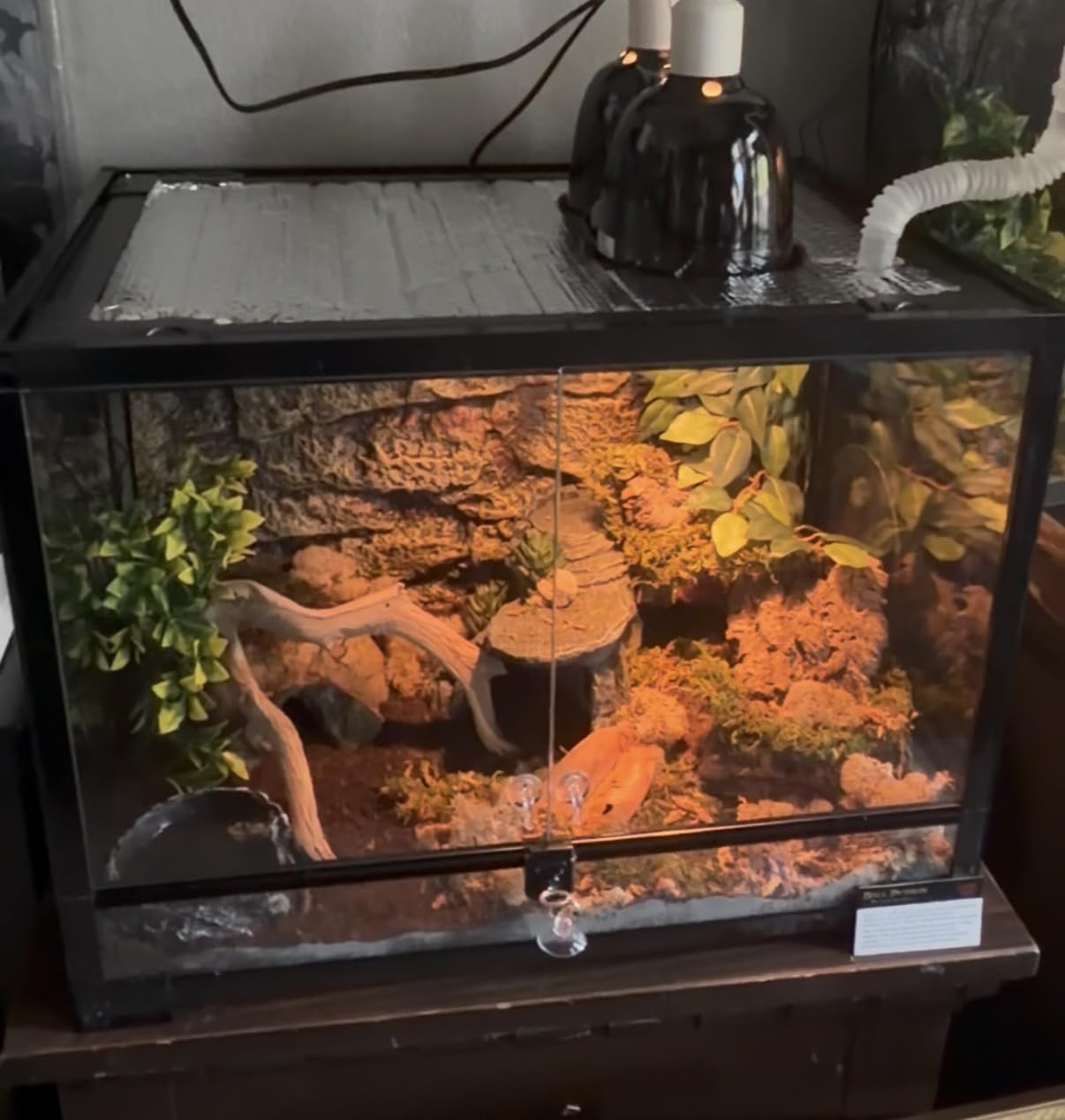
Ventilation comes from the patented tough screen top plus window vents on both side panels. The screen is designed to let UVB and infrared through, so a linear UVB fixture and a basking bulb mount overhead in the standard way. There are also closable inlets on the top and the right side for routing wires and tubing, so your thermostat probe and mister line can be run in without leaving the doors propped open.
The raised bottom frame is the other quiet win here. It lifts the enclosure off the table surface enough to fit a substrate heater underneath without cooking the surface it sits on or blocking ventilation. The base itself is waterproof.
What you get that you would otherwise buy separately
A background, a lock, a screen top, side ventilation, cable pass-throughs and a raised waterproof base. Add a bag of substrate, three hides and a heat source and you have a complete habitat. Several owners specifically mention the packaging — each glass piece is individually wrapped, and this tank is 35.2 pounds of tempered glass arriving in one box, so that matters.
Assembly is a genuine five-minute knock-down job, and the whole thing breaks down flat if you need to move it or store it. For anyone in an apartment who might relocate, that is worth more than it sounds.
Why the length is the compromise
At 24 inches long, this is four inches shy of the 36 inch length most keepers want for an adult. It works comfortably for a subadult or a young adult, and plenty of keepers run one of these as a permanent single-animal enclosure. But if you know your gecko is already full-sized, buy the 36 inch footprint instead of planning an upgrade later.
Two smaller complaints come up repeatedly. The glass panels can rattle during assembly and may need a bead of silicone to quiet down once everything is squared. And the side windows are not drilled for standard misting nozzles, so if you run a mister for a humid hide you will need a different mounting point.
4. Reptile Growth 10 Gallon – The Best Starter Tank for a Juvenile
Reptile Growth Reptile Terrarium,10 Gallon Reptile Tank 20″ x 10″x 11″,for Insect,Fish,Tarantula,Hermit Crab,Jumping Spider,Iguana,Tortoise,Leopard Gecko,Bearded Dragon
20 x 10 x 11 in
Watertight polycarbonate
Metal screen top
Magnetic locking lid
Pros
- Highest rating in this roundup
- Impact resistant polycarbonate that resists yellowing
- Watertight and usable straight out of the box
- Functional feeding port in the lid
- Lightweight at 7.35 pounds
Cons
- Far too small for an adult
- Polycarbonate scratches over time
- Unsuitable for heavily planted setups
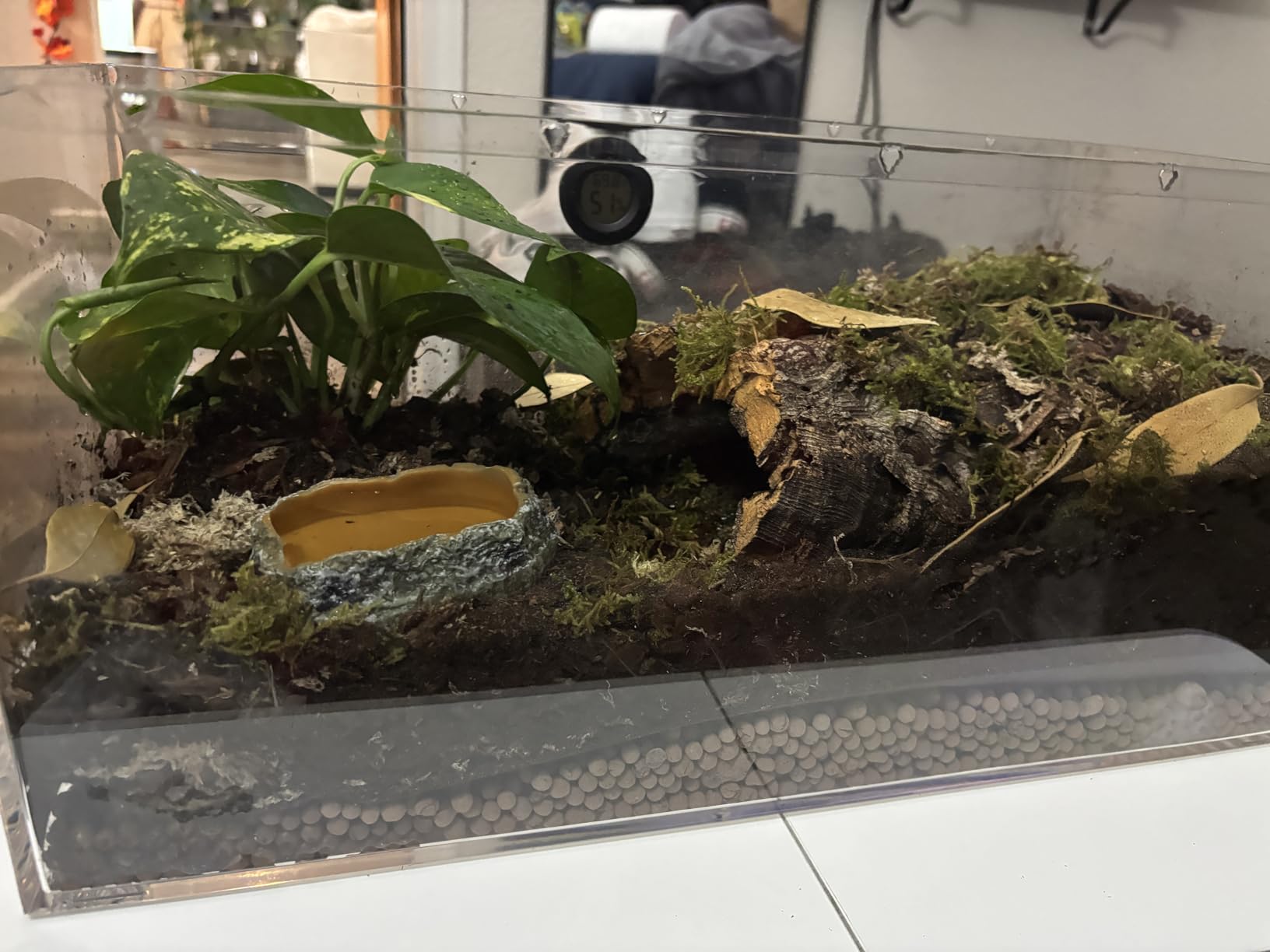
This carries a 4.7 average rating with 81 percent of reviews at five stars, the highest average in the roundup. It also happens to be the one I would put in front of a brand-new keeper who just brought home a hatchling, because it requires no assembly at all and the lid is genuinely secure.
The body is thick polycarbonate rather than glass. I was skeptical about scratch resistance until I saw how it handles in practice — the material is rated from minus 20 to 120 degrees Celsius and resists yellowing under UV, so it stays clear over a long husbandry timeline. Being shatter resistant also matters if you have a gecko that launches itself at the glass, which juvenile leopard geckos absolutely do.
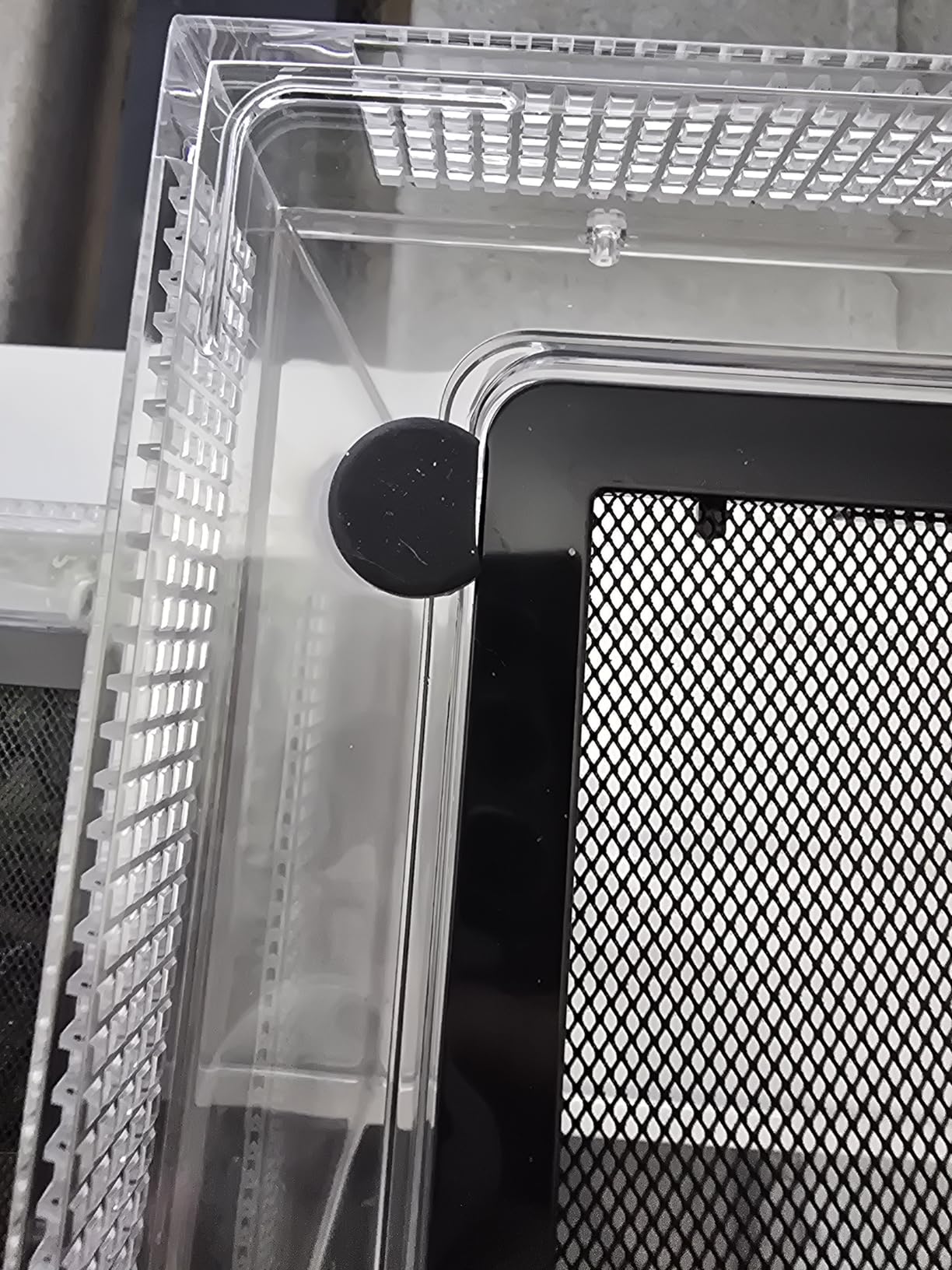
The lid is a magnetic spring closure that pushes itself shut, with an integrated feeding port so you can drop in a dubia roach or a mealworm without opening anything. Combined with the watertight construction, that means a humid hide with moist substrate actually holds moisture instead of wicking it into the base. For a juvenile that is in a shed cycle every week, this is a real convenience.
At 7.35 pounds it is light enough to pick up one-handed to check the animal, move to a different room to follow the light, and carry to a kitchen scale when tracking weight. That kind of convenience is easy to underestimate until you have been moving a 35 pound glass tank.
Why this is a juvenile and quarantine enclosure
Twenty by ten by eleven inches is roughly a 10 gallon volume, which is squarely in juvenile territory. The interior is tall enough to add vertical clutter and a cork bark piece, and the metal screen top gives a halogen or UVB fixture a clean overhead mount. But you cannot fit three separated hides and a proper heat gradient into that footprint, which is exactly what an adult needs.
It is a genuinely good quarantine tank, though. The watertight build means you can disinfect it thoroughly between animals without worrying about water getting into the seams, and the tight lid closure removes the escape risk during the nervous first days after a move.
What to know before you commit
Polycarbonate will scratch. It does not scratch like glass does — the marks are finer and shallower — but after a year of daily misting and hands-on cleaning you will see some surface haze that glass would not show. If optical clarity over a decade matters to you, glass is the better long-term material.
It is also not the enclosure for a heavily planted display. There is no drainage depth to work with and no solid wall structure to support a substrate composition. Use it for a simple desert setup with a hide, a water dish and a heat source, then upgrade to a proper adult enclosure at around 8 to 10 inches of body length.
5. REPTI ZOO 20 Gallon – The Best Mid-Size Glass Tank
REPTI ZOO Glass Reptile Terrarium 20 Gallon, Front Opening Reptiles Tank 30″ x 12″x 12″ for Reptile Pets Gecko Lizard Snake, Top Screen Ventilation Escape Proof Lid
30 x 12 x 12 in exterior
20 gallon tempered glass
Two front doors
Six cable inlets
Pros
- Thirty inch footprint gives real ground area
- Tempered glass on all four sides
- Two front doors open separately
- Six dedicated cable and tubing inlets
- Lid buckle plus door lock
Cons
- No background included
- Weighs 25 pounds when set up
- Narrow twelve inch depth limits wall space
This is the enclosure in the middle of the size ladder that most people should actually look at. Thirty inches long is a meaningful jump from a 20 inch juvenile box, and it is wide enough to place hides along the length rather than stacked in a corner. For a subadult gecko approaching full size, this is the most sensible step up.
It is tempered glass on all four sides with a thin wire screen top, which is the same ventilation approach used by the larger tanks in this group. A UVB tube and a halogen basking bulb both mount overhead without drilling anything.
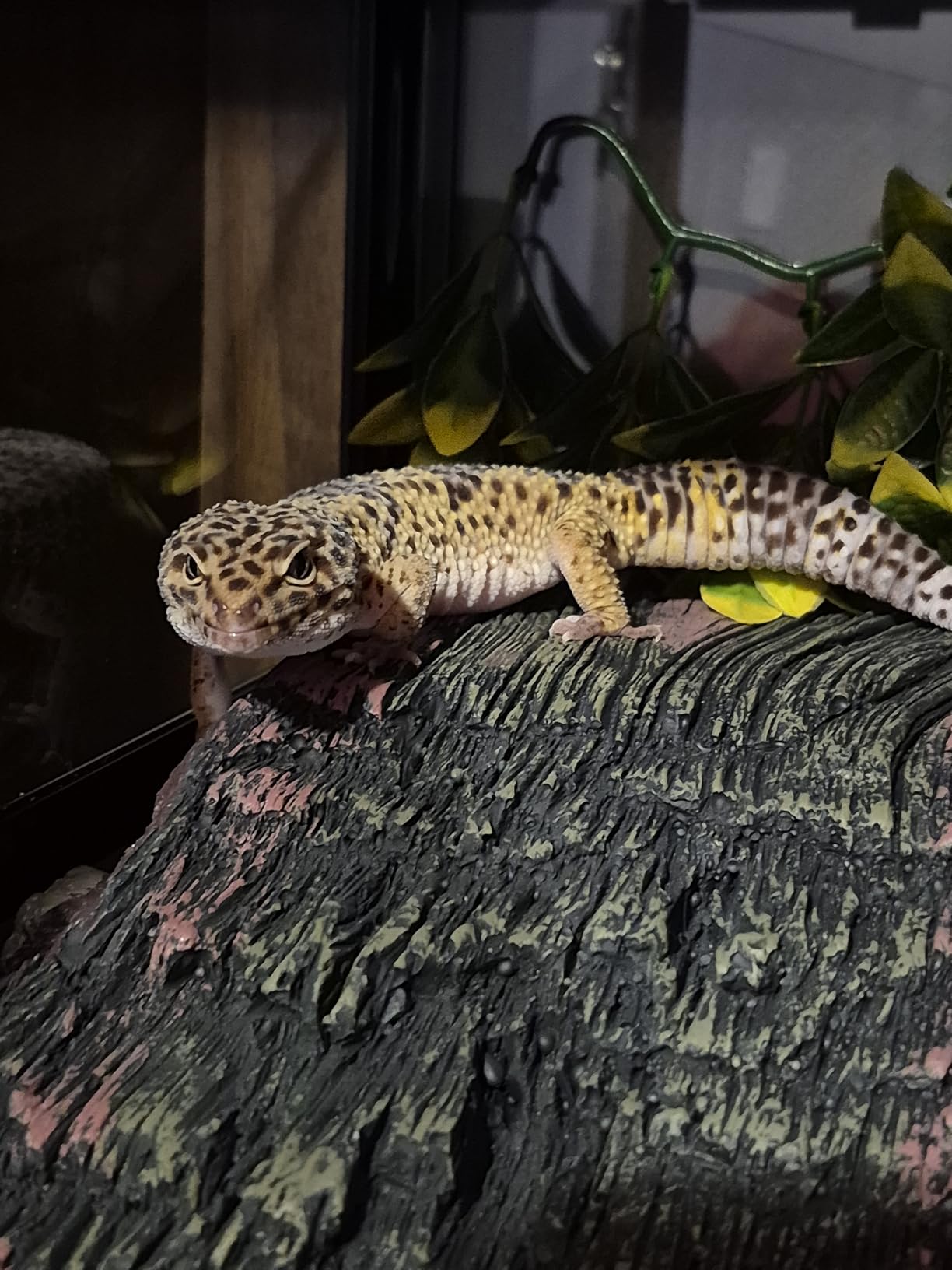
The six inlet holes on the top are the detail I appreciate most. Every time I see a terrarium with two or three rubber grommets, I end up routing four cables through two holes and pinning them shut with suction cups. This has dedicated openings for the thermostat probe, the lighting, the mister and the timer, all of which can be run in and left tidy without leaving a door propped.
Security is handled twice over. There is a buckle on the lid and a lock on the front doors. The raised bottom frame sits the enclosure high enough for a substrate heater underneath, and the base is waterproof, so it works for a desert layout or a wetter humid hide without modification.
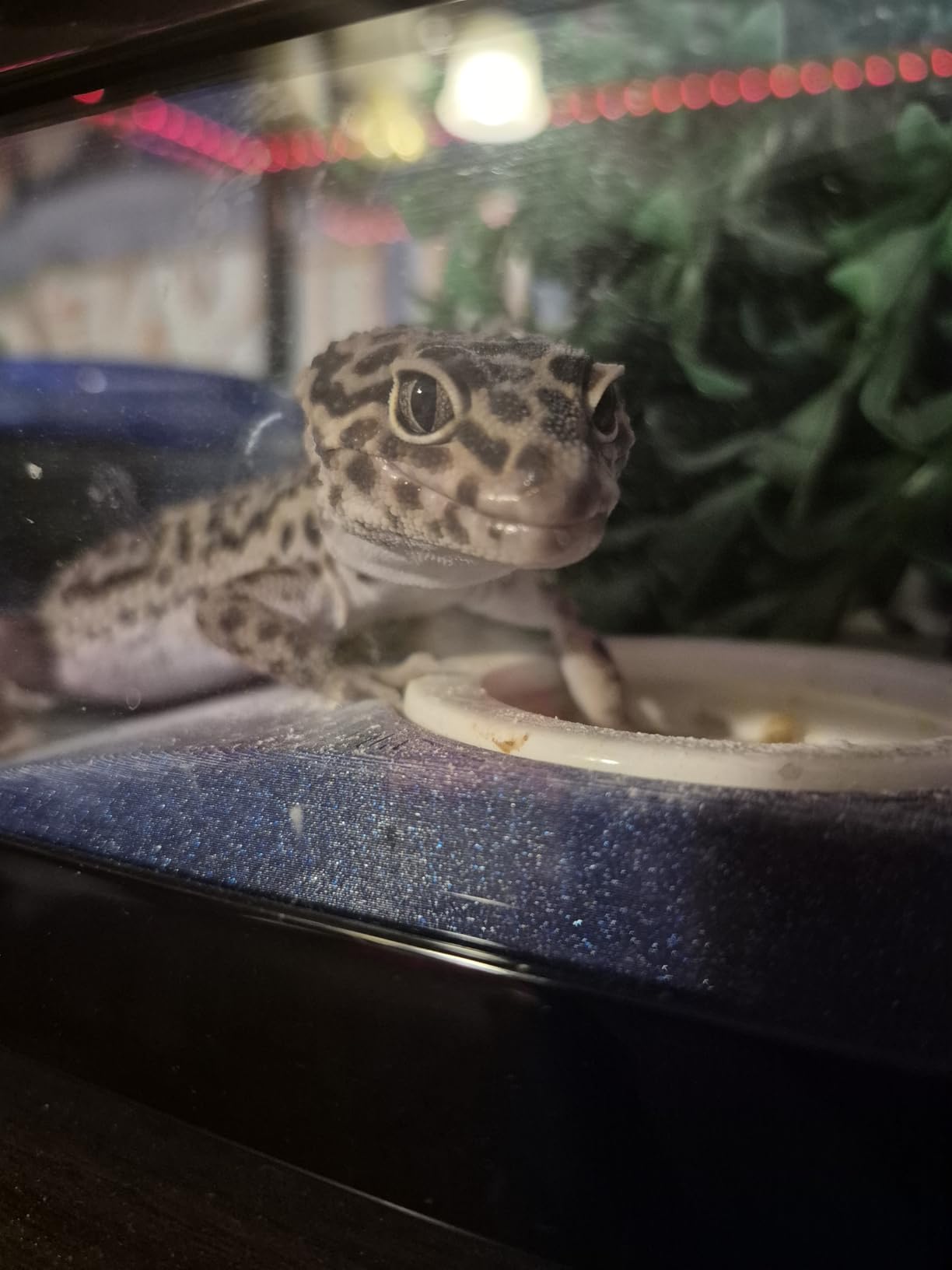
Where thirty inches gets you
Thirty by twelve inches is 360 square inches of floor area. The 36 by 18 footprint on the Phailozoo is 648. That is a real difference and I will not pretend otherwise — the twenty gallon tank is about 55 percent of the recommended adult footprint. For a juvenile or a young subadult that is genuinely comfortable, and plenty of keepers never need to move up.
What it does give you is a proper length for a heat gradient. A basking spot at one end and a cool zone at the other is easy to establish across 30 inches, and the animal can actually move between them rather than sitting in one thermal pocket. That is the thing that matters most day to day.
The three things buyers mention most
There is no background included. That is a genuine omission if you were expecting a ready-made display, and it is the single most common complaint about this tank. You are looking at adding a foam background, a paper backdrop or a self-adhesive vinyl scene yourself.
At 25 pounds it is awkward to move once it is set up and full of substrate, so decide where it is going before you build it out. And the twelve inch depth means there is not much vertical wall to mount climbing decor on — this is a floor-dweller animal, so you will mostly be using the floor anyway.
6. REPTI ZOO 8 Gallon – A Compact Cube for Hatchlings Only
REPTIZOO Small Glass Tank 8 Gallon, Top Opening Terrarium 12″ x 12″ x 12″ Leopard Gecko Tarantula Young Lizard Hermit Crab Frog Insects Breeding Tank
12 x 12 x 12 in exterior
8 gallon glass cube
Top opening only
Wire mesh top
Pros
- Compact cube fits small shelf spaces
- Flat packed with no tools required
- Thin wire mesh lets UVB and heat through
- Transparent PVC tray holds water and substrate
- Free replacement of damaged parts
Cons
- Top opening only
- Far too small for an adult
- Lowest five star share in this group
I want to be direct with this one, because it gets bought every week by people who then have to buy again. A 12 inch cube is a hatchling box. It is a perfectly good temporary home for a gecko under about six inches of body length, and an excellent quarantine unit, but it will not hold an adult.
What it does well is size. Twelve by twelve by twelve will fit on a shelf, a desk or a windowsill where nothing else in this roundup will, and it assembles flat-packed with no tools. Owners also mention that it arrives in reinforced foam and cardboard with free replacement of any damaged part, which is unusually good protection for a glass product.
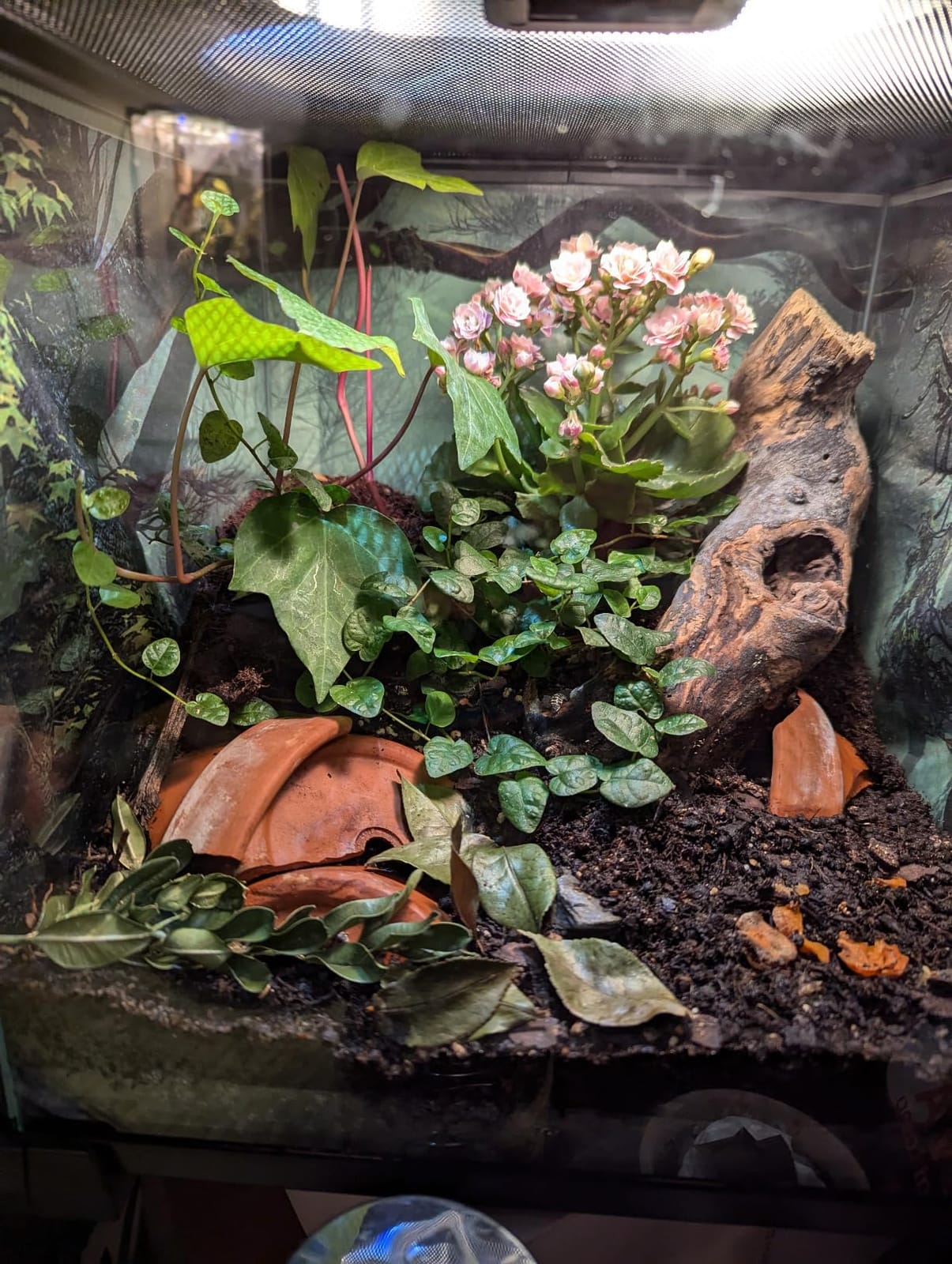
The full tempered glass on four sides gives a genuinely 360 degree view, and the thin wire mesh top lets UVA, UVB and infrared through for overhead lighting. A security buckle keeps the lid closed. The transparent PVC tray in the base holds water and substrate, which makes it convenient for a humid hide during a shed.
This is the one enclosure here where I have to flag the top-opening design as a real behavioural drawback rather than a preference. Every other front-opening tank in this roundup lets you feed, spot clean and place decor without a hand coming down from directly above. On a top-opening cube, you reach in from the top every time, and for a prey species that is the most stressful interaction you can offer.
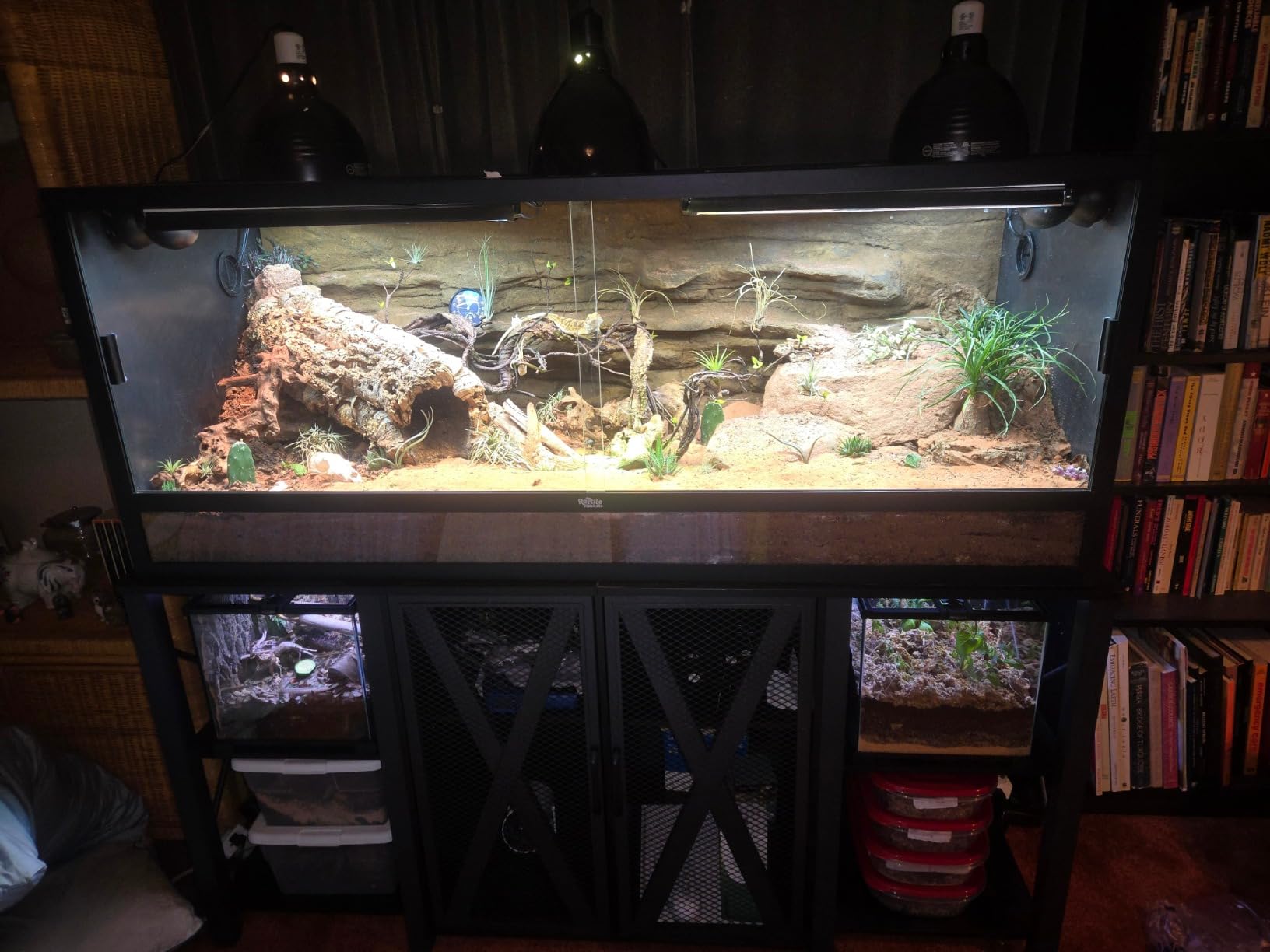
When a small cube is genuinely the right call
Hatchlings do not need floor area the way adults do, because they are not yet using the full range of the enclosure. A smaller box for a very young gecko is standard husbandry practice in a lot of collections, and it keeps the animal close to the heat source where you can watch it more easily.
It is also the best budget entry in this list if you want a second, spare, or hospital tank. Having a small secure tank ready means an animal can be separated immediately if one in a pair starts to bite, and you do not have to buy a full enclosure in a hurry.
Why it will not grow with your gecko
Twelve inches of length is the hard limit. There is no way to arrange three separated hides in a 12 inch square, and you cannot establish a real gradient across that distance. A gecko in a cube is either sitting in the heat or out of it, with very little choice in between, and that is a chronic stress factor.
Its 4.3 average rating sits in the lower half of the ten here, with 64 percent five star — visibly lower satisfaction than the other enclosures, and the three-star reviews concentrate on exactly the size and top-opening limits described above. Buy it as a hatchling box, not as an enclosure.
7. NEPTONION 20x12x14 – The Best Choice for Stacking Multiple Units
NEPTONION 20″x12″x14″ Reptile Terrarium, Double-Door Glass Terrestrial Vivarium for Small Desert Reptiles Such as Sandfish Skinks, with Lock, Cable Port & Waterproof Deep Base Below Front Doors
20 x 12 x 14 in
Front-opening double doors
Interlocking stackable frame
Ventilated metal mesh top
Pros
- Interlocking stackable design for organised reptile rooms
- Front opening double doors with a working lock
- Pre-drilled cable routing holes
- Raised frame leaves room for a heat mat
- Ready to use with no build required
Cons
- Only a juvenile footprint
- Door centre gap is wide
- Top frame can be lifted with little effort
Breeders and anyone housing more than one gecko raised stackable enclosures as a genuine unmet need, and this is the enclosure in the roundup that answers it. The frame is interlocking, and the manufacturer publishes a safety-tested top load rating of 93.76 pounds for this model. That is the number to look for if you plan to build upward.
For a single leopard gecko, 20 by 12 by 14 is a juvenile size. The doors are the reason to notice it anyway — a locking, front-opening double door on an enclosure this compact is unusual, and it means the stress profile is closer to a proper adult tank than to a budget aquarium.
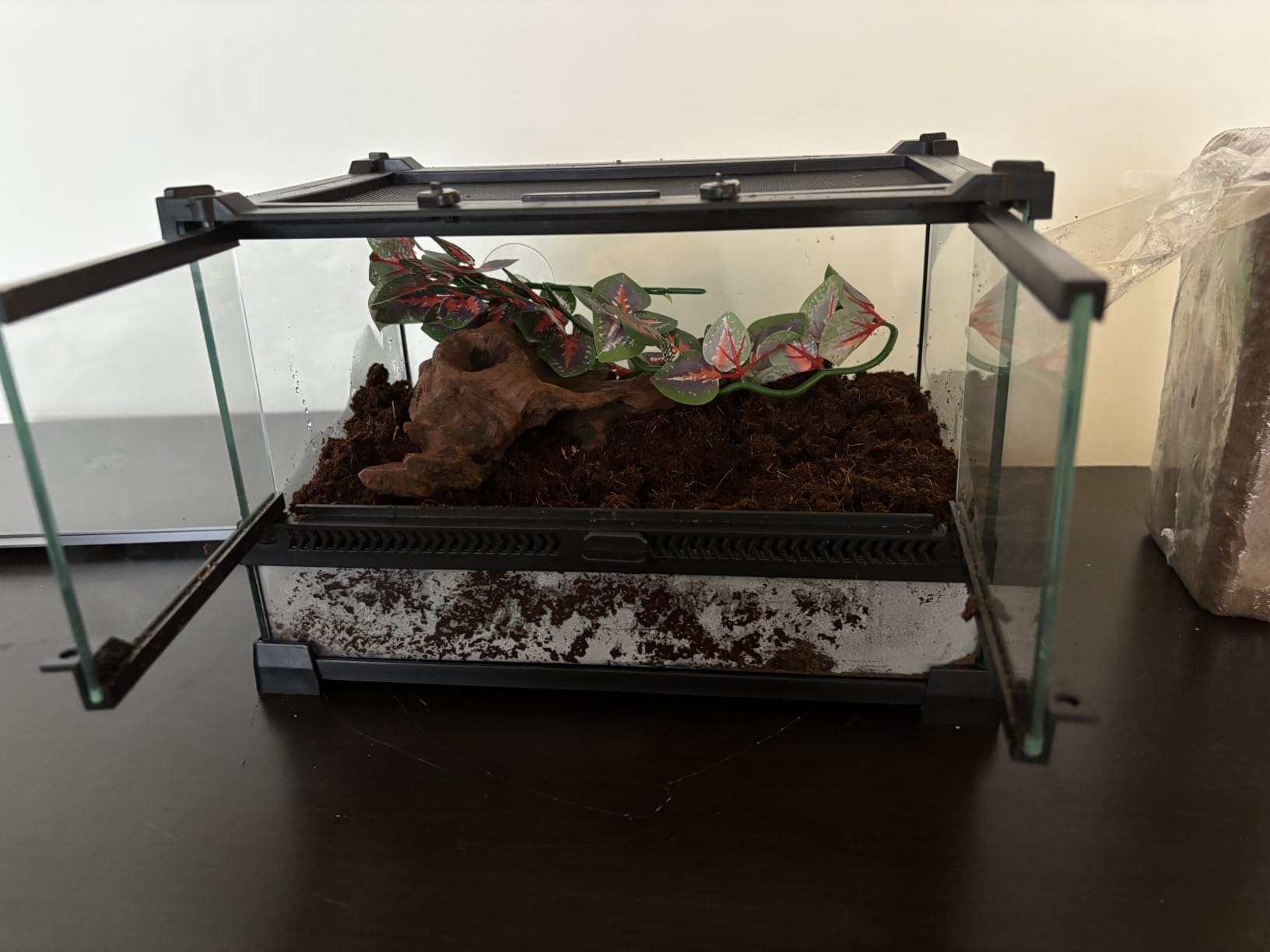
There are pre-drilled cable routing holes, so your thermostat probe and lighting cables pass through cleanly rather than through a rubber strip. The raised bottom frame leaves clearance for a heat mat underneath without blocking surface ventilation, and the metal mesh lid gives full overhead placement for a basking bulb and UVB tube.
It arrives fully assembled and packed carefully, so there is no build to do. For someone setting up a row of enclosures in a reptile room that is a meaningful time saving, and it also means a single unit is usable the moment it is unwrapped.
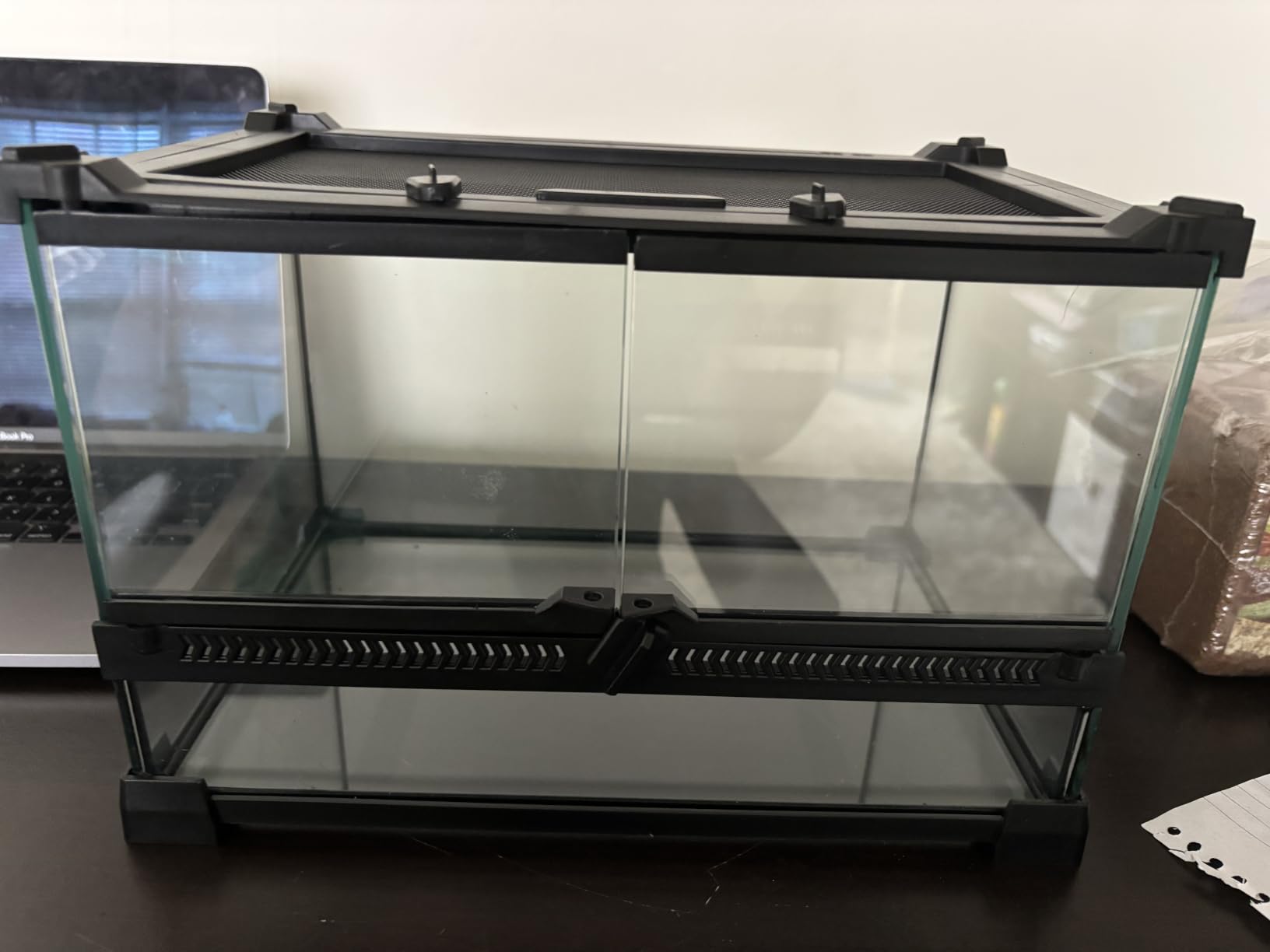
How stacking actually works with this design
Because the units interlock, you can place one directly on top of another and the frame carries the load rather than the glass edges taking point pressure. That is what the 93.76 pound top load rating refers to, and it is the difference between a safe stack and a pile of tanks slowly working their seals loose.
You still need a proper stand rather than an improvised shelf, and you need to check that the enclosure above is not blocking the heat escape path of the one below. Ventilation stacks top to bottom, so plan which unit gets the top position.
Two escape problems to plan for
Recurring criticism focuses on the gap between the two front doors. It is wide enough that small invertebrates can squeeze through, which matters for anyone running isopods or springtails as part of a cleanup crew. Blocks or strips of foam in the centre channel solve it in a minute.
Second, the top frame can be pushed up with little effort, so it is not fully escape proof for a strong climber. A leopard gecko is not an arboreal climber and will not force it, but I would not call this a locked enclosure in the way the 2 millimeter glass doors on the Phailozoo are locked. The eighteen months of service coverage is also the shortest warranty in this roundup.
8. Maiyuolg 16x16x24 Black PVC – A Lightweight PVC Build for Climbing Species
maiyuolg 16x16x24 Black PVC Reptile Tank for Adult Reptiles, Front Opening
16 x 16 x 24 in
Black PVC panels
Front opening door
Screen top with side vents
Pros
- Weighs only 9 pounds
- Black interior can reduce stress
- Front opening access with reinforced lock
- Side ventilation plus a screen top
- PVC retains heat well
Cons
- Vertical format is wrong for a terrestrial gecko
- PVC scratches and yellows over time
- Smallest review base in this group
Be honest with yourself about which animal this is for. A 16 by 16 by 24 enclosure is a tall vertical format, and leopard geckos are ground dwellers. They want floor area, not height, and no amount of climbing structure converts 256 square inches of base into the 648 square inches they actually need. This is an enclosure for arboreal and tropical species.
That said, the PVC build is genuinely well executed and the case for the material is real. At 9 pounds it is a fraction of the weight of the glass tanks here, so you can move it, rotate it for light, and lift it to check on an animal without recruiting a second person.
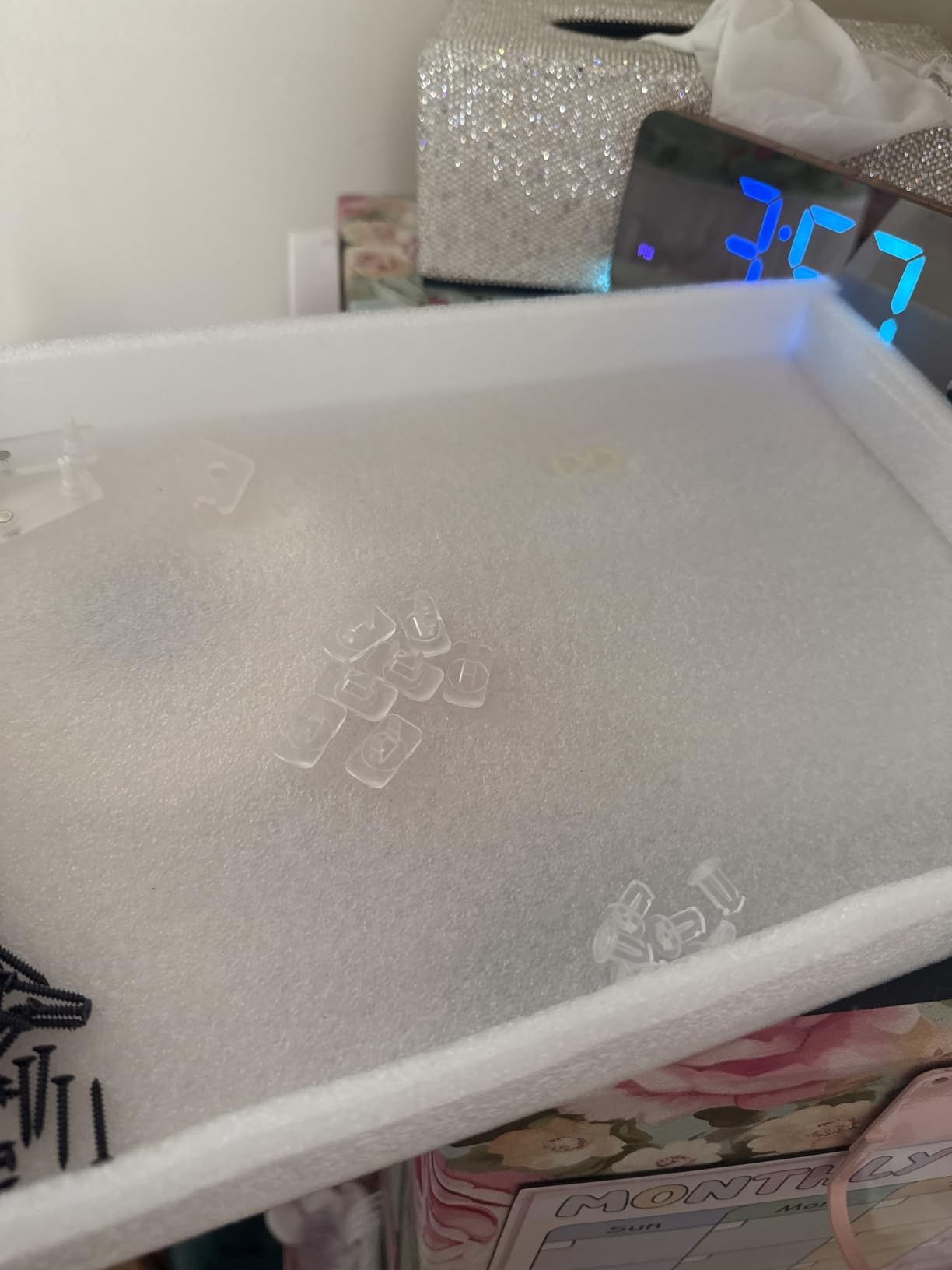
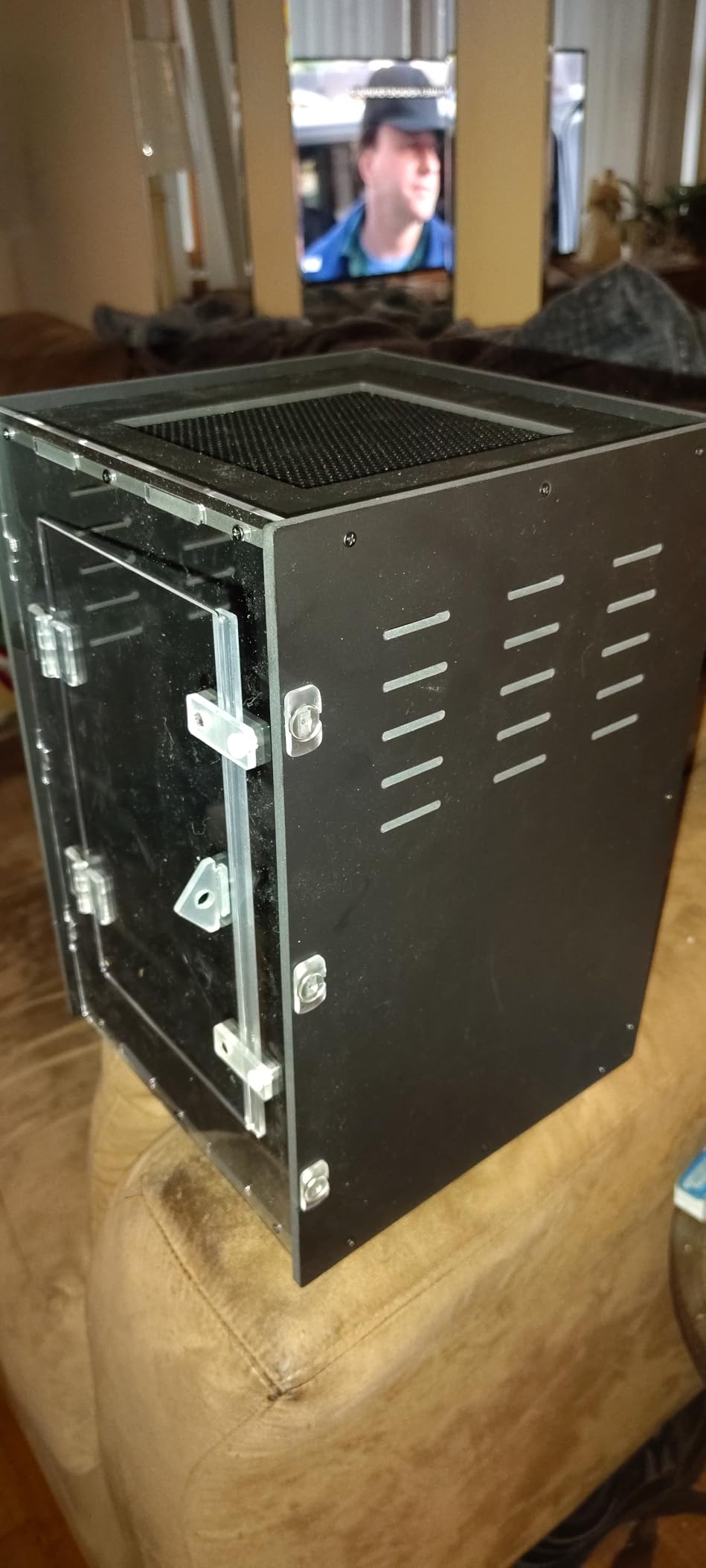
The black PVC interior is worth calling out. A dark interior reduces ambient light bouncing around the enclosure, and a lower-stress environment matters for crepuscular and nocturnal species. It is the same reason keepers line the sides of a glass tank with dark background film, built into the enclosure rather than added later.
Access is front-opening with a reinforced locking system and a modernised handle, plus side ventilation and a screen top that takes heating and lighting equipment in the standard overhead positions. PVC also retains heat more effectively than glass, which reduces how hard you have to work to hold temperature.
What PVC gets right that glass does not
Weight and insulation, both of them significantly. Glass is dense, cold to the touch and a conductor of temperature away from your basking spot. PVC is the opposite on both counts, so an enclosure built from it reaches temperature faster and holds it with less input.
It is also easier to modify. PVC can be routed, drilled and cut with standard tools for custom cable ports, light slots and vents, and the material will not shatter if it is dropped. For anyone building a custom setup, that flexibility is the deciding factor more often than the material’s thermal properties.
Why I would not put a leopard gecko in it
It is the base geometry. Sixteen inches square does not hold three separated hides, and the extra 8 inches of height is wasted space for an animal that never climbs. If your gecko is a juvenile in a transition phase it is workable, but you are buying another enclosure later.
PVC panels scratch more easily than glass and can yellow with prolonged UV exposure, and the black surface reduces ambient light enough that you will likely need more supplemental lighting than in a clear-fronted tank. At 98 reviews it also has the smallest owner base here, so there is less long-term feedback on how the panels look after a year of daily use.
9. BINANO 33 Gallon Foldable Mesh – Best for Travel, Storage and Lightweight Setups
BINANO 33 Gal Foldable Reptile Terrarium for Gecko & Dragon
32 x 18 x 18 in
5 pound folding frame
Mesh on all five sides
Locking front door
Pros
- Weighs only 5 pounds
- Mesh on five sides gives excellent airflow
- Locks flat for storage when not in use
- Large 32 by 18 footprint for the weight
- Simple assembly with magnetic joints
Cons
- Mesh walls lose humidity quickly
- Mesh openings will not contain hatchlings
- Less rigid for heavy substrate
Thirty-two by eighteen inches is 576 square inches of floor area, which puts this within striking distance of the adult minimum footprint, and it does that in a five pound package. No other enclosure in this roundup gives you that much usable space for that little mass, and it folds flat when you are not using it.
The frame is metal mesh on all five sides with a magnetic joint design and overall locking mechanisms that stop it shaking. The front door has its own lock, so feeding access is secure. Assembly is genuinely simple — you put the panels together and you are done.
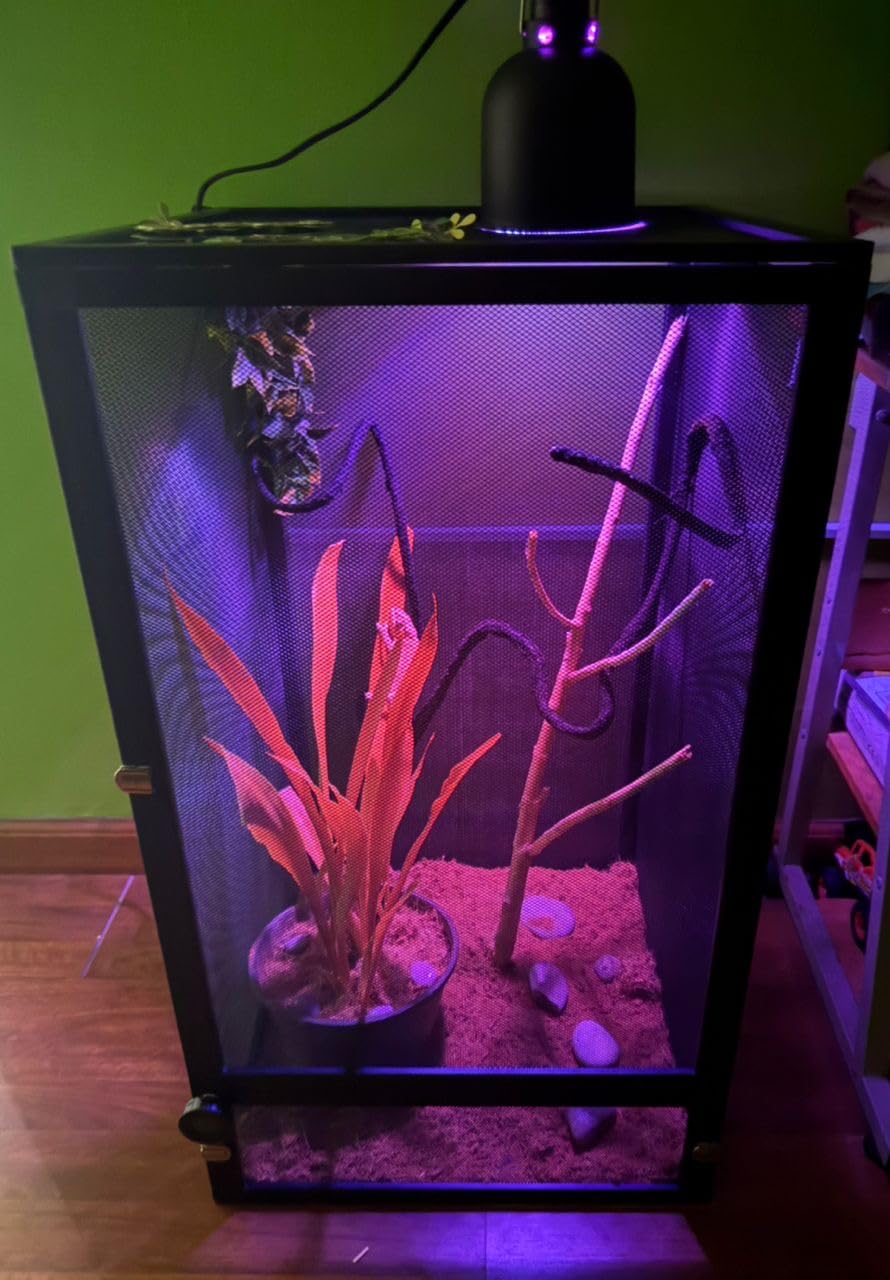
Airflow is the standout. Mesh on five sides means there is essentially no stagnant zone anywhere in the enclosure, which in a dry desert setup is a real advantage for preventing trapped humidity in the corners and reducing the risk of mould in a deep substrate.
For travelling or moving, it is a category of its own. At five pounds you can carry an entire gecko and its full setup in one hand, and folding it flat means it occupies a fraction of the storage space a rigid glass tank needs. For anyone who moves apartments on a regular cycle, that alone justifies the trade-offs.
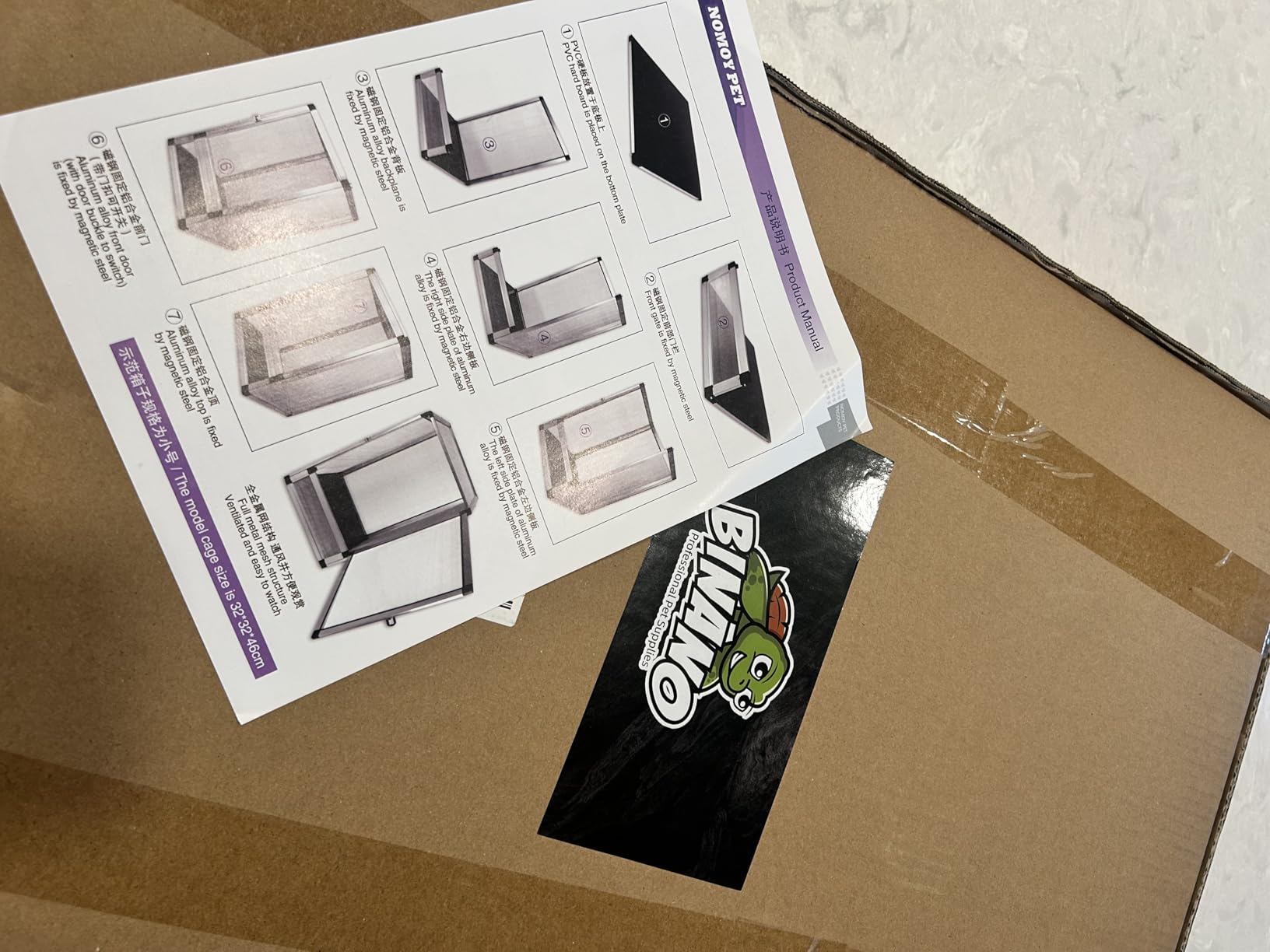
What mesh does well and what it does not
Mesh gives you airflow and observation in one material. You can see the entire enclosure from every angle without reflections, and every surface breathes. For a leopard gecko, a dry ventilated environment is not a compromise — it is close to what the species actually wants in the wild.
Humidity retention is where it falls down. A moist humid hide in a mesh enclosure dries out noticeably faster than in glass or PVC, so you are topping up damp substrate more often and watching the hygrometer more closely. In practice I find that workable but fiddly, and the most reliable humid hides in a mesh tank use a sealed plastic box with a lid rather than relying on the enclosure walls.
Two limits worth knowing before you buy
Mesh openings will not stop a hatchling. If you are setting up a very young gecko, this is not the enclosure, and it is worth noting that even some invertebrates can pass through the pattern. It is fine for a juvenile and an adult, and not fine for a hatchling.
It is also less rigid than a glass or PVC enclosure, so a very heavy wet substrate layer can cause the panels to bow over time. For a dry desert setup at normal substrate depth that is not an issue. For a deep saturated bioactive build, choose a rigid-walled enclosure instead.
10. ADVINCI 32 Gallon Vertical – A Versatile Mixed-Panel Design
Reptile Terrarium 18″x18″x24″ 32 Gallon,Aluminum Frame,Full Glass Tank Enclosure for Small Reptiles, Geckos, Frogs, Lizards, Snakes, Spiders, Turtles, Vertical Rainforest Habitat
18 x 18 x 24 in
Aluminum frame
Glass and insulated panels
Top mesh panel
Pros
- Ships with both glass and insulated panels
- Lightweight for a 25.79 pound build
- Dual-locking latches are reliable
- Knock-down tool free assembly
- Sleek aluminum frame looks premium
Cons
- Only about 3 inches of base depth
- Door gap admits springtails and isopods
- Upper panels block light and admit feeder insects
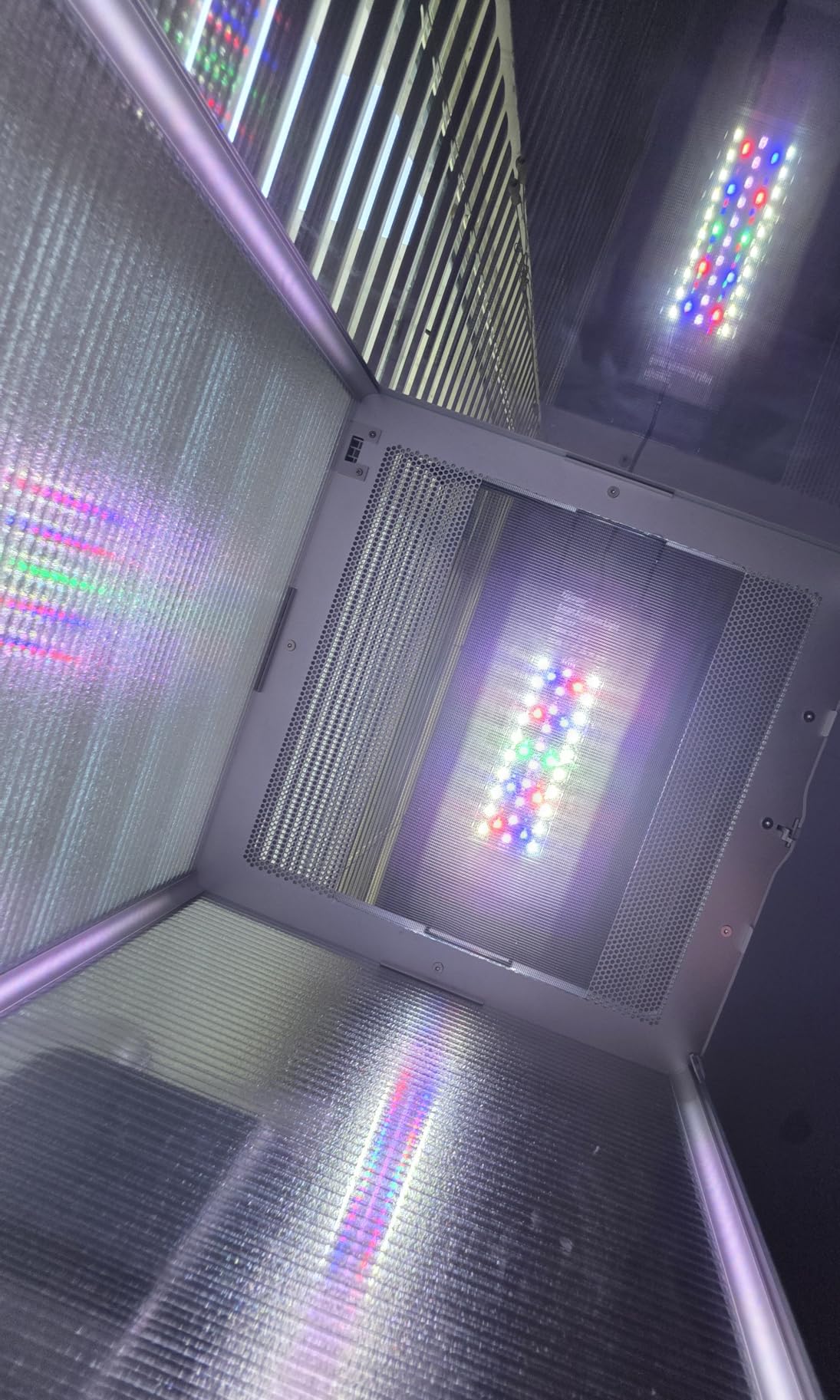
The most interesting idea in this roundup is the interchangeable panel set. This enclosure arrives with both high-clarity glass panels and insulating plastic panels, and you choose per wall which one goes where. Put glass on the front for full visibility and plastic on the sides to reduce reflections and hold heat, or reverse that if you want a more private, lower-stress enclosure.
Structurally it is a rust-resistant aluminum frame in a knock-down design, and it assembles and disassembles in about fifteen minutes with no tools. At 25.79 pounds it is much easier to handle than the weight suggests for a tank this tall, which owners consistently mention.
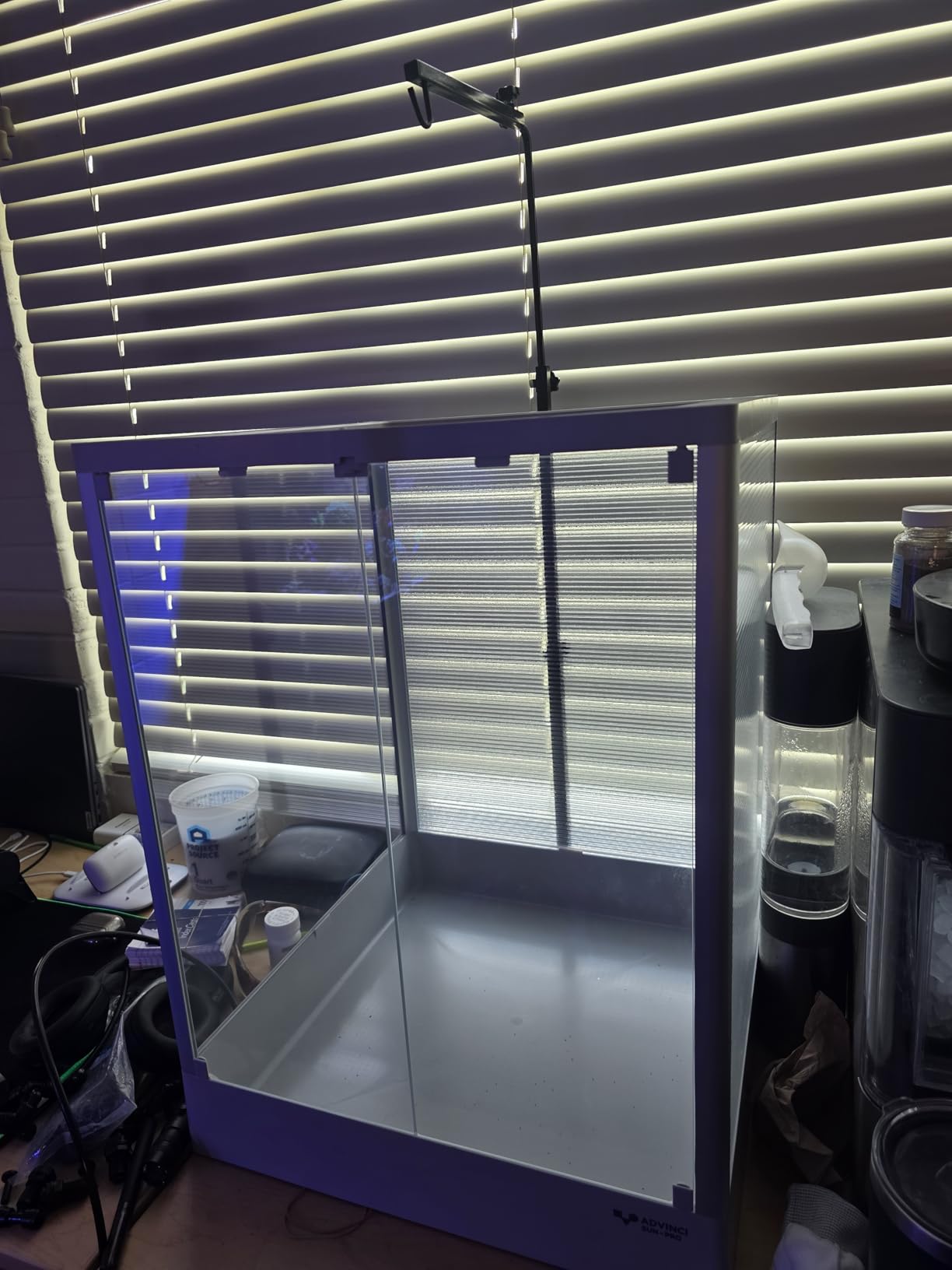
Security is handled with dual-locking latches on the doors, described by owners as working reliably and opening smoothly, and there is a mesh panel mounted on top that accepts a heat lamp or UVB bulb overhead. The detachable panels mean a full clean-out takes a few minutes rather than an afternoon.
Eighteen by eighteen inches of base is 324 square inches — closer to a square footprint than the long-and-low shape this species prefers, but enough floor area for a juvenile or subadult with hides arranged around the perimeter.
Why the mixed-panel approach is worth a look
It solves a real problem cheaply. Glass front, plastic sides, top mesh — that combination gives you a clear view where you need one, lower heat loss where you do not, and ventilation where the lamps are. It is the same principle behind the acrylic and PVC enclosures that cost considerably more, implemented with a mix you can reconfigure as your setup changes.
Buyers using it for geckos and frogs repeatedly describe the value positively, and the aluminium frame and clear glass give it a modern look that works in a living space rather than reading as equipment.
Three problems that show up in gecko setups
The base depth is about 3 inches. That is a decisive limitation for any bioactive plan — you need four to six inches of substrate plus a drainage layer, and this enclosure simply does not have the vertical room to hold it. For a dry desert setup with a shallow sand layer it is fine.
The gap under the doors is wide enough for springtails and small isopods to pass through, which rules out relying on a cleanup crew population that you intend to keep contained. And the solid upper panels block a substantial amount of light and can let feeder insects through, so you need to check how your UVB fixture and your dubia are contained before committing.
What Size Tank Does a Leopard Gecko Actually Need?
An adult leopard gecko needs at least 36 inches long by 18 inches wide by 16 to 18 inches tall. That is a front-opening enclosure with a screen top, and it works out to roughly a 40 to 50 gallon footprint depending on the frame. Here is the ladder, starting small:
- Hatchling (under 6 inches): a 10 gallon tank works. 20 by 10 by 11 inches is the common size. Keep it simple with a hide, a water dish and a heat source.
- Juvenile to subadult (6 to 10 inches): step up to a 20 gallon, ideally 30 inches long. This is where most first purchases land, and it is a comfortable size for a growing animal.
- Adult (over 10 inches): 36 by 18 by 16 to 18 inches. This is the floor, not the target. Reptile Kages recommends even more, at 36 by 24 by 18.
- Two animals: double the footprint. A 36 by 18 is the minimum for a monitored pair, and a 4 by 2 by 2 is the standard recommendation.
- Bioactive planted setup: add vertical room for a four to six inch substrate column over a drainage layer, plus headspace for the UVB to reach the basking surface.
Floor area beats height every time. A 4 by 2 by 2 is 8 square feet of floor, while a tall 18 by 18 by 24 gives you roughly 2.25 square feet and 24 inches of height a leopard gecko will never use. This is the most common sizing mistake in the hobby, and the reason so many geckos end up pacing a narrow strip instead of moving through a real habitat.
As for horizontal versus vertical: horizontal, without question. A ground-dwelling desert lizard in the wild crosses kilometres of open, flat substrate. A long, low enclosure lets you lay out a warm end, a cool end and a humid middle along a single axis, which is the entire point of a thermal gradient.
Reconciling the 20 gallon versus 40 gallon argument
You will see both numbers quoted as the minimum, and veterinary sources tend to say 20 gallons while hobbyist sources consistently say 40 to 50. Both are answering a different question. The 20 gallon figure is a floor below which an animal is genuinely cramped, based on welfare standards for reptiles generally. The 40 to 50 gallon figure is what the r/leopardgeckos community has settled on after watching animals kept in the smaller size.
Follow the 40 gallon number. Not because 20 gallons is cruel — a well-decorated 20 gallon tank is infinitely better than a bare 40 gallon one — but because leopard geckos are active, and because buying the adult size once costs you less time and money than buying twice. If you start with a juvenile, budget for the adult enclosure a year later rather than pretending the first one will do.
Measure inches, ignore gallons
Owners on r/leopardgeckos consistently quote dimensions in inches rather than trusting gallon labels, and they are right to. The Phailozoo in this roundup is sold as a 50 gallon tank and delivers about 40 gallons inside; a 34 gallon label on a different model does not mean it has a bigger floor. The number printed on the box describes the container, not the animal’s usable space.
Two more dimensions people forget. The enclosure needs to be front-opening, because top-opening access means reaching down over a prey species every time you feed it. And it needs a screen or mesh top so basking heat dissipates instead of pooling under a solid ceiling — which is also why the solid upper panels on some of the vertical designs are a real drawback.
Is Glass or PVC Better for a Reptile Enclosure?
Neither is universally better — they trade against each other on four axes, and the right answer depends on your room, your budget and your setup style. Glass wins on clarity, scratch resistance and cost. PVC wins on weight, heat retention and customisability. For a leopard gecko in a warm house, glass is genuinely fine and the premium on PVC is not necessary.
- Glass: best optical clarity, will not scratch, cheapest per cubic foot, holds humidity best, and does not yellow. Heavy, cold to the touch, and difficult to modify.
- PVC: light enough to move one-handed, retains heat better, can be drilled and routed for custom cable ports and light slots, and absorbs impact without shattering. Scratches, yellows under UV, and costs more.
- Polycarbonate: shatter resistant and rated across a wide temperature range, but scratches over time and is less suitable for humid or heavily planted displays.
- Mesh: excellent airflow and full visibility, folds flat for storage and travels easily. Poor humidity retention and not rigid enough for deep wet substrate.
Ask yourself one question first: does the enclosure have front-opening doors? If it does not, the material argument is largely academic, because top-opening access is the bigger daily welfare problem. Once you have narrowed to front-opening models, glass is the sensible default for a desert species unless you are building a deep bioactive setup or you need to move the tank regularly.
Acrylic sits in between glass and PVC. It is lighter than glass, cheaper than PVC and reasonably clear, but it scratches easily and can yellow with UV exposure over years. For a first adult enclosure on a budget, a glass model with front doors is the better value over five years.
How to Heat a Leopard Gecko Tank and Read the Temperature Gradient
Heating is where enclosure choice gets tested, because not every tank is compatible with every heat source. The numbers below are the targets you are building toward, and you cannot hit them if the enclosure will not hold a gradient.
- Basking surface: 94 to 97 F, measured with an infrared temperature gun on the actual surface, not in the air
- Warm hide interior: 90 to 92 F
- Cool side: 70 to 77 F
- Night floor: around 60 F, with no heat source running overnight
- Ambient humidity: 30 to 40 percent
- Humid hide: 70 to 80 percent
The sequence that works for me: a halogen basking bulb in a dome or bracket on a dimmable thermostat, a T5 HO UVB tube at the manufacturer-recommended distance from the basking surface, an under-tank heater as optional belly heat on the cool end, and a hygrometer and thermometer in the enclosure at animal height. Every heat source in this setup goes overhead or under, which is why a screen top is close to non-negotiable.
Leopard geckos are poikilothermic, so they cannot generate heat and must move through a gradient to regulate. That is why the footprint matters so much: a 36 inch length lets you establish a basking zone at one end and a genuinely cool zone at the other, while a 12 inch cube gives the animal no meaningful choice. If the gradient across your enclosure is only a few degrees, the tank is too small for the animal in it.
Aim for 200 to 350 W/m2 of infrared power density at the basking surface rather than relying on air temperature alone. That measurement is what tells you whether the gecko can actually process heat effectively, and it is why a low-wattage fixture in a large PVC enclosure can outperform a high-wattage bulb bouncing off bare glass.
Bioactive-Ready vs Bare-Bones: Which Enclosures Can Take 4 Inches of Substrate
For a bioactive planted setup, look for one thing before anything else: depth. A bioactive enclosure needs four to six inches of substrate over a drainage layer, which means six to eight inches of usable interior height with the drainage layer included. Several of the enclosures in this roundup simply do not have that.
The Phailozoo at 36 by 18 by 18 has the height to do it, with one caveat — the base is silicone sealed only and is not leakproof, so you need a proper second seal before you add a drainage layer that will hold water. The REPTI ZOO 34 gallon has a raised waterproof base and enough height, making it the easiest fully glass option here for a bioactive build.
The enclosures that cannot support one are the compact juveniles: the 10 gallon, the 8 gallon cube and the 20 by 12 by 14. The ADVINCI is the awkward case — 24 inches of height but a base tray of only about 3 inches, so the interior is too shallow to stack drainage plus substrate. The mesh BINANO is rigid enough that a deep wet substrate can bow the panels, so I would run that one dry.
The substrate mix that works with these systems is roughly 70 percent organic topsoil to 30 percent washed play sand, inoculated with a cleanup crew of isopods and springtails. A set of three hides — warm, cool and humid — is the minimum, and the layout is not optional decoration: it is how the animal controls its own exposure to heat and moisture.
What Else a Leopard Gecko Setup Needs Besides the Tank
The enclosure is the cheapest part of the list, and it is the part people budget for first. Here is the rest of what a working setup contains, so you can plan the whole thing before the animal arrives.
- Heating: a halogen basking bulb in a bracket or dome, plus an under-tank heater if you want belly heat on the cool end
- Thermostat: a dimmable model for the basking bulb, and a second one for any under-tank heater. A thermostat is not an accessory.
- UVB: a T5 HO tube, typically 6 to 7 percent for a leopard gecko, mounted at the distance that puts the basking surface at a UVI of 0.5 to 1.5
- Monitoring: a thermometer and hygrometer reading at gecko height, plus an infrared temperature gun for basking surface readings
- Three hides: warm, cool and humid. This is the one item owners most often under-buy.
- Substrate and water dish: sand and topsoil for a simple setup, or a full drainage layer and soil mix for a bioactive one
- Clutter and cover: owners on r/leopardgeckos are emphatic that a sparse enclosure is stressful and boring. Cover the sightlines.
Running costs are mostly electricity, and they scale with enclosure volume — a larger tank needs a larger heat source. That is the practical argument for PVC if you live somewhere with expensive power, since it reaches temperature faster and holds it with less input than the same volume of glass.
If you are weighing an upgrade path, buy for the adult animal from the start. The frustration I see most often is a keeper who buys a small tank, watches their gecko outgrow it in a year, and then has to buy again. Two purchases cost more than one, and the second one happens at the worst possible time.
Frequently Asked Questions
What size tank is best for a leopard gecko?
An adult leopard gecko needs at least 36 inches long by 18 inches wide by 16 to 18 inches tall — roughly a 40 to 50 gallon footprint. Juveniles under about 6 inches can be housed in a 10 gallon tank, and a 20 gallon works up to around 10 inches of body length. Floor area matters more than height, so a long, low enclosure is always better than a tall one.
Can a leopard gecko live in a 30 gallon terrarium?
A 30 gallon terrarium works well for a juvenile or subadult leopard gecko and is a comfortable size up to roughly 10 inches of body length. It is under the recommended 36 by 18 inch footprint for a full-grown adult, so plan an upgrade. The important detail is interior length — a 30 by 12 by 12 inch tank gives you a real heat gradient, which a taller but shorter tank does not.
Can a leopard gecko live in a 10 gallon terrarium?
Yes, but only for a juvenile. A 10 gallon tank, typically 20 by 10 by 11 inches, is appropriate for a hatchling under about 6 inches long and works well as a quarantine or hospital enclosure. An adult cannot fit three separated hides or a proper thermal gradient into that footprint, so it is a temporary home rather than a permanent one.
Is a 40 gallon tank too big for a leopard gecko?
No. A 40 to 50 gallon enclosure is the standard recommendation for an adult, and the community consensus on r/leopardgeckos is that it is the minimum rather than a luxury. Leopard geckos are active ground dwellers, and the larger footprint lets you place a warm hide, a cool hide and a humid hide with real separation while maintaining a temperature gradient from one end to the other.
Is glass or PVC better for reptile enclosure?
Glass offers better clarity, scratch resistance and lower cost, and it holds humidity well. PVC is much lighter, retains heat better, and can be drilled and routed for custom cable ports and light slots, but it scratches and yellows over time. For a leopard gecko in a warm house, glass is genuinely fine — the deciding factor is usually front-opening access rather than material.
How warm should my leopard gecko enclosure be?
Aim for a basking surface of 94 to 97 F measured with an infrared temperature gun, a warm hide interior of 90 to 92 F, a cool side of 70 to 77 F, and a night floor around 60 F with no heat source running. Keep ambient humidity at 30 to 40 percent and the humid hide between 70 and 80 percent. A dimmable thermostat on a halogen basking bulb is the standard setup.
What is the best way to heat a leopard gecko tank?
A halogen basking bulb in a dome or bracket on a dimmable thermostat, paired with a T5 HO UVB tube above the basking area. An under-tank heater can add belly heat on the cool end, but it must be on its own thermostat. The enclosure needs a screen or mesh top for heat to dissipate, and you should verify the fixture wattage suits the enclosure volume before buying.
Do leopard geckos prefer vertical or horizontal enclosures?
Horizontal, by a wide margin. Leopard geckos are terrestrial and in the wild cross large areas of open, flat desert substrate. A long, low enclosure lets you lay out a warm end, a cool end and a humid middle along one axis, which is what makes a real temperature gradient possible. A tall narrow enclosure wastes its height on space a leopard gecko will never use.
The Bottom Line for Leopard Gecko Owners in 2026
For a full-grown gecko, the Phailozoo 36 by 18 by 18 is the only enclosure in this roundup that hits the adult minimum footprint, and it is the one I would buy for an adult. For a first keeper or a brand-new hatchling, the New Age Pet ECOFLEX 24 inch is my Editor’s Choice: it has the largest review base in the category, the sliding lockable doors make daily life straightforward, and the ten-year warranty is the longest here.
Between those two sit useful options: the REPTI ZOO 34 gallon if you want a background included, the REPTI ZOO 20 gallon as a sensible mid-size step, and the NEPTONION if you are building a stacked row of enclosures. The compact cubes and vertical designs are honest products, but they are not adult leopard gecko housing.
Whatever you choose, buy the adult size now if you can, compare interior inches rather than gallon labels, and make sure the doors open at the front. Those three checks eliminate almost every expensive mistake in this hobby. Then set up the three hides and the gradient before the animal comes home, and use the plant and enclosure care guides to finish the habitat.