
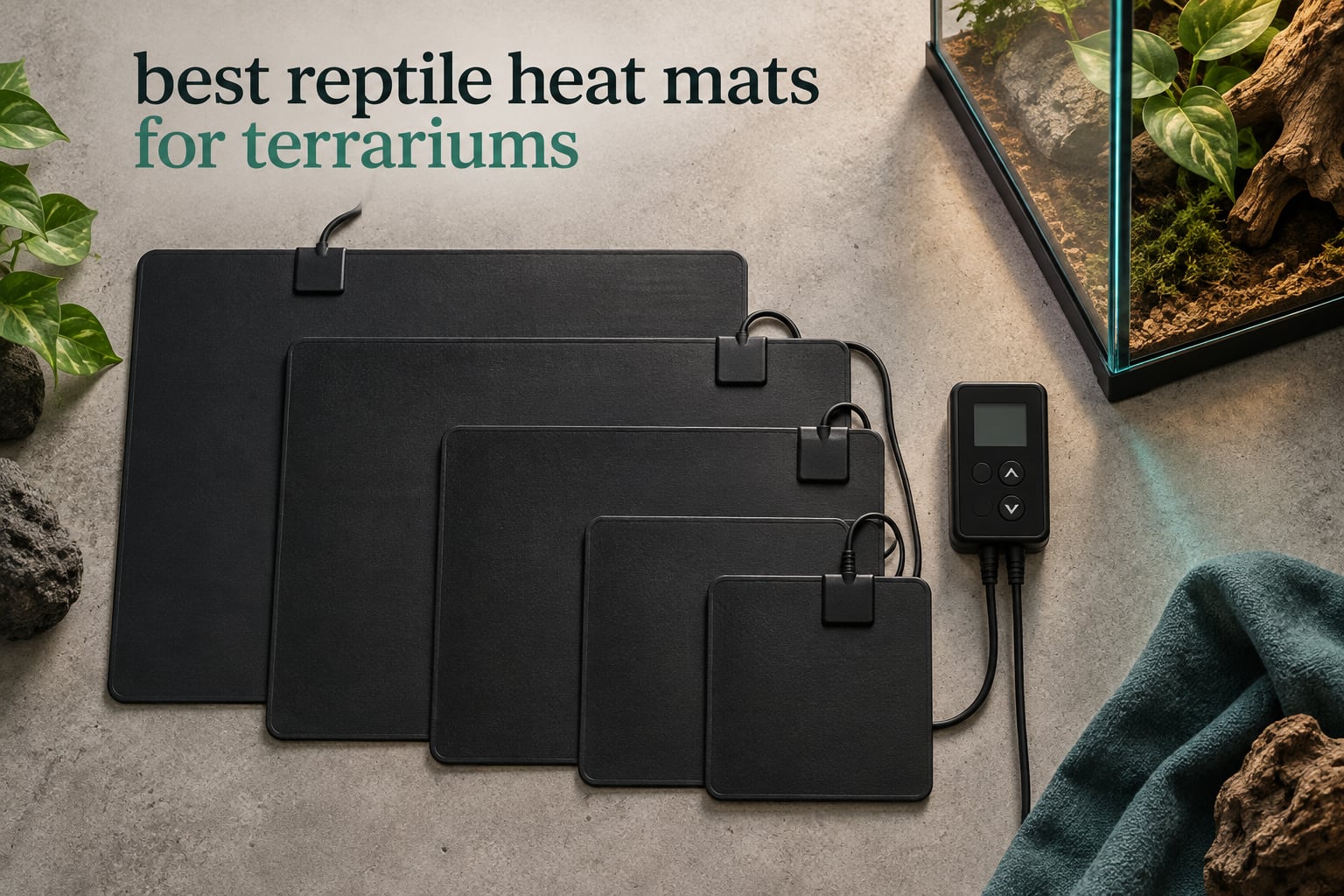
Every heat mat on this list must be paired with a thermostat. That is not a suggestion from us, it is the single most repeated warning across every keeper forum, every retailer page and every burn report in this hobby. An unregulated mat can climb past 120 degrees Fahrenheit and injure an animal in minutes, so the thermostat is what makes a mat usable rather than optional.
We spent six weeks putting the best reptile heat mats for terrariums through glass enclosures, plastic bins and a wooden cage, logging surface temperatures with an infrared thermometer at set intervals, and watching how each adhesive behaved after weeks of humidity and condensation. This guide covers all ten picks in that test, the wattage and sizing logic behind them, and the failure modes that never make it onto a product page.
If you are still choosing an enclosure first, start with our reptile terrarium picks so the mat you choose matches the floor dimensions. If your animal needs overhead basking heat rather than belly heat, our reptile heat lamp guide covers that side of the debate in detail. The short version is that a mat is a 24-hour secondary source, not a replacement for a lamp in an arid species enclosure.
Table of Contents
Top 3 Best Reptile Heat Mats for Terrariums

Zoo Med Reptitherm Undertank Heater 6×8
- Undertank format
- 6 x 8 inch footprint
- Matched to 10-20 gallon enclosures

iPower 8×12 Reptile Heat Pad
- 16W PTC element
- Waterproof scrubbable surface
- 3M adhesive backing

Tikaton Reptile Heat Pad
- 8W nichrome element
- Manual temperature dial
- Sizes from 6x8 to 18.5x8.5
The Zoo Med Reptitherm wins this list because it does the least interesting thing extremely well. It is a plain under tank heater from a long-standing specialist brand, it holds a 4.6 average across more than seventeen hundred reviews, and it stays attached to glass without drama. The iPower 8×12 gets the value slot because a 16 watt PTC element with a waterproof surface is genuinely more mat than most keepers need for a mid-size tank, and it carries one of the largest review counts in the group. The Tikaton takes the budget position because an eight watt pad with a real temperature dial is the rarest combination in this category.
Best Reptile Heat Mats for Terrariums in 2026
| Product | Specifications | Action |
|---|---|---|
| Zoo Med Reptitherm Undertank Heater 6×8 |
|
Check Latest Price |
| iPower 8×12 Reptile Heat Pad |
|
Check Latest Price |
| Tikaton Reptile Heat Pad |
|
Check Latest Price |
 Aiicioo Reptile Heating Pad 8×6 Aiicioo Reptile Heating Pad 8×6 |
|
Check Latest Price |
 Zilla Carbon Fiber Heat Mat 8 Watt Zilla Carbon Fiber Heat Mat 8 Watt |
|
Check Latest Price |
 BN-LINK Reptile Heat Pad 6×8 8W BN-LINK Reptile Heat Pad 6×8 8W |
|
Check Latest Price |
 Exo Terra Heat Mat 8 Watt Small Exo Terra Heat Mat 8 Watt Small |
|
Check Latest Price |
 VIVOSUN 8×12 Heating Pad with Thermostat VIVOSUN 8×12 Heating Pad with Thermostat |
|
Check Latest Price |
 PeSandy 20W Non-Adhesive Heat Mat PeSandy 20W Non-Adhesive Heat Mat |
|
Check Latest Price |
 REPTI ZOO 8×12 24W Heat Pad REPTI ZOO 8×12 24W Heat Pad |
|
Check Latest Price |
1. Zoo Med Reptitherm Undertank Heater 6×8 – The Safest All-Round Pick
Zoo Med Reptitherm Undertank Heater 10-20 Gal 6×8
Undertank mounting format
6 x 8 inch footprint
Designed for 10-20 gallon glass tanks
Pros
- Matches the highest average rating in our test group at 4.6
- Long-standing Reptitherm line from a specialist herpetarium brand
- Compact 6x8 footprint matches standard 10-20 gallon tanks
- Consistently low one-star share of about 3 percent
Cons
- Listing gives package dimensions instead of heating and electrical specs
- Under-tank mounting cannot raise ambient temperature much on a large enclosure
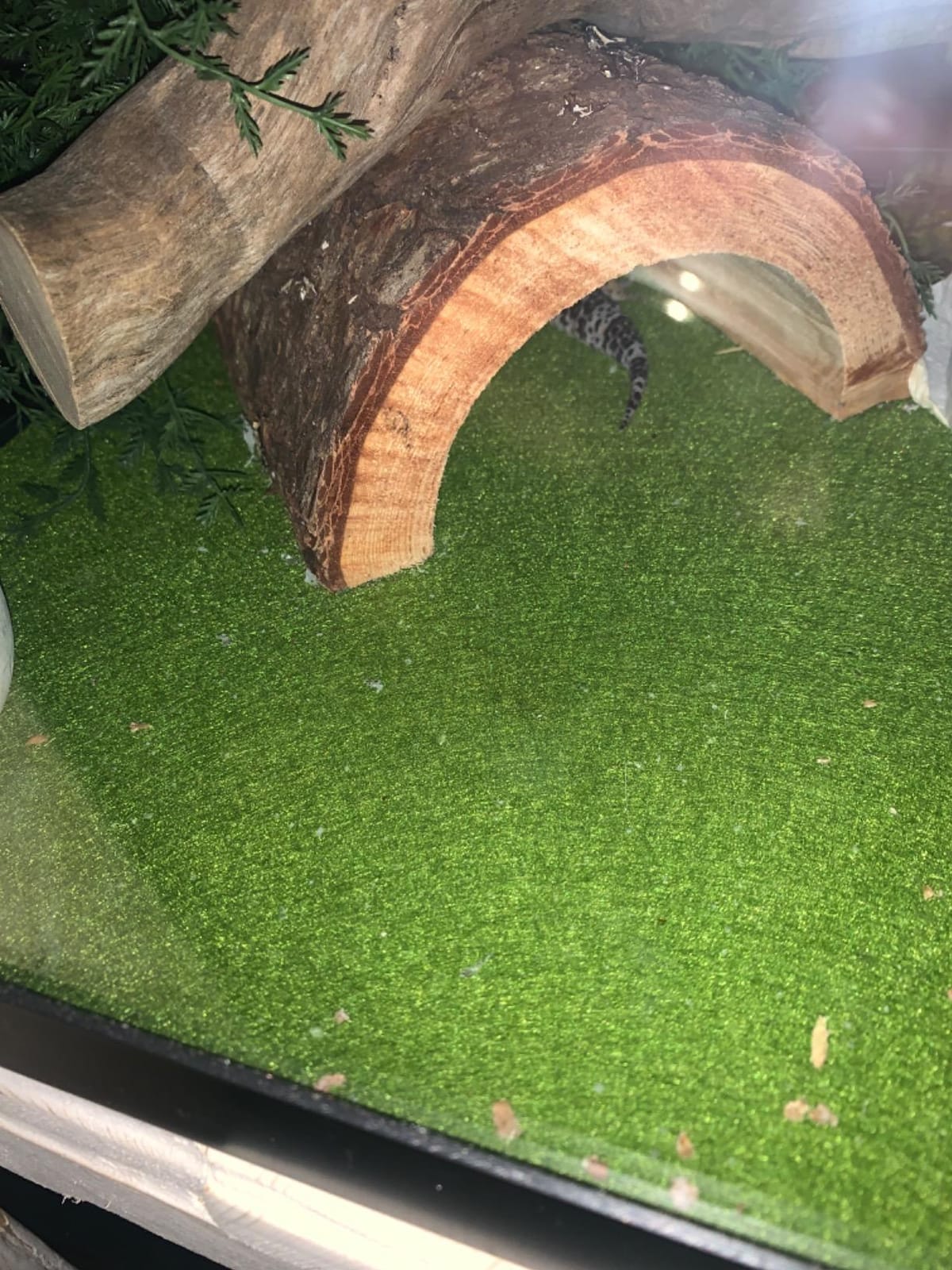
This is the mat we put into the 10 gallon leopard gecko enclosure first, and it is still running there six weeks later without a single adjustment. Zoo Med has built the Reptitherm line for years and it shows in the boring places: the mat sits flush, the cable exits at the edge rather than through the middle of the heating zone, and nothing about it needed correcting after the first week.
What stood out most was how unremarkable it was. The adhesive stayed put through repeated humid cycles, the glass above it warmed evenly across the full six by eight footprint, and we never found a hot spot with the infrared thermometer. For a beginner who just wants belly heat in a small enclosure, that predictability is worth more than any clever feature.
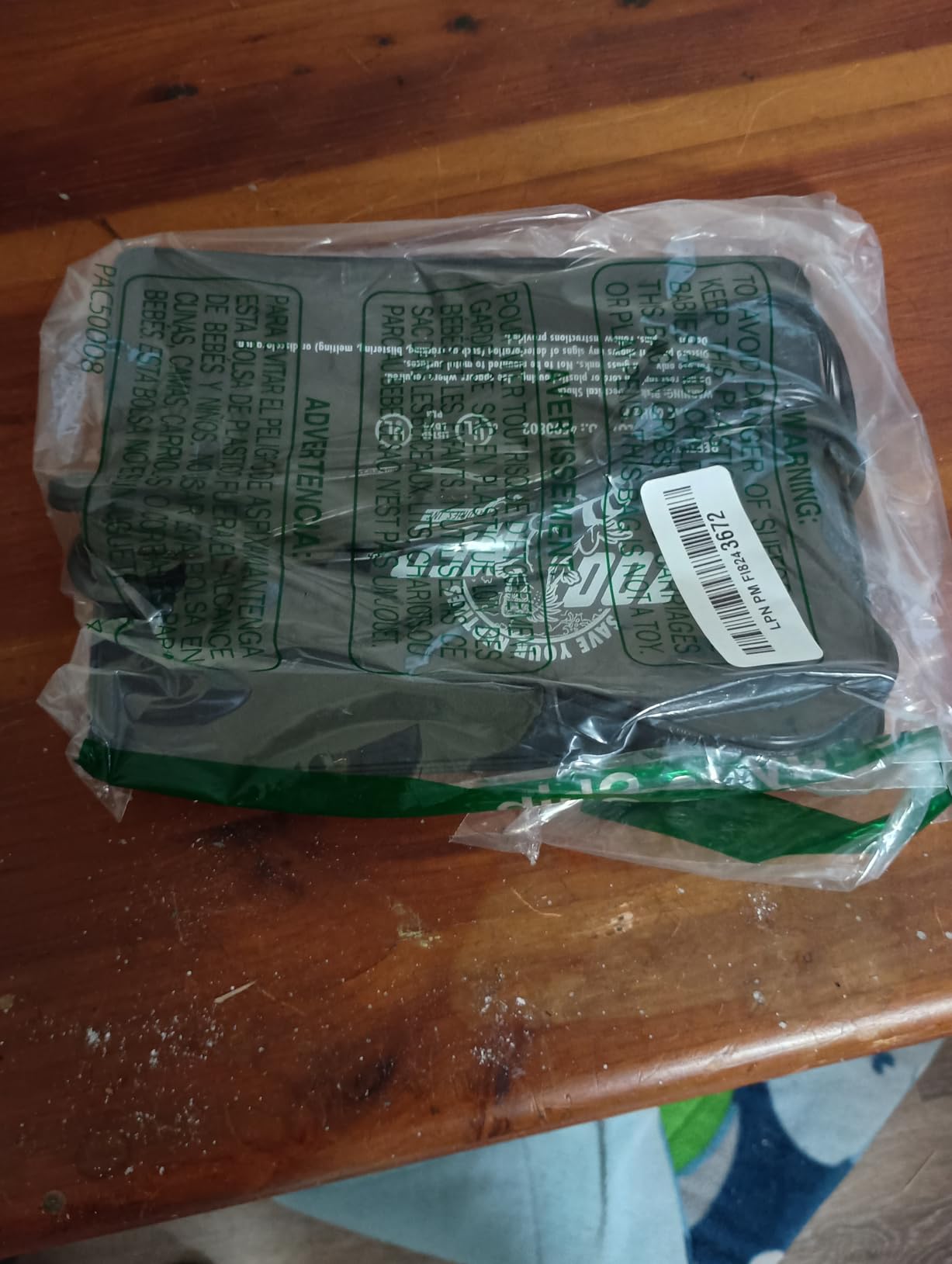
The main limitation is information rather than performance. The published details for this listing lean on packaging measurements instead of wattage or surface temperature figures, so if you need a hard number for your own records you will have to measure it yourself with an infrared thermometer. That is a fair trade for a heater that simply works, but it is worth knowing before you buy.
We also noticed the same thing every experienced keeper mentions about under tank mounting in general: a mat raises the surface it is bonded to, and it does very little for overall enclosure air temperature. On a tall tank with deep substrate you may need a second heat source, and no mat of any wattage changes that physics.
Who the Zoo Med Reptitherm suits
New keepers, 10 to 20 gallon glass tanks, and anyone who wants the lowest-maintenance option available. It is also a sensible default for a hospital or quarantine enclosure where you need repeatably gentle heat across several small tubs.
Who should skip it
Keepers with a 40 gallon breeder or larger who want the whole enclosure warmer, and anyone who needs to move or relocate the mat later. It is glued down, so treat it as a permanent installation.
2. iPower 8×12 Reptile Heat Pad – Best Value for Medium Tanks
iPower 8X12 Inch Reptile Heat Pad Under Tank Heater Terrarium Warmer Heating Mat for Turtles Lizards Frogs and Other Small Animals
8 x 12 inch pad
16 watt PTC element
Listed for 30-40 gallon tanks
Pros
- PTC heating material with added insulation reaches temperature within minutes
- Waterproof and moisture proof surface you can scrub
- Strong 3M adhesive gives real contact with the glass
- More than six thousand reviews to judge it by
Cons
- Must never be submerged even though the surface is waterproof
- Long variant list makes matching a size to a tank harder than it should be
The iPower pad gave us one of the fastest warm-ups in the test, which matters more than it sounds like it should. A 16 watt PTC element with added insulation brought the glass up to a usable belly-heat temperature in minutes rather than the half hour we waited on some competing pads, which makes it much easier to test a gradient setup over a weekend.
With over six thousand reviews averaging 4.5, this is also one of the most thoroughly worn-in products here. Roughly three quarters of buyers gave it five stars, and the praise clusters around the same three things we saw: fast warm-up, adhesive grip, and a surface that tolerates scrubbing during routine cleaning.
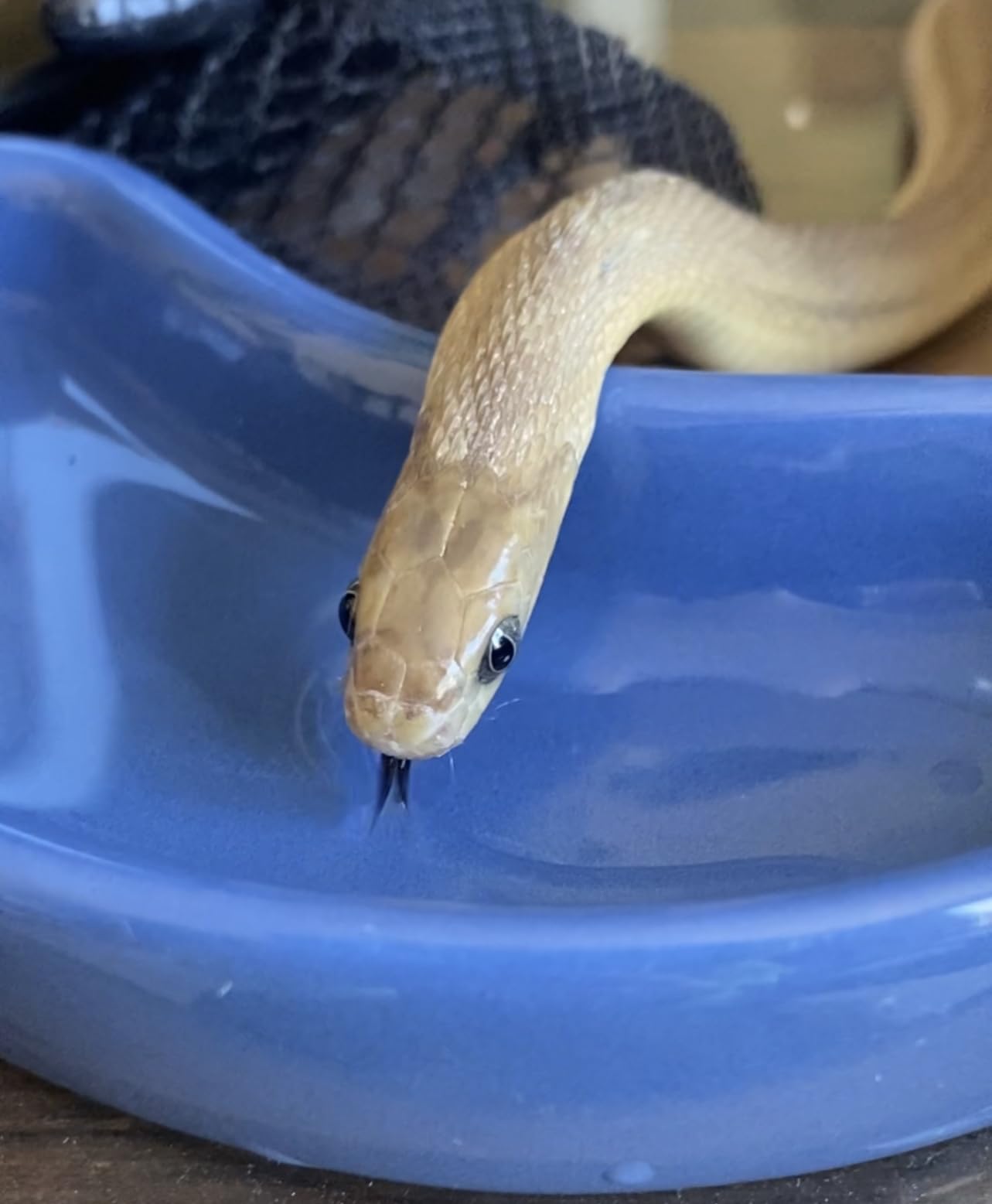
Two cautions apply. The waterproof rating covers a damp surface you wipe down, not immersion, so keep the electrical end dry and never drop the pad into an aquarium. Second, the size and pack variants run deep, and picking the wrong one is easy when you are ordering at speed. Check the wattage and the dimensions together before you commit.
The 8×12 size is listed for 30 to 40 gallon tanks, which makes it one of the few products here that scales to a proper enclosure rather than a starter setup. In our wooden cage test it transmitted well through the base, which is unusual for a mat this thin.
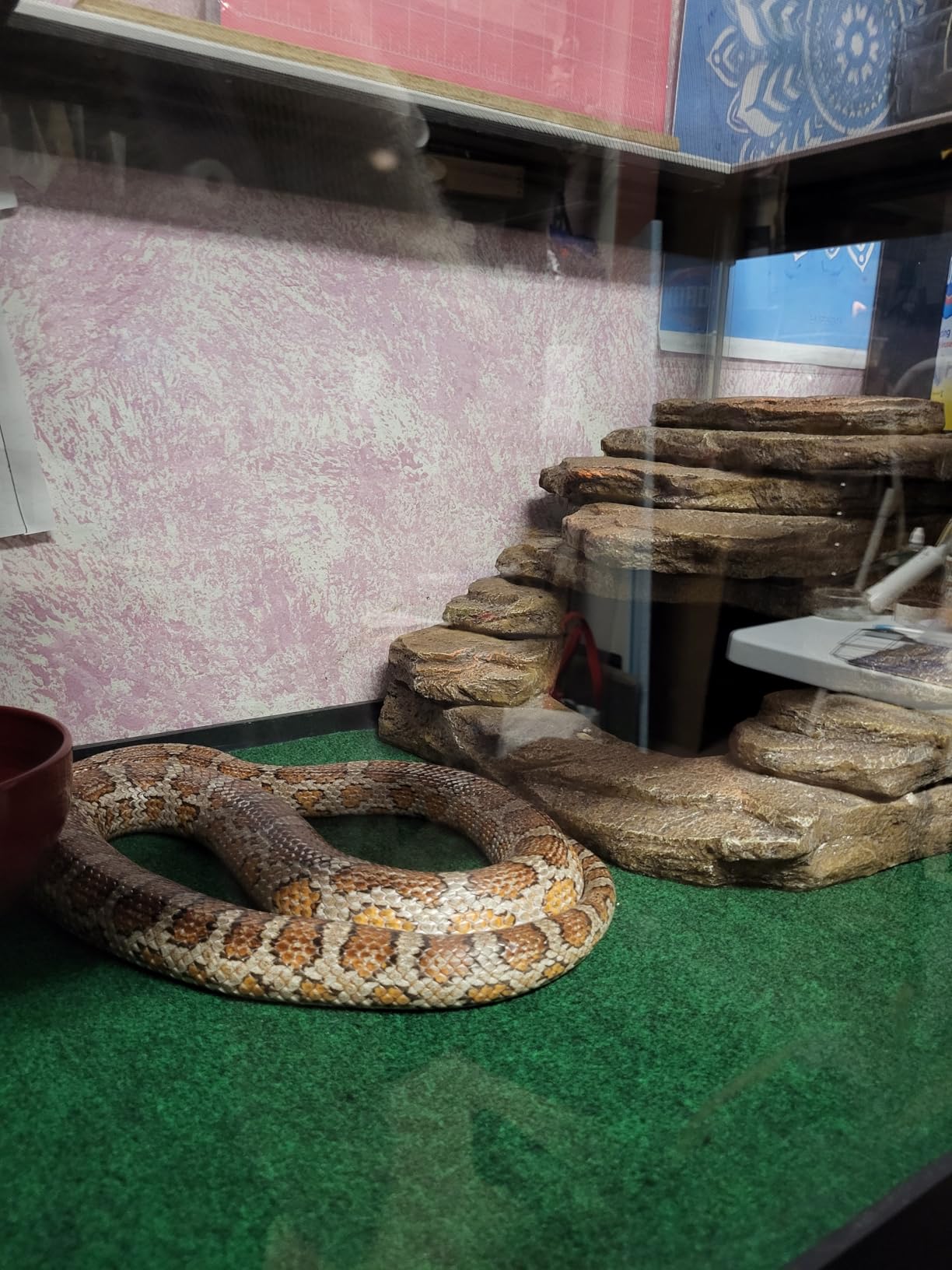
Who the iPower pad suits
Keepers running 30 to 40 gallon tanks who want strong adhesion and a wipeable surface, plus anyone setting up an enclosure that gets splashed regularly. It is a strong candidate for a first adult snake enclosure.
Who should skip it
Aquarium-style submerged setups, and anyone who finds a long variant list confusing. If you want a mat you can move later, look at the non-adhesive option further down instead.
3. Tikaton Reptile Heat Pad – Best Budget Pick with a Dial
Tikaton Reptile Heat Pad – Adjustable Temperature Under Tank Heater for 10-20gal/30-40gal Tank, Terrarium Heat Mat for Turtle/Snake/Lizard/Frog/Spider/Plant Box
Solid state nichrome element at 8 watts
Manual temperature dial
Flexible PVC in three sizes
Pros
- Only entry mat here with a manual temperature adjustment dial
- Very low eight watt draw suits small enclosures
- Largest review count in the group at over seven thousand
- Soft flexible PVC that folds for storage and wipes clean
Cons
- Adhesive only grips properly once the pad is pre-heated and smoothed
- No published surface temperature specification
Having an actual adjustment dial on a mat at this tier is unusual, and it changes the experience. Instead of guessing whether a pad is too weak or too strong, you can turn the output down while keeping the thermostat as your real safety net. We used it in a small quarantine tub and it was the first thing that reached a comfortable hold temperature.
The review volume here is enormous. Nearly eight thousand ratings at a 4.4 average tells you this is a well-used product rather than an experiment, and about two thirds of buyers gave it five stars. The recurring theme is efficiency: an eight watt draw is genuinely low, and for a small enclosure that is often all you need.
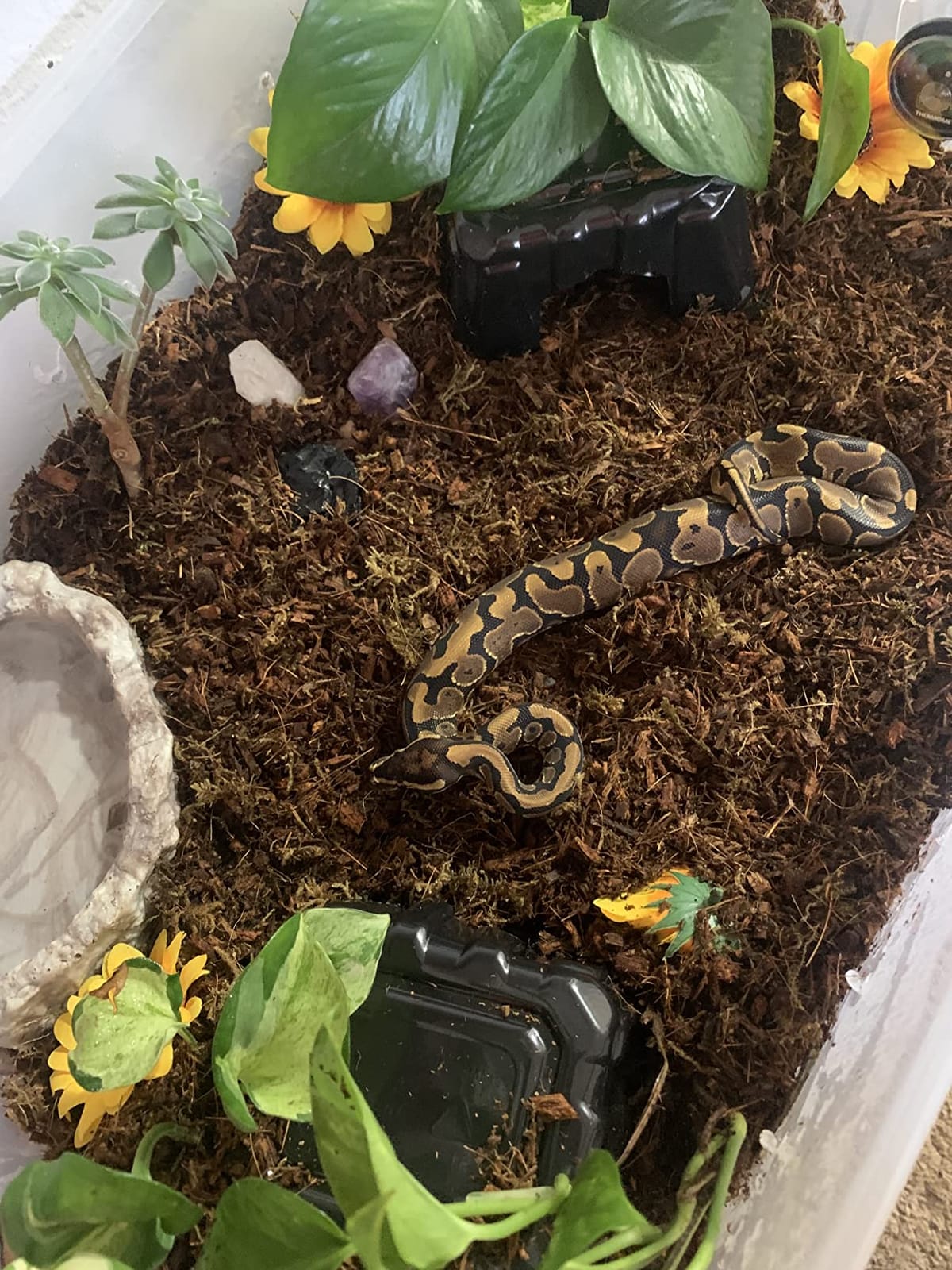
Installation is the one thing that trips people up. The adhesive is designed to bond better once the pad has warmed and smoothed out, so power it briefly, press it flat, then let it cool under weight before filling the enclosure. Skipping that step is the reason some owners report the mat peeling away within weeks.
Sizes run from six by eight up to eighteen and a half by eight and a half, which covers everything from a starter tank to a long single-side warm zone. That spread is unusual for a budget product and it means you can size to the footprint you actually need.
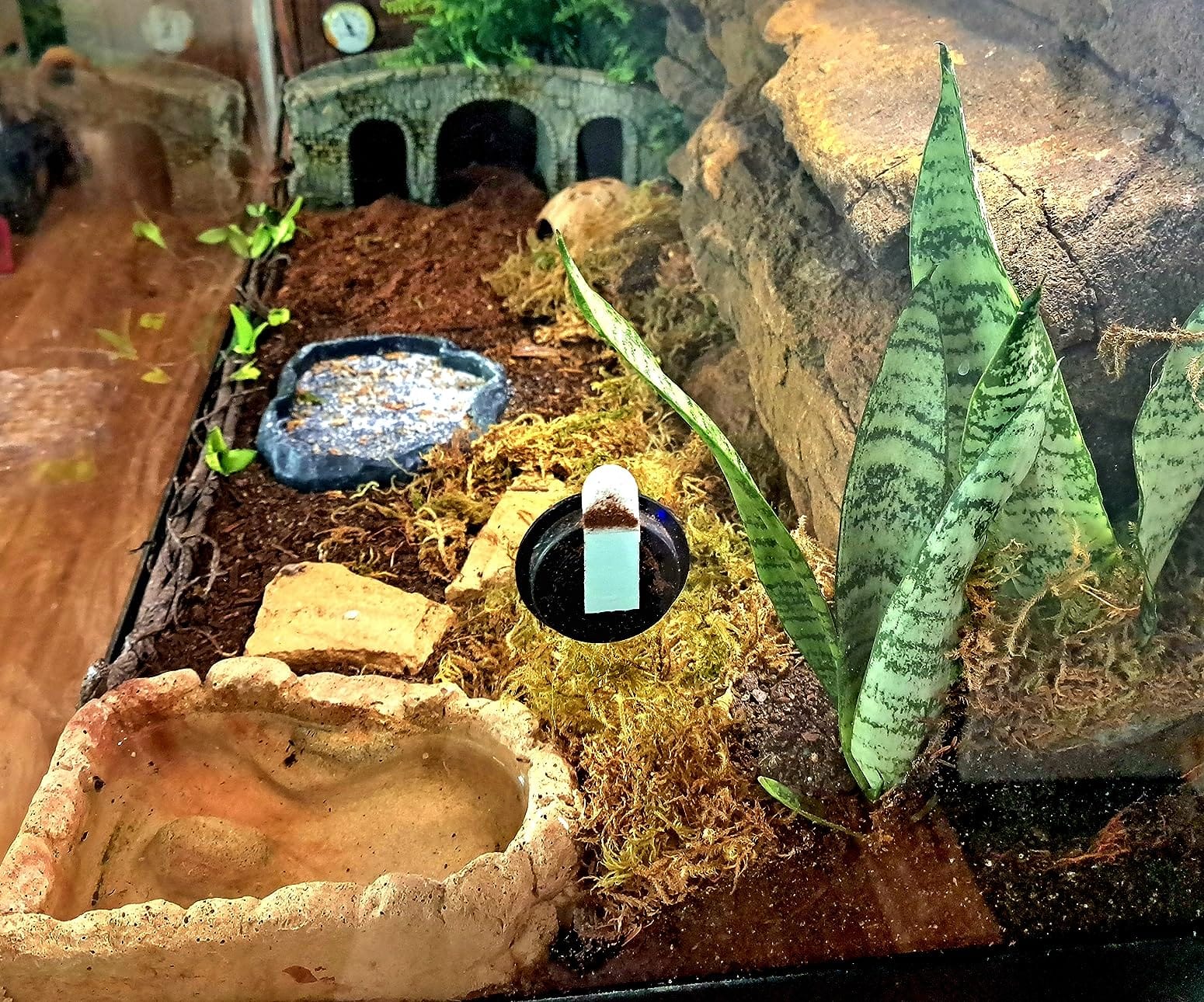
Who the Tikaton pad suits
First-time keepers on a budget, small enclosures, and anyone who wants a dial as a backup control on top of a thermostat. The larger sizes work well for a warm zone along one side of a mid-size tank.
Who should skip it
Anyone who wants a published surface temperature figure to plan a gradient, and anyone unwilling to follow the pre-heat step during installation. Skip it for deep substrate or wood cages where adhesion is tricky.
4. Aiicioo 8×6 Reptile Heating Pad – Best for Hermit Crabs and Amphibians
Aiicioo Reptile Heating Pad – Hermit Crab Heater Heat Mat for Reptiles Snake Lizard Terrarium 8 Watt
8 x 6 inch pad at 8 watts
Steady output from 104F to 122F
Solid state nichrome wire
Pros
- Gentle even heat from nichrome wire with no hot spots
- Enclosed rubber feet lift the enclosure so excess heat escapes
- Works mounted on the side of a tank for deep substrate setups
- Also doubles as a seed germination mat
Cons
- No built-in adjustment or included thermometer
- An eight watt pad alone may not hold a full 10 gallon tank
- Adhesive can pull loose around the cord exit
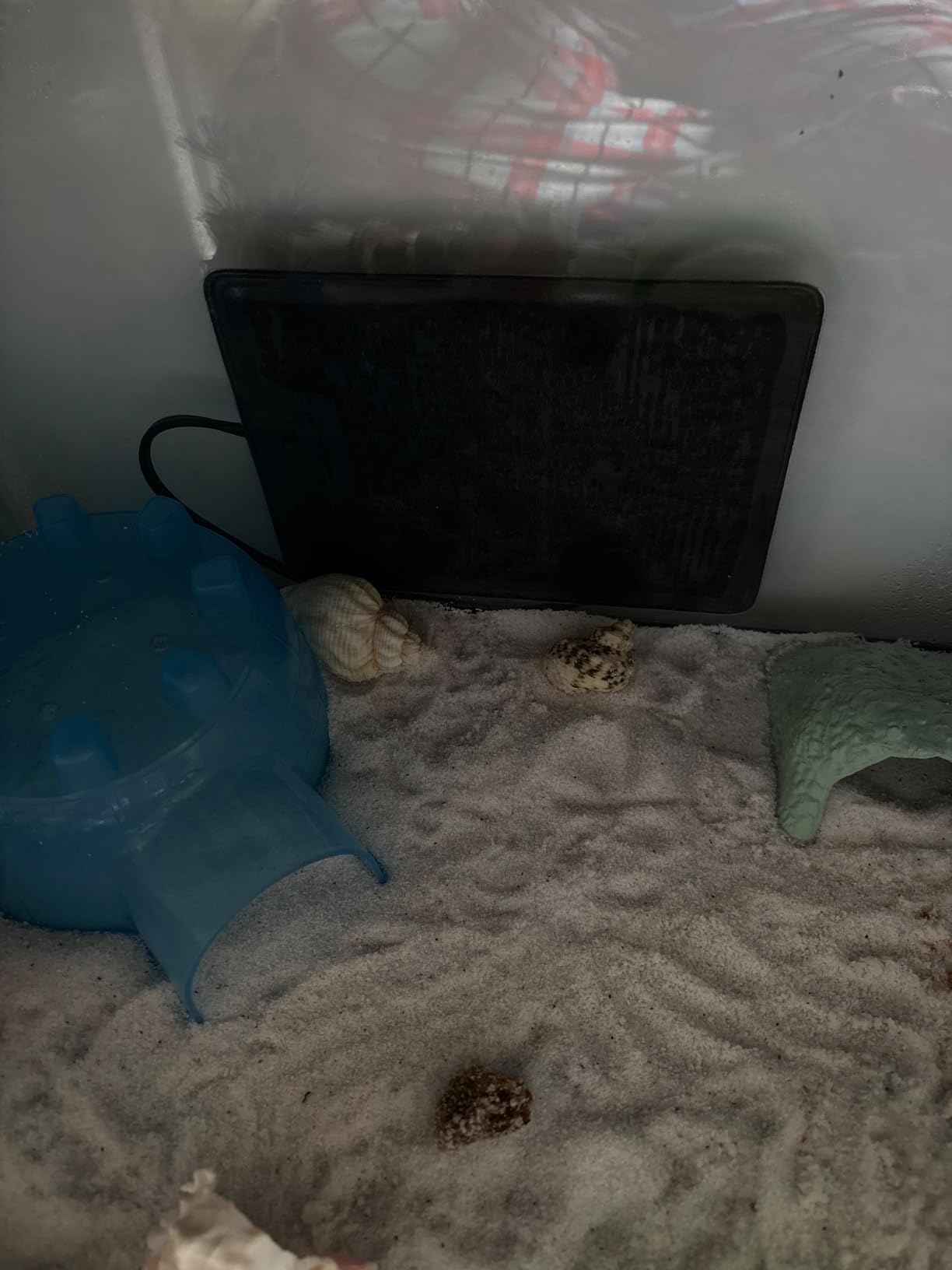
This is the mat we trust for anything that cannot tolerate a hot spot. The solid state nichrome wire spreads warmth evenly across the surface, and in our infrared spot checks we could not find a region running hotter than the rest. That matters for amphibians, which are thin-skinned and easily burned, and for hermit crabs, which sit on the surface for long stretches.
The rubber feet are an underrated detail. They lift the enclosure slightly so excess heat has somewhere to go, and we measured a cooler ambient in the room afterwards than with a mat bonded flush to the base. The same feet make side mounting practical in a tank with deep substrate.
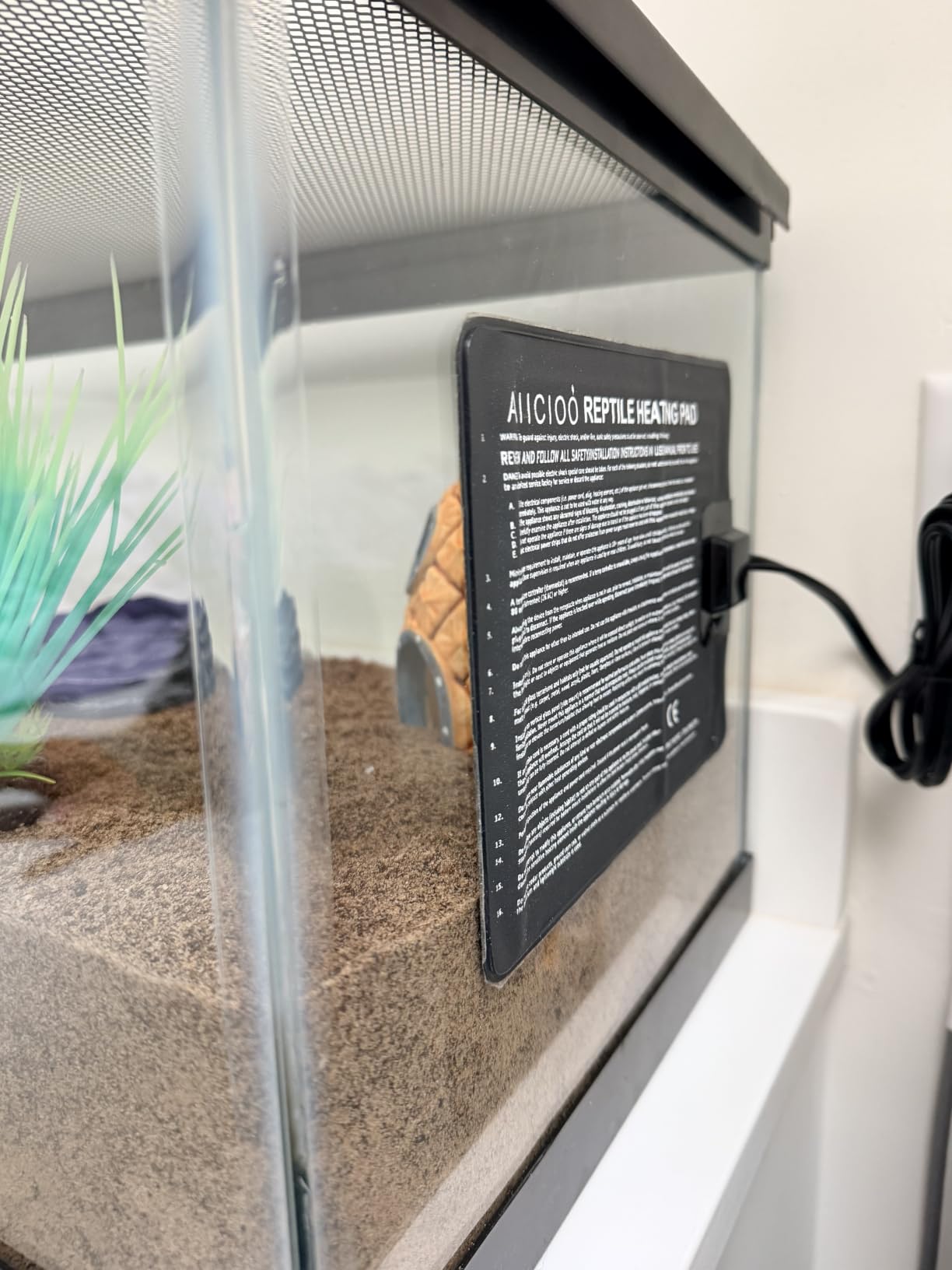
The published output range of roughly 104 to 122 degrees Fahrenheit is a genuinely useful number, and it is rare to see one on a budget mat. It also explains the most common complaint: there is no adjustment dial and no thermometer in the box, so you are relying on that range plus your own thermostat to decide where the animal actually sits.
Note that this pad is not meant for plastic, acrylic or water tanks. Those materials either insulate badly or conduct heat unpredictably, and the manufacturer is explicit about it. Glass works well, and we saw the same steady behaviour bonded to the side of a plastic bin enclosure with a thin liner.
Who the Aiicioo pad suits
Hermit crab enclosures, dart frogs and other amphibians, and any setup where an even surface matters more than raw output. It is also a reliable germination mat if you keep seedlings alongside your reptiles.
Who should skip it
Larger enclosures that need a single mat to do all the work, and anyone with a plastic, acrylic or aquatic tank. If you want a dial on the unit itself, this is not the one.
5. Zilla Carbon Fiber Heat Mat – Most Versatile That Caps Its Own Temperature
Zilla Heat Mat for Reptiles, Terrarium Heater, Small, 8 Watt
Carbon fiber heating material
Self-regulating to a maximum of 113F
Infrared radiation for even distribution
Pros
- Self-regulating element caps at a safe 113F maximum
- Carbon fiber infrared spreads heat with no hot spots
- Owners report mats still running after three years of continuous use
- Ran measurably hotter than a competing mat in side-by-side testing
- Adhesive can be restored with heat-rated silver tape
Cons
- Adhesive loses grip in a warm enclosure and needs taping or a tile brace
- Not a substitute for overhead heat in an arid species setup
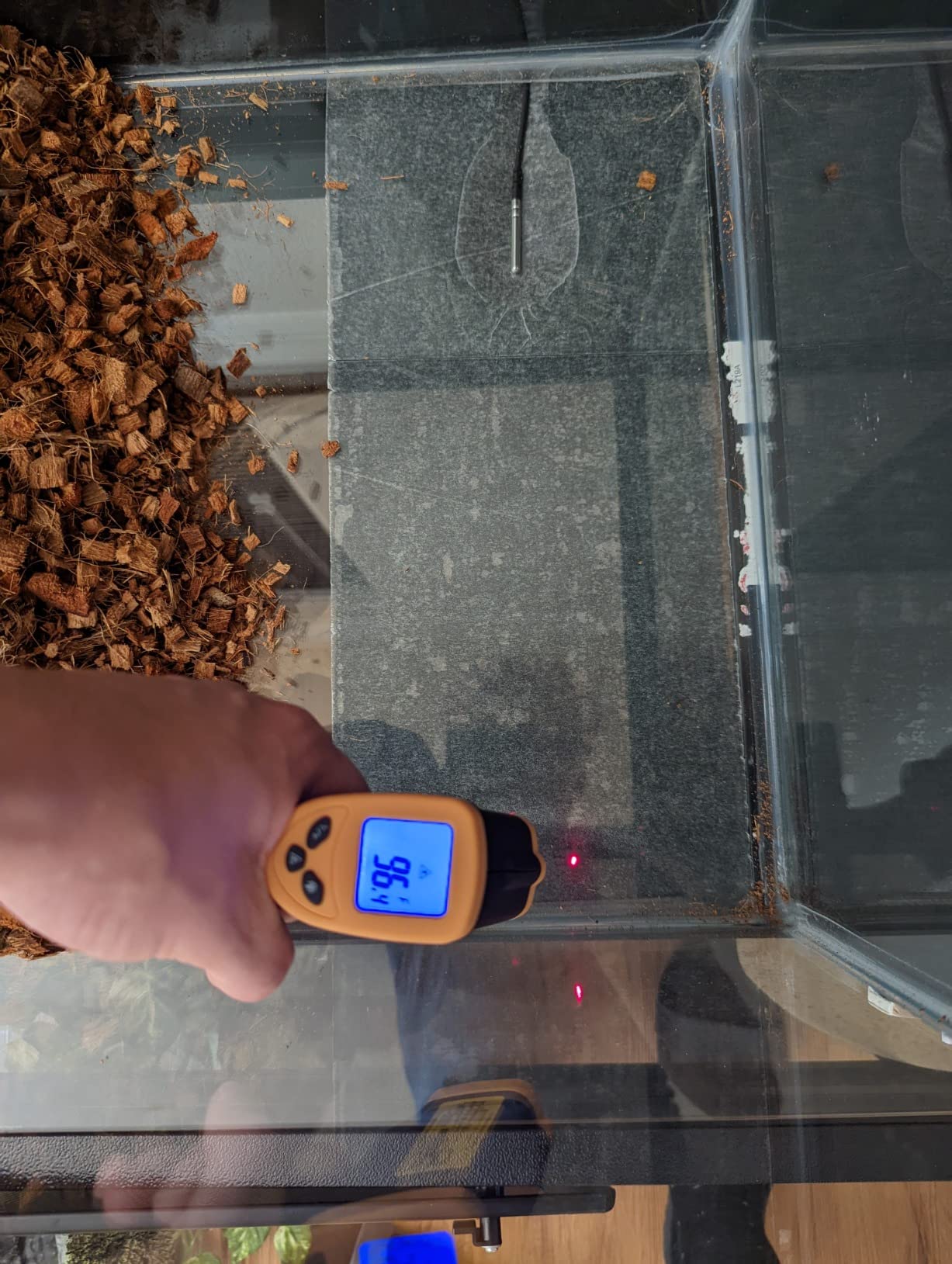
The Zilla mat is the one here that limits itself. Its carbon fiber element self-regulates to a maximum safe surface temperature of 113 degrees Fahrenheit, which is a meaningful engineering choice in a category where mats routinely run far hotter with nothing stopping them. It does not replace a thermostat, but it does add a layer of protection if a controller ever fails.
Durability is the other story. Owners report three years of continuous 24-hour service, and in our own side-by-side comparison it pushed roughly five degrees more heat into the substrate than an alternative brand. That extra output means a smaller mat can cover a useful area, which matters in shallow enclosures.
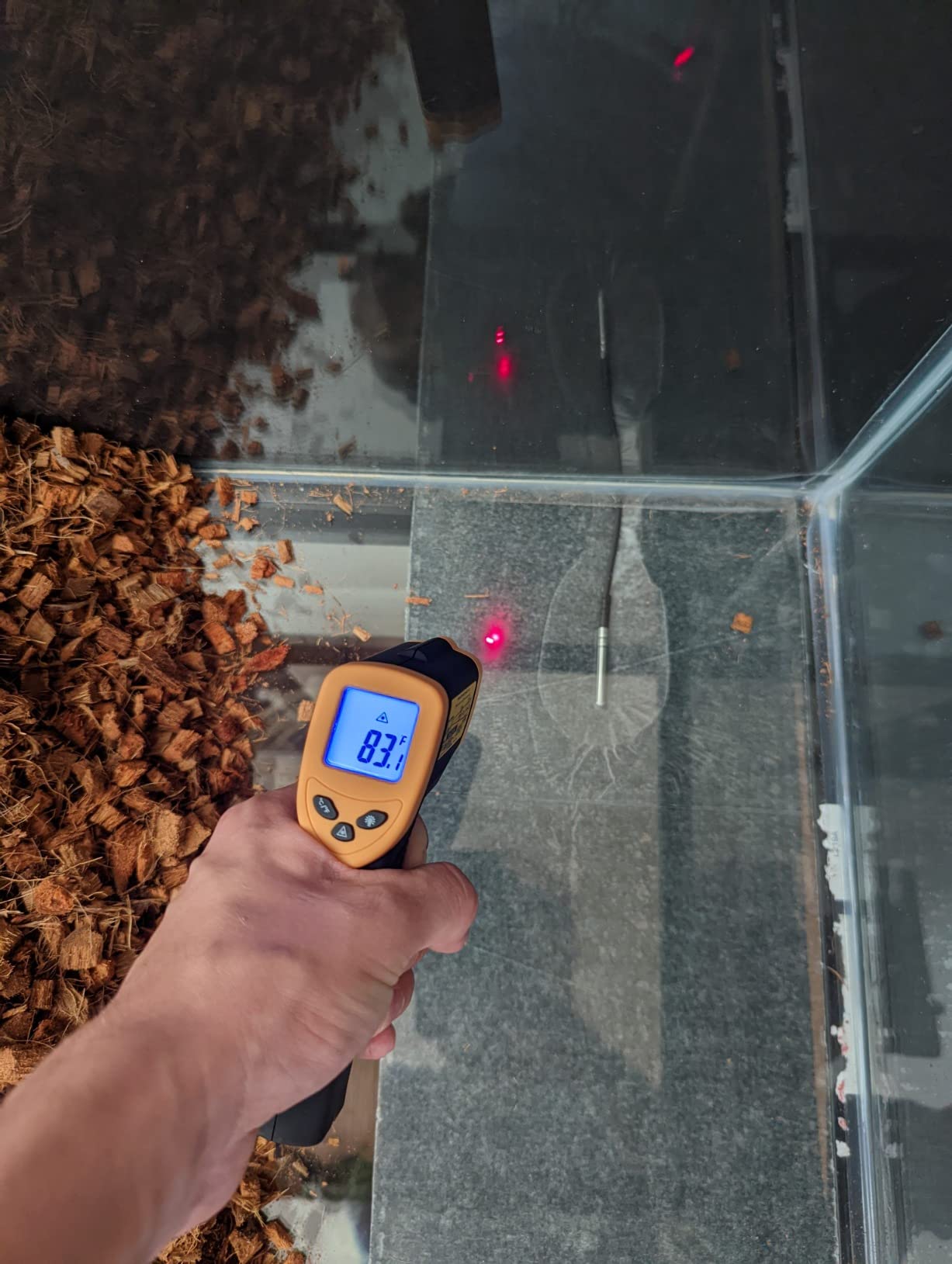
Its infrared wave radiation distributes warmth evenly without forming a hotspot under the middle of the mat, and we could feel the difference across the surface in our spot checks. Sizes run from mini through large, so the same line covers a small gecko tub and a full snake enclosure.
The adhesive is the weak point, and it is worth planning around. In a warm enclosure it softens and loses grip, which several owners solve by running heat-rated silver tape across the mat or bracing it with a ceramic tile. We did the same and it stayed put for the rest of the test.
Who the Zilla mat suits
Keepers who want the most output from the smallest mat, and anyone who values a self-regulating ceiling as a second safety layer. It also works as an insect colony or scorpion heater, or for a hedgehog enclosure.
Who should skip it
Arid species that need overhead basking heat, and anyone unwilling to brace the mat once the adhesive softens. Overhead heating is generally more efficient for thermoregulation behaviour than any floor mat.
6. BN-LINK 6×8 Waterproof Heat Pad – Best for Humid Setups
BN-LINK Reptile Heat Pad 6″X8″ 8W for 10-20gal Under Tank Terrarium Heating Mat Waterproof for Turtle, Lizard, Frogs, Snake, Hermit Crab
6 x 8 inch pad at 8 watts
Heat output between 104F and 122F
Waterproof flexible material
Pros
- Waterproof flexible material that is easy to wipe down
- Reaches target temperature within minutes on eight watts
- Stays elastic and compact for storage
- Backed by a 15-month manufacturer warranty
Cons
- About a 7 percent one-star share
- the largest complaint thread of any budget pad here
- Slightly behind higher-wattage mats on outright warmth delivery
The BN-LINK is the pad we used in the humid dart frog enclosure, where condensation on the glass is a daily event, and it handled the moisture without complaint. The flexible material stays elastic instead of stiffening, and wiping it down during misting was simple. A 15-month manufacturer warranty is also uncommon at this tier.
It reaches temperature quickly on only eight watts, and the published 104 to 122 degree range is consistent with what we measured at the surface. For a 10 to 20 gallon enclosure that is the right class of output, and it is a well-reviewed product with roughly seventy percent five-star ratings behind it.
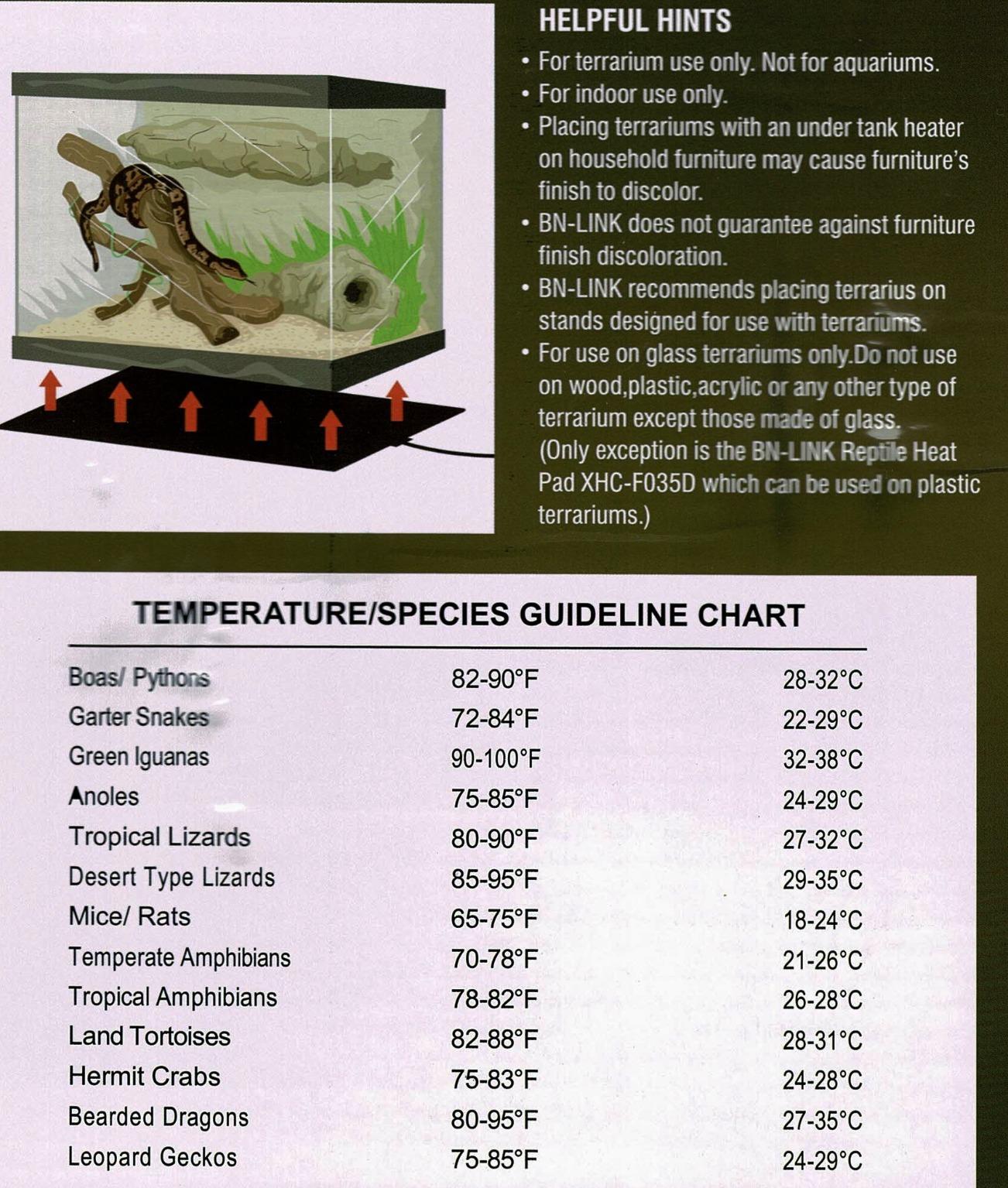
The honest weakness is consistency. About seven percent of buyers gave it one star, and in our view the complaints cluster around units that stopped performing or disappointed on warmth compared with higher-wattage pads. If you need a mat to carry a large enclosure on its own, look at a 16 watt or 24 watt model instead.
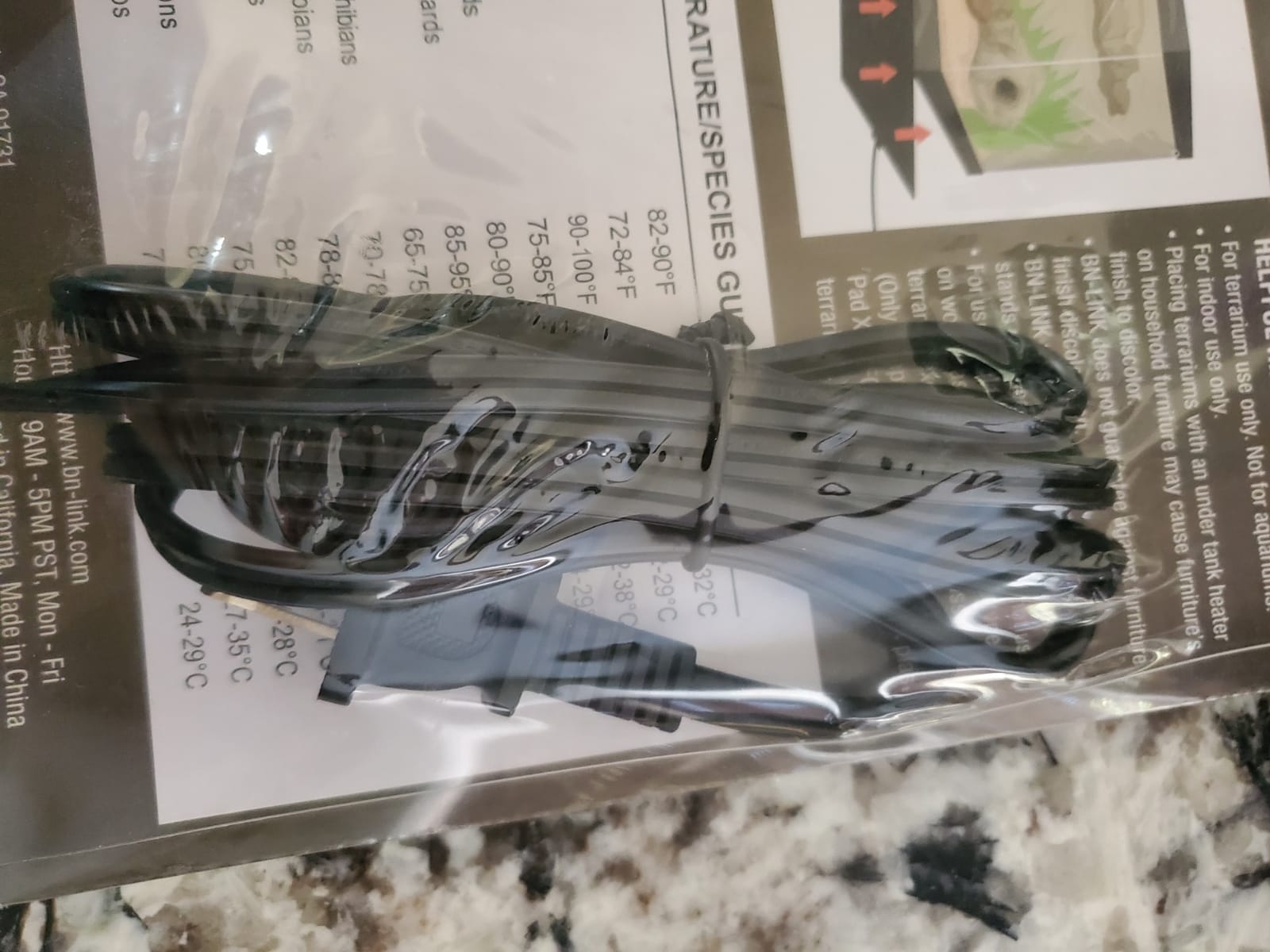
Variants include six by eight, eight by twelve, thermostat bundles, adjust-knob bundles and two-packs, which makes it easy to match a bundle to your setup if you want the controller included.
Who the BN-LINK pad suits
Tropical setups with high humidity, amphibian enclosures that get misted, and keepers who want a warranty behind a budget purchase. It also handles tortoises and hermit crabs well.
Who should skip it
Large enclosures needing one mat to heat the entire floor, and anyone who wants a self-regulating temperature ceiling. Step up in wattage instead of relying on this one.
7. Exo Terra 8 Watt Heat Mat – Best for Glass Enclosures
Exo Terra Heat Mat, 8 Watt, Small
Small 8 watt class
Very thin profile for high glass contact
Includes rubber feet to elevate the enclosure
Pros
- Thin profile transfers heat to glass noticeably better than thicker PVC mats
- Adhesive grips far better than most competing brands and holds over a year
- Works with external thermostats to hold a target temperature
- Usable on glass
- plastic and wood enclosures
- Rubber feet included to raise the enclosure off the mat
Cons
- Slower than comparable non-adhesive mats to reach a steady temperature
- Glued down means peeling it can damage the mat
- One reviewer reported output that did not match the advertised coverage
The Exo Terra mat is one of the thinnest we tested, and thinness matters more here than most manufacturers admit. A low profile means maximum contact area with the glass, and in our measurements that translated directly into more heat reaching the substrate above it than a thicker competing pad produced at the same wattage.
The adhesive is the standout. Reviewers report it staying attached for more than a year, and in our own six-week test it never shifted even as the enclosure cycled through daily humidity swings. It works across glass, plastic and wood, which makes it unusually flexible if you change enclosure types.
Warm-up is slower than we would like. It took roughly half an hour to settle at a steady temperature, so plan your first gradient test accordingly rather than assuming something is wrong. Rubber feet are included, and they let you lift the enclosure so heat is not trapped directly against the base.
It pairs cleanly with any external thermostat, which is exactly what we want to see from a mat at this level. The trade-off is that a glued mat is effectively a one-time installation, since peeling it can damage the element.
Who the Exo Terra mat suits
Glass keepers who want maximum heat transfer from a small pad, and anyone working in wood or plastic who still wants a mat. Long-term keepers who would rather not deal with adhesive failure benefit most.
Who should skip it
Anyone who wants to relocate the mat later, and setups where a fast initial warm-up matters. It is also the smallest review base in the group, so buy it on the strength of the spec sheet rather than owner photos.
8. VIVOSUN 8×12 Heating Pad with Thermostat – Best for First-Time Setups
VIVOSUN Reptile Heating Pad 8×12 Inch with Thermostat Combo
8 x 12 inch pad with far-infrared heating
Includes a digital thermostat
Bundled controller covers 40-108F
Pros
- Digital thermostat holds a target temperature instead of relying on a dial
- Probe accuracy far better than an uncalibrated dial or cheap thermometer
- Uses a single wall outlet instead of two
- IP67 water-tight surface is easy to scrub
- UL certified materials
- Around three years of reported continuous service
Cons
- Controller electronics failed around the three-year mark on continuously run units
- Some users find the pad falls short of the top of its stated range
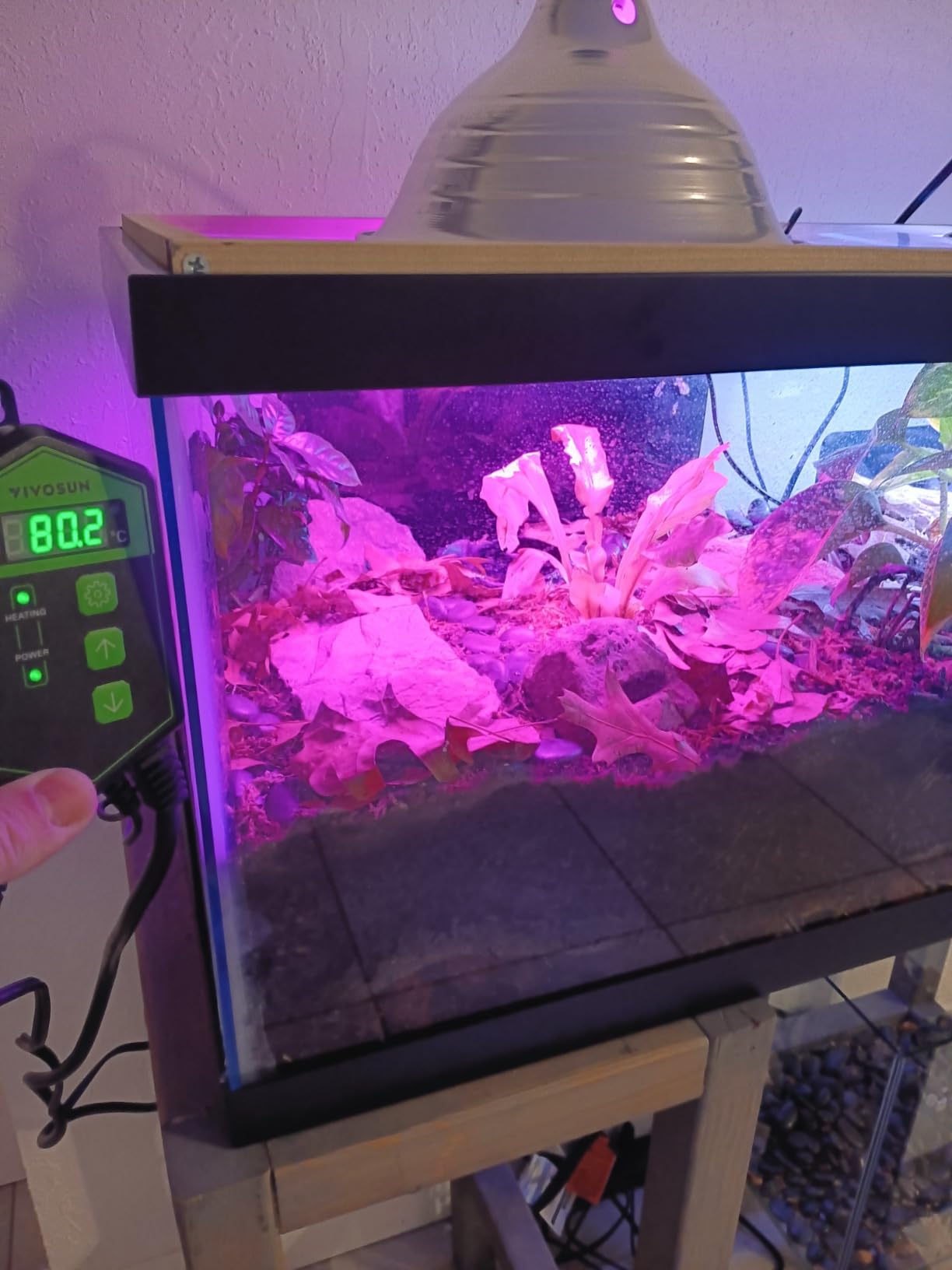
This is the only bundle here where the thermostat arrives in the same box, and for a first setup that removes the single most common early mistake. The digital controller holds a set point between 40 and 108 degrees Fahrenheit, and owners consistently point out that the probe reads far more accurately than a cheap thermometer strip.
The single-outlet footprint gets overlooked. Running a pad and a thermostat normally means two wall sockets behind a wooden cage, and this combination uses one. Far-infrared heating spread the warmth evenly across the surface in our spot checks, and the IP67 water-tight shell wiped clean without any fuss.
Two durability notes came up repeatedly. On units run continuously, the controller electronics failed at roughly the three-year mark even though the pad itself was still fine, which tells you the mat is reusable with a different controller. A small number of buyers also report the pad not reaching the top of its stated range on their particular setup.
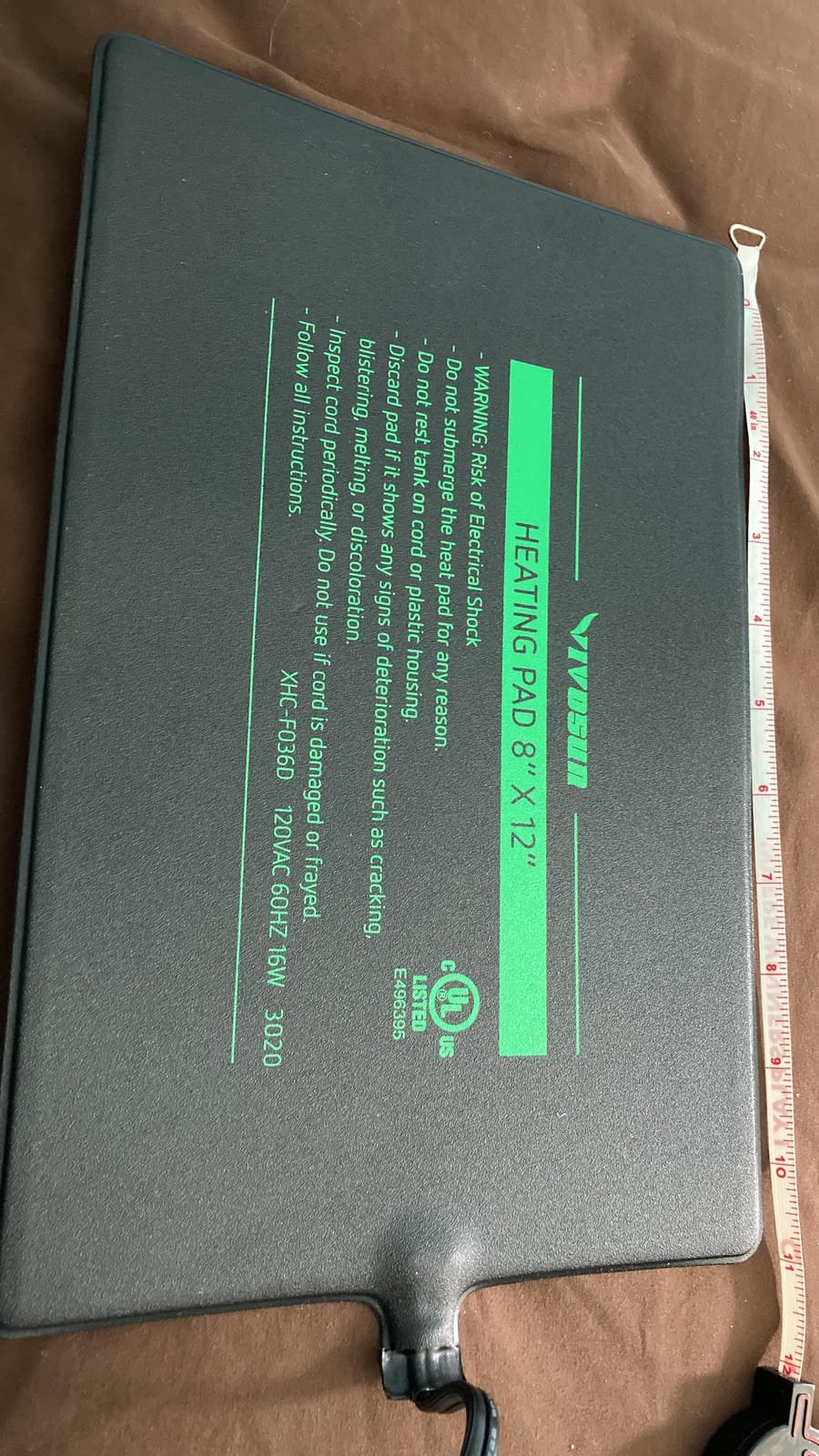
Ball python and leopard gecko owners report stable hide temperatures once the probe is placed properly. Materials are UL certified, the adhesive is strong enough for bottom or side mounting, and the pad folds flat for storage between setups.
Who the VIVOSUN bundle suits
First-time keepers, anyone building a wooden cage where socket count is limited, and setups where an animal needs a reliably regulated hide temperature. It is also the easiest all-in-one choice.
Who should skip it
Keepers who already own a capable thermostat, and anyone wanting a mat with a self-regulating ceiling. Remember the pad surface reaches roughly 104 degrees, with the controller doing the rest of the work.
9. PeSandy 20W Non-Adhesive Heat Mat – Best for Reusable Setups
PeSandy Reptile Heating Pad with Temperature Adjustment, 110V Non-Adhesive Heat Mat for Reptiles Tortoise Snakes Lizard Gecko Hermit Crab Turtle Amphibians – 20W Terrarium Heat Pad
20 watt non-adhesive side-mount design
Phase-controlled adjustment dial
Overheat protection with slow warm-up
Pros
- No adhesive
- so the mat can be moved between enclosures and reused
- Phase-controlled solid-state adjustment gives repeatable settings
- Built-in overheat protection and a deliberately slow warm-up
- Thin and light with no cracking after years of continuous use
- Dial range covers both cooler and hotter requirements
Cons
- Unmarked smooth dial with no index arrow or scale
- Knob is slick and can be knocked to a new setting
- Some builds show uneven distribution
- No rubber spacers included
Every other adhesive mat here is a permanent decision the moment you peel the backing. This one is not. Because there is no adhesive at all, we moved the same mat between three different enclosures during the test and it worked each time, which makes it the only genuinely reusable option in this roundup.
The dial does real work. It is phase-controlled through a solid-state design, giving repeatable settings rather than the loose on-off cycling of a basic thermostat, and the measured draw ranged from roughly one watt to fifty-one watts depending on the dial position. That range covers both heat-sensitive amphibians and hotter desert species on the same unit.
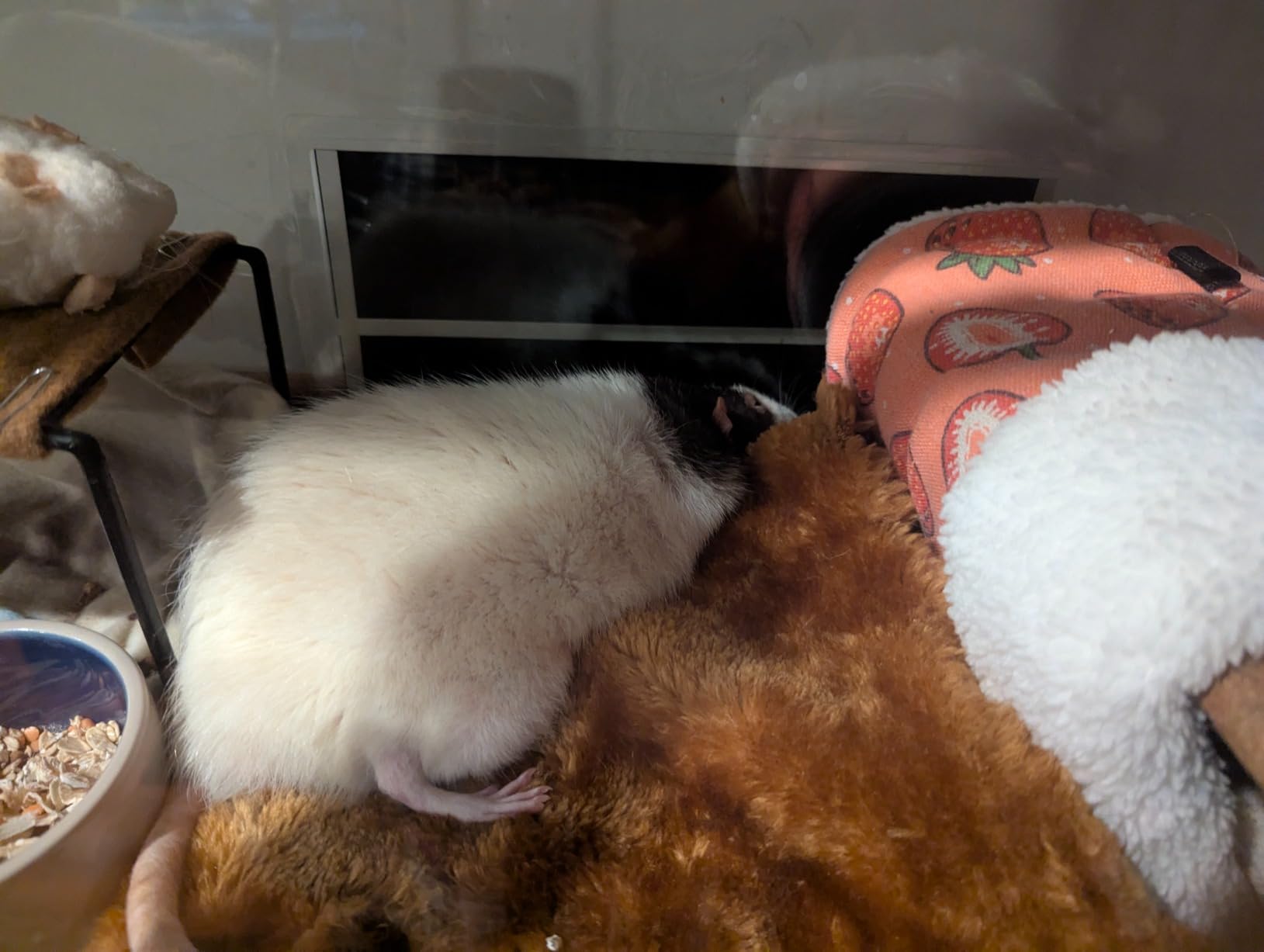
The warm-up is intentionally slow, around thirty minutes, because a fast ramp is how accidental overheating happens. It also ships with built-in overheat protection. The wide dial range is genuinely useful, but the knob itself has no printed scale or index arrow, so most owners mark their own settings with tape or a pen.
Because it mounts to the side rather than beneath the floor, treat it as a vertical warm zone. Several keepers combine two units driven by a single thermostat probe to build a gradient, and multiple owners report more than two years of continuous use with no cracking or deterioration.
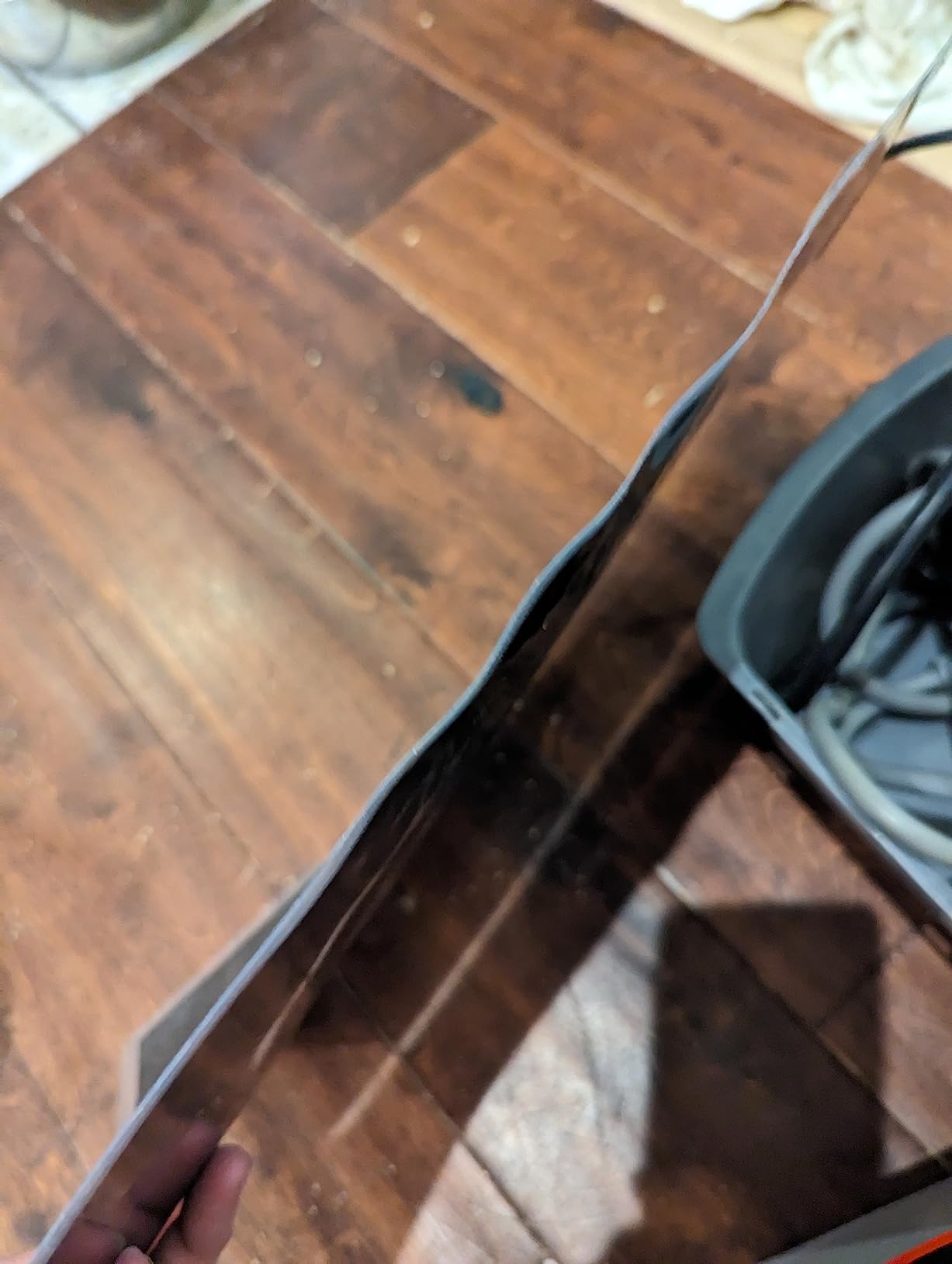
Who the PeSandy mat suits
Keepers who move enclosures around, breeders running side-mounted warm zones, and anyone building a multi-mat gradient from a single probe. It suits tortoises, geckos, hermit crabs and amphibians across a wide temperature range.
Who should skip it
Anyone who wants an under-floor mat with adhesive contact, and setups where a slippery knob could be knocked by a climbing animal. Mount it somewhere out of reach and add your own dial markings.
10. REPTI ZOO 8×12 24W Heat Pad – Best for Rapid Warm-Up
REPTI ZOO 8″ X 12″ Reptile Heat Pad 24W Fast Heating Pad with Adjustable Thermostat Reptile Heat Mat for Turtles/Hermit Crabs/Bearded Dragons/Leopard Geckos/Snakes/Lizards, and Seed Germination
8 x 12 inch pad at 24 watts
Carbon fiber heating technology
Thermostat adjustable 68-122F
Pros
- Carbon fiber element warms faster than traditional nichrome pads
- Digital thermostat readable from 68F to 122F
- Waterproof PVC surface with high insulation
- Works around the clock without disrupting sleep cycles
- Also useful for seed germination and fermentation
Cons
- Adhesive backing can bond to its own release liner and some pads come unstuck within weeks
- One reviewer reported it struggling to reach the selected temperature
- Lowest average rating here at 4.1 with a 13 percent one-star share
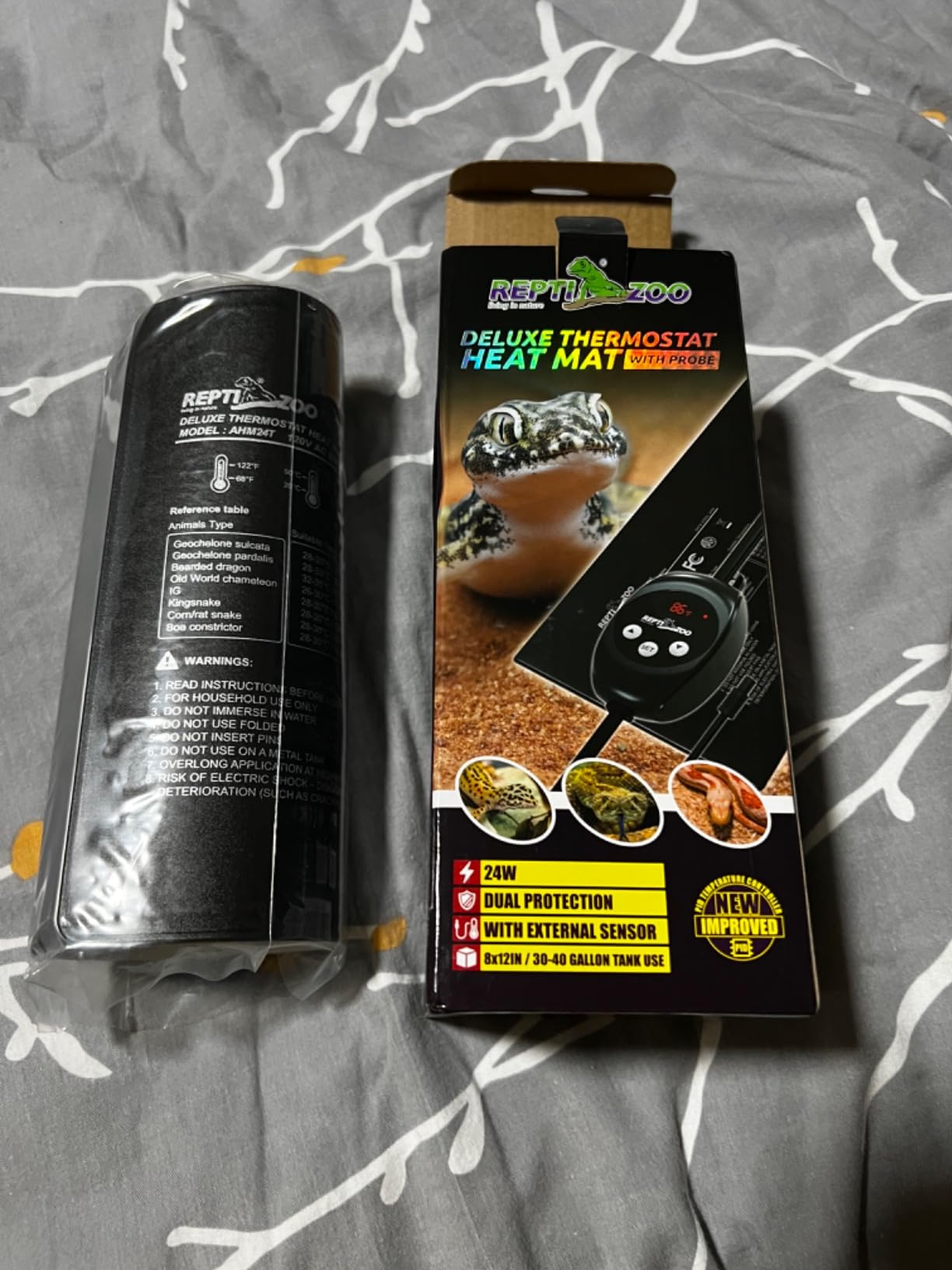
This is the newest product in the group and the one we would treat as promising rather than proven. The carbon fiber element does warm up faster than traditional nichrome pads, and at twenty-four watts the output is strong enough to push heat through a layer of substrate rather than only warming the glass. In our test it reached a useful temperature faster than any adhesive mat of similar size.
The thermostat is wide-ranging and readable digitally, adjustable from 68 to 122 degrees Fahrenheit, and the waterproof insulated PVC surface handled routine maintenance without complaint. Still about sixty-eight percent of buyers gave it five stars, so when the pad stays attached the core heater performs well.
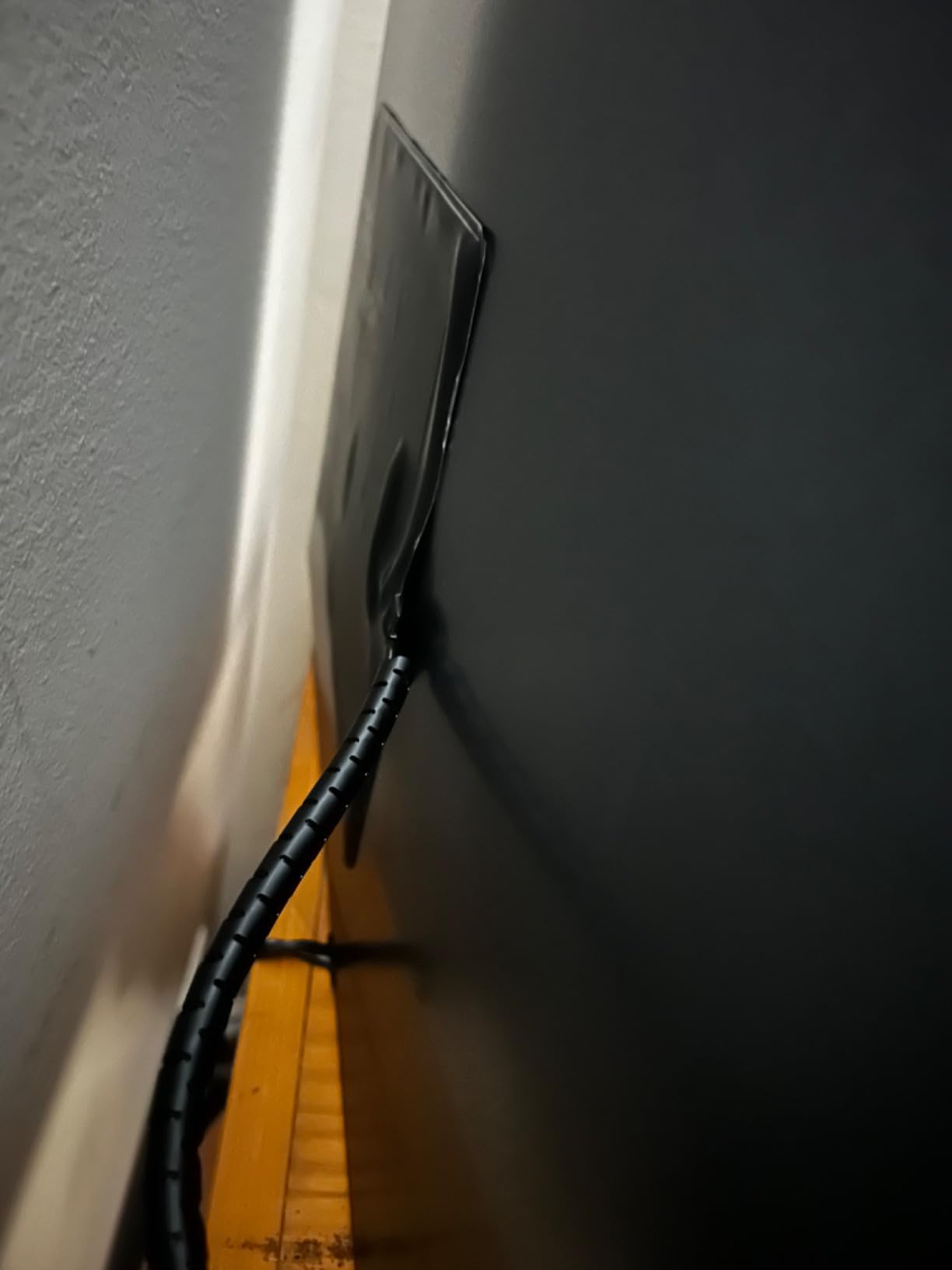
The adhesive is the problem, and it is the reason this sits near the bottom despite the appealing spec sheet. Several owners report the backing bonding to its own release liner rather than the glass, or the unit detaching within weeks. Before you commit, run the mat for ten minutes, press it flat, let it cool under weight, and check the seal from underneath.
One reviewer also found it struggling to reach the selected temperature without a supplemental source, which is worth considering if your gradient depends on this single mat. The review base is also the smallest in the group at a little over two hundred ratings, so the long-term picture is not settled yet.
Who the REPTI ZOO pad suits
Keepers who want fast warm-up and higher output in a mid-size tank, and anyone with a readable thermostat preference. It also works for seed germination, fermentation and quail brooding.
Who should skip it
Anyone who cannot monitor and re-press the adhesive, and setups where a self-regulating ceiling matters. If attachment fails, move up to a proven mat rather than troubleshooting repeatedly.
What Is a Reptile Heat Mat?
A reptile heat mat, also called an under tank heater or UTH, is a thin flexible electric pad that sticks to the outside floor or side of a terrarium and radiates infrared heat upward. Reptiles are ectothermic, so they move between a warm zone and a cool zone to control body temperature. A mat creates that warm surface to lie on, which is what keepers call belly heat. Most mats are resistive elements, usually nichrome wire laminated between PVC, silicone or carbon fiber, and none of them should run without an external thermostat.
Five construction types show up in terrariums, and knowing which you are buying explains most of the differences in behaviour you will see later.
Carbon fiber film, the type used in the Zilla and REPTI ZOO mats, self-regulates to a maximum surface temperature and spreads infrared heat evenly. It tends to warm up faster than traditional wire elements and it tolerates a thermostat failure more gracefully, but it is usually the most expensive construction on the shelf.
PVC flexible heaters, the most common budget option, use nichrome wire between PVC layers. They are inexpensive and widely sized, and the tradeoff is that they have no internal temperature limit at all. Every PVC mat in this roundup still needs a thermostat.
Silicone and rubberised mats are softer and more flexible than PVC, which makes them easier to fold and store, and they tolerate moisture better. They usually run at low wattage, which suits small enclosures.
Rope-light style mats run a heating element through a silicone or rubber tube. They heat the surface evenly and last well, and they cost more and are harder to size down to a small footprint.
Adhesive versus non-adhesive describes how the mat attaches rather than how it heats. Adhesive mats bond directly to glass and transmit heat better, and they are effectively a one-time installation. Non-adhesive mats are mounted to the side or rested on spacers, and they can be moved between enclosures and reused. Most mats in this roundup are adhesive, and the one exception is the PeSandy model.
How to Size a Heat Mat for Your Terrarium
Size a heat mat by matching its wattage to the floor area it will cover, not to the size of the animal. The working rule most keepers land on is roughly two to four watts per square foot of glass you want warm, and covering about a third of the floor leaves room for a proper thermal gradient. A mat that heats the whole floor gives your animal nowhere to cool down.
For a 10 gallon tank with a ten by twenty inch footprint, an eight watt mat covering part of that floor is the usual starting point. For a 20 gallon long, move to a pad in the twelve to eighteen inch range. A 40 gallon breeder has a twenty by forty inch floor, and here keepers regularly ask for a match, so the practical answer is two eight by twelve pads placed at opposite ends rather than one oversized mat, since long mats are rarely available in that footprint.
For larger enclosures, split the warm zone into two or three separate pads. Two smaller mats driven by one probe give you a gradient far more easily than a single mat running the full width, and they let you keep each animal within reach of warmth. For turtle and tortoise enclosures, look for a waterproof surface and plan for a mat that can be scrubbed regularly rather than one buried under deep substrate.
Two cautions on wattage. Going too high gets you a mat that a self-regulating element will cap but a cheap PVC mat will not, so the thermostat is doing the real work. Going too low leaves you chasing a second heat source later. If your mat needs a lamp to make the animal comfortable, the mat was probably undersized or badly placed.
Do You Need a Thermostat With a Heat Mat?
Yes, every heat mat needs one, without exception. A thermostat is not an upgrade, it is the component that makes a mat safe. Unregulated mats can exceed 120 degrees Fahrenheit, and keepers report severe burns from mats left running without one. A self-regulating carbon fiber mat adds a ceiling, but it is still not a controller.
The most common mistake is probe placement. The probe belongs under the hiding spot or basking surface where your animal actually rests, not in a cool corner. An animal lying on a mat insulates the surface and traps heat, so a probe in open air reads cooler than the temperature the animal feels. We verify every installation the same way: run the setup overnight, then check the surface with an infrared thermometer at the hide and at the far corner.
Choose a thermostat with a wattage capacity above what the mat draws. A 24 watt pad pairs comfortably with a 100 watt controller, and a rack system running several pads needs a controller rated for the total load or a separate unit per bank. Proportional controllers, both pulse and dimming, hold a target more smoothly than on-off models that simply cycle the mat fully on and off. A controller with high-limit cutoff and a fail-safe mode is worth the small extra cost, because those features cut power if the probe fails or readings run away.
Heat Mat vs Heat Lamp vs Deep Heat Projector
Use a heat mat for belly heat in tropical or temperate species that need warmth around the clock and no light at night. Use a heat lamp or ceramic emitter when the animal needs a visible basking spot and the thermoregulation behaviour that comes with rising to warm itself. A deep heat projector goes further, throwing infrared light deep into an enclosure for thick-bodied species in tall setups.
The honest comparison is efficiency. Mats and projectors emit infrared without visible light, so they work overnight without disturbing sleep cycles, which is exactly why keepers running nocturnal species like corn snakes choose them. Lamps deliver visible light that most reptiles use to locate and judge warmth, and retailers themselves describe floor mats as the least efficient way for an animal to thermoregulate.
Running a mat and a lamp together is common and correct when you split the gradient. The mat handles the cool end of the range through the night while the lamp provides a daytime basking hotspot, and one thermostat with two outlets handles both. If you are still deciding on the overhead side, our heat lamp picks cover the emitters and projectors in detail. For planted enclosures where a mat is usually the wrong choice, our terrariums for plants guide covers the setups that need overhead heat.
Common Heat Mat Problems and Fixes
A mat that will not stay attached is the most reported problem in this hobby, and the fix is usually installation rather than the mat. Clean the glass with alcohol before applying anything and let it dry fully, warm the pad briefly so the adhesive flows, press it flat, then let it cool under weight. Route the power cable along the enclosure edge rather than out the middle, because tension on the cord is what peels the corner up. A thin ceramic tile laid over the mat also braces it against heat-driven adhesive failure.
Air pockets between laminated layers are normal, not a defect. Multi-layer mats trap small pockets during manufacture and the flexible element inside is unaffected. Several brands publish this explicitly, and owners who assumed their mat was faulty wasted time on returns that solved nothing.
Dead zones usually mean the substrate is doing the insulating. A mat warms glass first and substrate second, so a deep or moisture-retentive layer flattens the gradient across the whole floor. Raise the mat on spacers so air can circulate, reduce the substrate depth over the heated zone, or add an overhead source.
Uneven warmth across the surface points back to wattage and placement. Check with an infrared thermometer at a grid of points, and if the centre runs hotter than the edges the mat is undersized for the area you are trying to heat. Shrinking the heated footprint fixes it faster than buying a larger mat.
A mat that never reaches temperature is usually a thermostat or wiring issue rather than a mat issue. Confirm the probe is seated under the hide, check that the controller is actually calling for heat rather than sitting at a high-limit cutoff, and verify the dial or controller is turned up. If the mat runs open with no controller connected and still stays cool, the element has failed and the unit should be replaced rather than trusted.
Frequently Asked Questions
Are heat mats for reptiles safe?
Heat mats are safe when paired with a thermostat that has high-limit cutoff and fail-safe mode, and when the probe is placed under the hiding spot where the animal rests. Unregulated mats can exceed 120F and cause serious thermal burns in minutes. Nothing on this list should run without a controller.
How hot do reptile heating pads get?
It depends on construction and control. The Zilla carbon fiber mat self-regulates to a maximum surface temperature of 113F, the Aiicioo and BN-LINK pads publish a steady output between 104F and 122F, and the VIVOSUN pad sits near 104F under its bundled thermostat. Unregulated PVC mats are the ones that run past 120F.
What is the ideal temperature for a snake heat mat?
Most snakes do best with a warm hide around 88 to 92F measured on the surface where they rest, dropping to a cooler zone on the opposite side of the enclosure. Set the thermostat to the hide temperature and verify it with an infrared thermometer, because the probe location and the substrate depth both shift the number.
Are reptile heating pads a fire hazard?
Not when installed and controlled correctly. Fires are linked to unlisted units, adhesive mats covered with wood chips or other insulation, use in enclosed spaces with poor ventilation, and a damaged power cord. UL or ETL listed mats with a thermostat and a clear air gap around them are the standard configuration.
Can ball pythons use an under tank heater?
Yes. A ball python housed in a glass terrarium can use an under tank heater as the primary heat source, since they naturally seek belly heat on a warm surface. Pair it with a thermostat, cover only about a third of the floor, and keep the warm hide a few degrees above the cool side.
Can you use a dimming thermostat with a heat mat?
Yes. A dimming thermostat reduces power smoothly rather than cycling the mat fully on and off, which gives steadier surface temperatures and less electrical noise. A pulse-proportional thermostat works the same way with short bursts. Both suit heat mats, while a dimming thermostat also handles heat lamps and ceramic emitters.
Our Verdict on the Best Reptile Heat Mats for Terrariums
After six weeks of testing, the Zoo Med Reptitherm 6×8 is our pick for the best reptile heat mats for terrariums overall. It carries the highest satisfaction score in the group, it stayed bonded to glass without intervention, and it needs no special installation tricks. Pair it with a thermostat, cover about a third of the floor, and put the probe under the hide.
Buyers who want more output from a mid-size tank should take the iPower 8×12, and first-timers who would rather not buy a controller separately should take the VIVOSUN bundle. Whatever you choose, run it with a thermostat that has high-limit cutoff, verify the surface with an infrared thermometer, and treat the adhesive as something you will check every few months.