
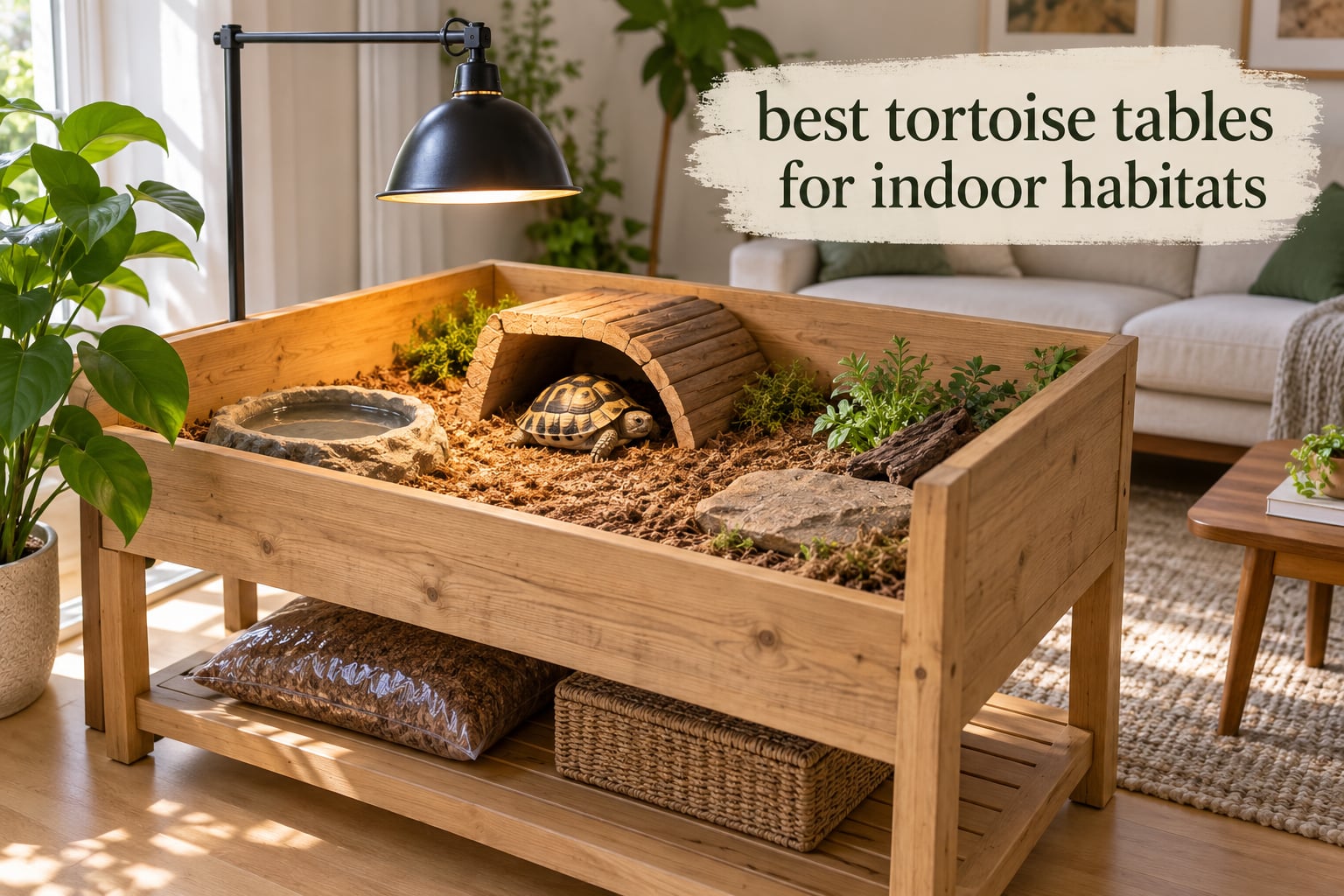
A tortoise table is a large, open-topped, low-walled wooden enclosure that gives an indoor tortoise floor space, airflow and a wide basking area instead of the cramped, glass-walled environment of a typical vivarium. Because the top is open, you can suspend heat and UVB lamps overhead and raise or lower them until one end of the floor holds about 30°C/86°F while the other sits near 20°C/68°F. That 10-15°C gradient is what lets a tortoise move between zones and regulate its own body temperature, and it is the single reason tables have become the default indoor setup in 2026.
That said, none of these tables replaces outdoor access. Tortoise Trust, the UK’s longest-running tortoise charity, is blunt about this: indoor accommodation cannot deliver the brightness, floor space or unfiltered sun that outdoor space provides, and their published lux measurements make the gap hard to argue with. What a good indoor table does well is give you a workable winter setup, a quarantine box, a recovery enclosure, and a plan for weeks of bad weather.
We spent several weeks going through the twelve most-reviewed wooden tables and habitats sold for indoor tortoises, comparing published dimensions, wall heights, lamp mounting, moisture management and the themes that keep showing up in owner reviews. Our picks below are the best tortoise tables for indoor habitats, sorted by what they actually do well rather than by marketing language. We have also flagged the honest limitation on each one, because the gap between a listing photo and the box that arrives is the biggest source of keeper frustration we found.
Top 3 Best Tortoise Tables for Indoor Habitats (October 2026)
Three tables stood out from the rest. The Aivituvin has the deepest review base in the group, the Zoo Med has the highest average rating and the longest production history, and the GEGURI gives you the biggest floor area per pound with a tray you can actually pull out. Here they are in one line each.

Every Pick at a Glance
All twelve tables, with the feature that separates each one from the rest. Interior floor measurements are rarely published, so treat the listed length and width as overall dimensions and subtract wall thickness before you plan your room.
| Product | Specifications | Action |
|---|---|---|
| Aivituvin Wooden Tortoise House |
|
Check Latest Price |
 Zoo Med Tortoise House Zoo Med Tortoise House |
|
Check Latest Price |
 GEGURI Detachable-Leg Habitat GEGURI Detachable-Leg Habitat |
|
Check Latest Price |
 Aivituvin Habitat with Storage Shelf Aivituvin Habitat with Storage Shelf |
|
Check Latest Price |
 Magazoopet Enclosure with Lamp Stand Magazoopet Enclosure with Lamp Stand |
|
Check Latest Price |
 PetsCosset Two-Room Habitat PetsCosset Two-Room Habitat |
|
Check Latest Price |
 PawHut Habitat with Shelf Storage PawHut Habitat with Shelf Storage |
|
Check Latest Price |
 ZENTAVO Three-Room Habitat ZENTAVO Three-Room Habitat |
|
Check Latest Price |
 VEVOR Cedar Habitat with Light Stand VEVOR Cedar Habitat with Light Stand |
|
Check Latest Price |
 PawHut 48 Inch Two-Hide Habitat PawHut 48 Inch Two-Hide Habitat |
|
Check Latest Price |
 PawHut Two-Layer Gray Habitat PawHut Two-Layer Gray Habitat |
|
Check Latest Price |
 BIRASIL Two-Tier Habitat with Pool BIRASIL Two-Tier Habitat with Pool |
|
Check Latest Price |
1. Aivituvin Wooden Tortoise House – The Most Proven Indoor Table
Aivituvin Wooden Tortoise House Large Tortoise Habitat Cage, Indoor Tortoises Enclosure for Small Animals, Outdoor Reptile Cage – Upgraded Weatherproof Bottom
Solid wood
Waterproof plastic bottom tray
Adjustable lamp holder
Two acrylic windows
Pros
- Solid wood resists rot in moist substrate
- Waterproof bottom tray contains substrate and wipes clean
- Adjustable lamp holder for UVB and burn control
- Separate sleeping and basking areas
- Acrylic windows on two sides for observation
Cons
- Compact footprint limits total roaming space
- Wire lid may not carry heavy fixture loads
This is the table we kept coming back to. It has been on sale since July 2019, it sits in the top 30 of Reptile Terrariums on Amazon, and 2,200 owners have left a 4.5 average behind it. That volume matters: with this many reviews, the praise stops being about how the box looks in a listing photo and starts being about what happens after six months of damp substrate.
The build is the reason. It is solid wood rather than plywood, which is the single most useful thing on the spec sheet for a tortoise habitat. Plywood delaminates when the bottom stays wet, and a table that swells and flakes is a table you will eventually replace. The waterproof plastic bottom tray runs fully around the base, so substrate stays where you put it and cleaning is a wipe rather than a scrub.
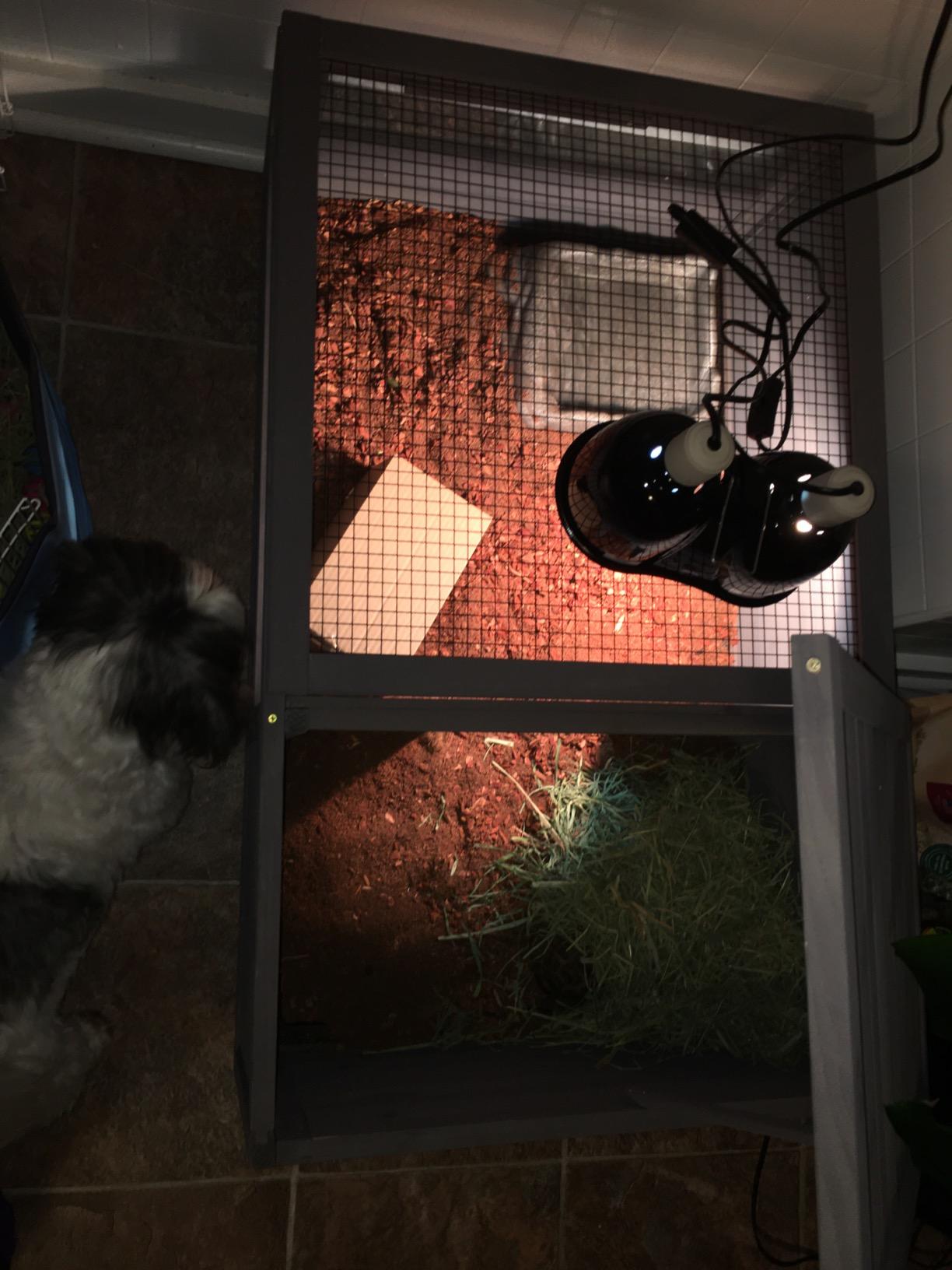
The lamp holder is free to adjust, and that flexibility is what lets you run a mercury vapour bulb high enough to avoid eye damage while still delivering usable UVB at floor level. Owners consistently praise the balance between a private sleeping area and an open basking and viewing area, plus acrylic viewing panels on two sides for observation without lifting the lid.
One number deserves attention. The listing publishes item dimensions of 15.51 x 9.45 x 4.88 inches, which reads far smaller than the product photography suggests and is likely a component measurement rather than the full house. This is exactly the mismatch keepers describe in forum threads about tables arriving smaller than expected, so message the seller and ask for the interior floor measurement before you commit.
What you get with this model
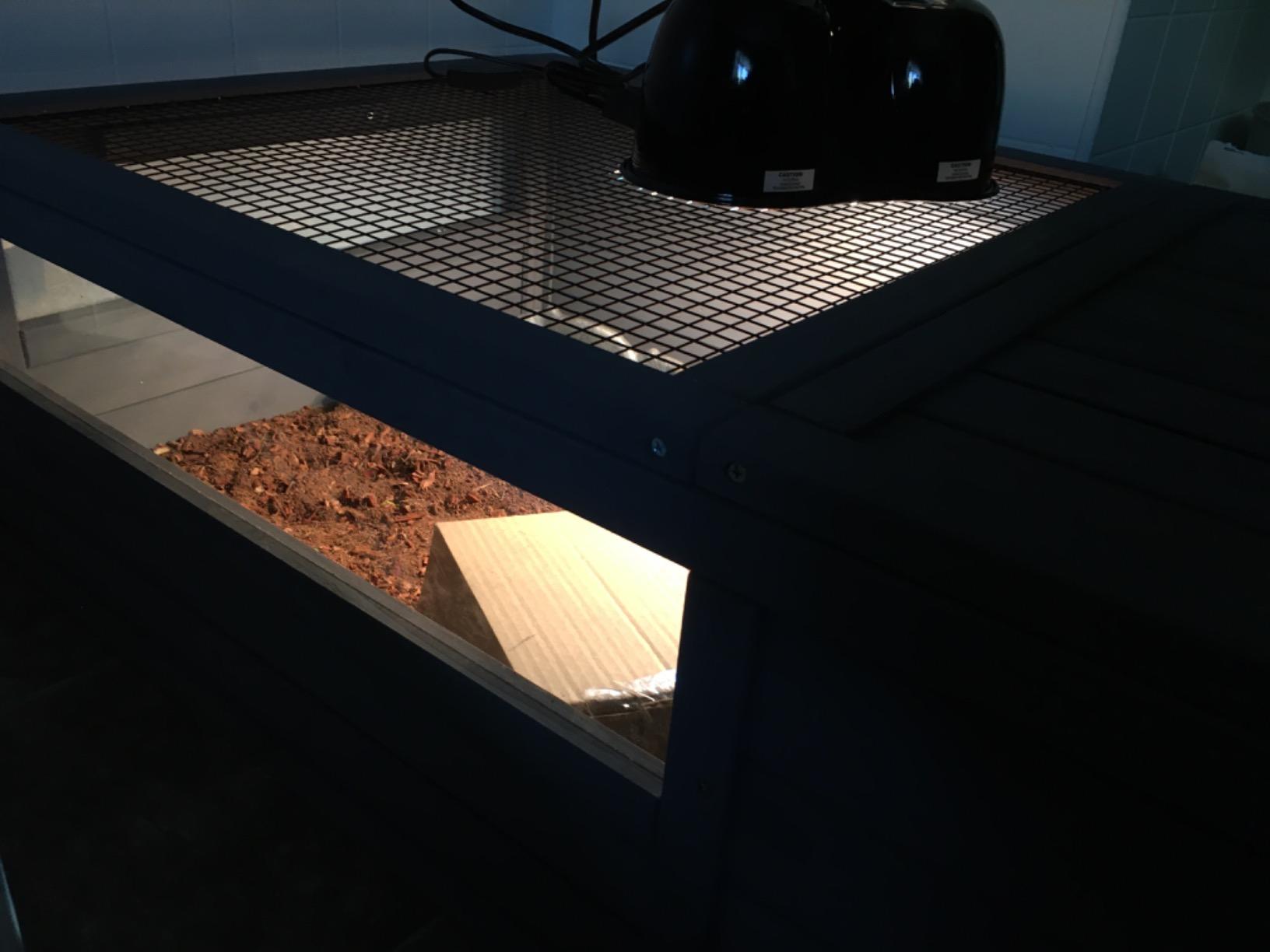
You get a genuinely two-zone habitat rather than a flat box with a roof. The private side is where a tortoise should be able to disappear completely, which matters for animals that spend the day under a hide and only emerge to warm up. Roughly 74 percent of reviews are five star, and the recurring theme is that the solid wood and waterproof tray survive a humid indoor winter without complaint.
It weighs 23.94 pounds, which is heavy enough to stay put around a curious pet but light enough to move for cleaning. The model number is WYE3ZH4X1817 if you need to check compatibility with replacement lamp parts.
Where it falls short
The compact footprint is the recurring limitation, and it is a real one. A hatchling will be comfortable here for months, but a juvenile Mediterranean tortoise will need something larger within a year, and buying twice is the outcome most owners regret.
The dense wire lid is another watch point. It is a sensible design for containment, but if you plan to hang a heavy ceramic fitting rather than a standard reflector and bulb, check the frame first.
2. Zoo Med Tortoise House – The Highest-Rated and Only Modular Option
Zoo Med Tortoise House
Fir wood
37 x 25 x 13 inch footprint
Joins two sections
Lockable wire cover
Pros
- Highest average rating in the group at 4.6
- Two sections join end to end to double the space
- Fir wood is attractive and reptile safe
- Lockable wire cover keeps cats and other pets out
- Generous 36 inch footprint suits hatchlings and juveniles
Cons
- Bare wood floor absorbs moisture unless you line it
- Pre-drilled pilot holes are inconsistent
- No integrated lamp holder
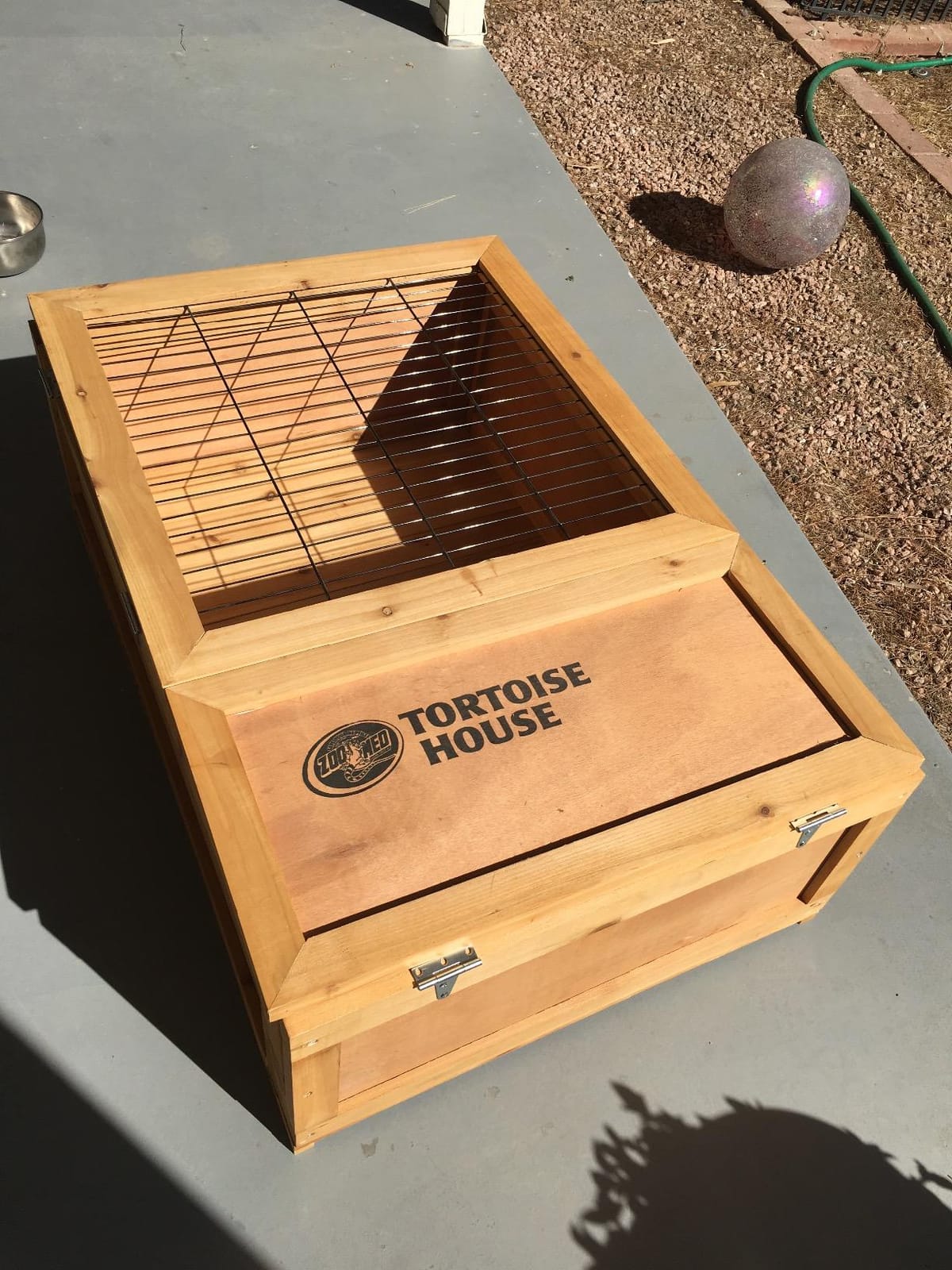
The Zoo Med Tortoise House has been sold since January 2005, which makes it the longest-running product in this roundup by a wide margin. It carries a 4.6 average from 764 reviews, the highest rating of the twelve, and that consistency is the point: a two-decade-old design that people keep re-buying has very little left to fix.
Published dimensions are 37 x 25 x 13 inches, with a natural wood variant listed at 36 inches long by 24 inches wide by 12 inches high. Interior doorway clearance is 8.25 by 8 inches, which is adequate for hatchlings and juveniles of Hermann’s, Marginated, Spur-thighed and Russian species, and tight for anything bigger.
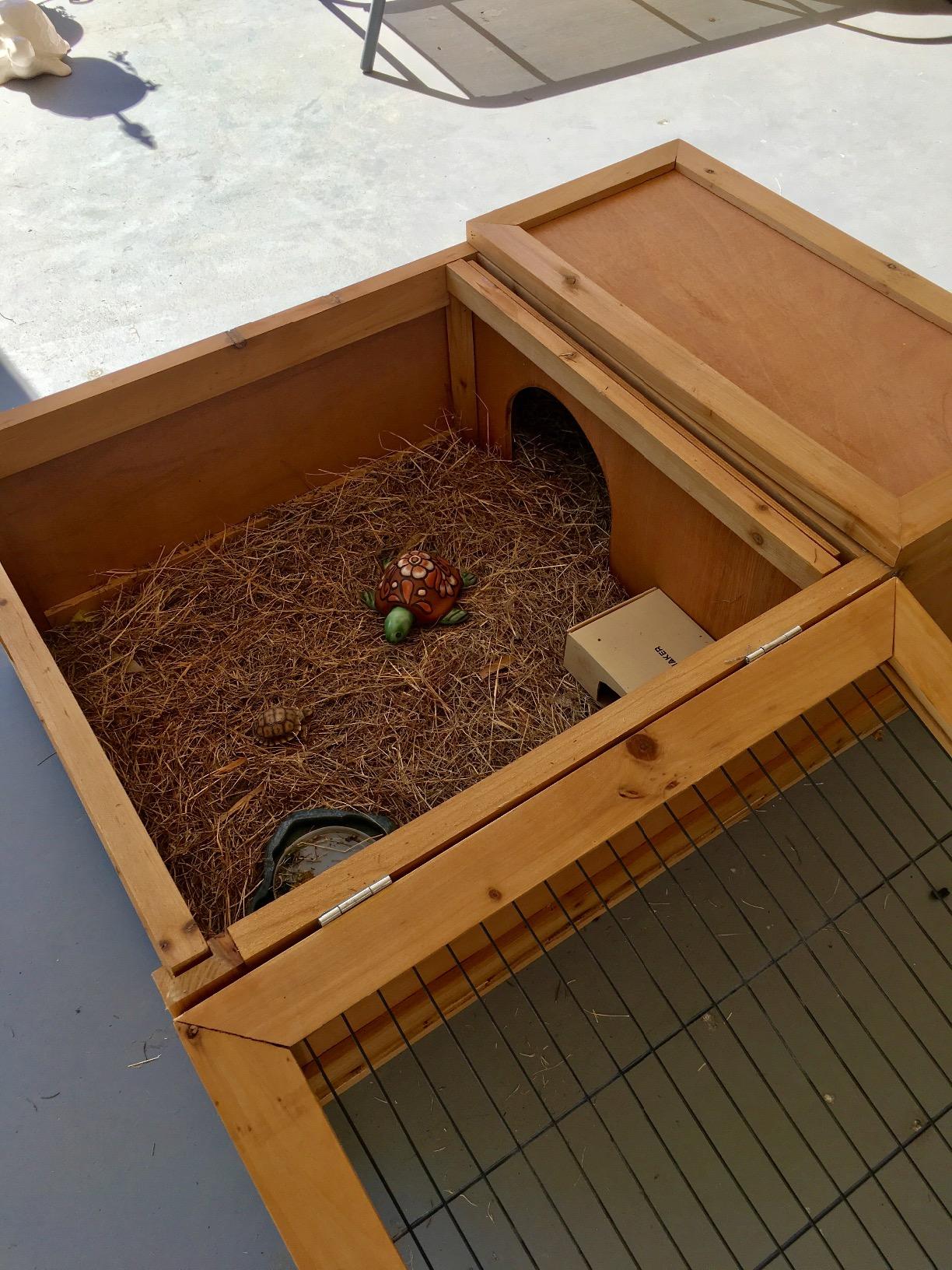
The feature no one else here has is modularity. Two sections join end to end to double the enclosure space, which is a low-cost way to solve the size problem that every other product in this roundup forces you to solve by buying again. The lockable wire safety cover is the other one keepers mention repeatedly, particularly in homes with cats.
It is fir wood throughout, and around 76 percent of reviews are five star. Reviewers single out the size, the double-up option and the fact that it looks better in a room than an assembled flat-pack alternative.
Why the modular design matters more than it sounds
Almost every keeper complaint in our forum research came down to the same thing: the enclosure is too small, and the next unit is even more expensive. The Zoo Med answers that with a design decision rather than a larger box. Buying one section now and joining a second later is a genuinely different budget path from replacing the whole habitat.
The private weatherproof sleeping area is built into the design rather than added as an accessory, so the hide is there from day one. For a tortoise that will spend most of its daylight hours under cover, that is not a minor convenience.
What to fix before you use it
The floor is bare wood, and bare wood plus a damp substrate is how you get a swollen, stained base. Line it with a waterproof liner above the substrate line, or fit removable tiles. This is the most common piece of advice that repeats across reviews of this model.
Expect to drill a few pilot holes yourself. The pre-drilled holes are inconsistent across panels, and the latches are light duty, so treat the wire cover as a pet deterrent rather than a security feature. There is also no integrated lamp holder, so budget for a separate stand or suspension rig.
3. GEGURI Detachable-Leg Habitat – The Best Value for the Floor Area
GEGURI Tortoise Habitat Indoor & Outdoor, Wooden Tortoise House with Detachable Legs, Reptile Cage for Small Animals
Fir wood
Detachable legs
Removable plastic tray
Three-sided window
Pros
- Two-room layout separates sleeping and activity zones
- Detachable legs allow floor or table placement
- Fir wood resists warping in damp conditions
- Plastic pull-out tray simplifies cleaning
- Three-sided viewing window
Cons
- Finish colour varies between pieces
- Some buyers report gaps at panel joints
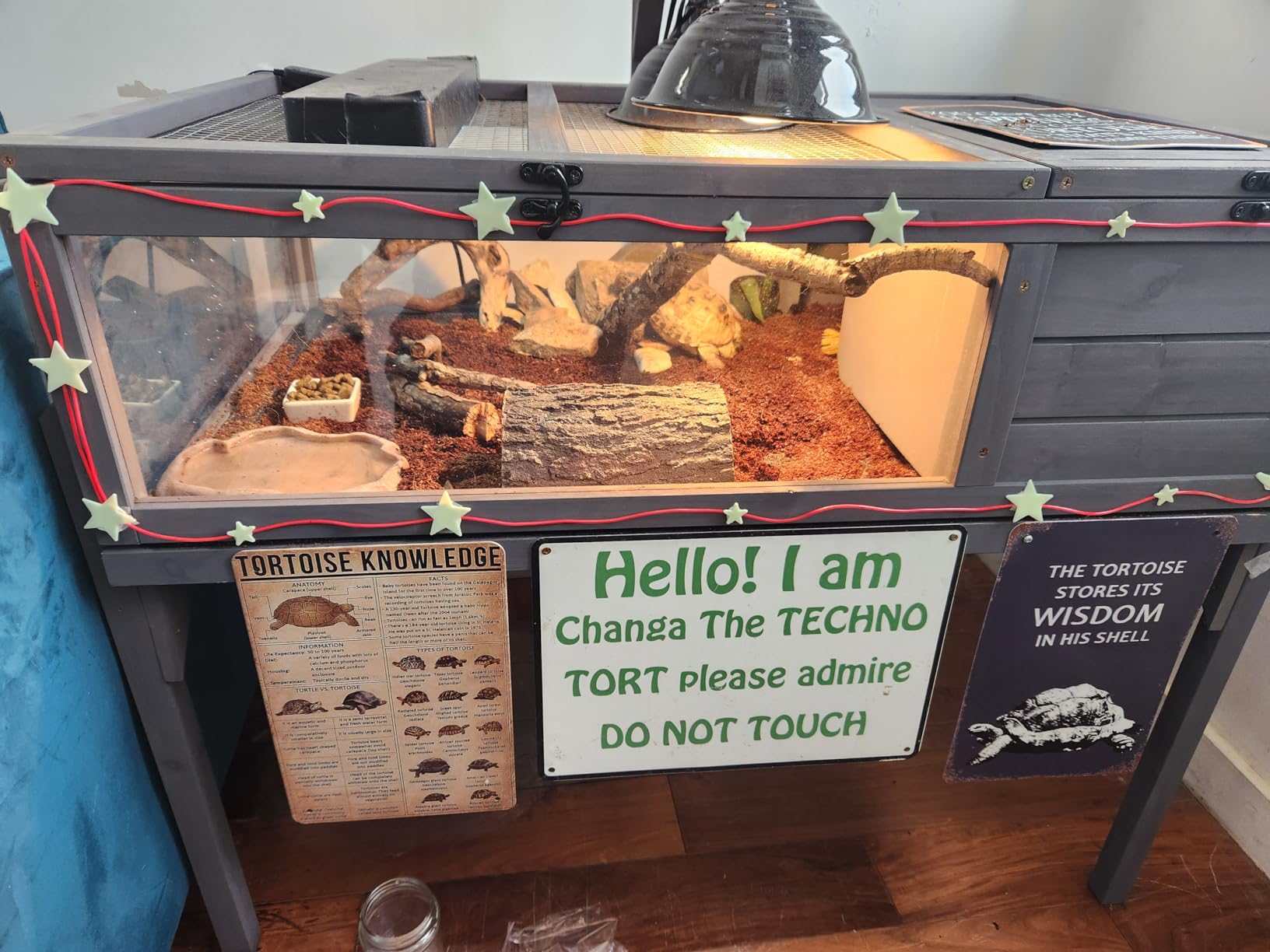
The GEGURI is the pick for anyone who wants the most usable floor area and a tray they can lift out without tools. It measures 38 x 23 x 32 inches including the legs, and at 17.86 pounds it is the lightest full-size habitat here, which matters a great deal in a flat or a second-floor flat where you may want to move the enclosure for cleaning.
It arrived on sale in April 2023 and holds a 4.3 average across 507 reviews, with about 65 percent five star. That is a solid review base for a product this age, and the themes are consistent rather than noisy.
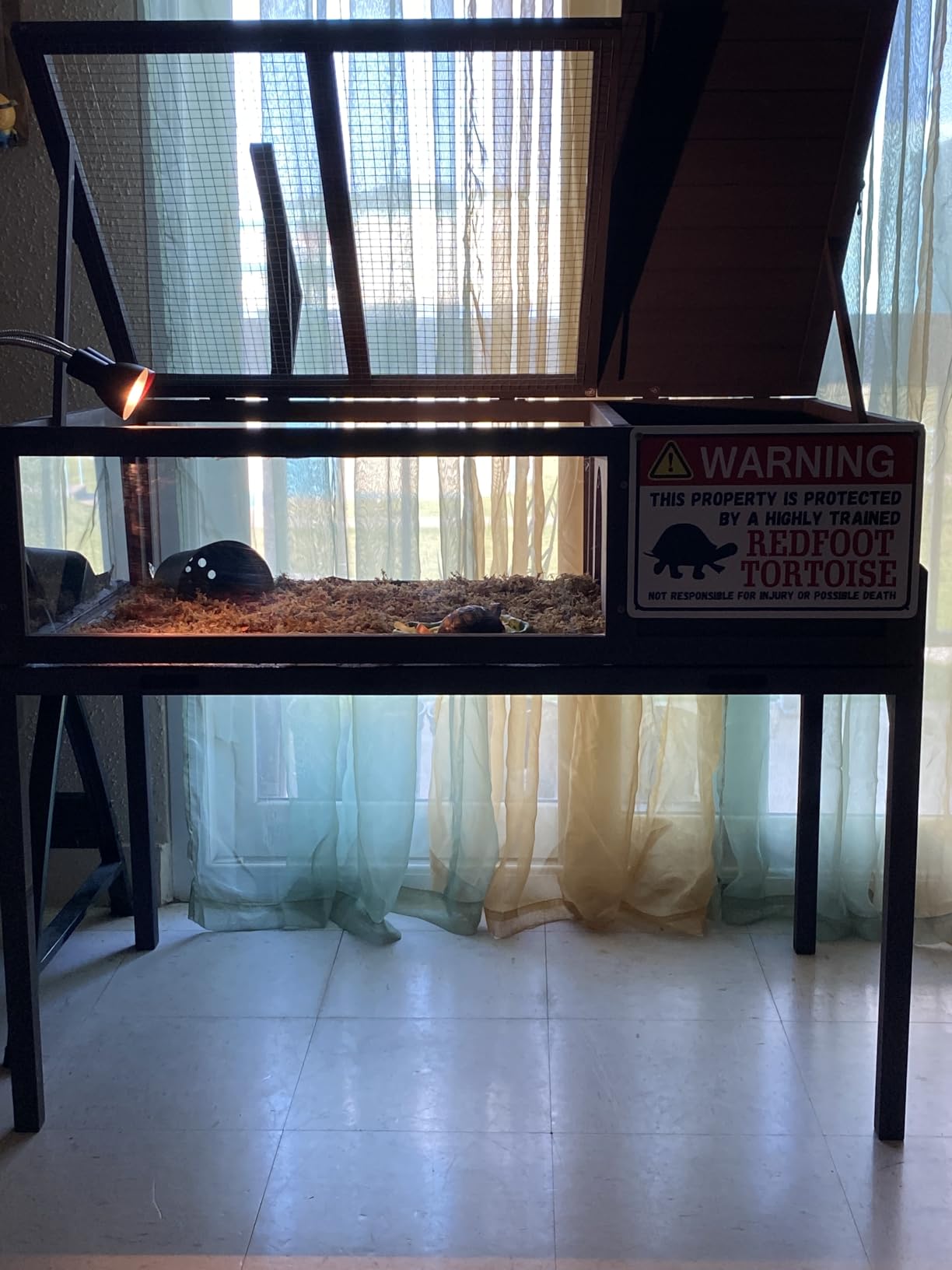
The two-room design is the core of it. A private sleeping section sits alongside a public viewing and basking area, separated by a solid wall rather than a see-through divider, so the animal can genuinely withdraw. The three-sided large viewing window means you can check on it from most of the room without opening anything.
Detachable legs are the feature owners underrate most. They let the same unit sit on the floor as a full-height habitat or come up to table height for a juvenile, and they are also the reason the enclosure can be moved by one person. Two size variants are offered, in grey/white, so check which footprint you are ordering.
Why the removable tray is the deal-breaker feature
The upgraded removable plastic pull-out tray has a fully surrounded bottom, so nothing escapes under the walls and the whole base lifts out for cleaning. Forum research on this topic keeps returning to the same frustration: wooden tables are hard to clean and sanitise, and owners end up buying several so they can rotate them. A tray that lifts out removes most of that problem.
It also makes spot cleaning honest. In a table with a fixed wooden floor, you are always choosing between scrubbing the whole surface and accepting odour and staining. Here you take the insert out, rinse it, dry it, and put it back.
Where the build quality shows
Reviewers do report gaps at panel joints that let humidity escape and, in a few cases, substrate fall through. That is the most serious negative on an indoor tortoise table, because a table that cannot hold humidity is really just a very large open box. Seal the joints with aquarium-safe silicone before you line the base.
The finish colour can also vary between pieces, which is cosmetic but worth knowing if the enclosure will live in a living room. Fir wood is the material, and it is a good choice for warp resistance in damp conditions.
4. Aivituvin Habitat with Storage Shelf – Best for Tight Storage Spaces
Aivituvin Tortoise Habitat Turtle Enclosure, Wooden Tortoise House Reptile Cage for Small Animals, Reptile Tank with Large Storage Shelf
Lamp stand 11-31 inch
Under-unit storage shelf
Removable legs
Acrylic window
Pros
- Removable legs give floor or table placement
- Adjustable lamp stand covers a wide height range
- Large storage shelf underneath for supplies
- Acrylic panel over the activity area
- Weatherproof hiding area
Cons
- Acrylic window scratches over time
- Lower five-star share than the top-rated models
This is the second Aivituvin in our lineup and it solves a different problem. Where the first model is a compact starter habitat, this one is built around storage. It measures 39.4 x 22.5 x 31.5 inches and weighs 29.5 pounds, and the space beneath the enclosure is a full shelf rather than a thin brace.
For anyone housing a tortoise indoors in a rented flat or a small house, that shelf is where the food, the spare substrate, the water bowl and the cleaning kit live. It is the difference between a permanent obstacle in the corner of a room and something that looks planned.
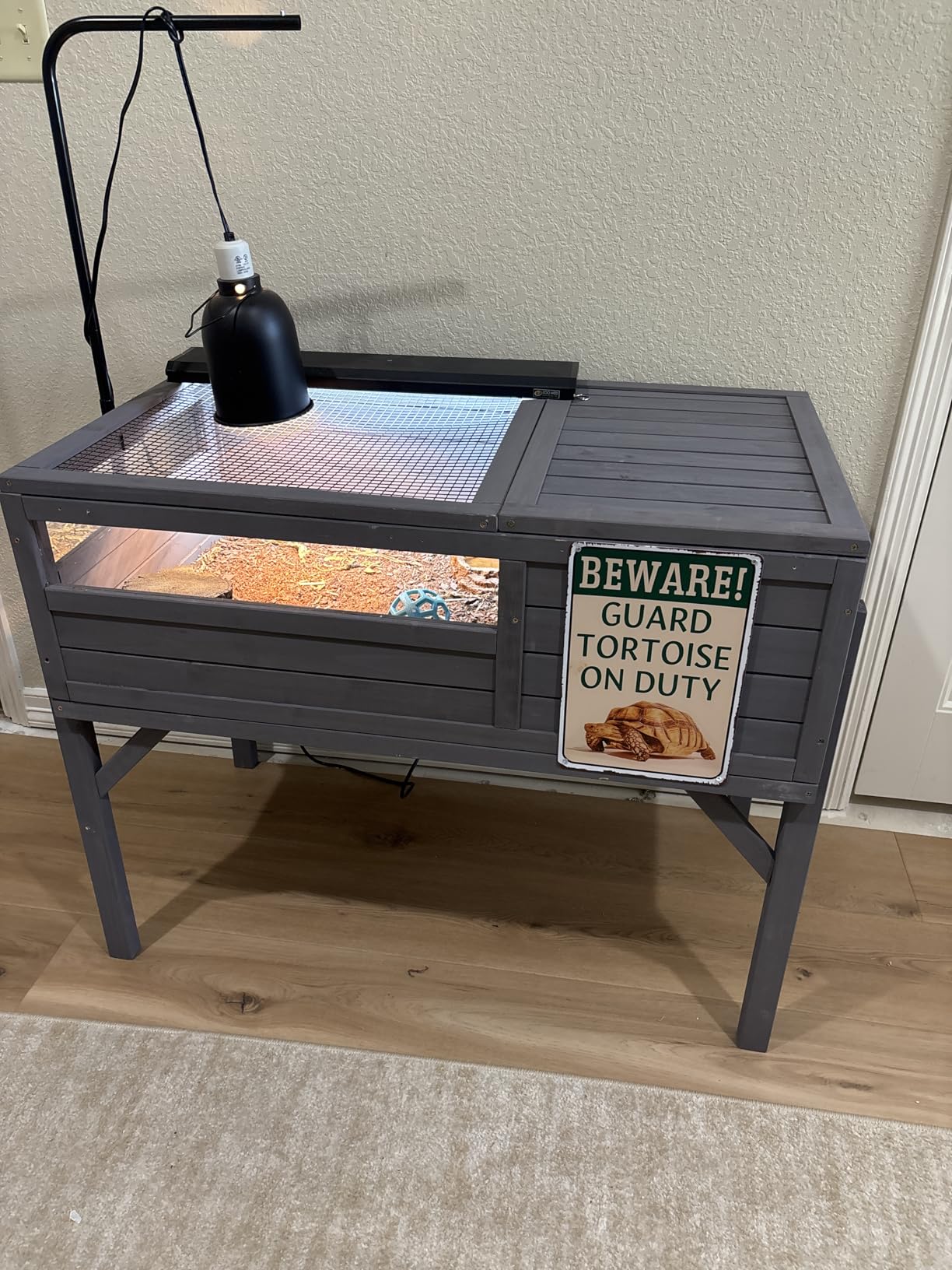
The lamp stand is the other headline. Published stand height runs from about 11 to 31 inches, and the hanging width adjusts from about 13 to 21.1 inches, with 360-degree rotation on the holder. That range is wide enough to place a mercury vapour bulb at a safe distance from the tortoise and still bring heat down to a workable floor temperature.
It has been available since December 2025 and carries a 4.3 average from 322 reviews, around 67 percent five star. Owners point to the storage shelf, the adjustable lamp arm and the two-bedroom layout as the three things that justify the footprint.
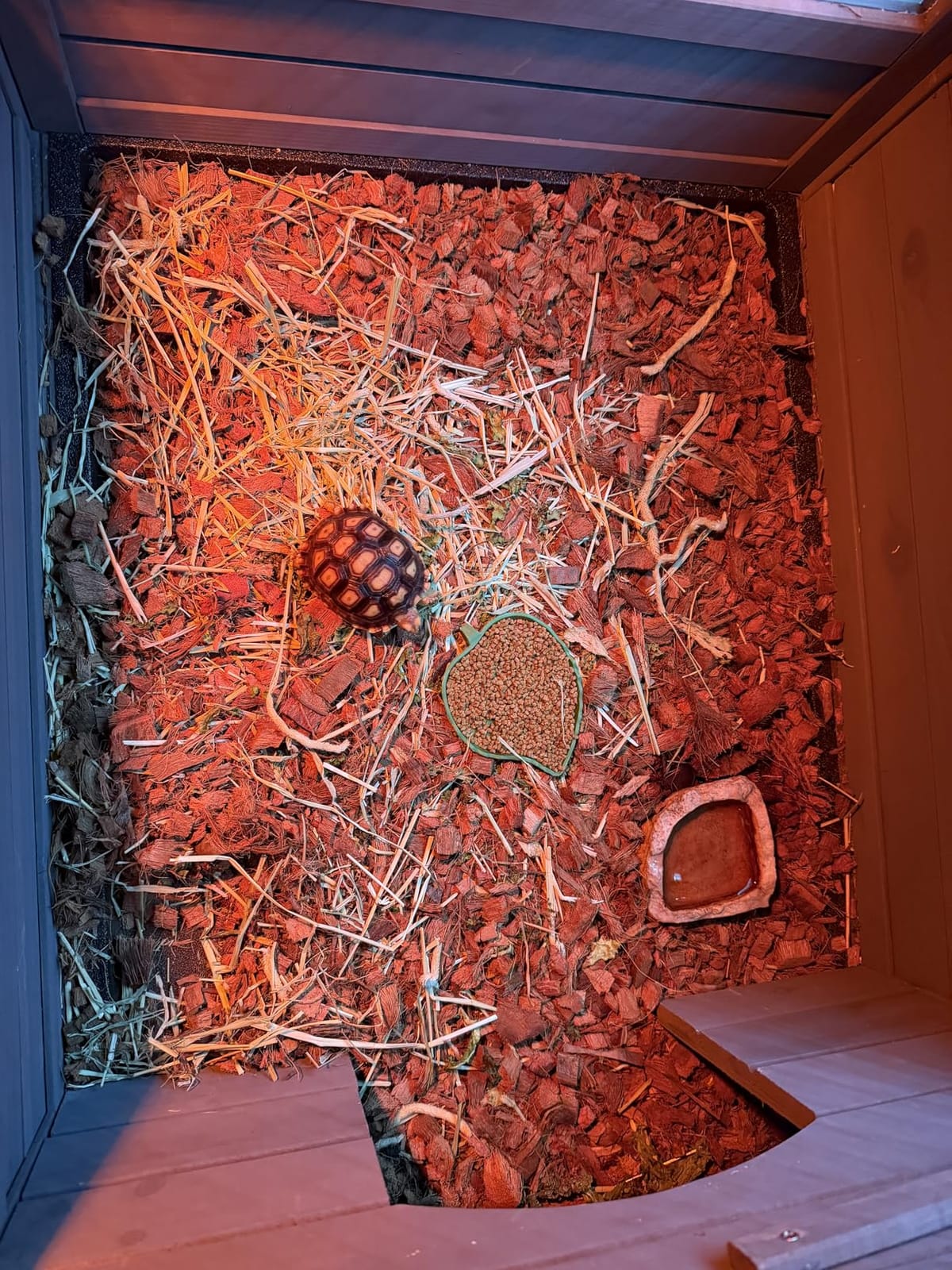
How the lamp stand range changes your setup
Lamp height is not a detail on an open-top table. It is the variable you will adjust most often, because the right distance changes with the bulb, the room temperature and how much the enclosure is in direct light. A stand that travels 20 inches of vertical range lets you tune the basking spot in minutes instead of rebuilding the whole arrangement.
Pair it with a dimming thermostat rather than a cheap dimmer switch, and check the temperature at tortoise height in the basking zone rather than at bulb level. Target roughly 30°C/86°F at the basking end and 20°C/68°F at the cool end.
Considerations before you order
The acrylic viewing panel over the activity area will scratch over time under normal contact with a curious animal, and acrylic does not repair itself. Expect a hazy panel after a year or two rather than a perfect one.
Its five-star share sits a little below the two models above it, and the moisture-proof finish is a factory coating rather than a species guarantee. Check the panel joins when the box arrives and seal any gaps you find before adding substrate.
5. Magazoopet Enclosure – The Finest Lamp Adjustment in the Group
Large Tortoise Enclosure with Adjustable Lamp Stand and Storage Shelf
Five-level lamp adjustment
Removable bottom tray
Openable top
Removable legs
Pros
- Five-level lamp height and width adjustment
- Dual-zone layout for lounging and activity
- Slide-out tray makes cleaning fast
- Removable bottom tray and openable top
- Compact enough to move in a camper
Cons
- Rustic wood colour differs from photos
- Strong odour on arrival
- Some panels crack and are not flush
The Magazoopet is the most interesting lamp system here. It has five discrete levels of horizontal adjustment spanning 14.6 to 22.4 inches and five levels of height adjustment spanning 30.3 to 38.2 inches, which is more granular control than any other enclosure in this roundup offers. If you have ever tried to hit a basking temperature with a fixed arm, this is the answer to that frustration.
Overall dimensions are 40.4 x 23 x 32 inches and it weighs 27.6 pounds. Four size variants are published, from 37 by 23 by 32 inches up to 40.4 by 23 by 34.2 inches, so check the variant carefully before ordering.
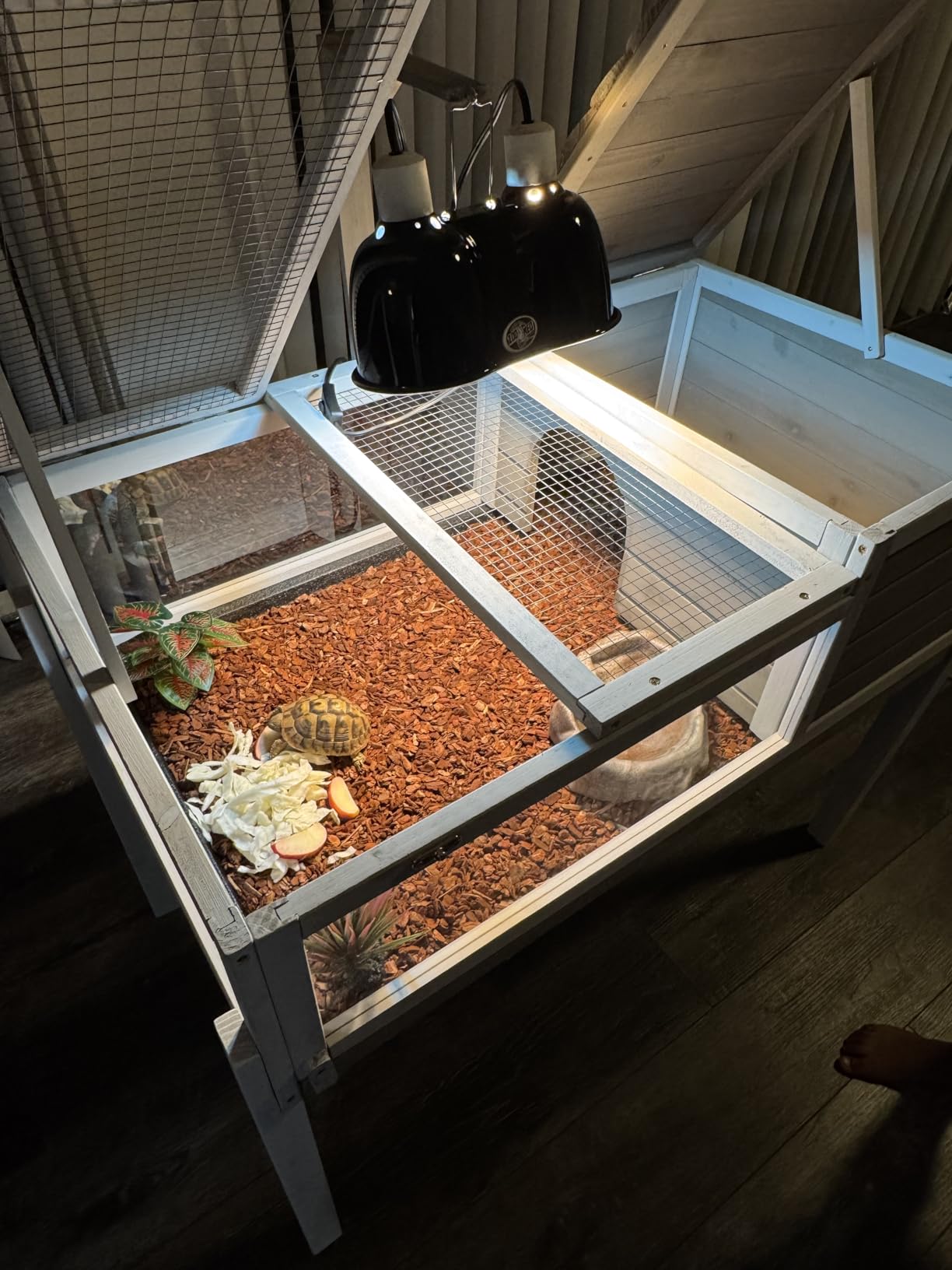
It arrived in June 2026 and holds a 4.4 average from 104 reviews, with roughly 76 percent five star. It also ranks in the top 20 of Small Animal Cages, which tells you something about how keepers actually use these enclosures.
The dual-zone layout divides the interior into a lounging area and an activity area, and owners note it works for two animals or for keeping the basking and hiding ends visually separate. The removable bottom tray slides out rather than lifting, and the top opens on a support rod, which makes spot cleaning and access straightforward.
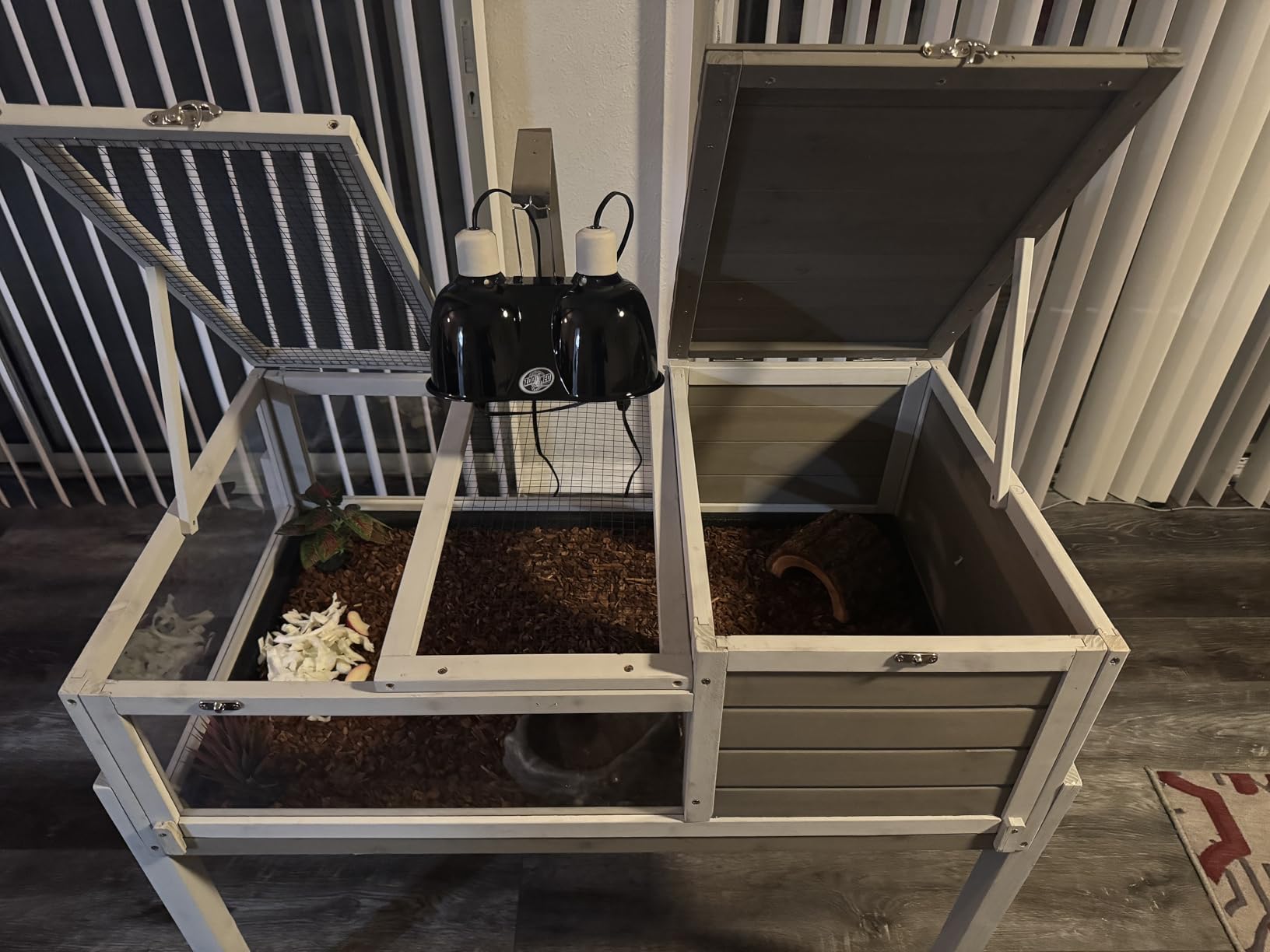
What the mesh cover and locks actually do
The top and bottom are secured with metal mesh covers and locks. That is a genuine advantage in a home with cats, and it also means you can be less precious about how the door is positioned. A tortoise that can see daylight movement nearby is more likely to come out and bask than one in a sealed dark box.
Escape-proofing matters more than most sellers admit. A hatchling can climb surprisingly well, and a tortoise that escapes into a cold room overnight is a vet visit, not an anecdote.
Build quality is the trade-off
This is a budget-built enclosure and reviews describe it honestly. Expect a strong odour on arrival that takes time to dissipate, some panels arriving cracked or sitting proud of each other, and assembly numbers painted on the wood rather than removable. The wood colour is also described as more rustic than the listing photos suggest.
Owners also note it is not built for heavier reptiles. For hatchlings and juveniles of Mediterranean species that is fine, but do not plan to house an adult in it.
6. PetsCosset Two-Room Habitat – The Cheapest Way In
PetsCosset Tortoise Habitat with Detachable Legs, Wooden Indoor & Outdoor Turtle Enclosure, Two-Room Reptile House, Large Observation Windows, Removable Pull-Out Tray, for Tortoises
Lightweight soft wood
Numbered panels
Removable tray
Detachable legs
Pros
- Lowest cost entry in the group with a 4.0 rating
- Numbered wood panels and clear instructions
- Lightweight enough for one person to build
- Multiple size options available
- Removable plastic pull-out tray
Cons
- Tray can sit proud of the ledges and fall out
- Gaps at panel joints let humidity escape
- Thin top mesh cannot support a heat lamp
The PetsCosset is the entry point, and it does the job of getting a hatchling properly housed without a large commitment. It is available in three sizes from 37.2 by 22.8 by 32.3 inches up to 40.4 by 22.8 by 34.2 inches, arrived in July 2024, and holds a 4.0 average from 182 reviews.
What makes it a credible budget pick is the assembly. The panels are numbered and the instructions are clear, and owners report building it in around half an hour alone. For a first-time keeper flat-packing a wooden habitat, that is worth more than another accessory.
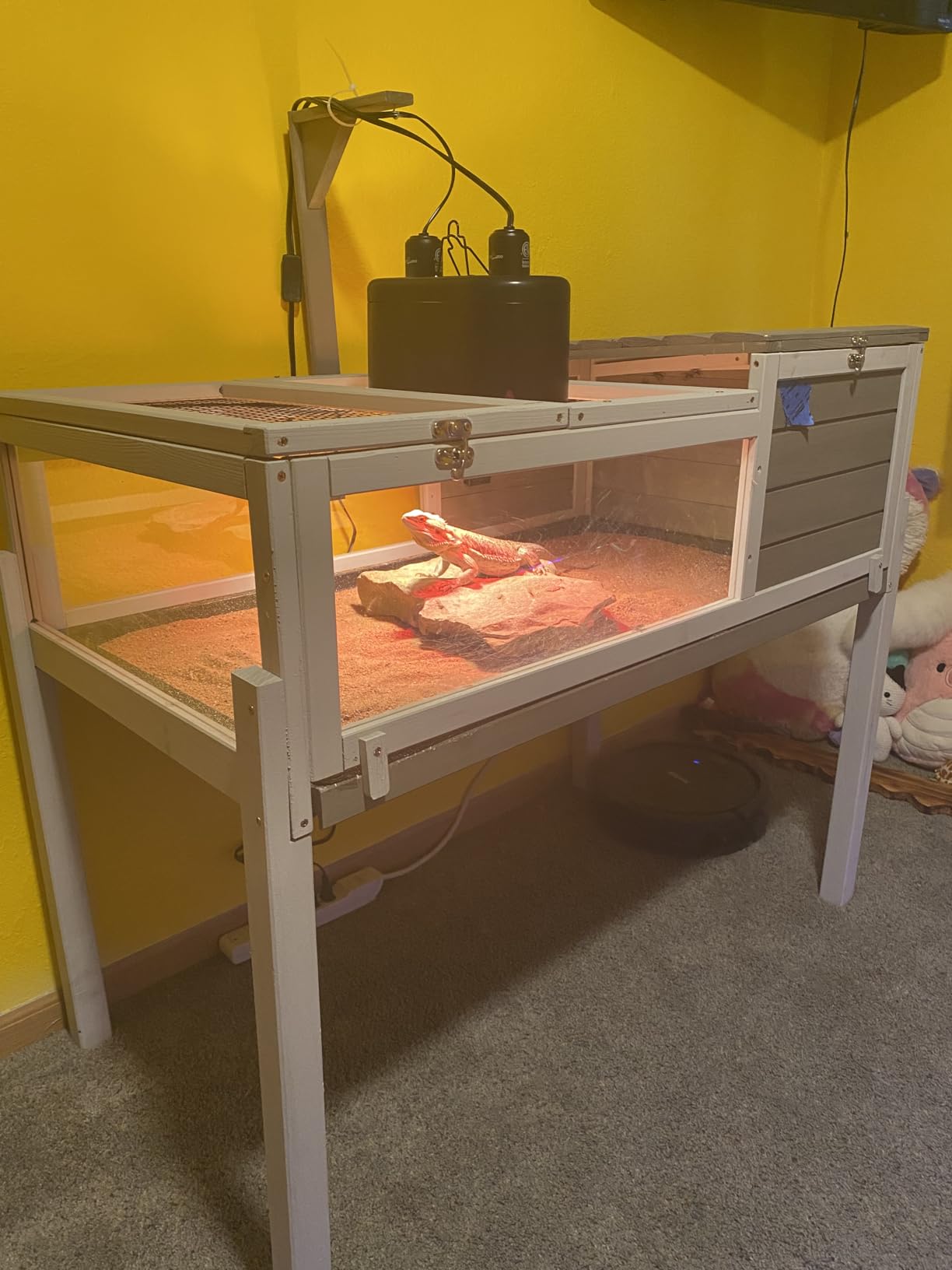
The two-room design splits a resting area from a play and viewing area, and three transparent acrylic observation windows mean you can see into most of it. Detachable legs let you run it on the floor or on a table as the animal grows. The removable plastic pull-out tray keeps the substrate contained and wipes clean.
The manufacturer lists compatibility with Russian, Hermann’s, Greek, Marginated, red-footed and sulcata tortoises plus common small reptiles, which is a reasonable claim for a hatchling setup given the size range.
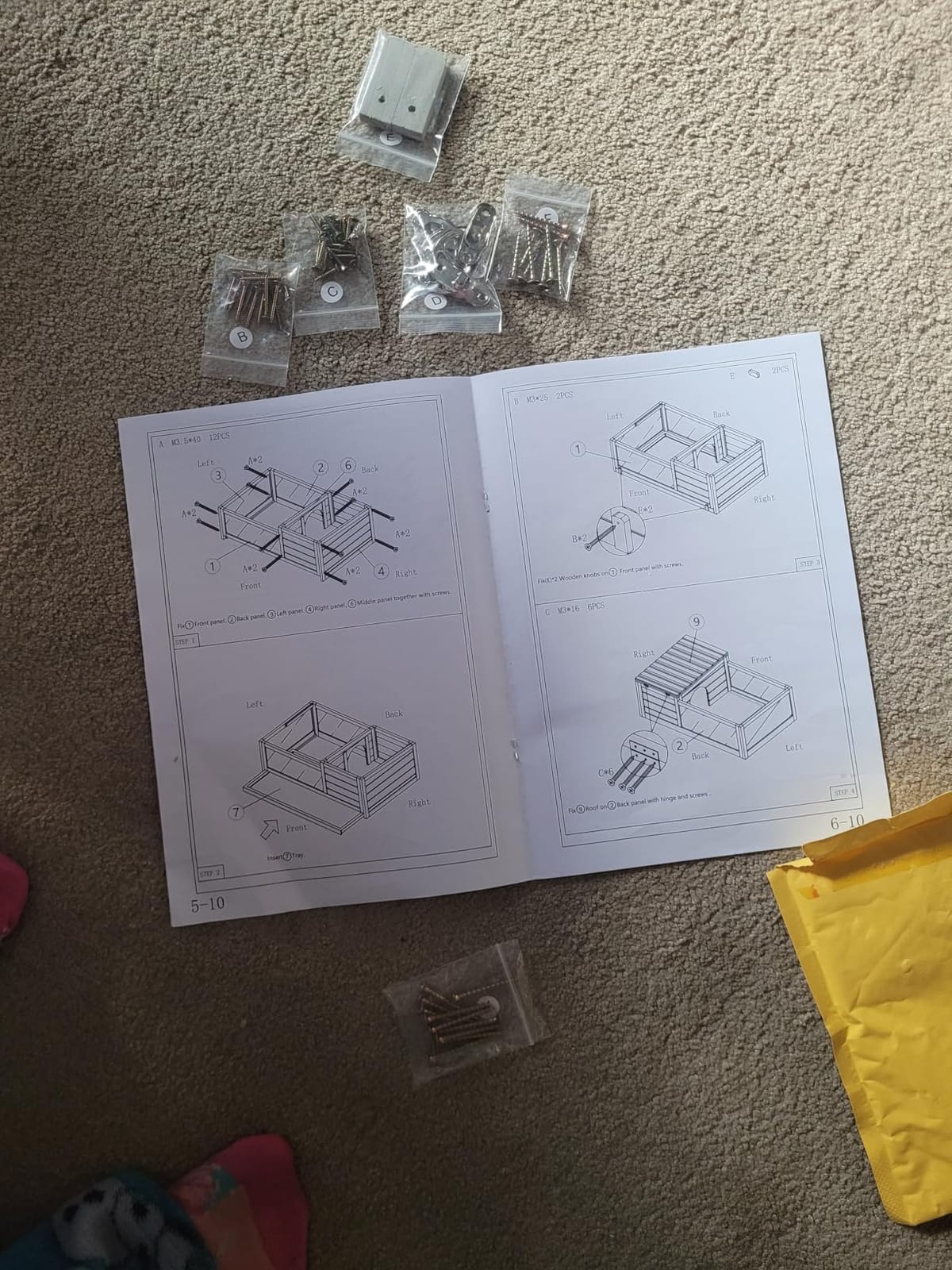
The gap problem is the one to solve first
This is the most polarised product in the roundup, and the reason is specific. It carries 59 percent five-star reviews but also 11 percent one-star, the widest spread in the group. The strong criticism is seam gaps at panel joints and corners that let humidity escape and let substrate fall through.
Several reviewers question it as an indoor tortoise enclosure for exactly that reason. If you buy it, seal every joint with aquarium-safe silicone before you add any substrate, and check the corners under a light once it is assembled. That single hour of work is the difference between a working habitat and a ventilated box.
Two smaller things to plan around
The top wire mesh is thin and cannot support a heat lamp. You will need a separate stand or suspension bar, and that should be part of your budget, not an afterthought.
The tray can also sit proud of the ledges and fall out if it is not seated properly, and on the base variant the viewing window does not extend to floor level. Both are annoying rather than dangerous, but they are the two things owners mention most often after the seams.
7. PawHut Habitat with Shelf Storage – Compact Footprint, Useful Layout
PawHut Tortoise Habitat with Shelf Storage, Tortoise Enclosure with Weather Protection, Reptile Enclosure with Tray, Light Support Frame, Yellow
33 x 20 x 40.5 inch
Integrated lower shelf
Hide box and basking area
Light frame
Pros
- Integrated lower shelf saves cabinet and closet space
- Solid plastic bottom pan holds bedding
- Two-room layout with hide box and steel-grating basking area
- Light frame accepts a zip-tied heat lamp
- Retains humidity reasonably well
Cons
- Soft wood splinters during assembly
- Tray is fixed rather than removable
- Divider does not sit flush with the pan
A 33 by 20 inch footprint fits rooms where 40-inch tables will not, and that is the whole reason this PawHut exists. At 33 x 20 x 40.5 inches and 24 pounds, it is the shortest footprint in the group, and the tall light frame above it compensates by taking the height out of the enclosure rather than the floor area.
It arrived in September 2023 and holds a 4.1 average from 119 reviews, around 59 percent five star. Colours are available in yellow and light grey.
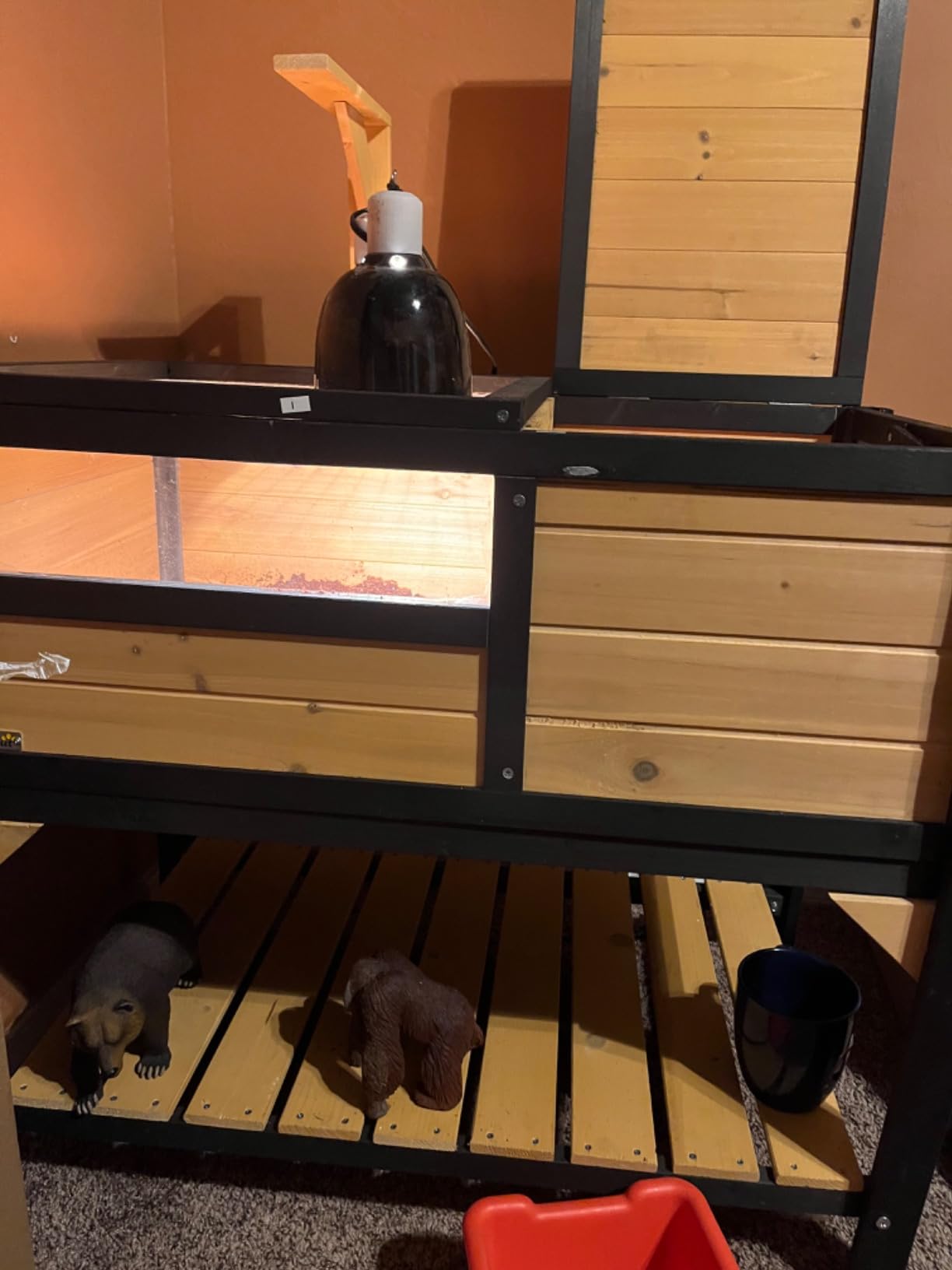
The two-room layout is unusually well specified. The hide box measures 12.5 by 17.25 by 12.5 inches and the basking area is 16.25 by 17.25 by 12.5 inches, with a steel grating in the basking section. Those are real dimensions rather than a vague “cozy den”, and they are worth checking against your tortoise before you buy.
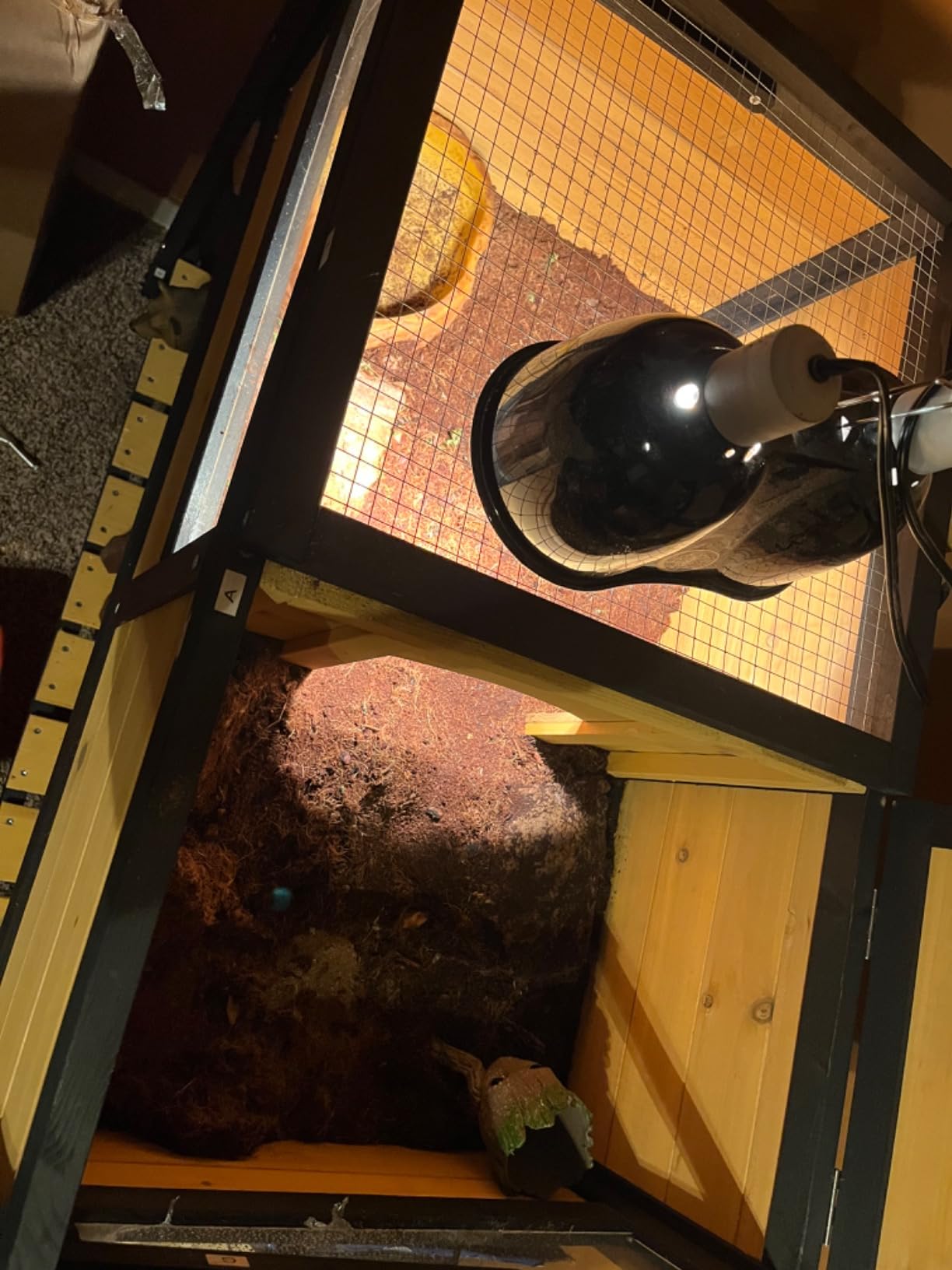
The light support frame above the enclosure is a simple open frame rather than a full hood, and owners report that a heat lamp can be zip-tied into it. There is an openable lid, a mesh wire screen over the living space for airflow, and a solid plastic bottom pan that holds bedding and wipes clean.
Humidity is the quiet strength here
Despite the open layout, reviewers consistently report that this model retains humidity reasonably well once it is set up. That is a function of the solid pan and the two-room division rather than anything sealed, and it is a real advantage in a house where the ambient air is already dry.
For Mediterranean species you are aiming for a fairly dry setup anyway, but a red-footed tortoise in a heated flat will appreciate the more stable environment. The lower shelf, sized 32 by 19 inches, is the practical bonus: it holds the feed store and the spare bags of substrate without eating into floor space.
Where the soft wood shows
The most repeated complaints are about cypress wood that is soft enough to splinter or gouge during assembly, a tray that is fixed rather than removable, and a divider that does not sit flush with the pan so bedding spreads across the floor. There is also a strong wood odour on unpacking that needs airing.
Once assembled, owners report it is sturdy and holds its paint, so this is a build-quality issue more than a durability issue. Line the base before you fill it and expect to reseal the divider joint.
8. ZENTAVO Three-Room Habitat – The Largest Footprint in the Group
3-Room Large Tortoise Habitat with Pull-Out Tray, Wooden Tortoise Enclosure Indoor & Outdoor with Ramp, Grass Mat, Openable Roof, Luxurious Reptile Enclosure for Small Animals, Yellow
44 x 25.6 inch footprint
Three-zone layout
Pull-out tray
Balcony mesh
Pros
- Largest floor footprint in the group
- Three-zone layout of house
- balcony and lower floor
- Pull-out plastic tray keeps the habitat hygienic
- Water-resistant paint and tight-grain fir
Cons
- Deep heavy unit is hard to move once assembled
- Ramp and balcony need modification for strong animals
At 44 x 25.6 x 24 inches, the ZENTAVO has the largest floor footprint of any table we reviewed. It works differently from everything else here, because it is not a tall box with a roof. It is a low, wide, multi-level structure where the floor area is the design.
It arrived in October 2024 and holds a 4.3 average from 94 reviews, around 66 percent five star. The review base is small, so treat the themes as directional rather than conclusive.
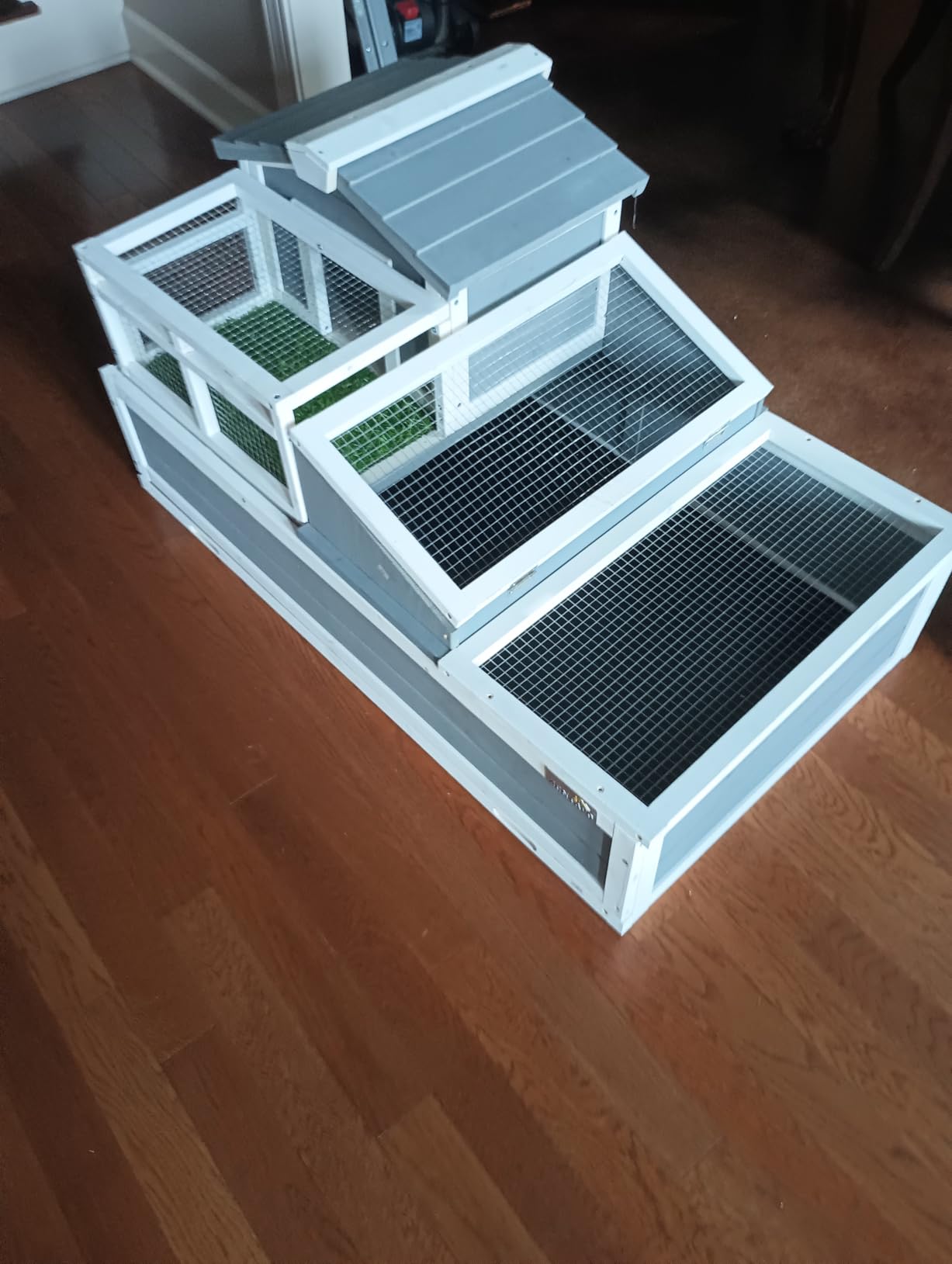
The layout runs across three zones. An upper sleeping house sits above a balcony, and the lower level is the expansive activity area. A ramp and a grass mat are included, which matters for tortoises that are not enthusiastic climbers, and the upper balcony is covered in metal mesh for airflow and light penetration.
The roof is openable, so you can reach the sleeping house without dismantling anything, and the plastic pull-out tray system makes cleaning the base straightforward. The build is tight-grain fir with a water-resistant outdoor paint, and panels come pre-drilled with detailed instructions.
When multi-level beats single-level
Height on legs is wasted space if your tortoise will not climb it. The ZENTAVO puts that height to work as a second zone, so an animal can warm up on the upper level and then come down to a cooler floor. That produces genuine microclimates rather than one flat temperature zone, which is exactly the behaviour-driven gradient tortoises rely on.
The balcony mesh is the detail worth paying attention to. Wire mesh with wide spacing lets UVB through in a way that solid clear panels do not, so an open balcony is better than a glazed one if you can suspend your lamp over it.
Two practical limits
It weighs 32 pounds and it is deep, which makes it awkward to move once assembled. Plan the position before you build it, and measure the route to that position, not just the floor space.
Some owners find the ramp and balcony need modification for stronger or more active animals. If you are housing a sulcata or leopard juvenile, check this carefully before committing, because the balcony is a fall risk for heavy animals.
9. VEVOR Cedar Habitat – Versatile, With One Real Wood Warning
VEVOR Tortoise Habitat, Cedar Wooden Tortoise House Indoor & Outdoor, Tortoise Enclosure with Light Stand, Reptile Enclosure Small Animal Cage with Stand Legs for Gecko, Lizard, Snake
Cedar wood
Light stand
Storage shelf
Legs or casters
Pros
- Storage shelf on the leg frame is genuinely useful
- Assembles in about 40 minutes for one person
- Wood has a pleasant smell
- Matches advertised size
- Available with fixed legs or casters
Cons
- Cedar is inappropriate for tortoises and drew breathing complaints
- Thin material can split at pre-drilled holes
- Bottom tray bows under substrate
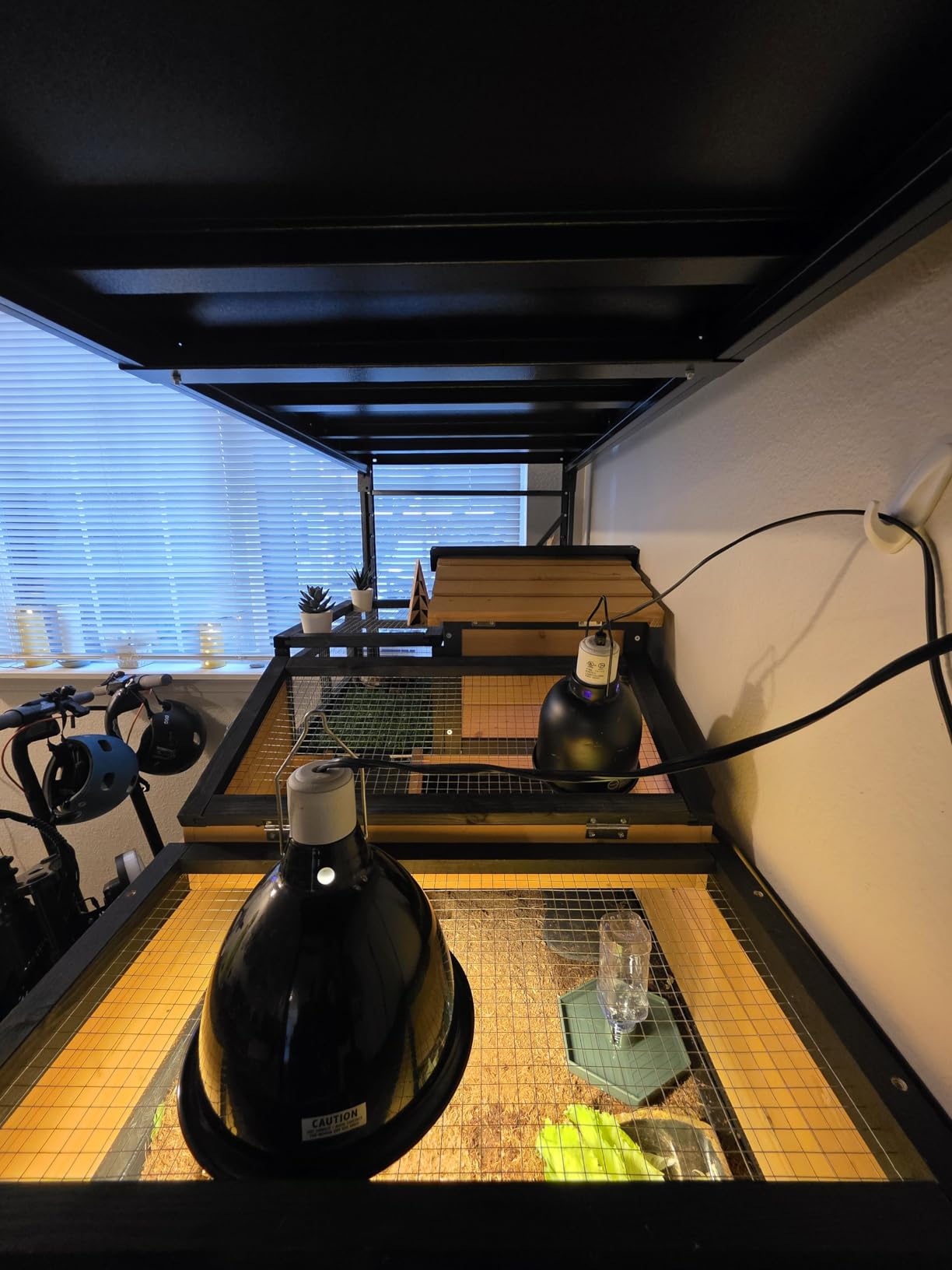
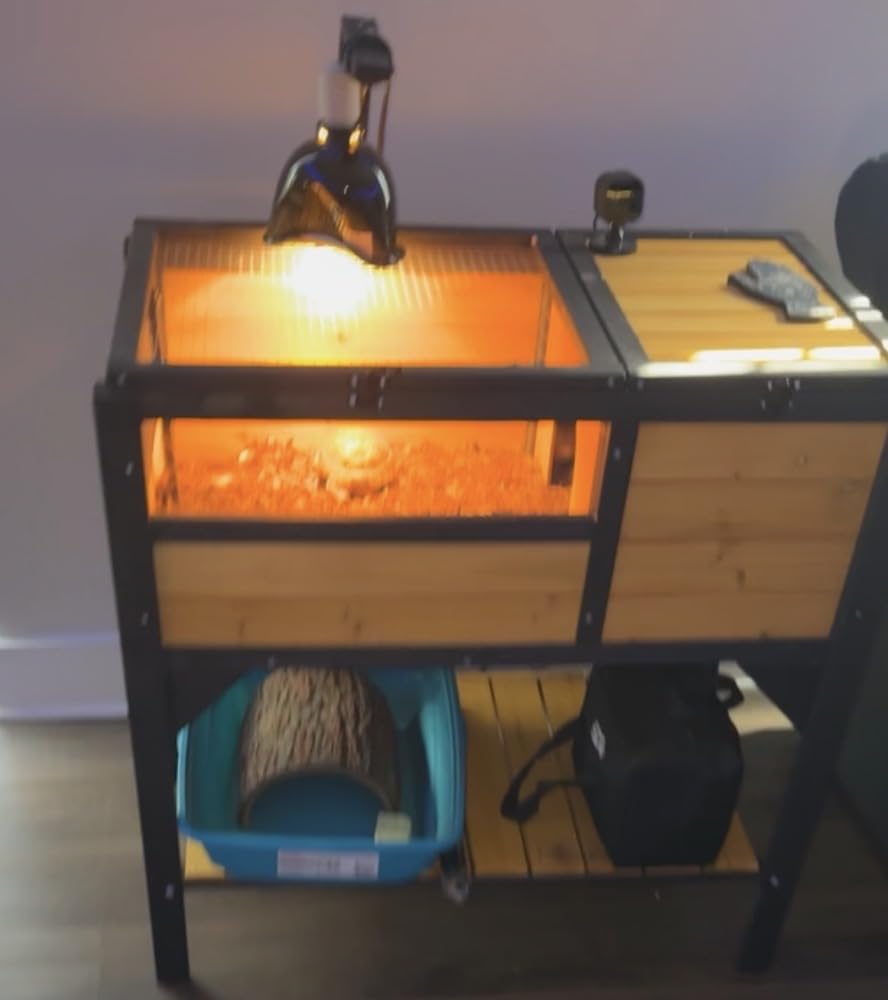
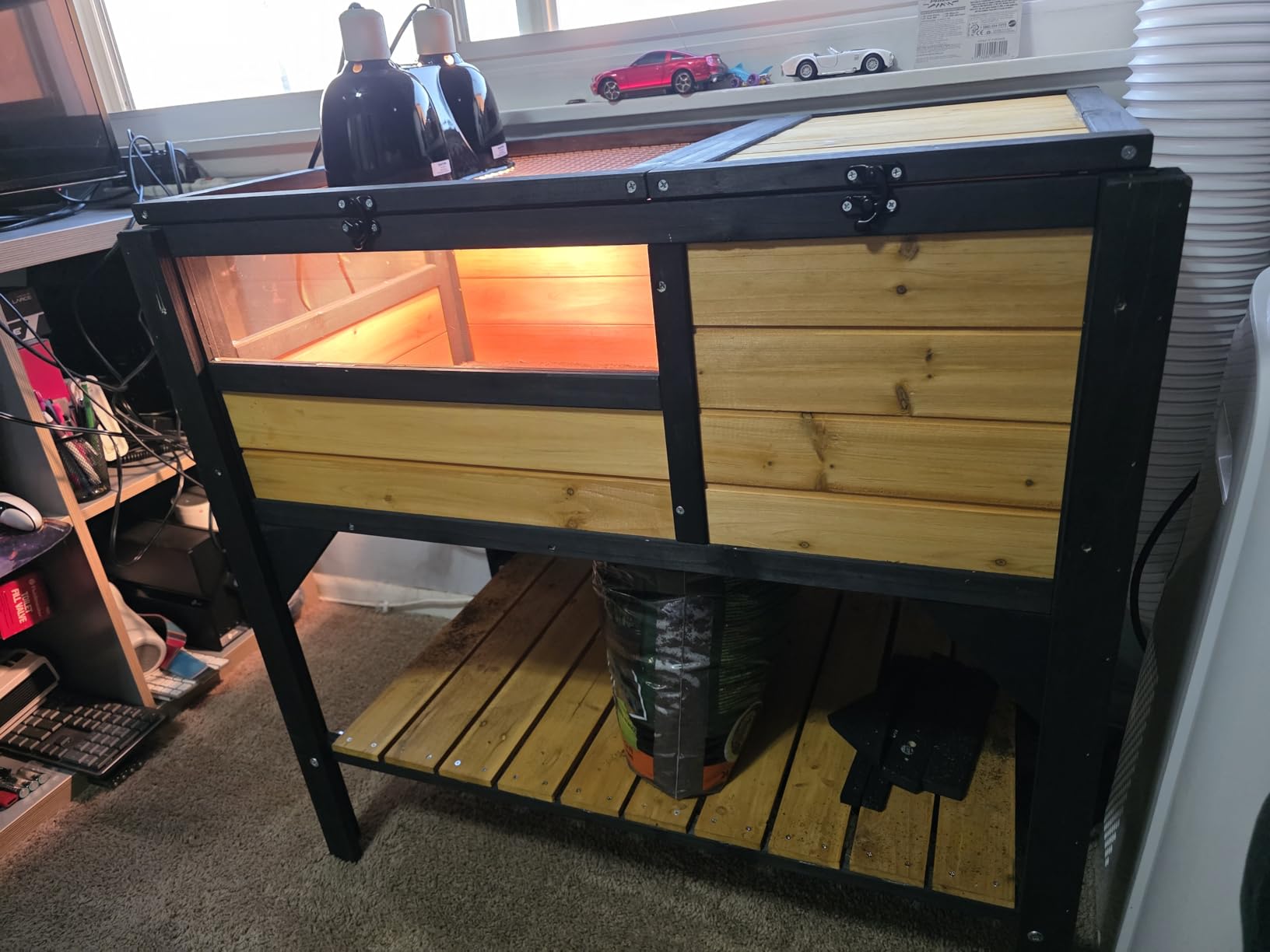
The VEVOR is 33 x 19.7 x 32.5 inches at 26.46 pounds, and it assembles in roughly 40 minutes for one person. That build speed, plus a caster option, makes it unusually easy to move and rearrange, which is a genuine advantage in a home where the tortoise table shares space with other pets.
It has been available since October 2024 and carries a 4.2 average from 59 reviews, about 65 percent five star. The heavy-duty storage shelf on the leg frame is the feature owners mention most, along with the fact that the finished size matches the advertised dimensions.
Before anything else, read this: the enclosure is cedar. Several owners report breathing problems in their tortoises after using it, and cedar is an aromatic softwood that is not appropriate for sensitive reptile respiratory systems. This is a repeated warning across the reviews, not a single outlier complaint. If you are keeping a tortoise, choose one of the pine, fir or plywood alternatives in this roundup instead.
That is why we have not given this model a tortoise-specific badge despite the useful design. As a general small animal enclosure for bearded dragons, geckos, snakes or brooders, the two-room layout, light stand and shelf frame all work well.
What works regardless of species
The leg frame with a heavy-duty storage shelf is well judged by owners. It is wide enough to hold a bag of substrate, a water bowl and a food tub, and it holds weight without deflecting. Owners also like that the wood has a pleasant smell rather than the chemical tang some budget enclosures arrive with.
The two-room layout separates a solid-wood private sleeping zone from a mesh-window activity space, and the light stand sits above the enclosure for a basking lamp. A caster-leg variant is available if you want to move the whole thing regularly.
Build quality issues to plan for
Owners report thin material that can split at the pre-drilled holes during assembly, instructions laid out in the wrong order, and a bottom tray that is unsupported and bows under the weight of substrate. Have a rubber mallet and a spare set of screws to hand.
Owners also comment that the light fixture design needs work. If you plan to use a mercury vapour bulb, check the fitting type before you buy, because a mismatched socket is a frustrating return.
10. PawHut 48 Inch Two-Hide Habitat – The Longest Run and Best Two-Animal Layout
PawHut Tortoise Habitat with Adjustable Lamp Holder, Attached Tray Yellow
48 x 22.2 inch run
Two hide boxes
Removable divider
Adjustable lamp holder
Pros
- Longest single run area in the group at 48 inches
- Two hide boxes allow separate housing
- Removable divider switches between one run and two rooms
- Adjustable lamp holder and openable top
- Attached leak-proof tray and bottom shelf
Cons
- Attached tray is fixed rather than fully removable
- Divider changes floor area flexibility
- Heaviest unit reviewed at 36 pounds
The PawHut 48 Inch habitat is the longest single run in this roundup at 48 x 22.2 x 36.6 inches, and that length is what makes it interesting. A long, narrow floor gives you a genuine thermal gradient, because a heat lamp at one end simply does not warm the far end. Shorter tables tend to end up with one uniform temperature and no meaningful cool end.
It arrived in May 2025 and holds a 4.0 average from 59 reviews, around 61 percent five star. Colours are available in yellow and grey.
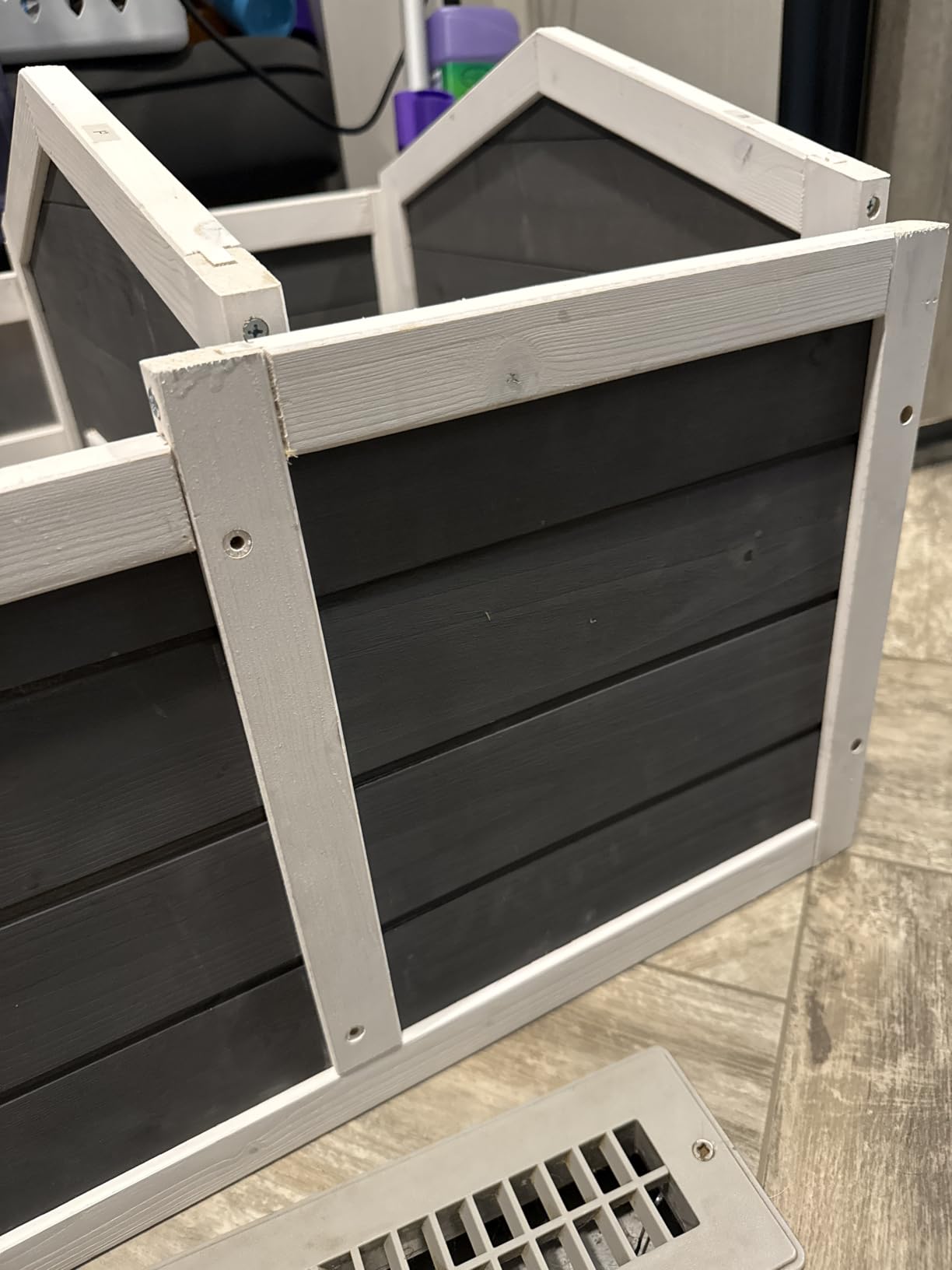
The second distinguishing feature is the pair of hide boxes with a middle run area between them. For a single tortoise, that means two separate hiding places and a movement route between them, which encourages the roaming that a flat open box never produces. For two animals, the removable divider panel converts the layout into two separate rooms, which is the only two-animal option in this roundup.
There is an adjustable lamp holder, an observation window and an openable top in the run area, a leak-proof design with an attached plastic tray, and a bottom shelf for food and supplies.
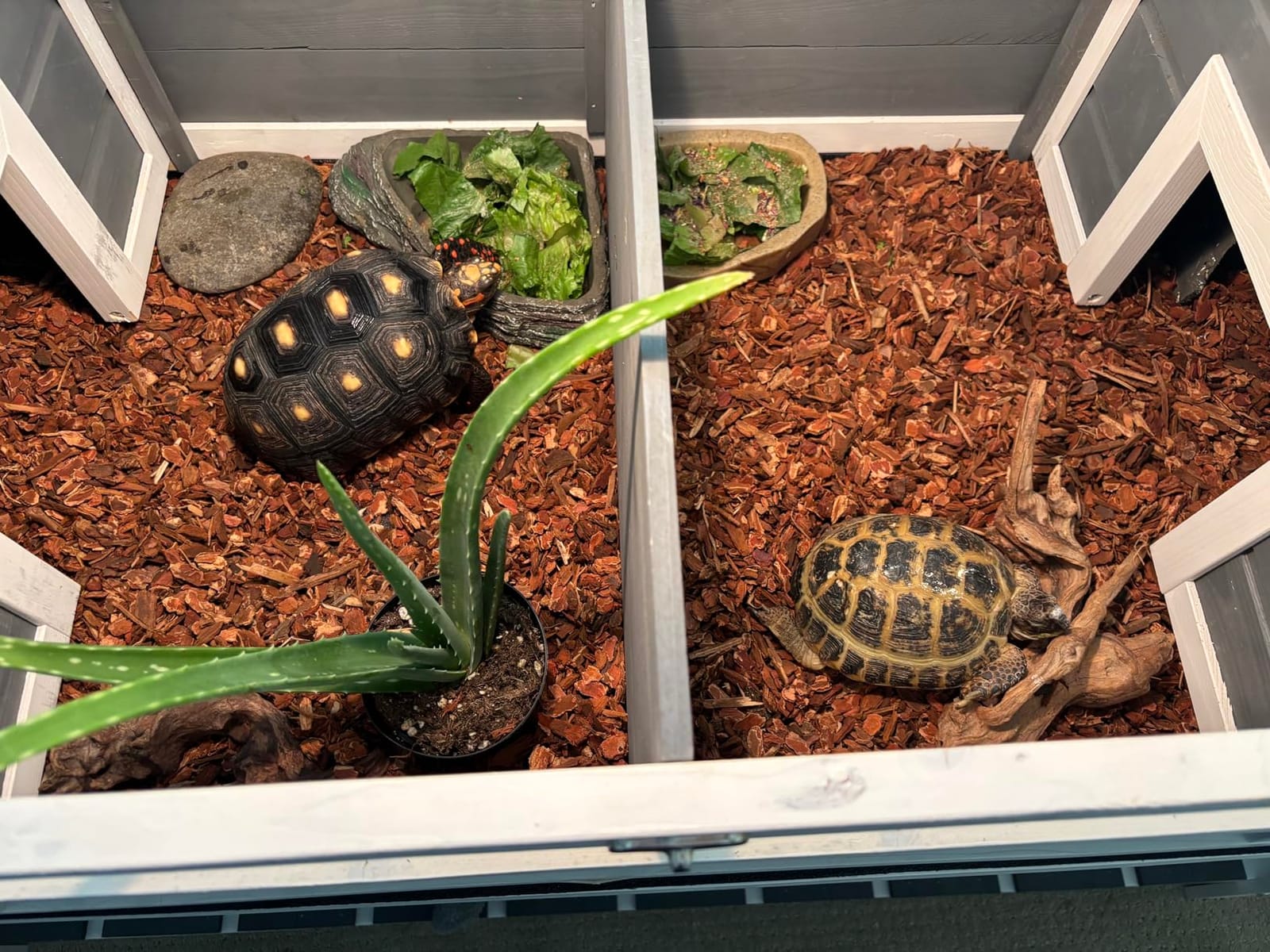
How to use the removable divider
The divider is the feature that makes this enclosure worth the footprint. With it in place you get two independent zones, each with its own hide, which is useful for quarantine, for a pair that needs separating for feeding, or for housing two juveniles of different sizes without doubling your floor space.
Take it out and the middle becomes one continuous run. A tortoise that has been sitting in a 20-inch box will use that space immediately, and the long axis is exactly the direction a heat lamp needs to create a real gradient across.
The weight and the fixed tray
At 36 pounds this is the heaviest unit in the group, and that is a real consideration above ground floor. Plan your route into position and get help lifting it into place.
The tray is attached rather than fully removable, so you cannot lift the whole base out for a deep clean. Owners note the fixed tray as the main limitation, and it is worth weighing against the PawHut Two-Layer model below, which sacrifices tray removal for a removable house instead.
11. PawHut Two-Layer Gray Habitat – The Easiest One to Deep Clean
PawHut Tortoise Habitat with Adjustable Lamp Holder, 2 Layer Tortoise Enclosure with Storage Shelf, Removable Main House, Fixed Tray, Openable Lid, Gray
40.2 x 22 x 40.9 inch
Removable main house
Attached tray
Storage shelf
Pros
- Removable main house and ramp make deep cleaning straightforward
- Solid routed joinery that fits together tightly
- Storage shelf underneath keeps supplies together
- Well packaged with all parts intact
- Adjustable lamp holder included
Cons
- Open-top design cannot hold humidity for tortoises
- Ramp is mounted dead centre rather than on a wall
- Heavy once built and hard to move solo
This PawHut answers a specific cleaning complaint. It measures 40.2 x 22 x 40.9 inches without the lamp holder, weighs 34 pounds, and its main house section lifts out entirely along with the ramp. That means the sleeping area can be washed, dried and put back rather than being a fixed box you can only reach with a cloth.
It arrived in February 2024 and holds a 4.1 average from 50 reviews, with roughly 56 percent five star. That is the smallest review base in the group, so read the themes as useful but not settled.
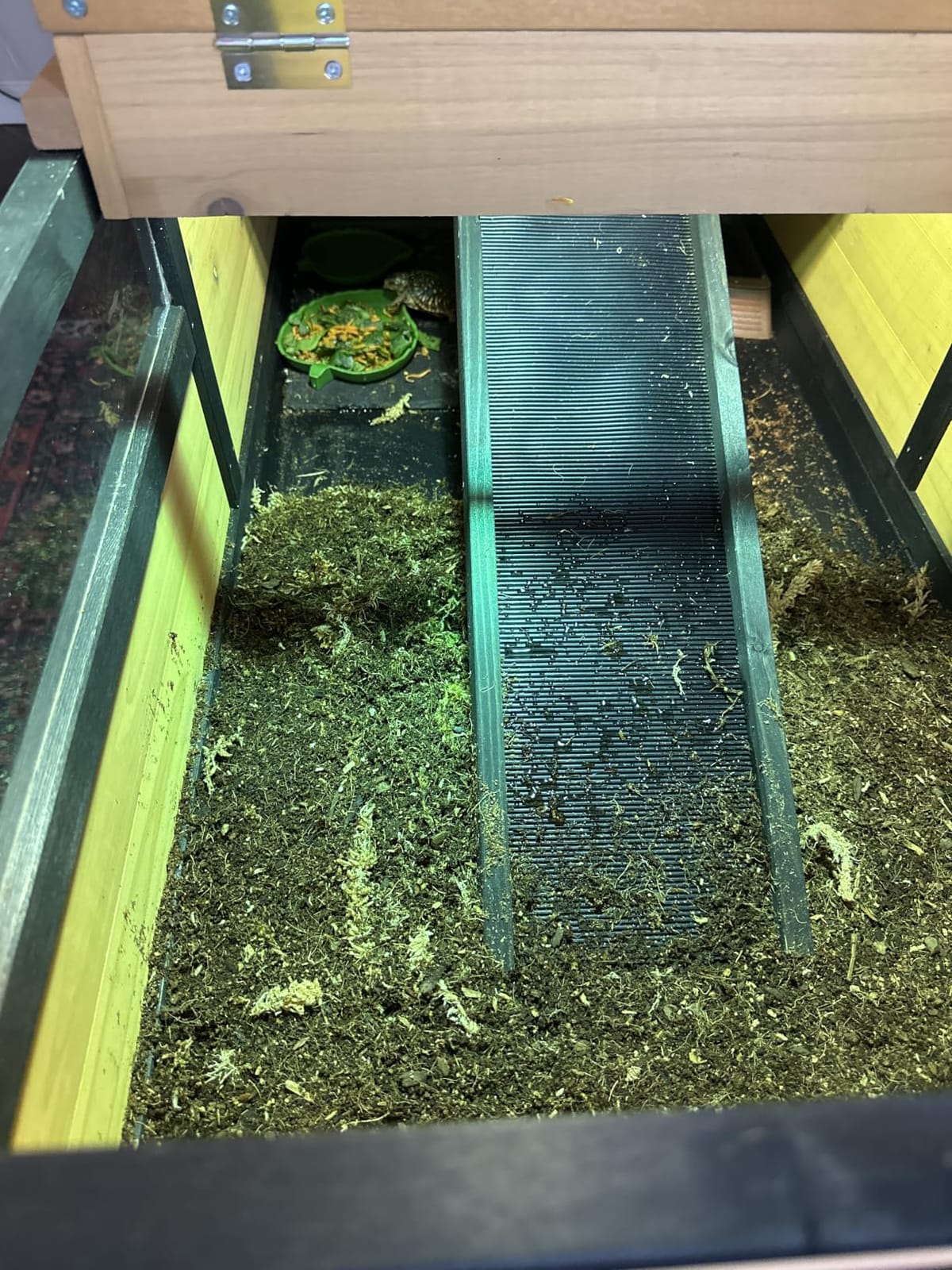
Build quality is the standout. Owners describe solid routed joinery that fits together tightly, and the unit arrives well packaged with all parts intact. A storage shelf runs underneath for supplies, and there is a clear viewing window and an openable top alongside the adjustable lamp holder.
The dual-level arrangement puts the main house above a run box, and the attached plastic tray is there to prevent water and sand leaking into the storage area beneath. Two colours are published, gray and yellow.
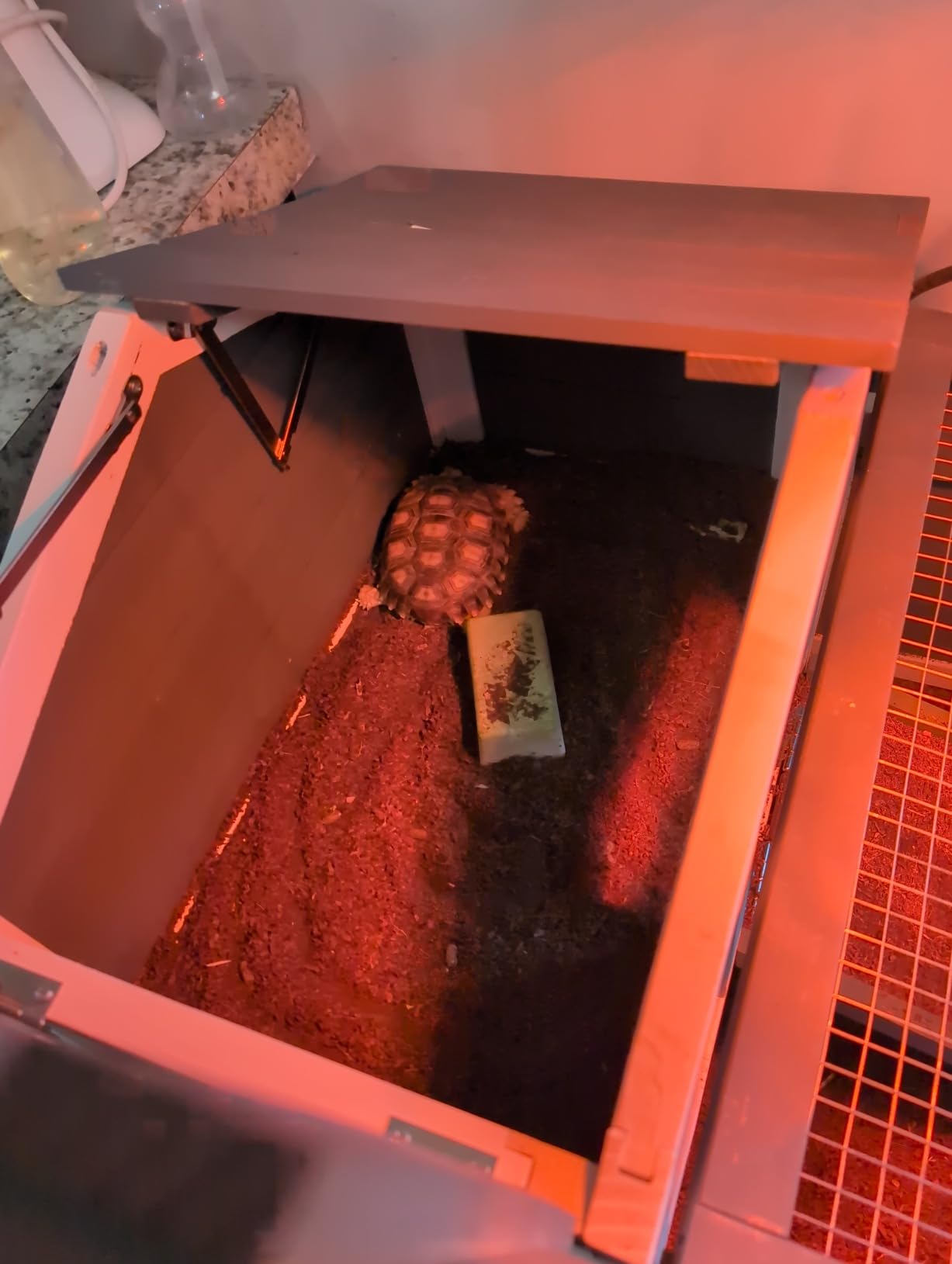
Why a removable house beats a removable tray
Forum research on this topic keeps surfacing the same line: wooden tables are hard to clean and sanitise, and owners end up buying several to rotate. A removable house attacks the problem from a different direction than a pull-out tray. The floor stays fixed, but the whole upper structure lifts away, and that is where hides, droppings and damp substrate actually accumulate.
The routed joinery matters here too. Tight-fitting parts mean fewer crevices for smell to lodge in, which is the underlying reason some wooden enclosures seem impossible to sanitise properly.
The humidity trade-off is real
Owners are direct about the main drawback: an open-top design makes it impossible to hold the humidity that tropical species need. For red-footed or other tropical tortoises this is a poor choice, and for Mediterranean species like Hermann’s, Marginated and Russian it is not a problem at all.
Smaller issues include a ramp mounted dead centre rather than against a wall, and some panels mislabelled in the instruction book. At 34 pounds it is also hard to move once built, so assemble it where it will live.
12. BIRASIL Two-Tier Habitat – The Only One With a Built-In Bathing Pool
BIRASIL Wood Tortoise Enclosure with Adjustable Light Stand,2-Tier Habitat Reptile Cage with Swimming Area Feeding Area, Tortoises House for Small Animals Lizards Hamster (Gray/White)
Upper bathing and feeding dish
Adjustable light stand
Steel mesh top
Removable tray
Pros
- Unique two-tier layout with an upper swimming and soaking pool
- Non-toxic water-based paint with a mild odour
- Latch lock keeps curious cats out
- Wide-spaced steel mesh does not block UVB
- Good value and fast seller support
Cons
- No pre-drilled holes so the wood splinters in assembly
- Sliding bottom leaves wall gaps and feeders escape
- Clear plastic walls scratch easily
The BIRASIL is the only enclosure here with an integrated water feature. It measures 38.97 x 23.03 x 31.5 inches at 32.55 pounds, and the two-tier design puts a plastic swimming and feeding dish on the upper floor, with a lower private room and activity room beneath it.
It arrived in August 2025 and holds a 4.0 average from 55 reviews. It also carries the highest one-star share in the group at 14 percent, with only 54 percent five star, so read the negatives carefully before you decide.
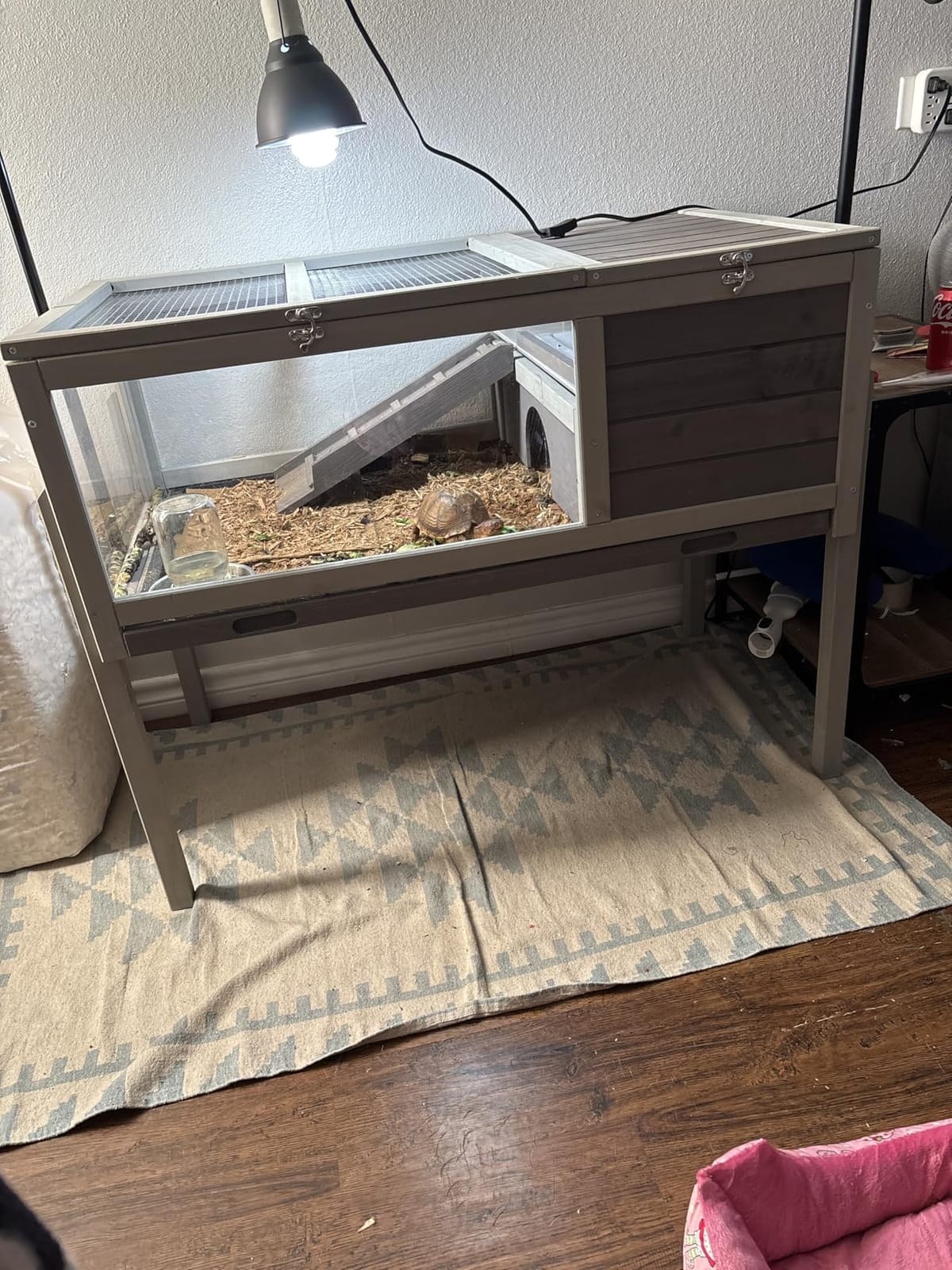
For a red-footed or other tropical juvenile, that upper pool is genuinely useful. It gives you a soaking dish that is part of the structure rather than a separate bowl on the floor that tips over when the animal walks past it. The adjustable and removable light stand sits above the enclosure and can be positioned over either tier.
Construction is fir wood with a steel mesh screen, and the mesh wires are widely spaced, which owners note does not block UVB. The finish is a non-toxic water-based paint, and there is a latch lock to keep curious cats out. Detachable legs allow tabletop placement.
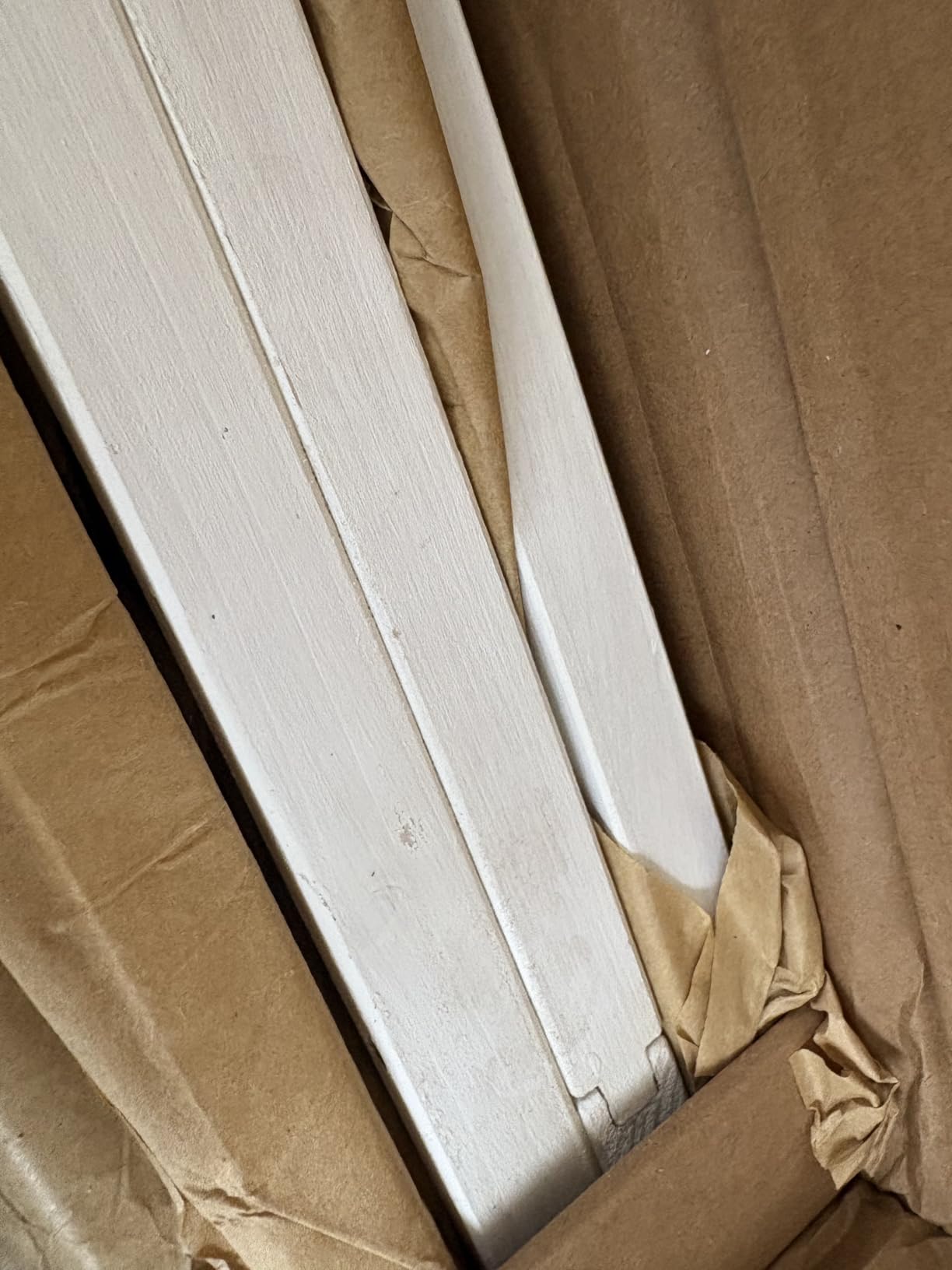
Mesh spacing and lamp placement are the strengths
UVB does not pass through solid clear panels, so enclosure material choice affects your lighting more than most listings admit. The wide-spaced steel mesh here is a genuinely good design decision, and one owner reports holding three light fixtures and a mealworm dish on it without complaint, which tells you something about the frame’s strength.
The adjustable, removable light stand is a plus for the same reason it is on the Magazoopet: you can move the heat source to create a gradient across both tiers rather than centring it over one spot.
Where the assembly falls short
There are no pre-drilled holes on this model, so the wood splinters during assembly and the lamp bar does not reach the full panel height. Have sandpaper and a file to hand, and check the light stand reach before you commit to a bulb height.
The pull-out bottom leaves gaps at the walls, so loose-feed crickets and mealworms escape. The clear plastic walls also scratch and mark easily, and some panels arrive cracked or discoloured.
What Size Tortoise Table Do You Actually Need?
A tortoise table should be at least 3 feet by 2 feet for a hatchling, and experienced keepers argue for 4 feet by 2 feet as a more realistic minimum once the animal is a juvenile. For adults, aim for 4 feet by 4 feet or larger, and go bigger again for sulcata and leopard tortoises, which will outgrow anything sold in this roundup.
Floor area is the number that matters, and it is the one sellers obscure. Published dimensions are almost always overall external measurements, so the usable interior is smaller by the wall thickness on all four sides. Ask the seller for the interior figure before you order, especially if you are near a size threshold.
As a rough guide, a hatchling of Hermann’s, Marginated, Spur-thighed, Russian or Greek species is comfortable in a 3 by 2 foot area. A juvenile wants at least 4 by 2 feet. Adult Mediterranean species are best in 4 by 4 feet. Sulcata and leopard juveniles outgrow indoor tables quickly and are far better served by a large outdoor pen with an indoor shelter for extreme weather.
Wall height matters less than floor area, but aim for enough head clearance in the hide that the animal can stand and turn without scraping. Around 10 to 13 inches of wall height is the usual range on the enclosures in this roundup, and anything under 8 inches is more of a tray than a habitat.
Tortoise Table vs. Vivarium vs. Glass Tank
Tables beat vivariums for tortoises because they offer more floor area, far better ventilation and room to suspend lamps at a safe height. Vivariums and glass tanks are easier to heat and hold humidity, but those are advantages for tropical species, and they come at the cost of the space and airflow that a tortoise needs.
Small, enclosed vivaria are specifically something to avoid for tortoises. The Tortoise Trust recommends open-topped table designs or very large custom units instead, on the grounds that tortoises are active walkers who need ground area for exercise and a broad basking zone rather than a tight warm box.
Glass tanks are the worst of the three for this purpose. Glass blocks UVB entirely, so the animal cannot synthesise vitamin D3 properly without a separate lamp, and the walls prevent any meaningful behavioural thermoregulation because there is nowhere to move to a different temperature.
The practical rule: if your tortoise is a Mediterranean or Russian species, choose a table and accept lower humidity. If you keep a red-footed or other tropical species, you need a covered enclosure with a misting system, and a table becomes the base of a hybrid setup rather than the whole answer.
How to Choose the Right Table
Start with floor area, because it is the one thing you cannot retrofit. Measure the space you have, subtract wall thickness from the published dimensions, and be honest about whether the tortoise will still fit in a year. Buying a larger table now is cheaper than buying two tables over three years, and several keepers told us the second purchase is the one they regret.
Check the lamp system next. An adjustable holder that moves vertically is worth paying for, because it is the variable you will adjust most. Avoid fixed arms entirely. The Magazoopet offers the widest range in this group and the Zoo Med offers none, which is a fair trade given its modular design.
Look at the base. A fully surrounded waterproof bottom tray is the single most useful feature for longevity. A tray that pulls out makes cleaning honest; a fixed tray means scrubbing. Either way, fit a waterproof liner above the substrate line so the wood never sits in contact with damp soil.
Measure the covered area, not the whole box. Listings give total dimensions including any sleeping house, but your tortoise can only use the floor. The PawHut with shelf storage is honest about this, publishing separate hide box and basking area measurements, which is why it was easy for us to assess.
Think about the room around it. Position the table in a bright room with no direct sun, no drafts and a nearby power outlet for the lamps. Keep it away from other pets, and check the route to its final position against the unit’s weight before you assemble it, because several models here weigh 30 pounds or more.
Decide how it will look. If the table will live in a living room rather than a utility space, the furniture-style finish matters as much as the dimensions. It is worth reading our picks on coffee tables with storage to get a sense of how shelf space changes how furniture functions in a room, and our notes on changing tables apply to the same principle: integrated storage is what turns a large object into a usable piece of furniture.
Check the wood species. This is a question almost nobody answers well, so we will answer it directly. Marine-grade plywood sealed with an aquarium-safe product, solid pine and fir are all workable. MDF and particleboard are not, because they swell irreversibly when wet. Aromatic softwoods such as cedar should be avoided for tortoises, which is why we did not recommend the VEVOR despite its otherwise useful design.
Look for a return window. Wooden enclosures are bulky and awkward to return, and a proportion of units arrive with panels that are not flush. A seller who will take it back within a month is worth more to you than a small saving from a seller who will not.
Heating, Lighting and Substrate for a Table Setup
Target a basking spot of about 30°C/86°F at one end and a cool end near 20°C/68°F at the other, which gives a 10-15°C gradient the tortoise can move through at will. Check the temperature at the animal’s height rather than at bulb level, and adjust until both ends are right rather than trusting the lamp’s rating.
Hang bulbs about 30 cm above the basking surface, and raise them if a mercury vapour bulb is in play, because UVB output at close range can damage eyes. Run a 12-hour lighting cycle on a timer so the photoperiod is consistent, and use a dimming thermostat rather than a cheap dimmer switch.
For UVB you have two sensible options. A mercury vapour combination bulb delivers UVB and heat from one fitting but has a narrow spread, so it suits a long table better than a square one. A high-output UVB fluorescent tube with a separate reflector bulb covers a wider area and gives a more even gradient across the floor.
For substrate, a 50/50 mix of topsoil and play sand gives the best balance of digging, drainage and stability. Aim for enough depth that the tortoise can bury itself and dig out, which is a behavioural need rather than a luxury. Fit a waterproof liner above the substrate line, never below it, so moisture cannot wick into the wood from underneath.
Cleaning a Wooden Tortoise Table Without Ruining It
Spot clean daily and do a full substrate change on a schedule rather than waiting for a smell. Remove droppings and uneaten food promptly, because ammonia damage to a sealed wooden interior is not reversible.
For tables with a pull-out tray, the routine is simple. Lift the tray, rinse it, dry it fully and refill. For fixed-floor models, lift out any removable hiding furniture, scoop the substrate, and wipe the bare wood with a reptile-safe disinfectant, then let it dry completely before returning the animal.
The most common mistake is sealing a table with a film finish. A completely sealed interior traps humidity you cannot vent, and tortoises need a dry surface to sit on. If you seal the wood, seal only the exterior and the underside.
Forum research on this topic found owners buying several tables in rotation specifically because wooden enclosures are hard to sanitise. That is an expensive workaround. A removable tray, a removable house, or a fitted waterproof liner solves the same problem once, and several models in this roundup are designed around exactly that.
When an Indoor Table Is Not Enough
An indoor table is supplementary housing, not a permanent home, and that distinction is the most important thing in this article. Tortoise Trust, the UK’s longest-running tortoise charity, is explicit that indoor accommodation cannot provide the floor space, ventilation, brightness or enrichment that outdoor access delivers.
The brightness gap is the starkest. Tortoise Trust reports lux readings outdoors in the region of 90,000 to 130,000, against levels under 1,000 indoors. No UVB lamp closes that difference, and metabolic bone disease in captive tortoises is strongly associated with inadequate UVB and calcium.
Use an indoor table for winter, quarantine, illness recovery, and days when outdoor conditions are genuinely unsafe. If your tortoise is otherwise healthy and the weather permits, outdoor access should take priority every day you can manage it, even a short period in a secure outdoor pen.
If you are reaching the point where a 4 by 2 foot table is no longer enough, the honest answer is that you need more space, not a bigger table from this list. Budget for a large outdoor pen and keep the indoor table as the winter and bad-weather space it is good at.
Frequently Asked Questions
What is the best indoor enclosure for a tortoise?
A large, open-topped wooden tortoise table is the best indoor enclosure for a Mediterranean or Russian species. It gives more floor area, better ventilation and room to suspend heat and UVB lamps at a safe height than a glass vivarium. Aim for at least 3 by 2 feet for a hatchling and 4 by 2 feet or more for a juvenile. Add a waterproof liner, a 50/50 topsoil and play sand mix, and a basking zone at 30°C against a cool end near 20°C.
Can a tortoise live in a tortoise table?
A tortoise can live in a well-built tortoise table, but it is supplementary housing rather than a permanent home. Outdoor access and unfiltered sun cannot be replicated by UVB lamps, and Tortoise Trust reports outdoor light levels far above anything achievable indoors. Use a table for winter, quarantine, recovery and bad weather. Give your tortoise outdoor access every day the conditions allow, and treat the indoor table as the backup space it is good at.
Are tortoise tables better than a vivarium?
Yes, for most tortoise species. Tables offer more floor area, far better ventilation and a wide basking zone, which supports the walking and thermoregulation behaviour tortoises need. Vivariums and glass tanks hold heat and humidity more easily, which helps tropical species, but glass blocks UVB and the enclosed space limits movement. The exception is a red-footed or other tropical tortoise, which needs a covered, humid setup.
How big should my tortoise table be?
At least 3 feet by 2 feet for a hatchling, 4 feet by 2 feet for a juvenile, and 4 feet by 4 feet or larger for an adult Mediterranean species. Sulcata and leopard tortoises need considerably more and are better suited to a large outdoor pen. Published listing dimensions are usually overall measurements, so subtract wall thickness to get the interior floor area, and ask the seller for the interior figure before ordering.
What type of wood is best for a tortoise table?
Marine-grade plywood sealed with an aquarium-safe product, solid pine and fir are all suitable for a tortoise table. Avoid MDF and particleboard, which swell permanently when wet, and avoid aromatic softwoods such as cedar, which have caused reported breathing problems in tortoises. Do not seal the interior surface completely, because a fully sealed base traps humidity that the enclosure cannot vent.
What are people saying about the PawHut tortoise houses?
Across the three PawHut enclosures in this roundup, reviewers consistently praise the integrated storage shelves, the heat lamp frames and the two-room layouts. The most repeated criticisms are soft wood that marks or splinters during assembly, trays that are fixed rather than removable, and dividers that do not sit flush with the pan. The 48-inch model is praised for its run area and twin hide boxes, while the Two-Layer model is liked for its removable house section.
Conclusion: The Best Tortoise Tables for Indoor Habitats
The Aivituvin Wooden Tortoise House is our pick as the best tortoise tables for indoor habitats, on the strength of the largest review base in the group and a solid wood build that resists damp substrate. If your priority is the highest average rating and a design that grows with the animal, the Zoo Med Tortoise House is the one to buy, and its modular double-up is the smartest answer to the size problem every keeper eventually hits.
For the best balance of floor area and cleanability on a sensible budget, the GEGURI gives you a pull-out tray and detachable legs. Whichever you choose, check the interior floor measurement before you order, plan the thermal gradient before you fill it with substrate, and remember that an indoor table is winter and bad-weather housing rather than a substitute for outdoor sun.