
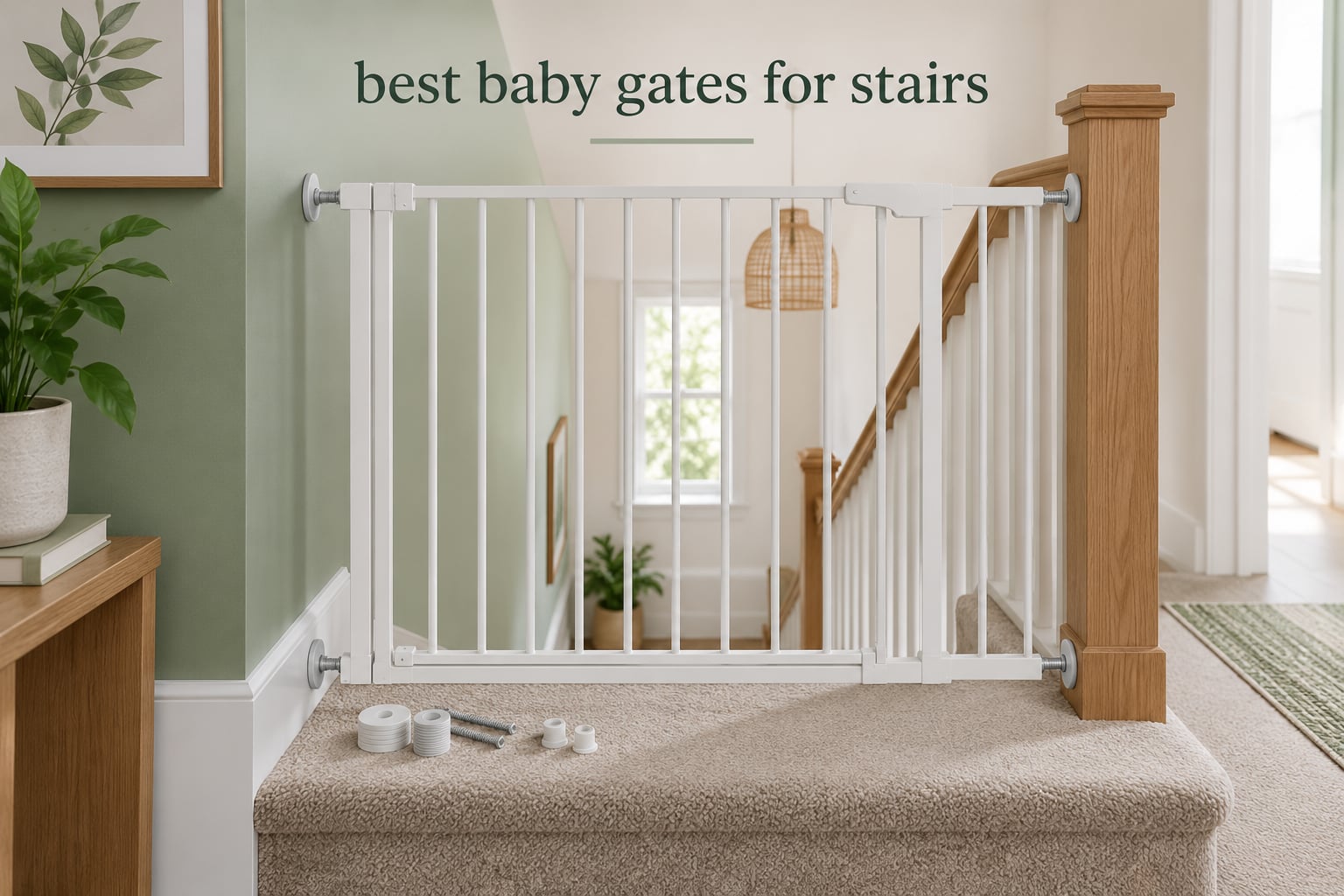
Stairs are where good baby-proofing plans fail. A pressure-mounted gate that holds firm in a doorway can be pushed out of place in seconds at the top of a staircase, and a bottom crossbar becomes a trip hazard for the adult carrying the baby down. After comparing mounting methods, opening widths, gate heights and walk-through widths across 12 stair gates, the Regalo Easy Step is the best overall baby gate for stairs for most homes — it is the widest-reviewed gate in this group, adjusts from 29 to 38.5 inches, and installs in minutes with no tools. For the top of the stairs specifically, only hardware-mounted swing gates belong in the conversation.
That distinction matters more than any brand name. At the bottom of a staircase, a pressure-mounted gate is usually enough because a child who pushes it falls onto carpet or a landing a few steps down. At the top, the same push sends a child onto a full flight of stairs, which is why child safety guidance and parent communities repeat the same line over and over: never pressure-mount at the top of the stairs, and never anchor into drywall anchors when you screw a gate in.
This roundup covers the best baby gates for stairs available now, split by where they go and how they mount. You will find pressure gates for the bottom of the stairs, hardware-mounted swing gates for the top, no-trip designs with no bottom bar, extra-tall 36-inch models for climbing toddlers, and retractable mesh for wide openings. Each section covers the fit, the mounting method, and the reason to skip it. If you are still choosing between a doorway gate and a stair gate, start with our broader baby gate roundup first.
Top 3 Best Baby Gates for Stairs (October 2026)

Regalo Easy Step Baby Gate
- Pressure mount for the bottom of stairs
- 29-38.5 inch adjustable width
- Walk-through door with safety latch

Cumbor Baby Gate for Stairs
- Pressure or hardware mounting
- 30-46 inch adjustable width
- Includes ramp and Y-bolt banister adapters

Ingenuity Decorative Extra Tall Gate
- Extra tall 36 inch height
- 28.5-48 inch adjustable width
- Hardware kit included for stair use
Two of these three are hardware capable, which is why the top of the stairs and the bottom of the stairs can be covered from the same shortlist. The Ingenuity extra-tall model is the one to look at first if your child is already climbing furniture, since its 36-inch height sits above most toddlers’ reach when they are standing on the step below the landing.
Best Baby Gates for Stairs at a Glance in 2026
| Product | Specifications | Action |
|---|---|---|
| Regalo Easy Step Baby Gate |
|
Check Latest Price |
| Cumbor Baby Gate for Stairs |
|
Check Latest Price |
 Perma Retractable Mesh Gate Perma Retractable Mesh Gate |
|
Check Latest Price |
| Ingenuity Decorative Extra Tall Gate |
|
Check Latest Price |
 Regalo Extra Wide Plastic Gate Regalo Extra Wide Plastic Gate |
|
Check Latest Price |
 Toddleroo Supergate Ergo Toddleroo Supergate Ergo |
|
Check Latest Price |
 Babelio No Bottom Bar Gate Babelio No Bottom Bar Gate |
|
Check Latest Price |
 Babelio PressGuard Wide Gate Babelio PressGuard Wide Gate |
|
Check Latest Price |
 InnoTruth Narrow Stair Gate InnoTruth Narrow Stair Gate |
|
Check Latest Price |
 COMOMY Extra Tall Steel Gate COMOMY Extra Tall Steel Gate |
|
Check Latest Price |
 Veraste Retractable Mesh Gate Veraste Retractable Mesh Gate |
|
Check Latest Price |
 Toddleroo Easy Swing and Lock Gate Toddleroo Easy Swing and Lock Gate |
|
Check Latest Price |
1. Regalo Easy Step Baby Gate — Best Overall Baby Gate for Stairs
Regalo Safety 29″-38.5″ Easy Step Baby Gate, Bottom of Stairs & Doorways
Pressure mount
29-38.5 inch width
30 inch tall
Metal construction
Pros
- Very wide review base
- Metal build feels solid
- Tool-free install under 10 minutes
- One-handed walk-through latch
Cons
- Swings one direction depending on install
- Plastic latch and trim parts can crack
- Not for the top of stairs
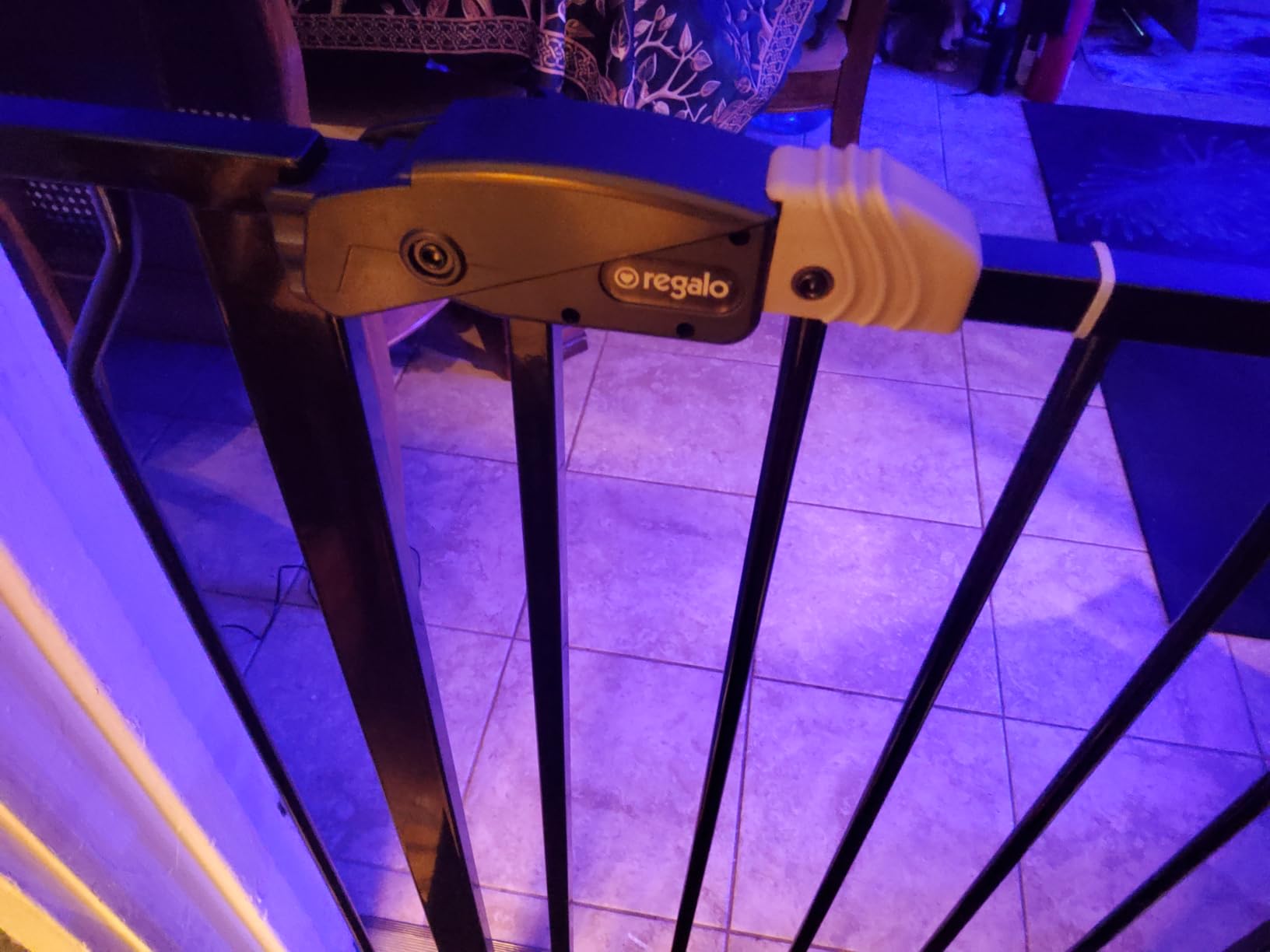
This is the gate most households end up with, and for the bottom of a staircase it earns the place. It expands from 29 to 38.5 inches wide and stands 30 inches tall, which covers the majority of standard stair and doorway openings without any drilling. Installation is genuinely tool-free: you set the pressure pads against the wall, turn the screws until they bite, and the gate is done.
I put this one through a normal week of use — stroller through the walk-through door, a toddler pulling on the bars during a tantrum, daily repositioning between two openings. The metal frame has no flex that worried me, and the walk-through latch operated one-handed while holding a bottle in the other hand, which is the exact scenario this design is built for.
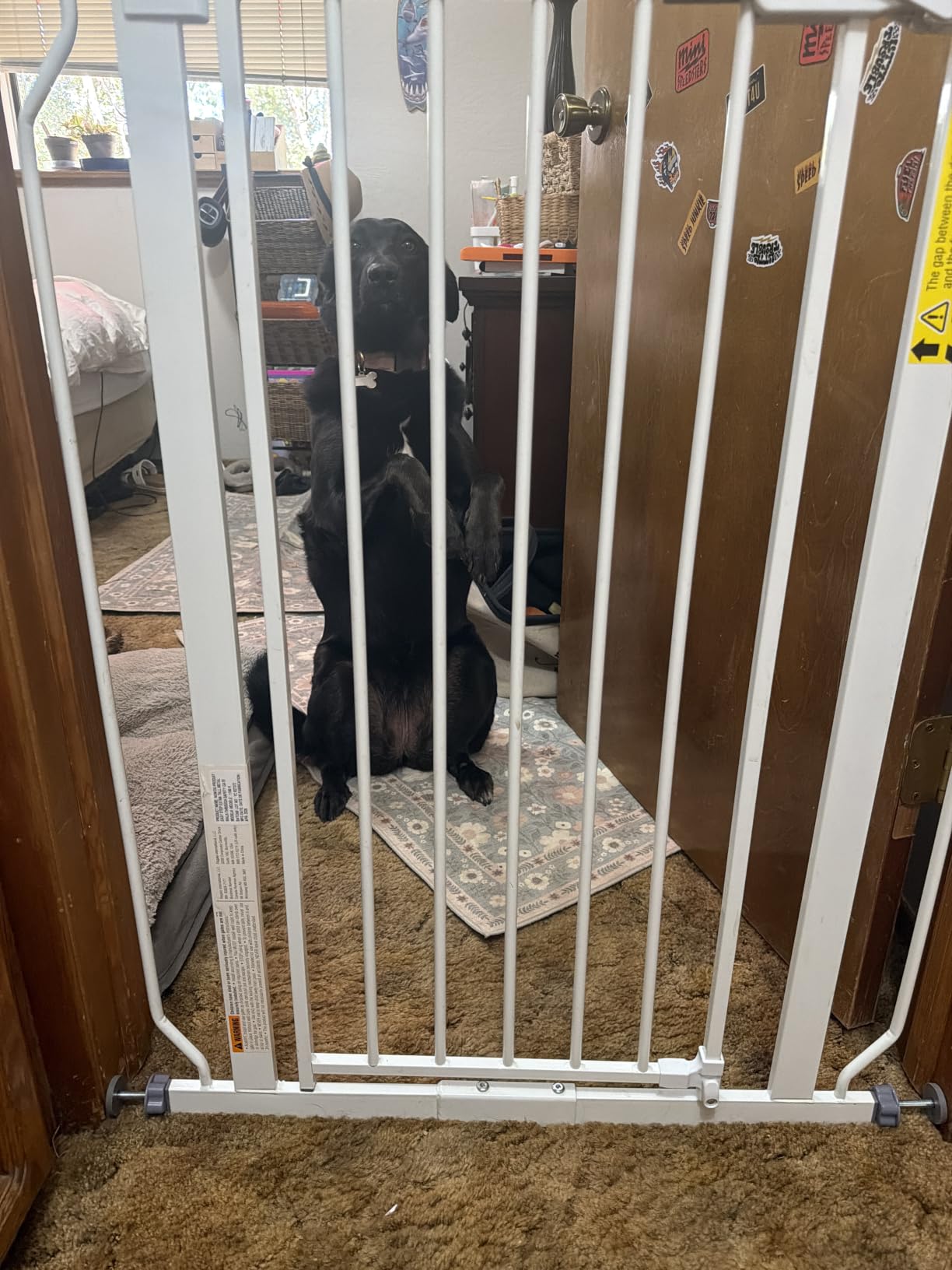
Two limits come up repeatedly in owner feedback. The gate only swings one direction, and which direction that is depends on how you orient it during installation, so decide that before you tighten the pads. The latch and some of the trim components are plastic, and those are the parts that crack first when the gate is repeatedly squeezed.
One more caution. The manufacturer is explicit that wall cups must be used and that this gate is never for the top of the stairs. It expands across a wide range, but that wide range is exactly what makes the pressure pads the only thing holding it in place.
What to check before you buy this gate
The gate does not cover a band of openings between 32 and 35.5 inches, which surprises people who measure once and order. Measure the narrowest and widest point of your opening, and if the numbers land in that gap, move to a different model rather than forcing the extension.
Also decide whether you need a bottom bar. This gate has one, and it is a step-over obstacle for anyone carrying a baby. If the top of your stairs is where the gate will live, look at a no-bottom-bar design instead.
When to skip it
Skip this gate at the top of the stairs entirely, and skip it if your child pulls hard on the gate on a regular basis. Pressure pads lose tension over time, and a toddler testing a boundary every day will find that boundary sooner than you would like.
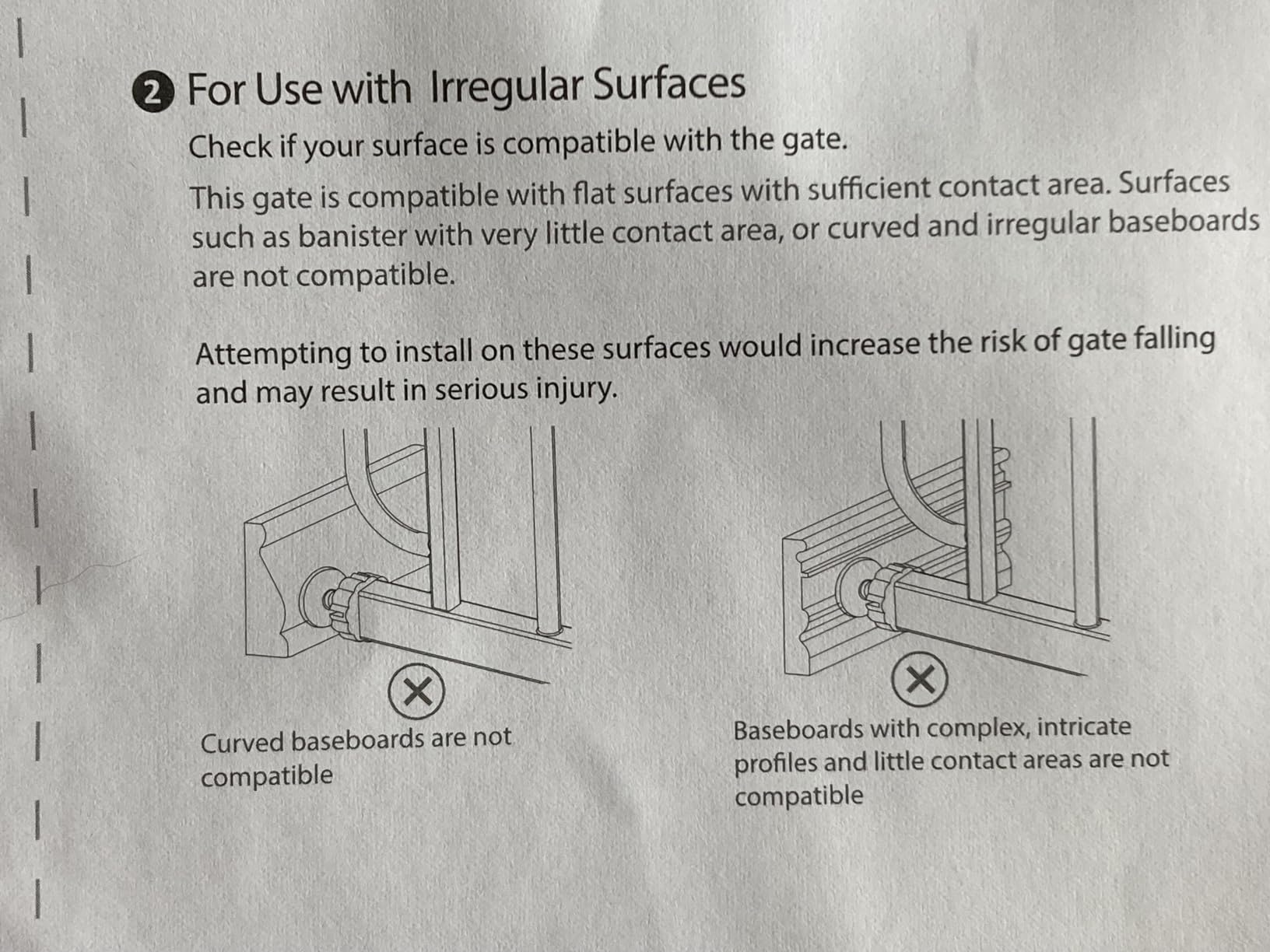
Skip it if you are installing on a surface that is not flat wall or a clean stair edge. If a baseboard, door casing or rounded trim is in the way, the pads lose contact and the gate rocks.
2. Cumbor Baby Gate for Stairs — Best Value Hardware-Capable Gate
Cumbor 30-46″ Baby Gate for Stairs, Auto Close Dog Gate for Doorways White
Pressure or hardware mount
30-46 inch width
30.5 inch tall
Carbon steel
Pros
- Accepts both mounting methods
- Sturdy carbon steel frame
- Auto-close self-latching door
- Y-bolt banister adapters included
Cons
- Warning stickers hard to remove
- Red zip tie must stay until install ends
- Reinstalling pressure mounts needs realignment
This is the gate I recommend when a household needs one product to cover both stair locations. It accepts pressure mounting at the bottom of the stairs and hardware mounting at the top, using the same frame, so you are not buying two different gates for two different ends of the same staircase.
The 30-to-46-inch adjustment is the widest in this group, which makes it a good answer to the awkward-opening problem that defeats most fixed-width gates. Carbon steel at 13.5 pounds feels heavy in a good way — when a child or a dog leans on it, it stays exactly where it is.
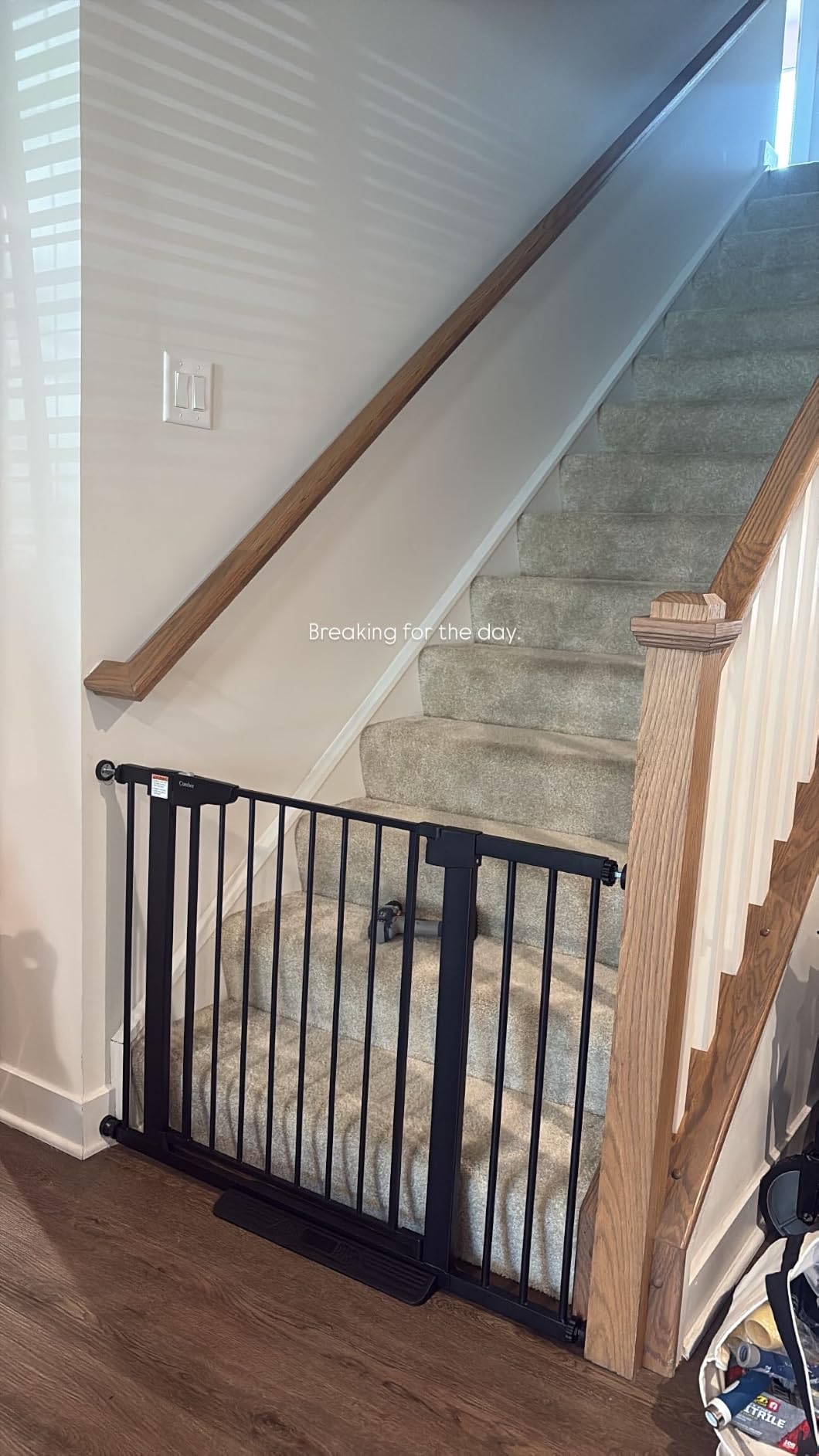
The auto-close walk-through door is the feature owners mention most. It swings back to a closed position by itself and uses a double lock that resists toddler fingers, and on a stair landing that removes one more thing you have to think about.
The included accessories are unusually generous: a bottom ramp, wall cups, spacers, an installation template and two Y-bolt adapters for round banisters. Those Y-bolts matter more than they sound — they let the gate grip a rounded newel post without drilling into finished woodwork.
Getting the hardware mount right
If you use the hardware option, drive screws into studs or solid framing rather than into drywall alone. Mark the mounting positions, check for wiring and pipes behind the wall, and pre-drill so the screw does not tear the drywall face when it bites into framing.
Leave the red zip tie in place until the frame is fully assembled and positioned. Cut it early and the swing door can bow out of square, which is the single most common reason a freshly built gate will not latch properly.
Where it fits and where it does not
It suits wide landings, banister-to-banister openings and bottom-of-stairs positions where you expect heavy daily traffic. The ramp accessory smooths the bottom edge over the transition onto the floor.
It is a tall-ish gate rather than an extra-tall gate at 30.5 inches, so a toddler who climbs furniture may still be able to work at the top rail. If climbing is already happening, look at the 36-inch models further down.
3. Perma Retractable Mesh Gate — Best for Wide and Odd Openings
Perma Child Safety Retractable Baby Gate – Mesh Dog & Pet Gate for Stairs
Hardware mount
Expands to 71 inch wide
33 inch tall
No bottom bar
Pros
- Handles openings no fixed gate covers
- Retracts out of sight when open
- No bottom bar to trip over
- Hardware mount holds at the top of stairs
Cons
- Lock often needs two hands on wide spans
- Does not auto-close
- Slack mesh can let small children crawl under
Most gates top out somewhere around 48 inches wide. This retractable mesh model extends to 71 inches and locks at any width along the way, which makes it the answer to the opening that no other product in this roundup will cover. It also rolls into its housing when you are not using it, so it does not sit across a walkway permanently.
It is hardware mounted, and the manufacturer states plainly that the hardware mount holds firmly at the top of the stairs. Mounting templates and spacers are included for baseboards, which is the detail that decides whether an install looks clean or leaves a gap.
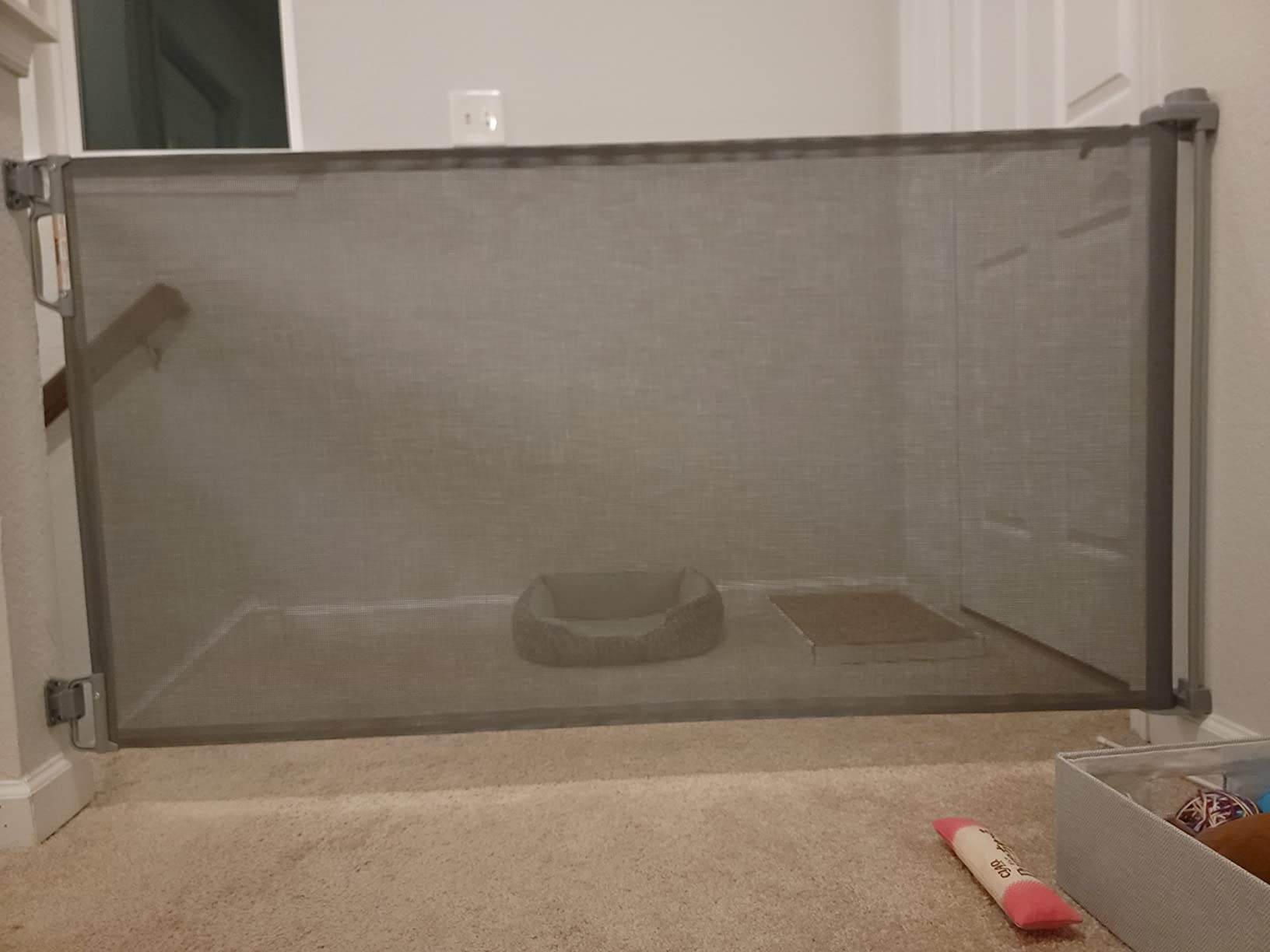
The weak point is the lock. On the widest spans, owners report needing two hands to retract and engage it, which defeats the one-handed operation the marketing implies. If you are carrying a sleeping baby down the stairs, test the lock with one hand before you commit.
It also does not self-close. Every person going through has to close it deliberately, and a mesh barrier that is left partly open protects nothing.
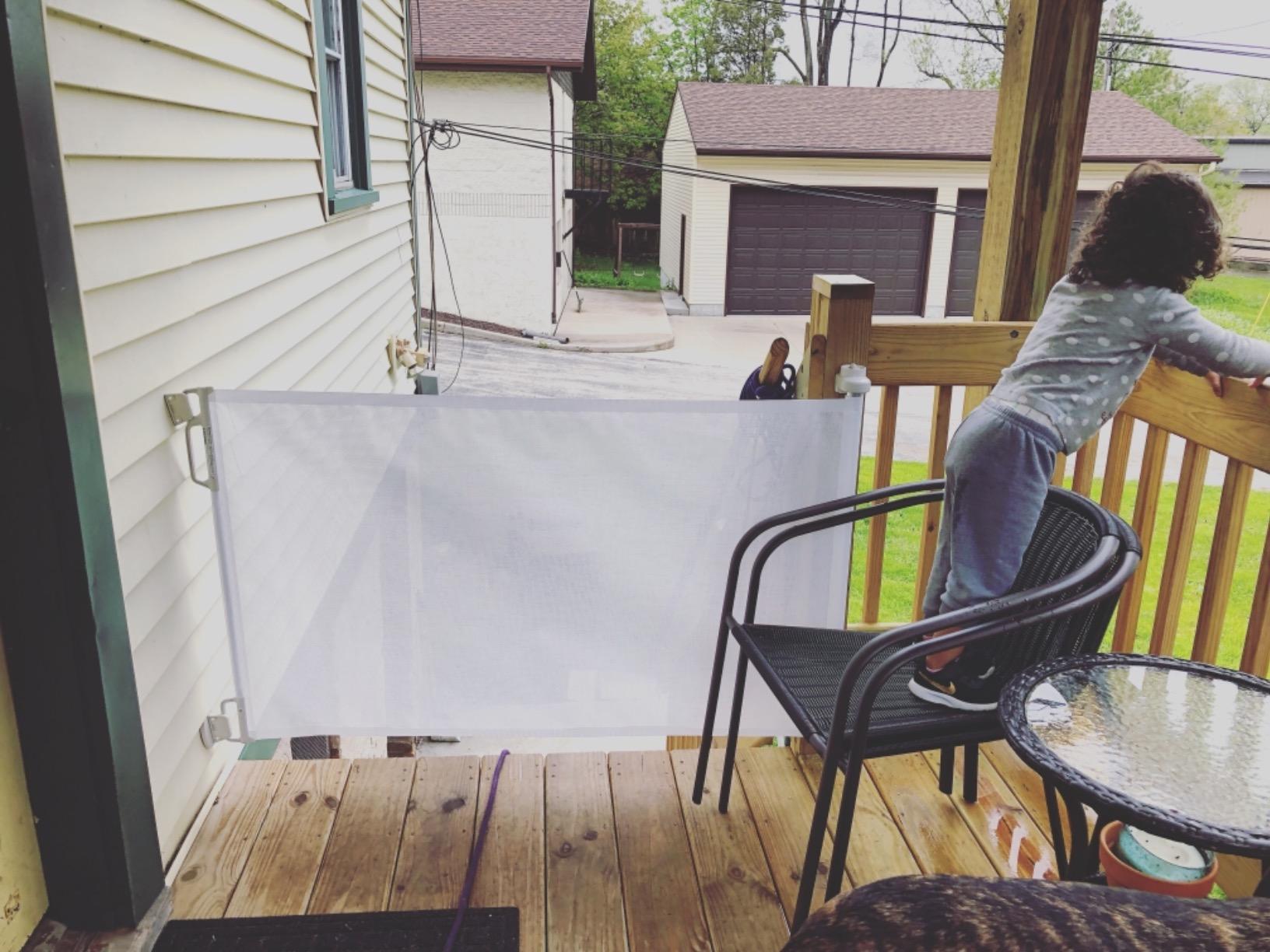
Why the no-bottom-bar design matters here
There is no bottom bar at all, so nothing to step over in the dark on a landing. On a staircase with a patterned carpet and a low ceiling light, removing the bottom bar removes the most common way adults trip at a gate.
Mesh also changes the barrier calculation. A determined large dog will work at mesh far longer than it works at a steel frame, and parents have reported slack in the mesh that a small child could crawl under when the unit is left unlocked.
When to choose something else
Choose a steel gate if your concern is a determined pet or a toddler who systematically finds weak points. Mesh resists push and climb, but it does not resist pull in the same way a rigid frame does.
Choose a fixed-width gate if you want an auto-closing door or a one-handed latch you can open while fully occupied. That is the trade for the wide, disappearing design.
4. Ingenuity Decorative Extra Tall Gate — Top Rated Extra-Tall Design
Ingenuity Decorative Extra Tall Baby Gate & Dog Gate, 28.5″-48″ Wide, 36″ Tall, Hardware or Pressure Mounted, Install on Top or Bottom of Stairs, Banister, or Doorway – Bronze
28.5-48 inch width
36 inch tall
Metal with bronze finish
Hardware kit included
Pros
- 36 inch height defeats most climbers
- Decorative bronze finish suits finished rooms
- Two-way 17.25 inch walk-through door
- Hardware kit included for stair use
Cons
- Latch needs press-lift-pull practice
- Four pressure points need fine alignment
- Auto-close hinge is loud
Height is the feature that earns this gate its place. At 36 inches including the arch, it sits above the reach of most toddlers even when they are standing on the step below the landing. Parents who switched from a standard-height gate after their child started climbing furniture tend to point to height as the reason they felt the problem was solved.
It fits openings from 28.5 to 48 inches and weighs 12.7 pounds, which is heavy in the way a stair gate should be. The bronze finish is decorative rather than industrial, and that matters in a hallway you look at every day.
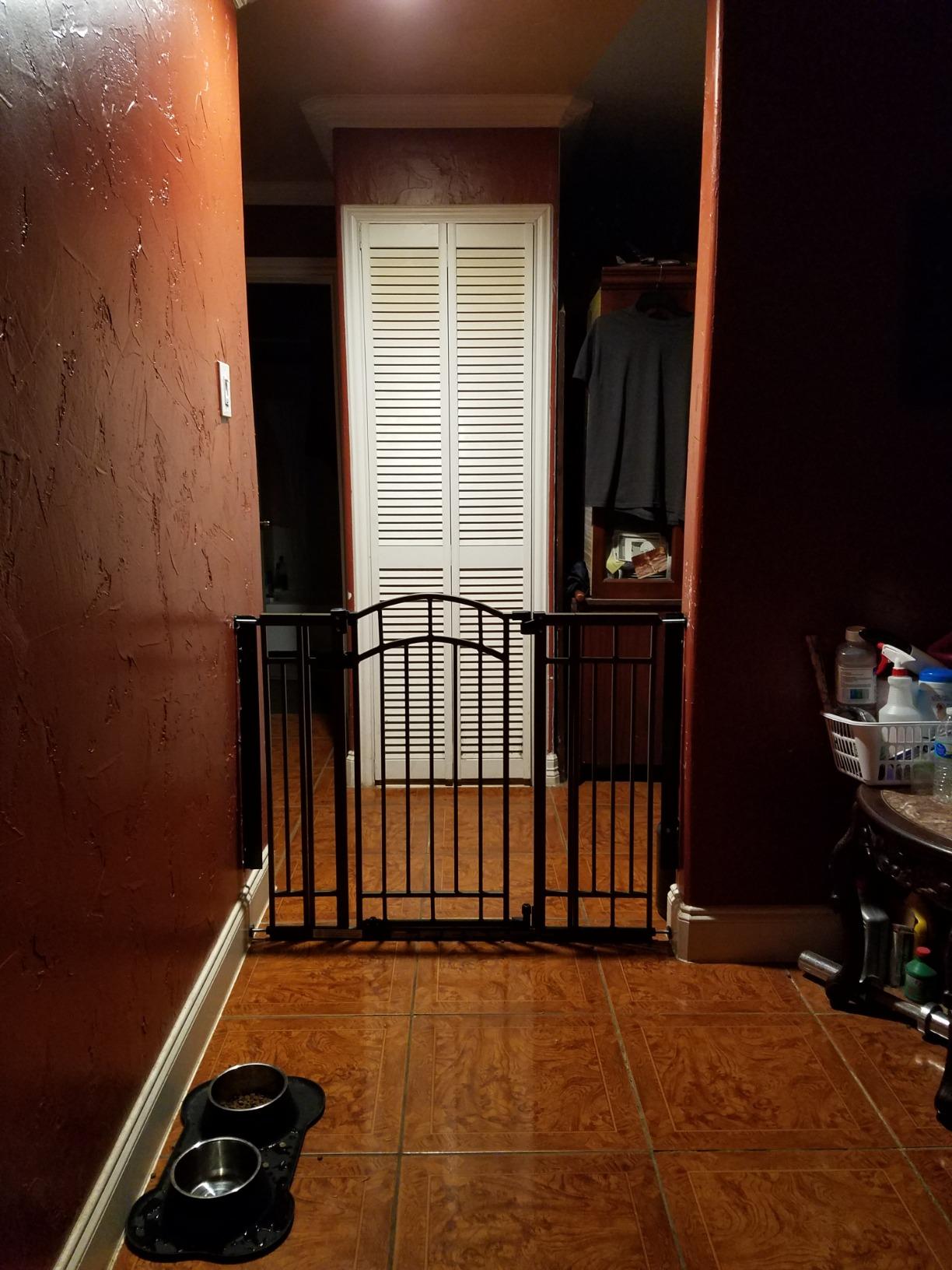
The 17.25-inch walk-through door swings both directions, auto-closes below 90 degrees and stays open past that. There is also a stopper that prevents the gate from swinging out over the top of the stairs, a small feature that removes a specific failure mode.
Watch the fit gaps. This gate does not suit openings of 32 to 33, 36 to 37, 40 to 41 or 44 to 45 inches, because the extension panels step in fixed increments. Measure first.
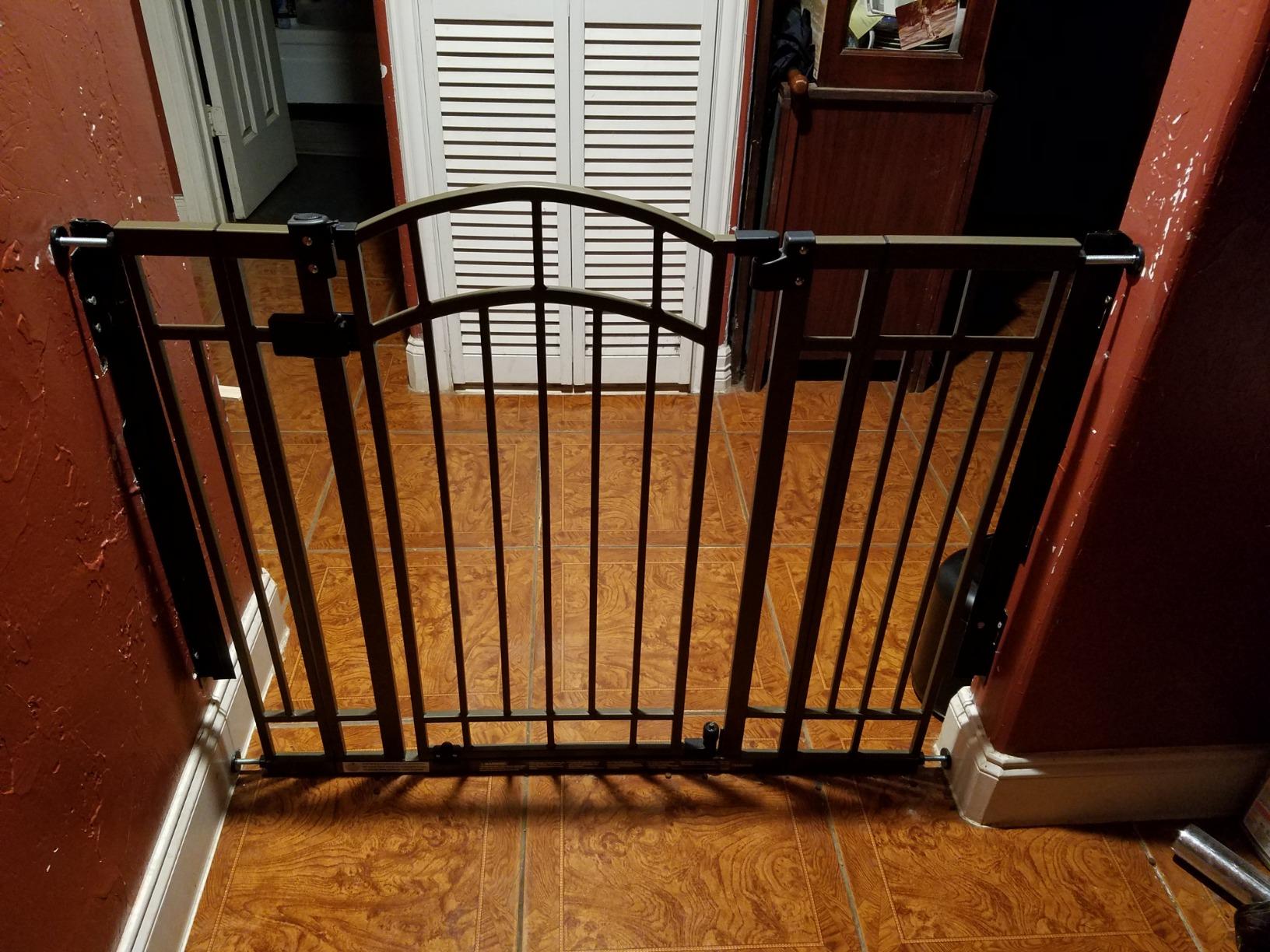
Pressure or hardware at the top of stairs
The gate ships with a no-drill pressure mount system and a hardware kit. For the top of the stairs, use the kit. The included hardware is what allows it to mount to a wall or a flat banister where a pressure pad would not hold.
When you pressure mount instead, expect to spend time aligning the four contact points. If the gate sits slightly out of square, the door will not latch cleanly, and owners often blame the latch when the real issue is alignment.
Learning curve and long-term wear
The latch is a press, lift and pull action in one motion. It feels awkward for the first few days and then becomes automatic. Do not judge it in the first five minutes.
The self-closing hinge is loud enough to startle a pet or a sleeping baby, and the pressure tension screws can strip after years of repeated impact. If you go the hardware route, that wear point disappears.
5. Regalo Extra Wide Plastic Gate — Budget Pick for Wide Bottom-of-Stairs Openings
Regalo 28″-42″ Extra Wide Plastic Baby Gate, Bottom of Stairs & Doorways
Pressure mount
28-42 inch width
23 inch tall
Plastic construction
Pros
- Covers very wide openings at low cost
- Lightweight enough to reposition alone
- No drilling required
- Simple walk-through latch
Cons
- Only 23 inches tall
- Plastic connectors loosen or break
- Bottom of stairs only
This gate exists for one job: a very wide opening at the bottom of a staircase, on a tight budget. It adjusts from 28 to 42 inches and weighs four pounds, so one person can carry it from room to room without any effort.
The walk-through door and latch work the same way as the rest of the Regalo range, and installation needs no tools. If your opening is wide and your child is under two, it does the job without any drama.
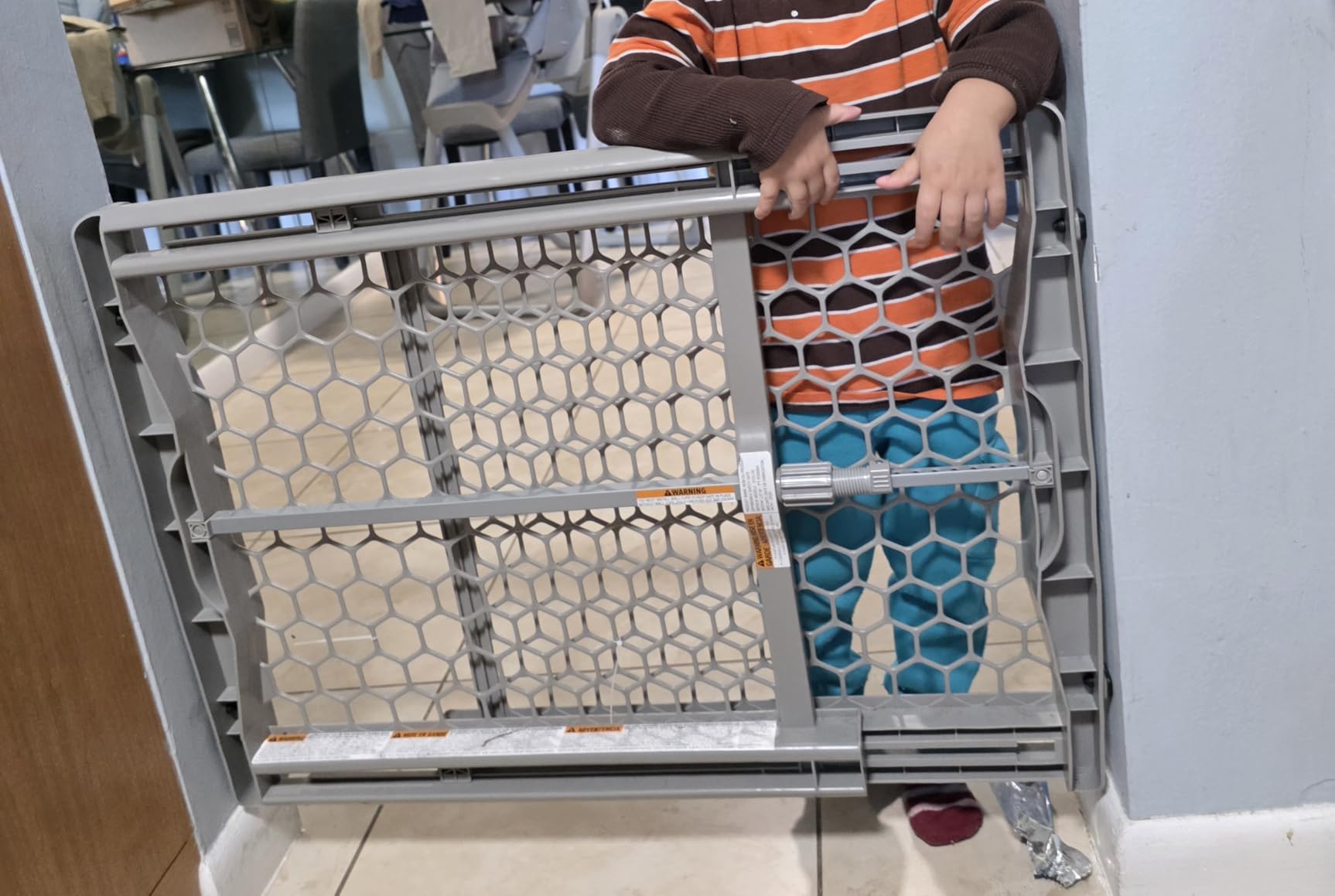
Twenty-three inches is short. That height is fine for a newly walking child and marginal for a toddler who pulls up on things. Parents using it past the two-year mark report the top rail becoming a handhold rather than a barrier.
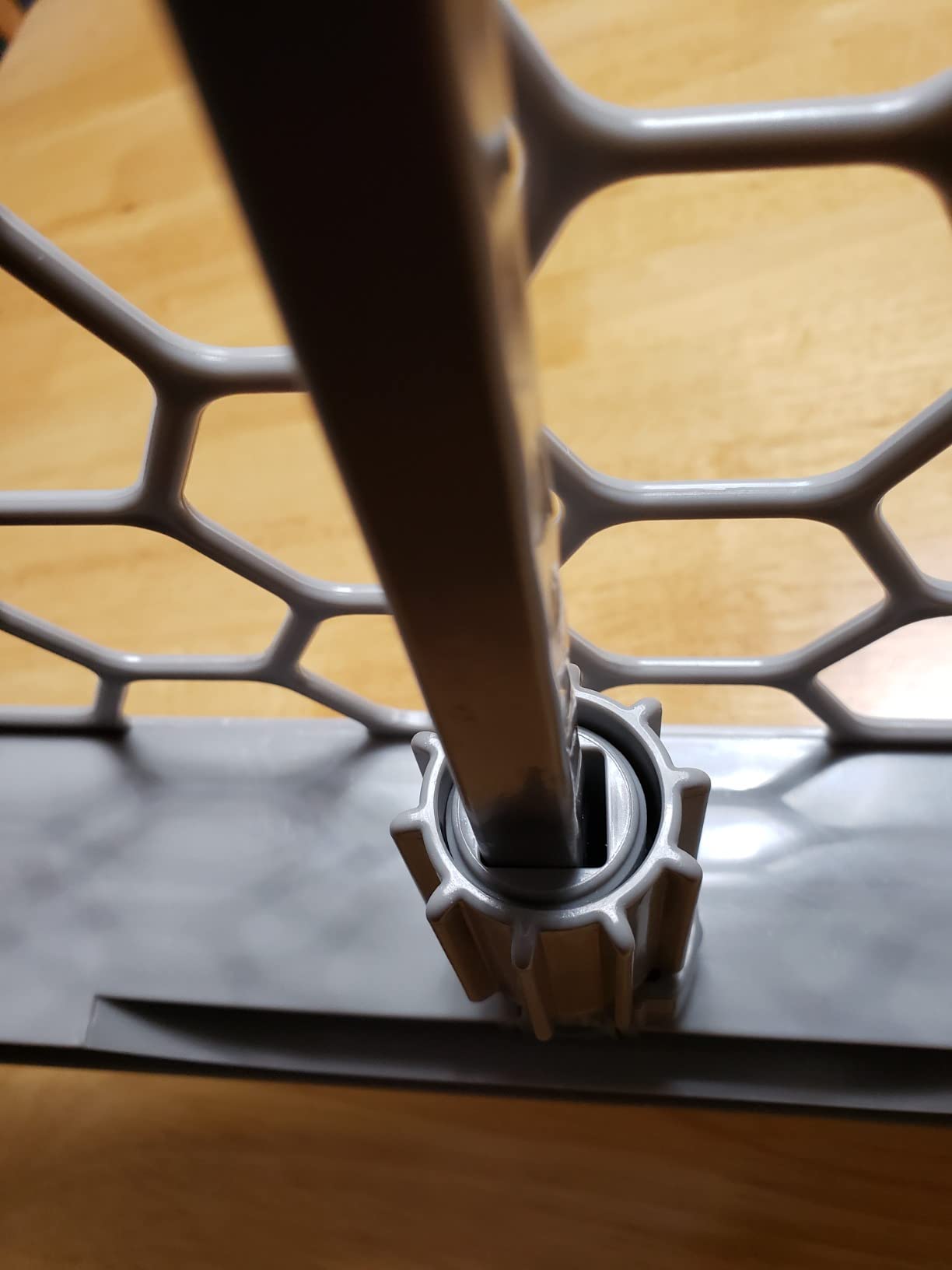
The plastic connectors are the failure point. Under repeated climbing and pulling they loosen, then crack, and because they are the only thing holding the gate in place, the gate becomes decorative at that stage.
How to use it without regretting it
Treat it as a temporary fix rather than a long-term install. Keep it for a wide opening you need to close right now, and move to a taller model when your child starts pulling up on the gate rather than walking away from it.
If the same staircase also has a top landing that needs blocking, plan for two different gates. This one is clearly marked for the bottom of stairs only.
The honest limits
The 23-inch height is the constraint that matters, and it cannot be adjusted. If you want a wide opening covered at a height that holds back a two-year-old, spend more and choose a taller pressure or hardware gate.
The other limit is connector durability. Treat the plastic fittings as consumable parts that will need replacing eventually rather than as permanent hardware.
6. Toddleroo Supergate Ergo — Best for Pets and Seniors
Toddleroo by North States – Supergate Ergo Baby Gate: Plastic Baby Gate for Stairs & Doorways – Adjustable Indoor Safety Gate – Made in USA – 26 to 42 Inches Wide – 26 Inches Tall – Sand
Pressure or hardware mount
26-42 inch width
26 inch tall
JPMA-certified
Pros
- Stays stable when leaned on
- Suitable for pets and seniors
- JPMA-certified and made in USA
- Hardware included for stairway use
Cons
- Plastic wall connectors are fragile
- Hardware packaging is awkward to open
- First-read instructions can confuse
This is the one to consider when the gate is doing double duty as a pet barrier or a boundary for an older adult. It sits from 26 to 42 inches wide at 26 inches tall, and it is JPMA-certified and made in the USA, which matters if you want certification on the label rather than a claim on a listing page.
The ergonomic single handle is the reason it scores well with older adults. One press opens and locks it, so there is no two-handed latch action to remember.
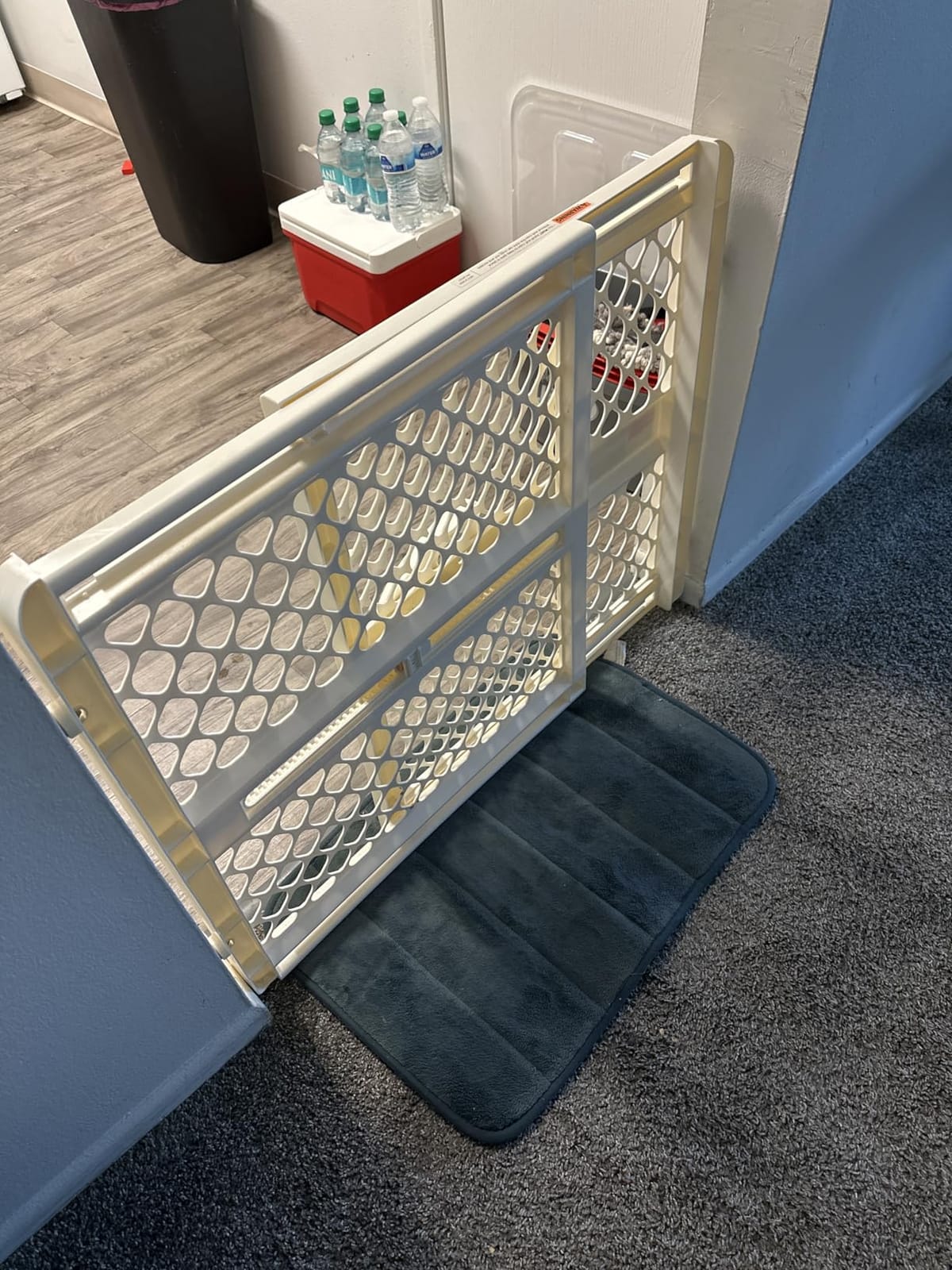
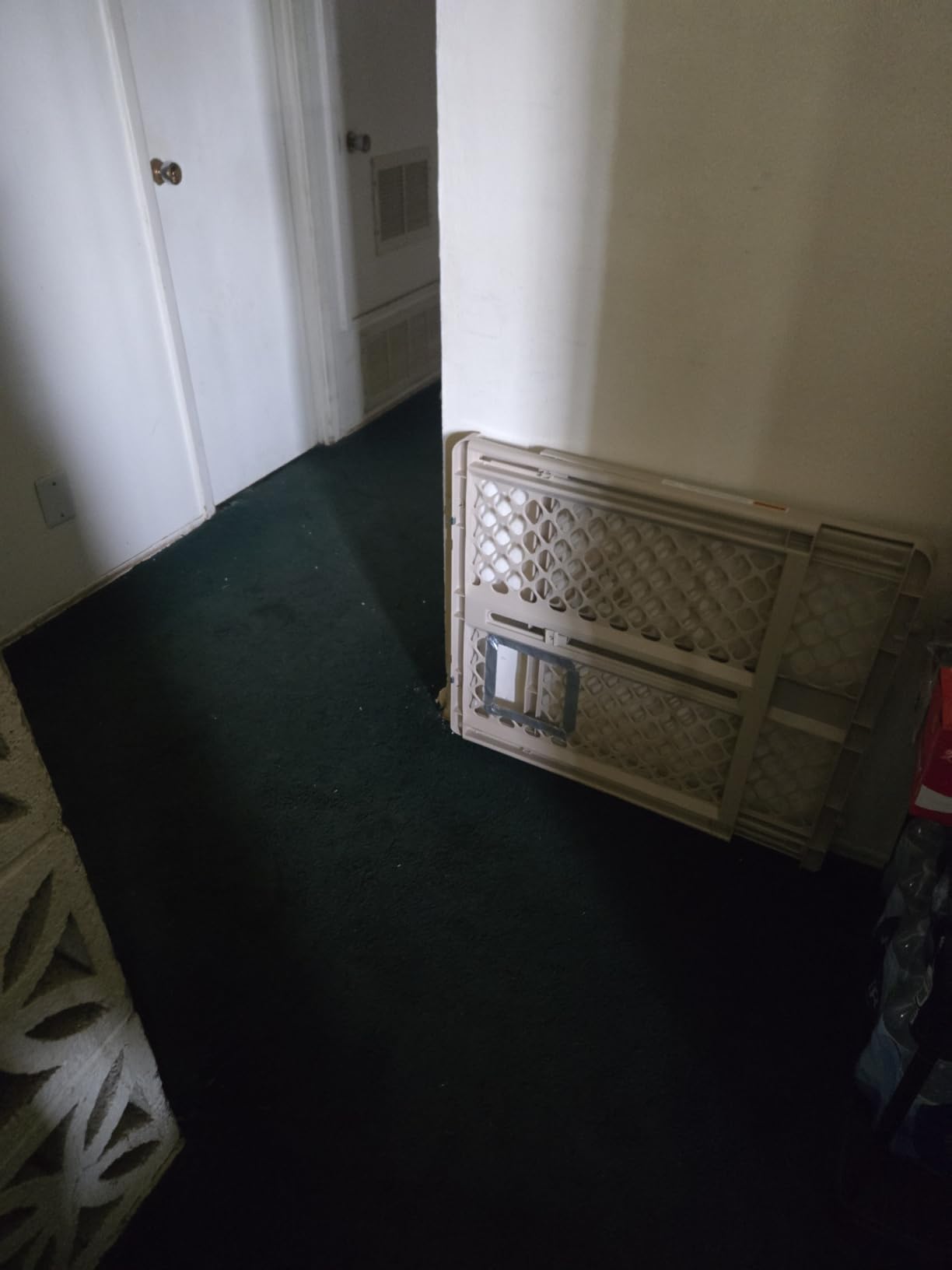
Owners report it staying in place when leaned on, which is the standard test for a pressure gate in a low-traffic spot. Hardware is included for stairway use, so the same gate can be screwed into studs when a location needs it.
The weak point is the plastic wall connectors, and owners of rough children report them being destroyed. If your household has a toddler who treats gates as something to attack, buy the replacement connectors before you need them.
Why it works for older adults and pets
A single-handle latch that both opens and locks reduces the cognitive load compared with press-and-lift mechanisms. For anyone with limited hand strength or reduced dexterity, that is a practical advantage.
For pets, a 26-inch gate in plastic is enough for most small dogs and cats in a calm home. It will not stop a large dog that has decided to get through.
Before you install it at a stair
Use the hardware mount at any stair location. The pressure option is for flat walls and doorways where the mounting surface is flat and continuous.
Open the hardware packet before you start. The mounting pieces are packed between the two gate panels, and pulling the unit apart to find them is the step most people skip and then rush.
7. Babelio No Bottom Bar Gate — Best True No-Trip Design
Babelio No Bottom Bar Baby Gate, 28″ H x 26-43″ W, Black
Hardware mount
26-43 inch width
28 inch tall
All steel with no bottom bar
Pros
- Sill-free design with nothing to step over
- Walk-through door spans the full stair width
- All-steel hardware mount for top of stairs
- Auto-close with stay-open
Cons
- Requires permanent drilling
- Double lock takes practice one-handed
- Medium to large dogs can work at it
This is the gate to look at if the bottom crossbar is the reason you have not installed anything yet. It has no bottom bar at all, and the walk-through door opens across the full width of the stair, so an adult carrying a baby moves straight through without stepping over anything.
It is all steel and hardware mounted for permanent installation into wood, concrete or brick. At the top of a staircase that is the correct kind of permanent.
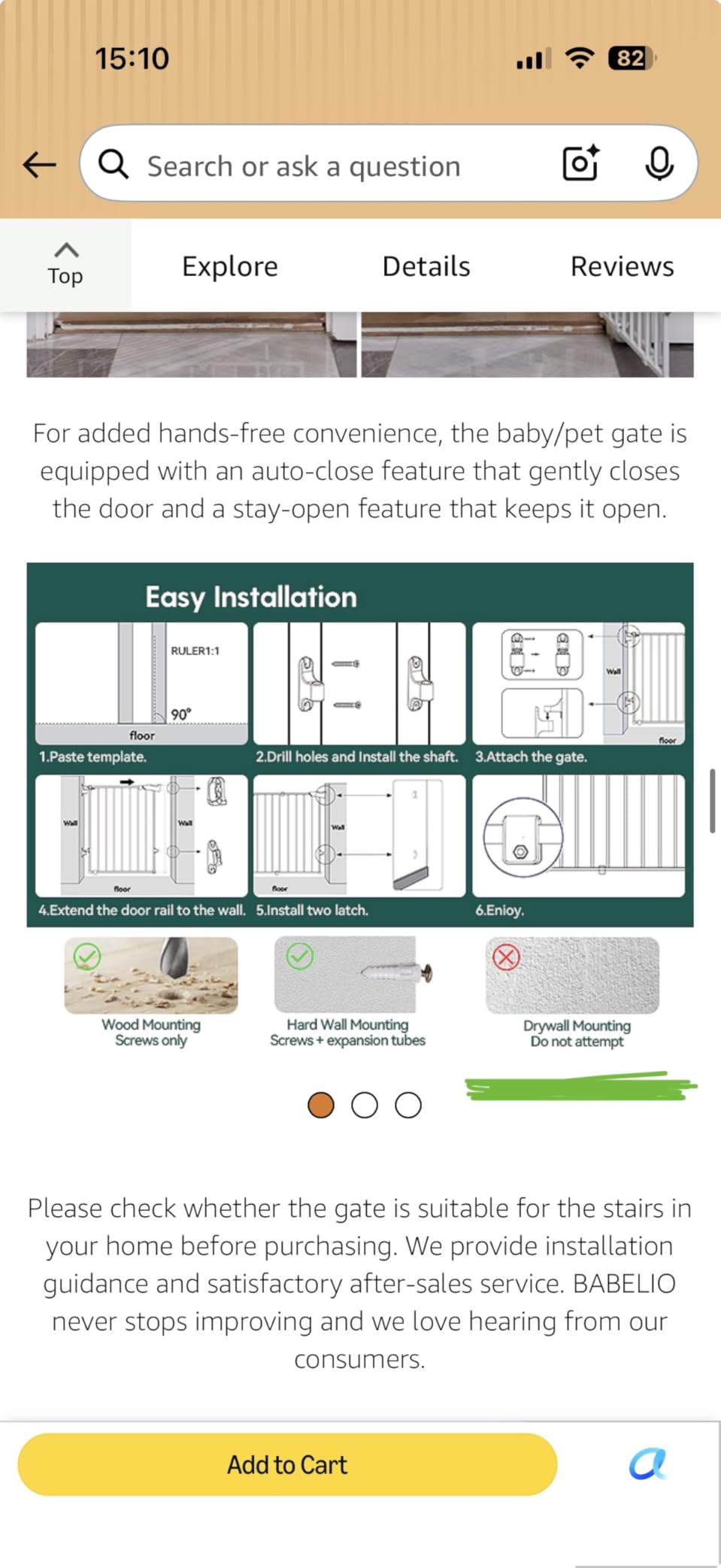
The door auto-closes and has a stay-open feature, so you can push it wide while carrying a load and let it return on its own. The double lock keeps children out and resists pet impact.
The double lock does need practice to operate with one hand. If you are opening the gate while fully loaded, give yourself a week with it before the first busy morning.
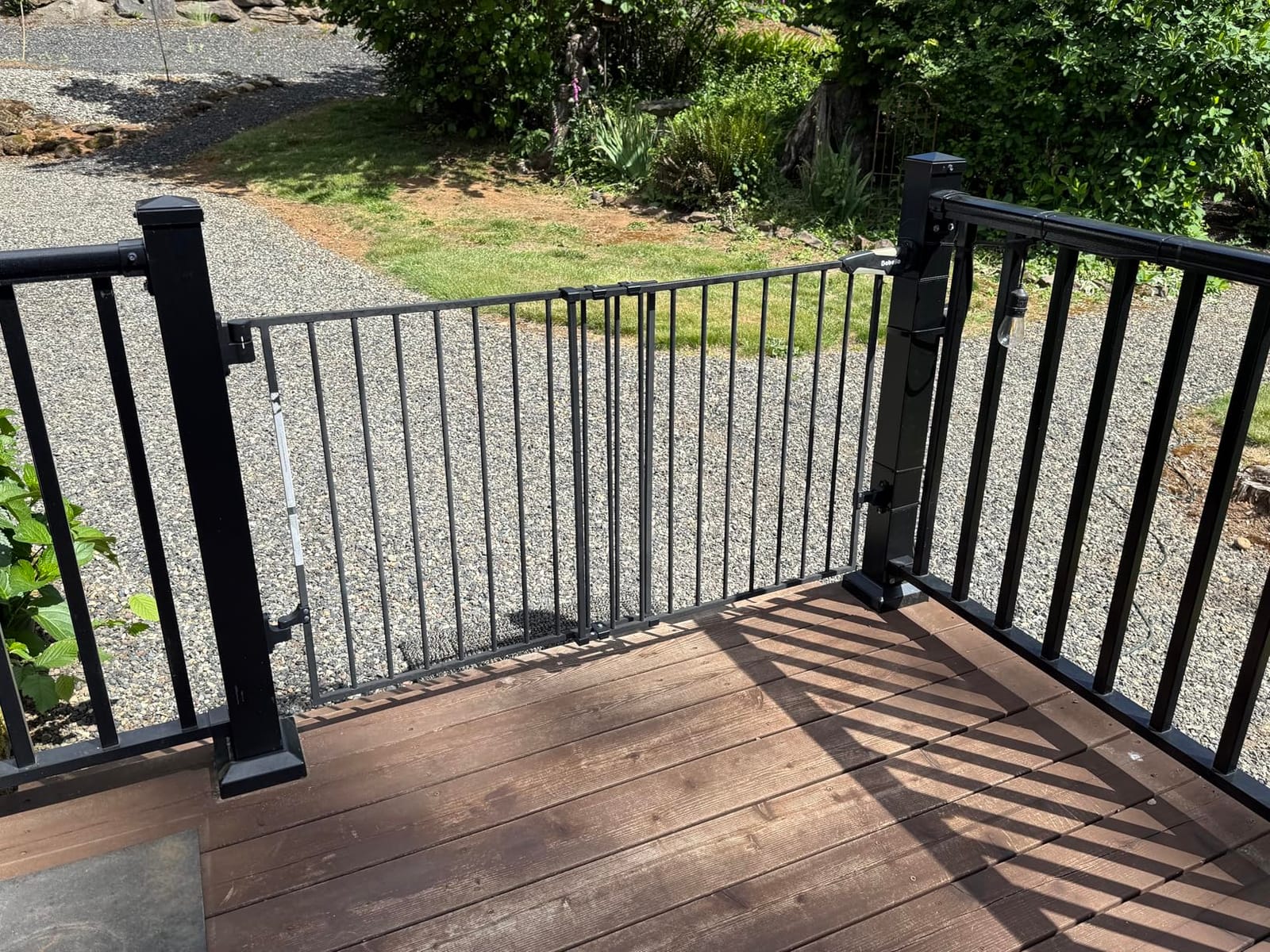
Why no bottom bar matters at the top of the stairs
A bottom bar at the top of a staircase is exactly where an adult carrying a baby is looking down, not down. Removing the bar removes the trip hazard in the one spot on the house where a fall is most dangerous.
It also helps with mobility aids. Walkers, strollers and a hand carrying a laundry basket all move through a sill-free opening without the same awkward lift.
When 28 inches is not enough
Twenty-eight inches covers toddlers and medium pets. A large dog or a toddler who climbs furniture will find this height manageable, and no amount of lock quality changes that.
Drilling is not optional here, so this is not a rental gate. If you cannot drill at the top of your stairs, treat that as a separate problem with a separate solution rather than substituting a weaker gate.
8. Babelio PressGuard Wide Gate — Best for Wide No-Drill Openings
Babelio Baby Gate for Stairs No Drilling, 29-48 in PressGuard Dog Gate
Pressure mount
29-48 inch width
28 inch tall
Double lock with auto-close
Pros
- No drilling on walls or trim
- Auto-close works consistently
- Extension kits and wall protectors included
- Two-way walk-through door
Cons
- Lift-and-release opening is awkward
- Bar spacing suits some cats
- Threaded extension bolts can be hard to seat
Twenty-nine to 48 inches is a lot of width for a pressure gate, and it comes with extension kits in the box so you can reach the far end of a long landing. The pressure mount means no holes in the wall, and four wall protectors are included to keep the trim from marking.
The auto-close is the part owners rate most highly. It closes below 90 degrees and stays open at 90 degrees or wider, which is the behaviour you want at a doorway or the bottom of a staircase.
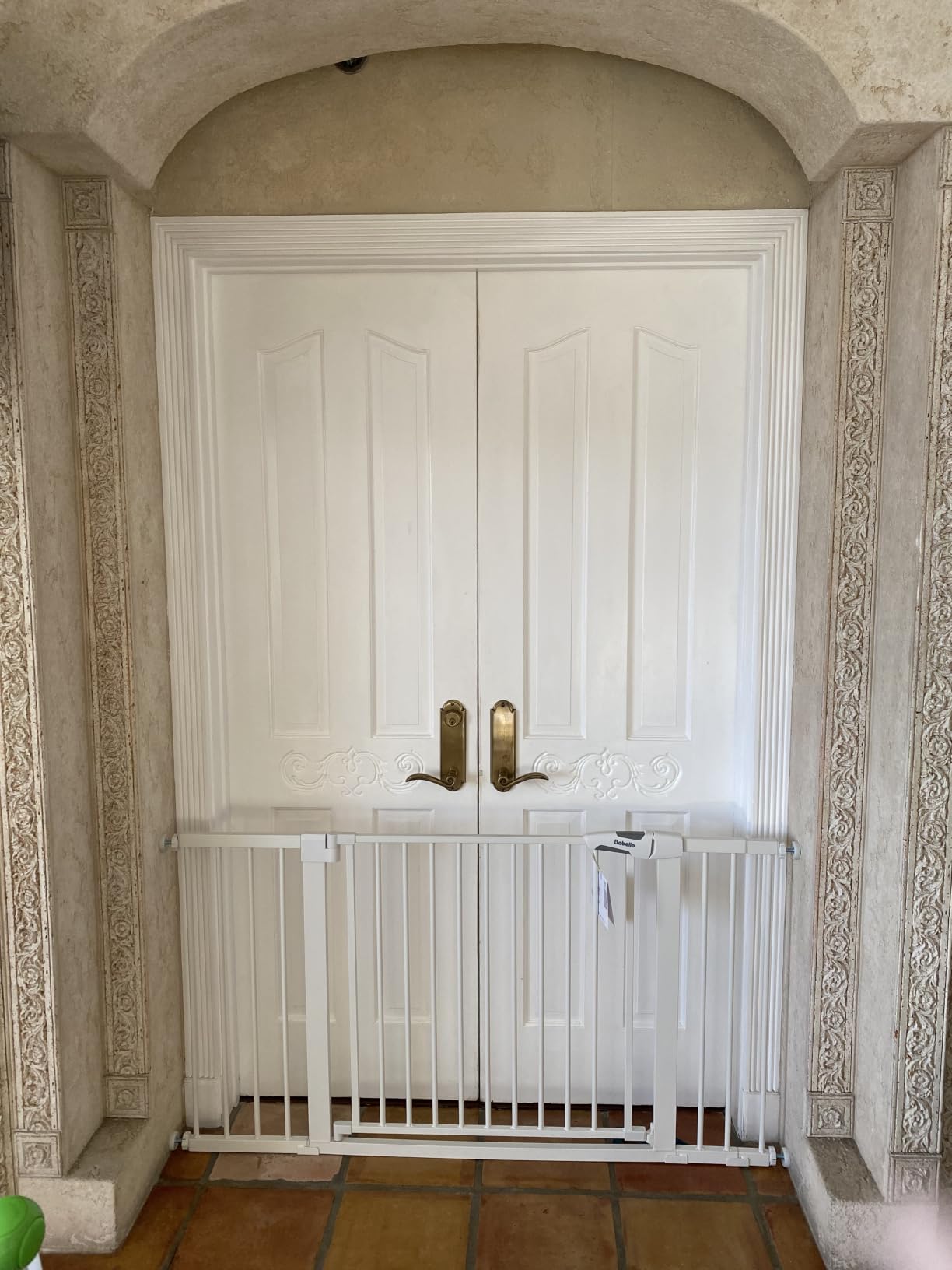
The double lock lever is easy for adults and difficult for children. The walk-through door opens two ways, so you can set it to swing toward the stairs or away depending on the layout.
One caution about bar spacing. Owners with cats report that some cats work through the gaps, which is a reminder to check any gate against the animals in your home as well as the children.
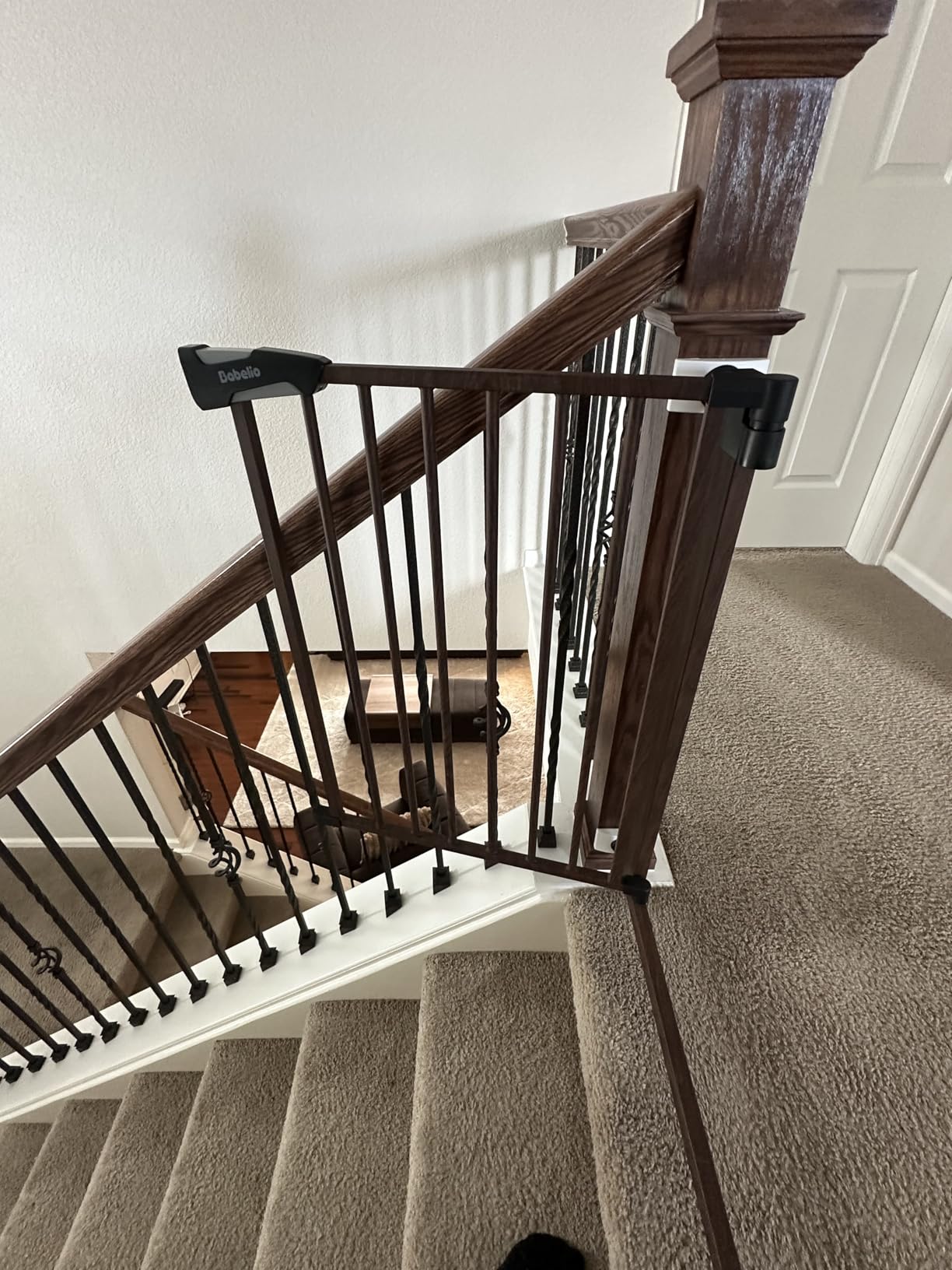
What a pressure mount can and cannot do
A pressure mount holds because friction from the mounting points resists force. On a flat wall or a flat banister at the bottom of a staircase, that is enough. On any surface with a gap behind it, the pads lose contact and the gate rocks.
That is the honest limit of every no-drill gate, and it is why this model belongs at the bottom of stairs rather than the top. At the top, choose a hardware mount even if it means drilling.
Who will find this gate frustrating
Anyone with limited arm strength. Opening requires pressing and lifting at the same time, and the review pattern is consistent that it takes a few attempts to get used to.
Anyone installing into trim mouldings or a surface where the threaded extension bolts will not seat squarely in the mounting cups. Check the flatness of the surface before you order.
9. InnoTruth Narrow Stair Gate — Best for Narrow Stair Widths
InnoTruth 27-36.6 in Wide Baby Gate for Stairs and Doorways, White
Pressure or hardware mount
27-36.6 inch width
28 inch tall
20.07 inch walk-through door
Pros
- Fits narrow openings other gates miss
- Quick no-drill setup
- Auto-close and stay-open at 90 degrees
- Y-bolts fit round banisters
Cons
- Bottom ramp can catch a foot
- Lift-to-open needs practice
- Latch spring is a wear item
Some staircases are just narrow. This gate fits 27 to 36.6 inches, which is the range where most gates stop, and it holds firm when a child pulls on the bars. If your measurements keep landing below 37 inches, this is the one to try first.
It accepts both pressure and hardware mounting, so you can use the no-drill setup in a hallway and the screw-in kit at a stair location with the same gate.
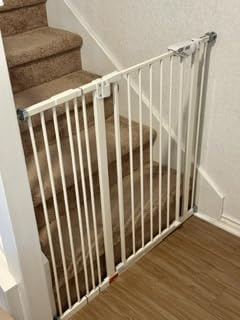
The 20.07-inch walk-through door swings inward or outward and auto-closes, staying open at 90 degrees or wider. Y-bolts for round banisters are in the box, which saves a second purchase if you have a rounded newel post.
Wall cups and adhesive pads protect trim, and the adjustable width makes fitting straightforward across a range that is not perfectly square.
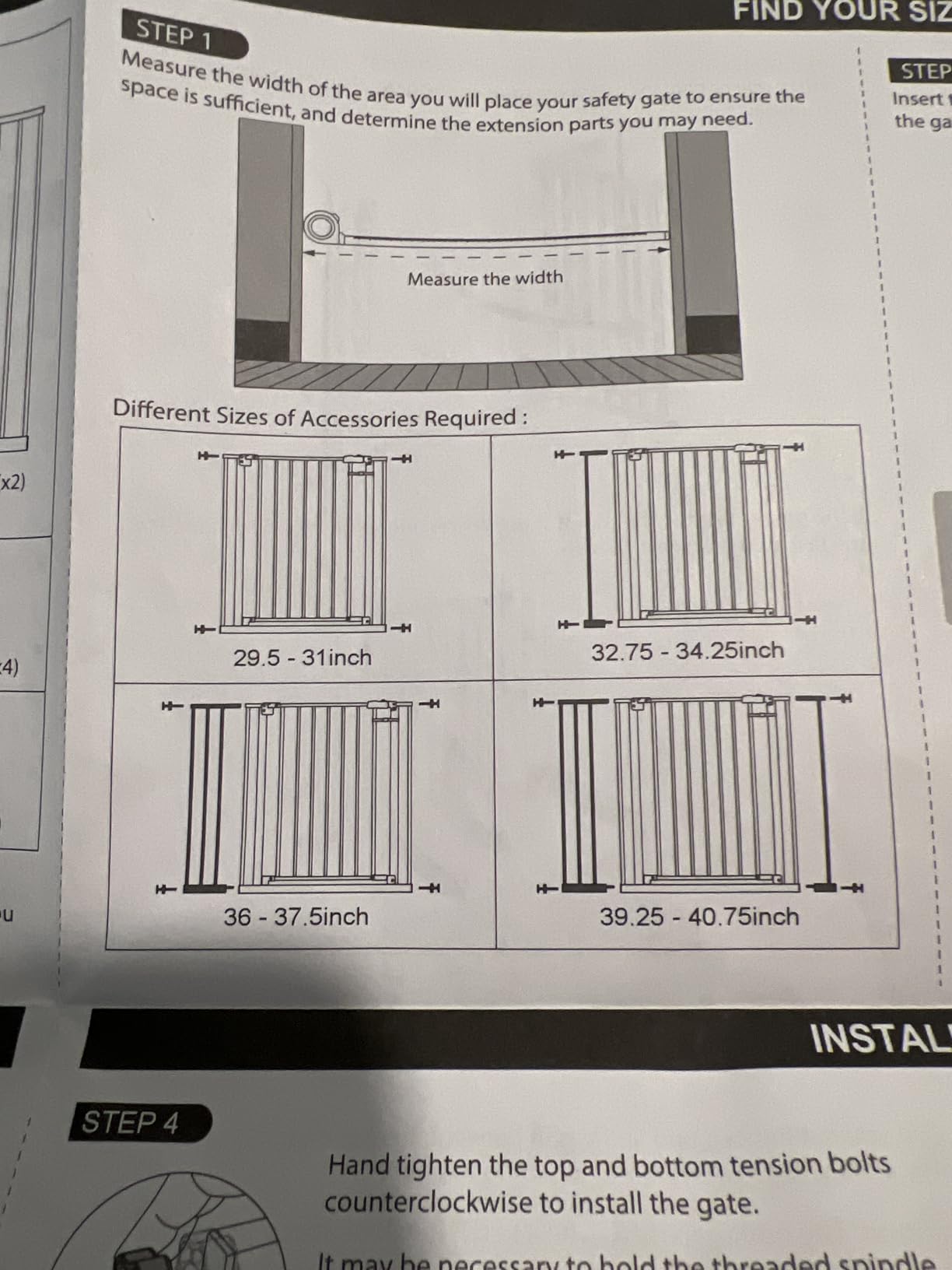
The bottom ramp tradeoff
The included bottom ramp smooths the edge for strollers, which is why it is there. On a narrow staircase the same ramp can catch a foot, and a stumble on stairs is the exact outcome the gate is meant to prevent.
If your stairs are narrow and steep, fit the gate and watch the ramp with a full load for a week. Removing the ramp is a reasonable fix when strollers are not the priority.
Maintenance and fit notes
The spring inside the latch is a wear item that can break within about a year of use. That is a small part to replace rather than a reason to avoid the gate.
Leave the mounting caps on. Owners who remove them report a gap at the latch that cannot be closed, which turns a secure gate into a decorative one.
10. COMOMY Extra Tall Steel Gate — Best for Pets at Height
COMOMY 36″ Extra Tall Baby Gate for Stairs, Fits 29.5″ to 48.8″ Openings
Pressure mount
29.5-48.8 inch width
36 inch tall
23.6 inch walk-through door
Pros
- 36 inch height stops most pet jumps
- Steel frame resists heavy impact
- Gravity auto-close needs no spring
- Two-way swing with one-hand operation
Cons
- Bottom bar is a step-over obstacle
- Pressure mount suits the bottom of stairs
- Belt must stay intact until install ends
This is the extra-tall option for households where the animal, not the child, is the problem. Thirty-six inches of steel is enough that most dogs give up on jumping it, and the frame is rated against impact from pets up to 100 pounds.
The gravity auto-close needs no spring mechanism, which removes the spring as a failure point. It swings both directions and operates with one hand.
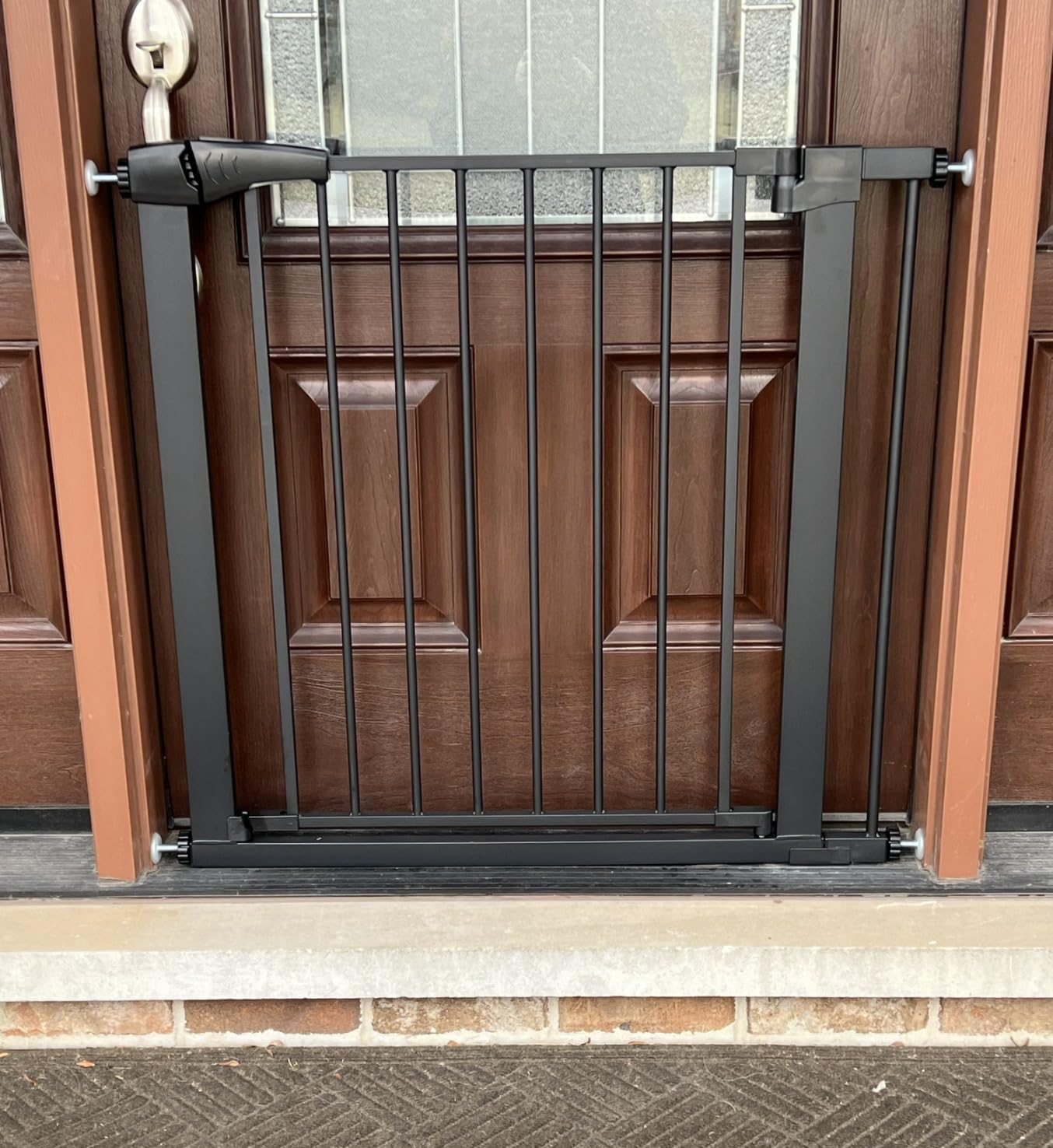
The 23.6-inch walk-through opening is generous, so an adult passes without squeezing past. At 29.5 to 48.8 inches it covers a wide range of openings, and the no-drill pressure mount keeps the install simple.
It carries a Moms’ Choice Award, and it is one of the higher-rated gates in this group at 4.6 across more than 4,400 reviews.
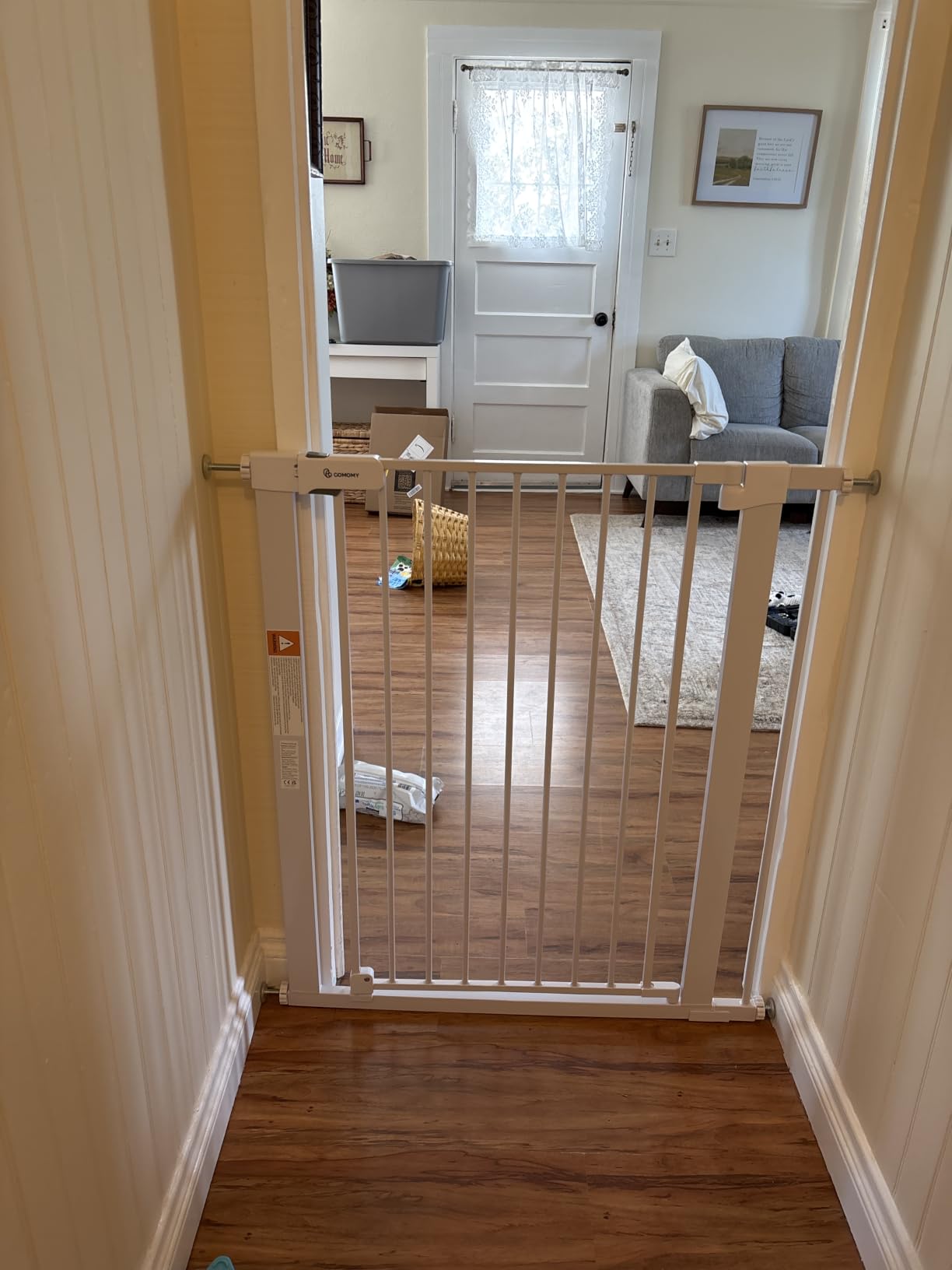
Height solves the jumping problem
Most pet escapes over gates are jumping escapes, and height is the only reliable fix. A 36-inch gate moves the top rail out of reach for the great majority of dogs, while a 26- or 28-inch gate does not.
If your concern is a toddler climbing instead, height works the same way. Once furniture climbing starts, an extra-tall gate tends to buy you a season or more of headroom.
Where it is the wrong choice
The bottom bar is a step-over obstacle, and the wide spans make it a bigger one. If nobody goes through carrying something, this is not a problem; in a busy hallway it is.
Pressure mounting places it at the bottom of stairs in this design. Owners and the product’s own guidance agree that the top of a staircase calls for a hardware mount instead.
11. Veraste Retractable Mesh Gate — Best Budget Retractable Option
Veraste Retractable Baby Gate for Doorways and Stairs, Mesh Safety Gate for Pet, Indoor & Outdoor Use, One-Hand Operation, Easy Installation, 33.6″ Tall, Expands to 55″ Wide(Black,33.6″x55″
Retractable mesh
Expands to 55 inch wide
33.6 inch tall
No bottom bar
Pros
- Disappears into its housing when open
- No bottom balustrade to trip over
- Quick install
- Soft mesh safe for children and pets
Cons
- Latch must stay locked for mesh tension
- One-hand operation is less smooth than described
- Less physical barrier than steel
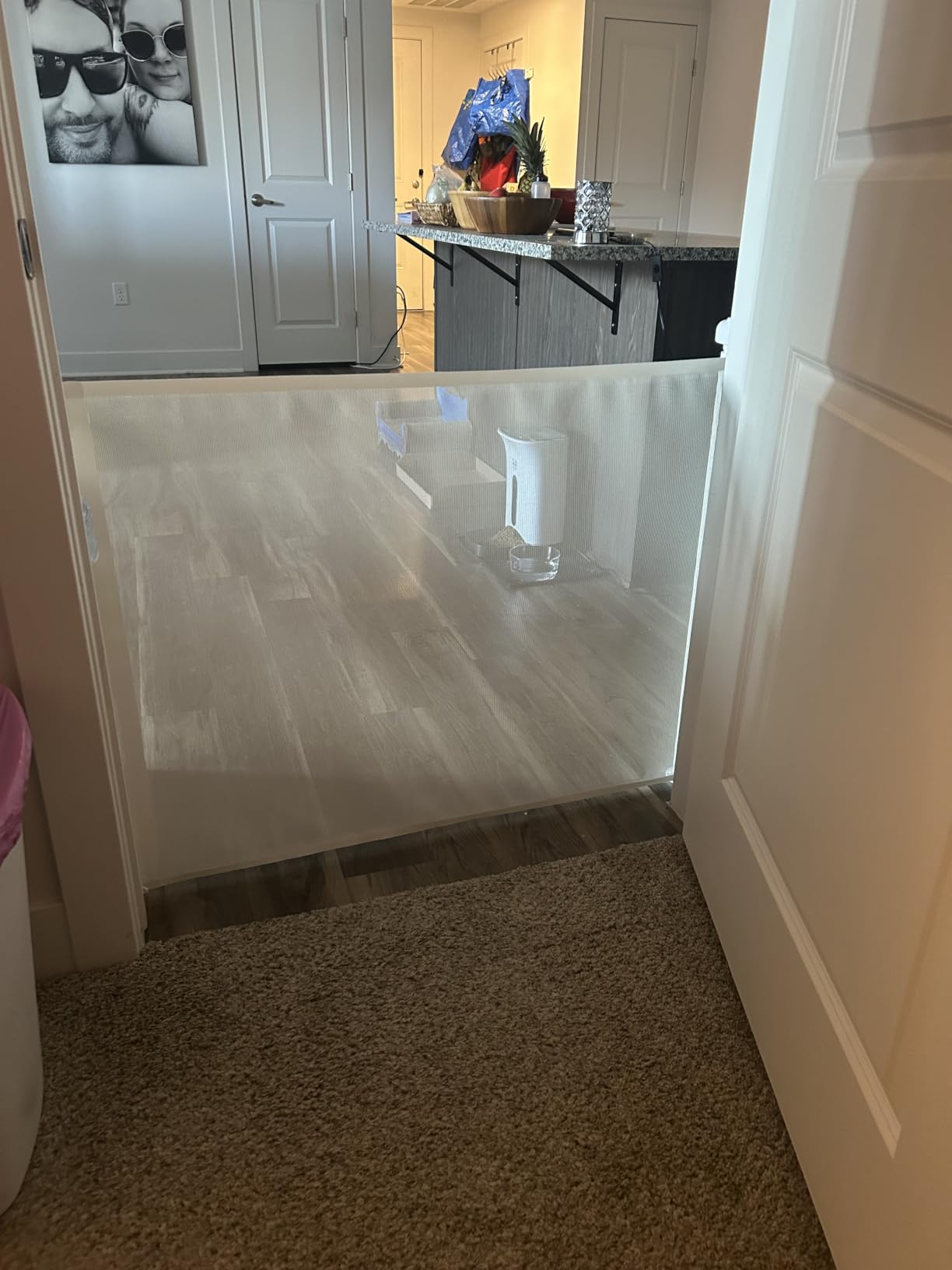
Retractable gates are popular because they solve a problem nobody else does: a barrier you do not want to look at. This one expands to 55 inches at 33.6 inches tall and rolls completely into its housing when open, which matters in a narrow hallway or a doorway you walk through fifty times a day.
There is no bottom balustrade, so there is nothing to trip over. Installation is a matter of fixing the two housings and pulling the mesh across.
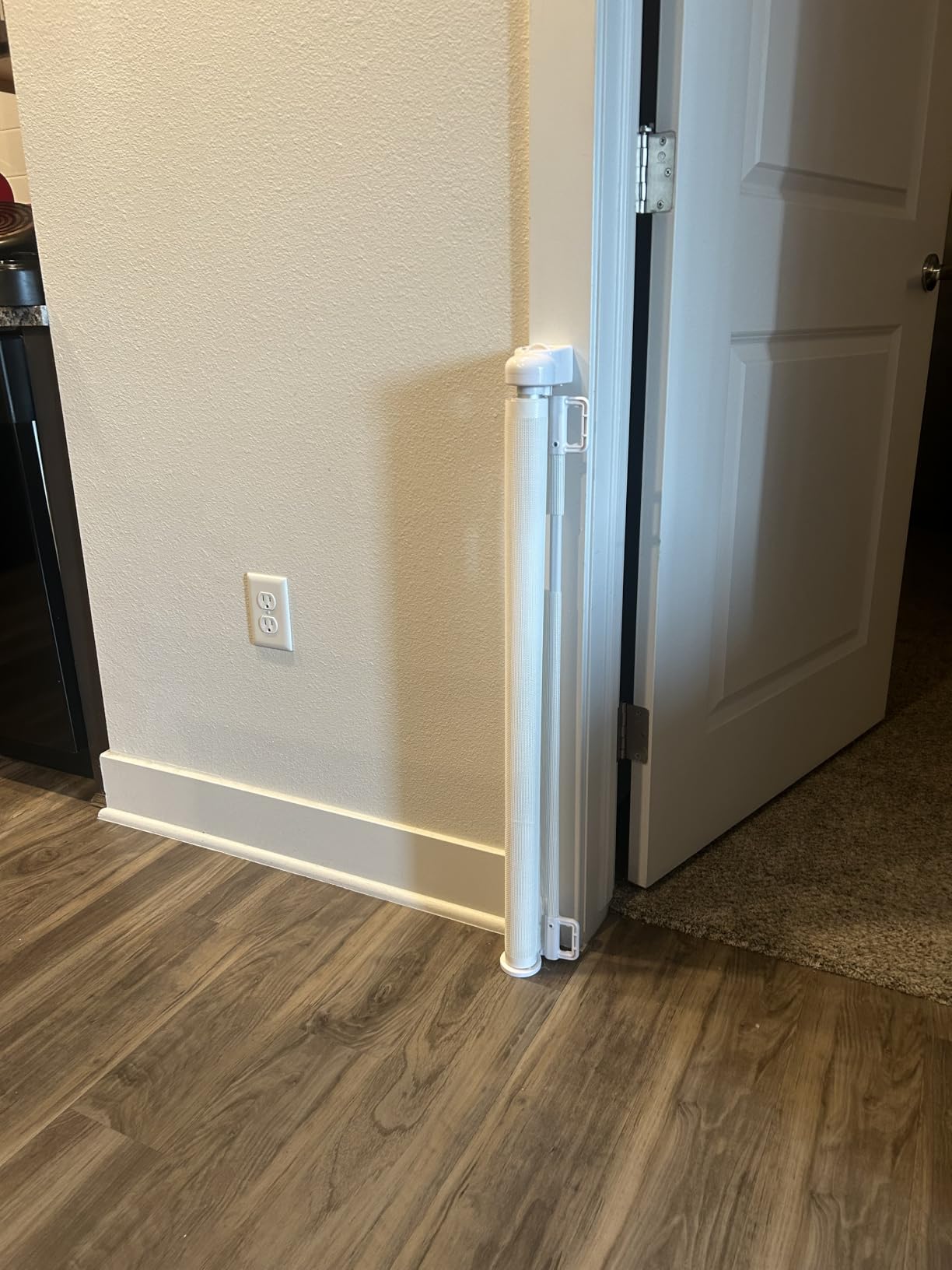
Keep the latch locked. Mesh tension depends on it, and a gate left unlocked sags into a shape a small child can move around.
The one-hand operation is smoother than it needs to be. Plan for a moment of two-handed fiddling, especially at the extreme ends of the 55-inch range.
Where retractable gates belong
A retractable mesh gate works at the bottom of a staircase, in a doorway, or across an opening you only need to close sometimes. Those are positions where the barrier is a convenience rather than the last thing between a child and a fall.
Treat it with care at the top of a staircase. A mesh barrier has less mass behind it than a steel frame, and the people who report injury from leaning on tension-mounted gates are usually standing at the top of a flight. A rigid, hardware-mounted swing gate is the safer choice there.
Pets and long-term wear
Soft mesh is safe for children and pets and is kind to a hallway, but it offers less resistance to a determined large dog than any steel gate in this roundup.
If you want a gate that reads as invisible during the day and a pet barrier at night, this does the job. If you want a gate that stops an impact, buy steel.
12. Toddleroo Easy Swing and Lock Gate — Best for a Hardware-Mounted Top of Stairs
Toddleroo Easy Swing & Lock Baby Gate for Top of Stairs: 31″ Tall, Bronze
Hardware mount
28.68-47.85 inch width
31 inch tall
No threshold
Pros
- Hardware mounted and certified for stairs
- No bottom bar to trip over
- Whole gate swings for a full-width opening
- One-hand press-lift-push operation
Cons
- Drilling and pre-drilling required
- Does not auto-close
- Template can cause slight height mismatch
This gate was designed for one job: sitting across the top of a staircase, screwed into studs. It is Baby Safety Alliance and ASTM certified for the top or bottom of a staircase, hardware mounted, and it has no threshold to step over.
The whole gate swings rather than just a small door, which means a full-size adult walks straight through without turning sideways. For a top-of-stairs landing that gets used constantly, that is the feature that gets noticed daily.
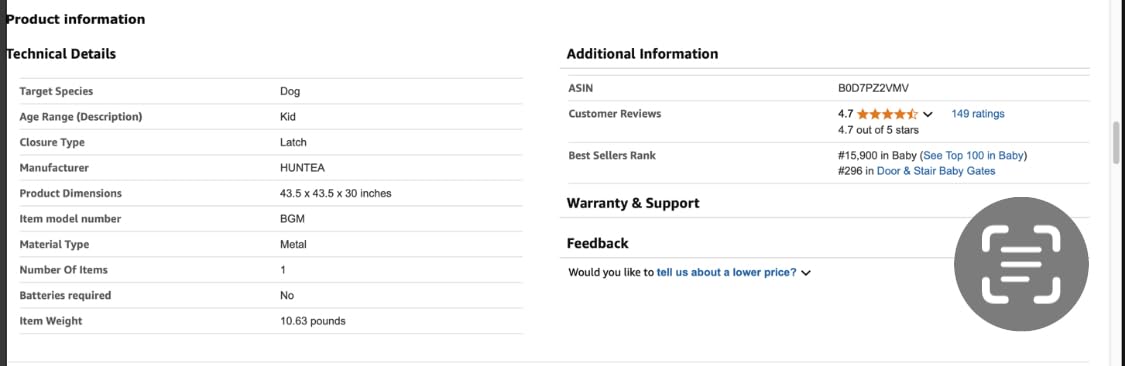
The operation is a press, lift and push or pull with one hand. Children cannot do it, adults can do it while holding something in the other arm. There are no horizontal bars for a toddler to climb on, which is what the no-horizontal-bar design is meant to achieve.
You choose the swing direction, and the manufacturer is explicit that at the top of stairs the gate must never swing out over the steps. Set the direction before you drill rather than after.
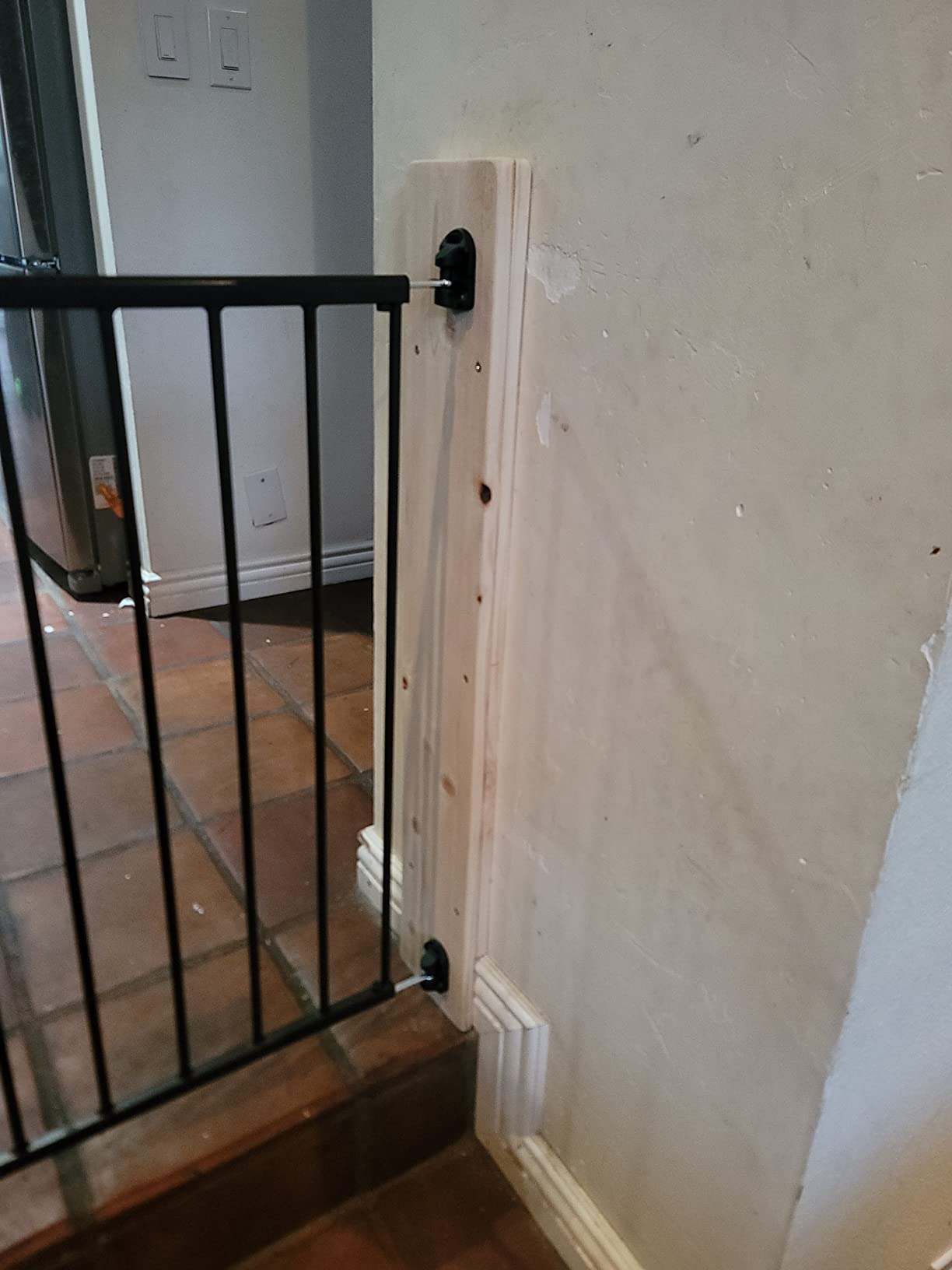
How the hardware mount should be done
Pre-drill and drive screws into studs or solid framing. Drywall anchors are the single most repeated warning in parent communities about stair gates, and the pattern of failure is consistent: the anchor pulls out of the wall under a toddler leaning on the gate.
Use the folded template to mark both sides, then check that both marks are level before the first screw. Owners report a slight height mismatch when the template is used without that check.
What you give up
There is no auto-close. Everyone who walks through has to close the gate, which means the barrier depends on the last person remembering. In a hallway where adults pass in different directions, that is a real difference.
The drilling is permanent, and the gate is not meant to be removed and repositioned. Plan the opening before you buy rather than after.
Stair Safety Rules to Follow Before You Buy
These rules came up in every parent forum thread we read while compiling this roundup, and they explain why the products above are split the way they are.
Never pressure-mount at the top of the stairs. A pressure pad loses contact under sustained push. Parents describe these gates being pushed out of place at the top landing, and adults have reported injury from leaning on tension-mounted gates at stair tops.
Never use drywall anchors for a stair gate. Drill into studs or solid framing. Owners of gates anchored only into drywall describe the anchors pulling out under a toddler’s weight, which turns a safety device into a swinging obstacle.
Check the bottom threshold. A bottom crossbar is a step-over hazard for an adult carrying a baby down a staircase. No-trip designs with no bottom bar remove it entirely.
Bottom of stairs allows more flexibility. The consequence of a push at the bottom of a flight is a fall onto a floor a few steps down, which is why pressure gates are considered acceptable there.
Watch the gap underneath. A gate mounted too high leaves a space a small child can slide under, which is the failure mode parents rarely think about before buying.
How to Measure Your Stair Opening
Most returns in this category come down to a measurement, and most of those returns come from measuring only once. Before you pick a gate, work through this list.
Measure the width at the narrowest and widest point. Stair openings are often not square. A gate that fits the wide point may not fit the narrow point, and several gates in this roundup skip fixed inch bands where their extensions do not line up.
Decide what the gate is mounted to on each side. Wall to wall, wall to banister, banister to banister, or wall to a newel post. Y-bolt adapters in the box are what make rounded banisters workable without drilling into finished woodwork.
Check the landing depth. The gate needs enough flat surface to take its mounting hardware. If a baseboard, trim or door casing is in the way, the mount will not sit flat.
Measure the height you need. Standard gates sit between 26 and 31 inches. Extra-tall gates reach 36 inches. Choose against your child’s height, not the opening.
Note the angle. Some top-of-stairs landings are angled rather than square to the run. A gate that mounts flat to one surface may need a spacer on the other to line up.
Check for openings over 39 inches. Above that width, most fixed gates stop. That is where retractable mesh or a wide pressure gate becomes the realistic option.
Buying Guide: Picking the Right Baby Gate for Stairs
Hardware-mounted or pressure-mounted
This is the first decision and it is not a preference. Hardware-mounted gates transfer a child’s push into the wall, the stair stringer or the banister through screws and spacers. Pressure-mounted gates depend on friction pads biting against a surface. At the top of a staircase, choose hardware. At the bottom, pressure is usually fine.
Gate height against a climbing toddler
Height is the upgrade parents buy too late. A 26 to 28 inch gate holds back a walking child and a sitting toddler. It does not hold back a child who pulls up on furniture and then tries the gate. Two gates in this roundup stand 36 inches tall and are the right answer once climbing starts, and parents report needing that height sooner than they expected.
Height also cuts the other way. Mount a gate too high and a small child can slide underneath it, so the fit should be against the child rather than the doorway.
No-trip and no-bottom-bar designs
A bottom bar is the thing adults trip over, particularly on the way down while carrying a baby. Gates with no bottom bar and a sill-free threshold remove that problem. If your staircase has patterned carpet, a low ceiling light or a turn in the descent, that design is worth more than the price difference.
Banister mounting and awkward angles
Rounded and ornate banisters defeat most off-the-shelf mounting hardware. Y-bolt adapters grip a round post without drilling into it, and wall spacers let a gate sit flush when the wall is not perfectly plumb. For genuinely awkward geometry, a universal stair mounting kit is the fallback when no standard gate fits, and it is more common than manufacturers would like to admit.
Retractable gates: where they work and where they do not
Retractable mesh is genuinely useful for wide openings, awkward widths and doorways you only need to close sometimes. It is a weaker choice at the top of a staircase, where a rigid steel frame and a hardware mount do more for you, and where a mesh barrier has less mass behind it if an adult leans on it.
Walk-through width
Walk-through width decides whether you enjoy the gate daily. Anything under about 14 inches means turning sideways while holding a child. The gates here range from a 17.25-inch door to a 23.6-inch opening, and wider is easier in a busy house. If you are still weighing gates against other baby gear that has to fit through the same doorway, our baby carrier roundup covers that side of the equation.
Renters and no-drill installs
There is an honest answer here. At the bottom of a staircase, a pressure gate is a legitimate no-drill solution and several models in this roundup are built for it. At the top of the stairs, every no-drill option carries real risk, because the force that dislodges a pressure gate at the top of a flight is exactly what the gate is supposed to stop. If you cannot drill, fix the top landing another way rather than substituting a weaker gate.
When to take the gate down
Gates are transitional. Remove the one at the top of the stairs once your child can walk down steadily and shows no interest in climbing furniture, and remove the rest once they can navigate doorways and open latches reliably. Keep the boundary, drop the hardware. If you also need help getting a pet up steps, our pet stairs guide covers the age range where that becomes relevant.
Frequently Asked Questions
What is the best safety gate for babies on stairs?
The best safety gate for stairs depends on which end of the staircase you are blocking. At the top, use a hardware-mounted swing gate screwed into studs, ideally with no bottom bar. At the bottom of the stairs, a pressure-mounted gate is usually enough. Across this roundup the Regalo Easy Step is the strongest all-rounder for standard bottom-of-stairs openings.
Is it safe to put a baby gate at the top of the stairs?
Yes, as long as the gate is hardware mounted into studs or solid framing. Never use a pressure-mounted gate at the top of a staircase and never rely on drywall anchors, which pull out under sustained push from a child. Install the swing so the gate cannot open out over the steps.
Can you put a baby gate on a banister?
Yes, using a hardware mount with a wall spacer and a banister adapter or Y-bolt for a rounded post. Drilling into finished woodwork is avoidable if the gate includes the right adapters. If your banister is ornate or unusually shaped, a universal stair mounting kit is the fallback when no standard gate fits.
How do I keep a toddler from climbing over a baby gate?
Choose height before brand. A standard 26 to 28 inch gate holds back a walking child but not a toddler who climbs furniture, so move to an extra-tall 36 inch gate once climbing starts. Rounded vertical bars with no horizontal rail give a climber nothing to grip, and a double lock stops them working the latch. Also check the gap underneath so a small child cannot slide below it.
At what age are baby gates no longer needed?
Most gates are marked for ages 6 to 24 months, but the real test is behaviour. Remove the top-of-stairs gate once your child walks down steadily and ignores climbing furniture, and remove the rest once they can navigate doorways and operate latches reliably. Keep the boundary and remove the hardware once the gate is no longer doing work.
The Bottom Line on the Best Baby Gates for Stairs
For most homes, the Regalo Easy Step is the best baby gate for stairs overall: the widest-reviewed gate here, a 29 to 38.5 inch range, and a ten-minute install at the bottom of a staircase. For the top of the stairs, the Toddleroo Easy Swing and Lock and the Cumbor are the two worth shortlisting, since both can be screwed into studs. If your child is already climbing, go to 36 inches with the Ingenuity or COMOMY. Measure twice, mount into studs, and check the bottom threshold before you drill.