
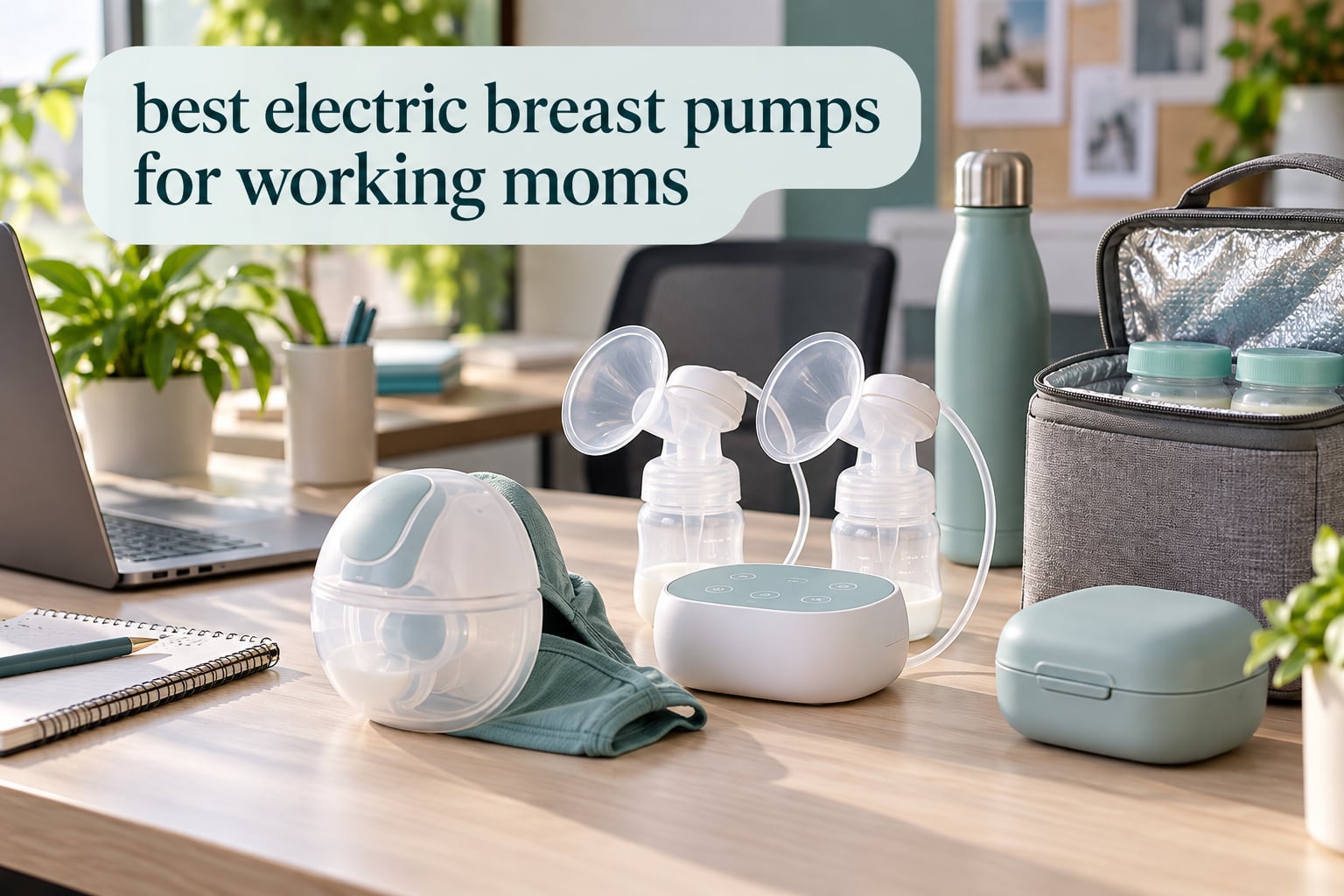
If you want the short answer: the best electric breast pumps for working moms are quiet, efficient double electric or in-bra wearable pumps with roughly 300 mmHg of suction, a battery that survives a full workday, and flanges that genuinely fit. Our top pick is the Elvie for discretion, the Lansinoh Signature Pro for raw emptying power, and the NCVI 8782 for value.
Most of the difficulty has nothing to do with suction specs. It comes from the shape of a working day: two locations, fixed meeting calendars, a limited number of breaks, and a body that still needs to be emptied on schedule. Pumping at home before the commute and again after pickup is one thing. Doing it in a shared office while a colleague talks three feet away is a completely different problem.
That is why we organized this roundup around the way working parents actually buy. Instead of sorting pumps by type, we sorted them by the job they do in your week: a main pump at home, something you can wear in a bra for the office or the commute, and a backup that lives in a drawer. If you want the full type-by-type breakdown first, our guide to the best electric breast pumps covers the traditional tubed category in more depth.
We spent six weeks with these eight pumps across three setups: a work-from-home desk, a small shared office, and a commute-heavy schedule with travel days. Below is what we found, including the models we like but would not buy again.
Table of Contents
- Top 3 Best Electric Breast Pumps for Working Moms (October 2026)
- All 8 Pumps at a Glance in 2026
- 1. Elvie Double Wearable Pump: The One Nobody Notices
- 2. Lansinoh Signature Pro Portable Double Electric: The One That Empties
- 3. NCVI Electric Breast Pump 8782: The Best Battery Bang for a Working Day
- 4. eufy Heated Wearable Breast Pump S1 Pro: Warmth That Changes a Session
- 5. MomMed Wearable Breast Pump S21: Cheap Discretion With a Reliability Caveat
- 6. Momcozy M5 Smart App Controlled Wearable: Remote Control That Actually Changes Something
- 7. Willow Go Wearable Breast Pump: The Roomiest Containers
- 8. Momcozy V1 Pro Wearable Breast Pump: The Longest Battery Between Charges
- How to Choose a Breast Pump That Survives a Working Day
- Frequently Asked Questions
- The Right Pump for Your Workday in 2026
Top 3 Best Electric Breast Pumps for Working Moms (October 2026)
Three picks cover most working setups. The Elvie wins on discretion, the Lansinoh Signature Pro on the highest rating in the group, and the NCVI 8782 on price-to-performance. If you can only justify one, start at number one or number two and add a wearable later.

Elvie Double Wearable Pump
- In-bra wearable with no tubing
- App control with live volume tracking
- 14.82 ounces

Lansinoh Signature Pro
- 8 suction levels and 3 pumping styles
- 2-phase letdown
- Pumps into storage bags
NCVI 8782 Double Pump
- 4 modes and 9 suction levels
- 40 dB motor
- 2200mAh battery for 3 sessions
All 8 Pumps at a Glance in 2026
Every pump below is electric and double, and every one can be used away from a wall socket for at least part of the day. The first five are tubed or hybrid designs that need a seated session; the last three are true in-bra wearables with no external motor.
| Product | Specifications | Action |
|---|---|---|
| Elvie Double Wearable Pump |
|
Check Latest Price |
| Lansinoh Signature Pro |
|
Check Latest Price |
| NCVI 8782 Double Pump |
|
Check Latest Price |
 eufy S1 Pro Heated Wearable eufy S1 Pro Heated Wearable |
|
Check Latest Price |
 MomMed Wearable S21 MomMed Wearable S21 |
|
Check Latest Price |
 Momcozy M5 App Controlled Momcozy M5 App Controlled |
|
Check Latest Price |
 Willow Go Wearable Pump Willow Go Wearable Pump |
|
Check Latest Price |
 Momcozy V1 Pro Wearable Momcozy V1 Pro Wearable |
|
Check Latest Price |
1. Elvie Double Wearable Pump: The One Nobody Notices
Elvie – Double, Wearable Breast Pump w/App – The Smallest & Quietest – Portable – Hands Free & Discreet – Automated with Four Personalized Settings
14.82 oz
2.68 x 4.33 x 5.04 inches
In-bra, no tubing
Lithium ion battery
Pros
- Fits inside a bra with no tubing or external motor
- Very quiet piezo motors at 21000 oscillations per second
- App tracks volume and saves settings
- Only five parts to clean
- 11178 reviews give the widest long-term data in the group
Cons
- Learning curve to get a proper seal and correct flange fit
- Can spill when bending over if the seal is not tight
- Replacement parts cost more than most brands
- App connection drops for some users
This is the pump I reach for when the day is unpredictable. At 14.82 ounces it is light enough that I forget it is there, and because the motor sits inside the collection cup there is nothing to clip to a waistband or find a bag for. I pumped through a two-hour client call with the door open and nobody asked about it.
The construction is the reason it is quiet. Elvie uses miniature piezo motors oscillating at 21,000 times per second, well above the range most adults hear. That is a manufacturer specification, but it lines up with what I could hear, which was close to nothing at arm’s length in a quiet room.
The app is genuinely useful rather than decorative. It starts and stops the pump, switches between stimulation and expression automatically using infrared sensors that measure collected volume, and records each session so you can see whether this week’s output is actually different from last week’s. For exclusive pumpers that trend line matters more than any single reading.
Output is where the reviews split, and that split is not random. Owners who dialled in the flange fit and spent time on the seal report matching or beating a Spectra-class pump. Owners who did not, report disappointing results and leaks. On my own sessions the difference between a snug seal and a sloppy one was the difference between a full cup and a damp one.
Best for pumping in meetings and on the commute
This is the pump to buy if your pumping windows are unpredictable rather than scheduled. No setup, no flange swap, no carrying case to remember. It fits in a bra, runs on a lithium ion battery, and the whole thing weighs less than a small bottle of water.
It also works well for the drive to daycare drop-off and pickup, which is where many working parents quietly recover sessions they would otherwise miss. If your office has no private room, discretion is not a nice-to-have, it is the whole point.
When you should skip it and buy a tubed pump instead
Skip the Elvie if your priority is the single biggest session of the day and you have time to sit down for it. A tubed pump with a stronger motor and a larger bottle empties faster for that session, and you can read the volume at a glance rather than trusting an app.
Also weigh the running cost. Replacement flanges, valves and diaphragms from Elvie cost more than the same parts from budget brands, and over a year of exclusive pumping that adds up. If you are exclusively pumping eight sessions a day, the running cost is not a rounding error.
2. Lansinoh Signature Pro Portable Double Electric: The One That Empties
Lansinoh Signature Pro Portable Double Electric Breast Pump
8 suction levels
3 pumping styles, 2-phase
25mm ComfortFit flanges
Pumps into bags or bottles
Pros
- Highest rated in the roundup at 4.5 with 77 percent five-star ratings
- ComfortFit flanges have soft flexible rims
- Pumps straight into storage bags and cuts a step from the routine
- Clear LCD display
- Three power options including battery
Cons
- Requires a seated session with a motor unit and tubing
- More parts to wash than a collection-cup wearable
- Not hands-free
This is the highest-rated pump in the group at 4.5 out of 5, with 77 percent of buyers giving five stars. That consistency matters more than the average. A pump that occasionally disappoints is recoverable; a pump that works on the third Tuesday of the month when you are back at work is what protects supply.
The ComfortFit flanges are the quiet hero here. They have soft, flexible rims rather than a hard plastic circle, which spreads the seal and reduces the sore, abraded feeling many pumping parents describe at higher suction levels. Eight suction levels and three pumping styles, combined with two-phase technology that shifts from stimulation to expression, give you enough control to tune down when a session gets uncomfortable.
One feature quietly saves time every session: it pumps directly into Lansinoh breast milk storage bags or bottles. Most tubed pumps force you to decant into a bottle, then a bag, then the fridge. Cutting the decanting step removes two chances to spill and saves several minutes, which during a 25-minute break is not nothing.
The LCD display is large and legible, which sounds minor until you are one-handed and half-awake at 5am. Three power options mean it runs from a wall outlet at home, from battery when you travel, and from a car socket on a long drive.
Best for home pumping and exclusive pumping
If you are exclusively pumping, build your main pump around the sessions you can sit down for. This one handles the long morning and evening sessions at home, where volume matters most and where you can afford the setup time. The dual pumping means you are done in the time one breast would take.
It is also the safest first electric pump for a first-time user, because eight levels and three styles give you room to find a comfortable setting without guessing wildly. Add a wearable later for the office and you have the two-role system most working parents end up with.
When a tubed design works against you
This pump needs you to sit still with a motor unit and tubing attached. If your workday does not contain two reliable seated breaks, it will not get used, and an unused pump is a supply problem regardless of how good it is.
Cleaning is the other consideration. Tubing, bottles, flanges, valves and membranes add up to more washing than a cup-based wearable. For many households that is a dealbreaker, particularly without a bottle washer or a second sink for parts.
3. NCVI Electric Breast Pump 8782: The Best Battery Bang for a Working Day
NCVI Electric Breast Pump 8782, Portable Hospital-Grade Double Pump
40 dB motor
4 modes, 9 levels
2200mAh battery, 3 sessions
2.65 pounds
Pros
- Runs up to three pumping sessions on one charge
- 40 dB is quiet enough for a shared room
- Four modes including massage and stimulation
- Dishwasher-safe food-grade silicone parts
- 3-year product support
Cons
- Tubed design requires a seated session
- Suction and sound are good but not Spectra-class
- Tubes
- valves and bottles sold separately
The NCVI 8782 exists because most insurance-allowable picks are expensive, and most cheap picks are unusable away from a wall. This one runs up to three pumping sessions per charge on a 2200mAh lithium battery, which is enough for a full workday if you charge it overnight.
Four modes and nine suction levels include a massage mode that some parents find useful for the first minute of a session while letdown is still starting. The silicone diaphragm in the anti-backflow design keeps milk out of the motor path, which is both a hygiene and a longevity decision, since milk residue in the mechanism is a common cause of early failure.
At 40 dB it is quiet enough to use in a room where a baby is sleeping, and quiet enough that a coworker a few feet away would not register it as a pump. It is not silent the way an in-bra wearable is, because the motor and tubing are exposed, but it sits well inside normal conversation volume.
Cleaning is the part we liked most. The removable parts are food-grade, non-BPA silicone and go in the dishwasher, so the daily routine is a rinse, a dishwasher cycle and a reassembly. At 2.65 pounds it is also light enough to move between a kitchen and a spare room without thinking about it.
Best for night pumps, travel days and tight budgets
This is the pump to buy first if your budget is limited but your schedule is not. Three sessions per charge covers a full workday, and the battery means you can pump in a car, a hotel room or a relative’s house without hunting for an outlet.
It is a sensible backup too, which is exactly what a backup pump is for. A backup does not need to be beautiful or feature-rich, it needs to work at 7am when the charger is still in the other bag.
When the missing accessories add friction
Tubes, valves and bottles are sold separately, so factor that into your planning if you are starting from zero. New parents often discover this after the pump arrives, at the moment they need to pump.
Also set expectations on power. Reviewers consistently place the suction and noise a step below a Spectra-class machine. If you are exclusively pumping and your supply is already fragile, a stronger primary pump is the safer investment and this one can be the backup.
4. eufy Heated Wearable Breast Pump S1 Pro: Warmth That Changes a Session
eufy Heated Wearable Breast Pump S1 Pro, Charging Case, Hands-Free
Up to 300 mmHg
46 dB
9.12 ounces
Wireless charging case
Pros
- Heated HeatFlow pumping warms the breast during use
- Wireless charging case holds up to five days of power
- 300 mmHg suction ceiling with adjustable intensity and cycle speed
- 46 dB operation
- Few parts and easy assembly
Cons
- Cup markings read low and under-report volume
- Cups can spill when pouring if the seal is imperfect
- No timer on the pump itself
- Heating mode drains the battery faster
The eufy S1 Pro is the only pump here with heating built into the cup. HeatFlow warming technology relaxes the breast tissue during a session, and the practical effect I noticed was a shorter warm-up phase before letdown started. On cold mornings that difference was obvious.
On paper it also has the highest published suction ceiling in this group at up to 300 mmHg, with adjustable intensity and cycle speed, plus four presets and the option to run an expert-recommended rhythm or build your own in the app. The presets are genuinely well chosen, so a first-time user is not starting from a blank control panel.
The charging case is the feature that most changes a working week. It holds up to five days of power, and the pump charges wirelessly in it, so the routine becomes drop the cups in the case at the end of the day rather than hunt for a cable. If you travel for work, that case is the reason to choose this over a cheaper wearable.
At 9.12 ounces and 46 dB it is quiet and light, and the double-seal design is one of the better leak protections we saw. Suction is adjustable while worn, which means you can turn it up mid-session without taking anything off.
Best for long days out and slow letdown
If your letdown is slow, or you pump frequently and find yourself sore from cold sessions, the heating mode is the feature to prioritise. It is also a good fit for anyone whose pumping happens across a long stretch rather than in two short breaks.
The charging case makes it the strongest option for commuting, travel and multi-day trips. Five days of stored power means you do not need to find an outlet between the office and home.
When the cup and the app get in the way
The cups hold a limited amount and can spill when you pour them out if the seal was not perfect. For exclusive pumpers doing three sessions a day, that means more transfers into storage containers.
Two practical annoyances to plan for. There is no timer on the pump itself, so you need your phone to know when a session should end. And the heating mode drains the battery faster than a full day of pumping, so on long days you either recharge or run it without heat.
5. MomMed Wearable Breast Pump S21: Cheap Discretion With a Reliability Caveat
MomMed Wearable Breast Pump (Model S21) – Double Electric Hands-Free Breast Pump, Leak-Proof Design, 3 Modes (Stimulation, Expression, Auto) & 12 Vacuum Levels, Portable and Quiet
Under 45 dB
3 modes, 12 levels
Under 1 lb per cup
1.92 pounds
Pros
- 12 vacuum levels across stimulation
- expression and auto modes
- Quieter than most pumps at this price point
- Under a pound per unit in a nursing bra
- Backflow membrane cuts leaking
- Generous kit with four flange insert sizes and spare valves
Cons
- No battery indicator so a pump can stop mid-session
- Some motors fail within months and support handling is inconsistent
- Top-heavy design tips over
- Resumes in whatever mode it last ended in
The S21 does something simple that a lot of more expensive wearables do not: it fits in a bra, runs quietly, and costs a fraction of the price of the flagship in-bra pumps. Three modes and twelve vacuum levels give you more control than the entry-level wearables usually offer.
The accessory kit is unusually generous for the money. You get two 24mm shields, six flange inserts covering 17, 19 and 21mm, a nipple ruler, spare valves, diaphragms, buckles, bags, brushes and USB-C cables. Having the ruler and three insert sizes in the box means you can get the fit right on day one instead of ordering parts twice.
Output surprised me. Several owners report sessions matching or exceeding a Lansinoh or Spectra, and that matches what I saw once the inserts were sized correctly. The backflow prevention membrane separates milk from the vacuum system, which reduces both leaking and the risk of the motor taking on moisture.
Noise is under 45 dB by specification, and the semi-circular shape disappears under a nursing bra. At under a pound per cup it is one of the lighter wearables here, which matters if you are wearing it for two hours.
Best for a low-cost second wearable or a first pump
If you are building the three-role system on a budget, this is the most sensible way to own a second in-bra pump. It covers office sessions, travel and pumping in the car, and it does not threaten your budget the way the flagship wearables do.
It is also a reasonable first pump for a first-time mum who wants discretion before she knows what her supply will be. The learning curve is gentler than a premium wearable because the parts are simpler and the controls are physical.
When reliability worries you
Reliability is the dividing line here. Several reviews describe motors or LED displays failing within weeks or months, and frustration getting a replacement. With a backup or a low-stakes role that is tolerable. As your only pump during a fragile supply stage, it is a gamble.
Two smaller issues. There is no battery-level indicator, so a pump can stop mid-session and you will only find out at the worst moment. And the top-heavy design tips over if set down on a flat surface, which is easy to do in a busy office.
6. Momcozy M5 Smart App Controlled Wearable: Remote Control That Actually Changes Something
Momcozy M5 Smart APP Controlled Wearable Breast Pump, 2-Pack Cozy Red
232 g per pump
3 modes, 9 levels
Flange sizes 17-24mm
App control
Pros
- App starts and stops the pump and tracks volume remotely
- Suction strong enough that some owners report matching a Spectra
- 232 g per pump with no tubing or visible motor
- Baby Mouth structure with micro-vibration feels comfortable
- Four flange sizes and few parts to wash
Cons
- Output slightly below a Spectra for exclusive pumping
- Bulkier than the most discreet wearables
- Milk lingers in cup corners
- No carrying case in this package
The M5 is the wearable where the app earns its place. You can start a session remotely, switch modes, run one breast or both, and watch your volume trend over weeks. That is not a gimmick if you are tracking supply across a return to work, because it turns a guess into a record.
At 232 grams per pump it is fully in-bra with no exposed motor, and the Baby Mouth suction structure with double-sealed flange and breast-arc design is noticeably more comfortable than a flat funnel. Micro-vibration runs alongside three modes and nine suction levels, and the sensation is closer to a slow pulse than a hard pull.
Four flange sizes, 17, 19, 21 and 24mm, are all included, which removes the most common early failure in wearables. Sizing takes one measuring session, and once you have it, output becomes a much simpler problem to solve.
Some owners report that consistent use of this pump increased their supply markedly. That is a real possibility with any pump that you will actually wear for six hours, but the M5 has the best rating distribution of any wearable in this roundup at 4.3, with 70 percent five-star ratings.
Best for tracking output across a return to work
If your concern is protecting supply rather than emptying one session as hard as possible, remote start and volume tracking is the feature that earns its money. You can log a session from a meeting and see your daily total later.
It is also a strong commute pump. No tubing means nothing to set up in a car, and the parts count is low enough that a quick rinse in a bottle of water is a realistic standard for a workday bag.
When size and app dependence get in the way
It is bulkier and heavier than the sleeker wearables here, so a supportive bra is not optional. If you want the smallest possible profile under clothing, this is not the one.
Output runs slightly below a Spectra for exclusive pumping, and there is no physical timer, so the app is part of the routine rather than an accessory. Milk can also sit in the corners of the cup and needs a deliberate pour to get out.
7. Willow Go Wearable Breast Pump: The Roomiest Containers
Willow Go Wearable Breast Pump, Hands Free Double Electric Breast Pump, Wireless In-Bra Design with 15 level Hospital Grade Suction, includes 24mm & 21mm Flanges & 5oz Reusable Containers, App enabled
5 oz per container
9 suction levels
Battery for 3 sessions
FSA and HSA eligible
Pros
- True wireless in-bra design with no cords
- bottles or external motor
- Largest containers in the group at 5 oz each
- Rechargeable battery good for about three sessions
- App start and stop with output tracking
- Dishwasher-safe parts
- FSA and HSA eligible
Cons
- Highest one-star share in the group at 13 percent
- Removable switch and container design can leak after extended use
- Cleaning involves small parts in tight crevices
- Larger and louder than sleeker competitors
The Willow Go solves a specific problem: how much milk can you store before you have to stop and decant. Five ounces per container is the largest capacity here by a wide margin, which means fewer transfers, fewer spills and fewer times you are standing at a sink mid-session.
Beyond capacity, the design is genuinely wire-free. No tubes, no external motor, no bottles hanging off a belt. The app handles start, stop, suction adjustment and output tracking, and the dishwasher-safe parts make the end-of-day routine short.
The rechargeable battery covers roughly three pumping sessions, so one overnight charge handles a typical workday. It is FSA and HSA eligible, which matters if you use a flexible spending account to cover the gap when insurance only covers one pump.
Suction is strong, with nine levels described as hospital-grade. In use it emptied well, and the extra container headroom meant I could run a full session without watching the cup fill and panicking about where to put the overflow.
Best for long stretches away from a cooler or sink
If your pumping happens in a place where stepping away to store milk is hard, container capacity is the feature that matters most. Five ounces per side removes the mid-session decant entirely, which is a real time saving three times a day.
It is a good choice for long shifts, for travel days where you are not near a fridge, and for anyone who has sat through a session with wet hands and nowhere to pour.
When spillage risk rules it out
This pump draws the most one-star reviews in the group at 13 percent of buyers, and the complaints cluster around one issue: the removable switch and container design can leak or spill after extended use as the seal wears down. That failure mode matters a lot for a working parent because it happens in public.
It is also larger and louder than the sleeker in-bra options, and cleaning means working small parts out of tight crevices. If you are buying it as your only pump, factor in the one-year manufacturer warranty, which can be voided when the unit is bought from a reseller.
8. Momcozy V1 Pro Wearable Breast Pump: The Longest Battery Between Charges
Momcozy V1 Pro Wearable Breast Pump, Hospital-Grade Pocket Primary Pump
Up to 300 mmHg
8-9 sessions per charge
120 g collectors
48 dB
Pros
- 2300mAh battery covers 8 to 9 sessions per charge
- Only three milk-contact parts to wash
- 120 g collectors with transparent marked cups
- 102-degree angled tunnel and soft silicone DoubleFit flange
- 48 dB operation
- 15 levels across 3 rhythms
Cons
- Output typically a little below a hospital-grade primary pump
- Insert sizing takes measuring and practice
- Fewer long-term reliability reports than the Elvie
- eufy or Willow
The V1 Pro is built around a single number: 8 to 9 pumping sessions per charge. If you pump frequently, travel regularly, or simply forget chargers, that figure changes the relationship you have with the pump. Charge it on a Sunday and the battery covers the week.
Suction goes up to 300 mmHg across three rhythms and fifteen levels, so there is real headroom rather than a top end you never use. The 102-degree angled tunnel and soft silicone DoubleFit flange are designed to reduce the soreness that comes from a nipple being pulled at an awkward angle.
Cleaning is the sleeper advantage. Only three milk-contact parts means the end-of-day routine is genuinely short, and for a working parent doing multiple sessions in a bathroom that matters as much as suction does.
The transparent marked cups let you check output at a glance without stopping the session, which is the opposite of the complaint we heard most often from wearables whose graduations read low. At 120 grams per collector it is also one of the lighter units here.
Best for heavy pumpers and frequent travel
Exclusive pumpers running six or more sessions a day will exhaust most wearable batteries before the day ends. This one will not, and that removes the small recurring anxiety of watching a percentage drop between sessions.
For a week of commuting plus a work trip, packing the pump and a USB-C cable is genuinely the whole kit. Combine it with the three milk-contact parts and you have the least fussy travel pump in this group.
When you need maximum output in one session
Reviewers consistently place the output a little below a hospital-grade primary pump. If you are building or rebuilding supply, or exclusively pumping with a fragile history, use this as the office and travel pump rather than as your only one.
Insert sizing takes measuring and a little practice to get right, and the flange inserts still need to be sized correctly even with so few parts. Finally, it has the smallest review base here at 1798 ratings, so there is less long-term reliability data than the Elvie, the eufy or the Willow.
How to Choose a Breast Pump That Survives a Working Day
Start from your actual week rather than from a spec sheet. The pump with the highest suction number is the wrong answer if you do not have two seated breaks to use it in. Write down where you will be on the two days you are least in control of your schedule, and pick the pump type for that location first.
How many pumps a working mom really needs
One pump is enough only if your pumping happens in one place. Forum threads on this question are remarkably consistent: parents who haul a single pump between home and office get frustrated fast, and parents who own a main pump plus a wearable report the difference as night and day.
Our recommendation is two for most people, three for exclusive pumpers or field workers. A main pump at home for the long, high-volume sessions. A wearable for the office and the commute. And a small backup that lives in a bag and never leaves it. The backup is not about features, it is about the morning the charger is missing.
Measuring and fitting your flange
Flange fit explains more output differences than any pump comparison. A flange that is too small pulls inefficiently and rubs, and a flange that is too large fails to seal, which in a wearable means leaks. Sizing charts differ between brands, so measure rather than trust the size printed on the box.
Measure the diameter of your nipple at the base while it is lightly stimulated, not flatted. Compare that to the flange opening. If you are between sizes, start with the smaller insert and move up only if output drops or you feel rubbing. Some pumps here include three or four insert sizes and a ruler, which saves a round of ordering parts.
Re-measure after a few weeks and again when supply changes. Supply typically grows in the first months, and a nipple can change size enough that a previously correct flange becomes too tight. Persistent declining output with an old flange is one of the most common fixable causes of a supply drop.
What noise level actually matters in an office
Quietness matters less as an absolute number and more as a relationship to your surroundings. The pumps here cluster between 40 dB and 48 dB by specification, which is a narrow band. In a private room that difference is irrelevant. In an open-plan desk area it is the difference between a colleague asking and a colleague not noticing.
If discretion matters, the deciding factor is not only decibels. It is whether there is tubing to tap against a desk, a motor sitting on the table, and whether your pumping bra holds everything still. In-bra wearables win that comparison even when a tubed pump is nominally quieter.
Battery, power and the workday
Count your sessions per day first, then look at sessions per charge. A pump with three sessions per charge needs charging every night. One with eight to nine sessions per charge can be charged once or twice a week. For anyone with an unpredictable schedule or regular travel, the second kind is worth the extra money on its own.
Also check whether the pump works while charging. A pump that dies at 3pm because the battery ran out is a supply risk, and a pump that cannot run on a wall outlet during a long session at home is an inconvenience. Our broader category guide covers wearable breast pumps in more detail if you want to compare designs beyond this shortlist.
Using insurance for a pump and replacement parts
In the United States, the Affordable Care Act requires most health plans to cover a breast pump, either by providing one or by reimbursing the cost of one you buy yourself. Coverage usually lands in one of three forms: a rental through a supplier, a purchase through an in-network retailer, or a reimbursement after you buy.
Check whether your plan covers a wearable or only a traditional double electric. Traditional double electric pumps are the easiest to get approved, and many plans will not cover an in-bra wearable at all. That is the single most common source of disappointment in forum threads, where parents describe loving a wearable and then discovering they had to pay for it entirely themselves.
Replacement parts are covered differently from the pump itself. Many plans will cover new flanges, valves and membranes at set intervals, often once or twice a year, because these wear out with normal use. If you are exclusively pumping, that adds up quickly. Get a copy of your plan’s breast pump policy in writing before you buy, and ask your insurer specifically about replacement parts and about which pump types qualify. If a claim is denied, your state insurance department can tell you whether the denial followed the plan’s own policy.
A pumping schedule template for an eight-hour day
Protecting supply while working comes down to frequency and consistency rather than any single session. Most lactation consultants describe a steady schedule of roughly every three hours during waking hours as the practical target, with flexibility built in for the one session that will always run late.
A workable shape for a standard day: an early session before the commute or immediately after drop-off, a mid-morning session, a session at lunch, a mid-afternoon session, and one on the way home or straight after pickup. Where a wearable lets you squeeze a session into a meeting, use it. Where a long session is possible, take it at home.
Consistency over a week matters more than perfection in a day. Three reliable days a week will hold supply better than seven erratic ones, because your body responds to the pattern.
When output drops: what to check first
If your output falls noticeably, work through the simple causes before assuming the pump has failed. Start with flange fit and re-measure if it has been more than a few weeks. Then check the parts, because a worn duckbill valve or a stretched membrane quietly reduces vacuum across every session.
Then check the seal on a wearable, and the tubing for kinks or condensation on a tubed pump. Finally, look at your schedule, since a missed session or a skipped overnight feed can shift output for a day or two before recovering. Persistent, unexplained drops are worth raising with a lactation consultant rather than solving with a stronger suction setting.
Finally, a note on cleaning and care. Wash parts after every use where guidance requires it, air-dry fully before reassembly, and follow your pump’s own cleaning instructions. A pump that is properly assembled and properly clean performs more predictably than a stronger one that is not.
Frequently Asked Questions
What is the best breast pump for working mothers?
It depends on where you pump. For an office or commuting, an in-bra wearable such as the Elvie is the most discreet. For long seated sessions at home, a tubed double electric like the Lansinoh Signature Pro empties more effectively. Most working parents end up owning both, plus a small backup pump.
Which breast pump is suitable for wearing while working?
An in-bra wearable is the right category, because it has no tubing, no external motor and no bottles to set up on a desk. The Elvie is the smallest and quietest option, the eufy S1 Pro adds heating and a long-life charging case, and the Momcozy V1 Pro has the longest battery per charge. All three run quietly enough for a shared space.
How many breast pumps does a working mom really need?
Two is the practical answer for most parents: a main pump at home for the long sessions, and a wearable for the office or the commute. Three is worth it if you exclusively pump, travel regularly, or want a backup that lives permanently in your work bag. Hauling one pump between two locations is the arrangement parents report resenting most.
Can a wearable pump be my main breast pump for work?
For many pumping schedules, yes. The strongest wearables reach 300 mmHg with many adjustment levels and now cover a full workday on one charge. If you are exclusively pumping, are rebuilding a low supply, or have a history of supply problems, keep a tubed double electric as your main pump and use the wearable for sessions away from home.
Do insurance plans have to cover breast pumps?
In the United States, most health plans are required to cover a breast pump, either by supplying one, selling one through an in-network retailer, or reimbursing you after purchase. Coverage varies widely by plan and pump type, and many plans cover traditional double electric pumps only. Ask your insurer in writing which categories qualify before you buy.
The Right Pump for Your Workday in 2026
The best electric breast pumps for working moms are not one machine but a small set matched to your week. If your pumping happens where nobody can see, start with the Elvie for discretion or the eufy S1 Pro if warming and multi-day battery matter. If you have reliable seated breaks at home, the Lansinoh Signature Pro is the highest-rated option here and the strongest single-session emptier in the group.
Add a backup only after the main pair is working. Most parents in the forums settle on two pumps and stop buying; the third is for exclusive pumpers, frequent travellers, and anyone who has been burned by a dead motor mid-shift.
Check your insurance coverage before you buy rather than after, measure your flange properly, and give any new pump a two-week trial before you rely on it for supply. If your supply or fit is giving you trouble, a lactation consultant is worth more than any comparison chart.