
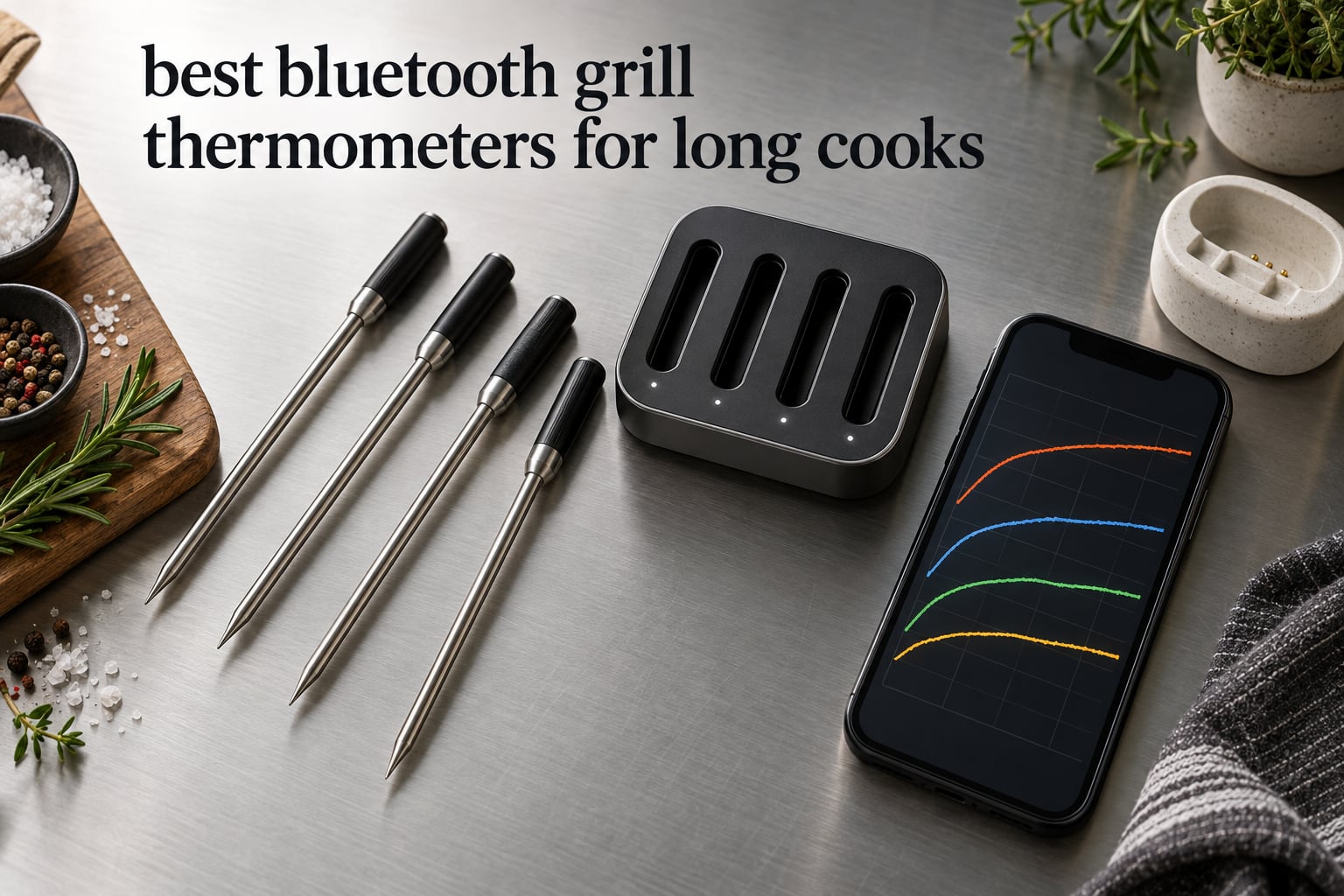
The best Bluetooth grill thermometer for long cooks is the MEATER Plus, because it is the only wire-free probe in this group that a large number of owners have run through 10-hour-plus smokes, and its app keeps predicting finish times through the stall instead of giving up on it. If you cook a brisket, a pork butt or a rack of ribs overnight, that combination matters more than any spec on a box.
Everything else in this roundup is scored against the same question: will this thing still be reporting accurate temperatures when you wake up at hour eleven? That framing changes what matters. Bluetooth runs on 2.4GHz, and a 2.4GHz signal loses strength passing through the walls of a closed metal cooker. Runtime claims on a packaging panel are measured with an idle probe in open air, not a probe transmitting through a 225°F pit for ten hours. And an app that predicts your finish time confidently at hour two is worth very little if it stops updating at hour five, right in the middle of a three-hour plateau.
We pulled ten Bluetooth thermometers, compared published accuracy, channel count, runtime figures and app behaviour, and cross-checked owner feedback on the things that break long cooks. Two of the ten are RF rather than Bluetooth, and we say so plainly in their sections rather than hiding it. If you want a broader look at thermometer types first, our meat thermometer guide for grilling covers the instant-read and wired options that long cooks genuinely do not need.
Two products here are RF rather than Bluetooth, and one Bluetooth entry carries a WiFi mode. That is deliberate, because the honest answer to “is Bluetooth a downgrade for long cooks” needs more than one opinion, and the section on connectivity below explains where Bluetooth holds up and where it does not.
Top 3 Best Bluetooth Grill Thermometers for Long Cooks In 2026

MEATER Plus
- Truly wire-free probe
- Bamboo charger doubles as Bluetooth repeater
- Ambient sensing to 527F

TempPro TempSpike CORE
- RF plus Bluetooth 5.2
- 1050F ceramic handle
- IPX8 probe
- Pre-paired out of the box

The MEATER Plus takes the top slot on evidence rather than on hardware. The TempSpike CORE posts the highest average rating of the ten and has the most heat-tolerant handle here. The INKBIRD IBT-4XS gives you four channels and about 40 hours of runtime for the money most people spend on one probe.
All 10 Picks at a Glance (October 2026)
| Product | Specifications | Action |
|---|---|---|
| MEATER Plus |
|
Check Latest Price |
| INKBIRD IBT-4XS |
|
Check Latest Price |
 TempPro TempSync 650 ft TempPro TempSync 650 ft |
|
Check Latest Price |
 Govee Bluetooth H5055 Govee Bluetooth H5055 |
|
Check Latest Price |
 TempPro TempSync 1000 ft TempPro TempSync 1000 ft |
|
Check Latest Price |
 BFOUR six-probe BFOUR six-probe |
|
Check Latest Price |
 Inkbird four-probe WiFi Inkbird four-probe WiFi |
|
Check Latest Price |
| TempPro TempSpike CORE |
|
Check Latest Price |
 ThermoMaven WT11 ThermoMaven WT11 |
|
Check Latest Price |
 Inkbird five-sensor WiFi Inkbird five-sensor WiFi |
|
Check Latest Price |
How We Scored for Long Cooks
We weighted five criteria, and the first two carry double the weight of the rest because they are the two ways a long cook actually fails.
1. Probe battery runtime under an active session (25%). Not the number on the box, but whether the stated runtime plausibly covers an 8- to 18-hour cook with the transmitter pushing readings the whole time. Where a manufacturer publishes runtime we used it as given; we did not extrapolate drain rates we cannot measure.
2. Signal behaviour with the cooker lid closed (25%). A closed offset, a double-walled electric smoker and an insulated garage door each remove Bluetooth signal differently. We weight RF and WiFi models ahead of Bluetooth-only models here, because radio frequency that does not rely on 2.4GHz propagation is structurally less exposed to that problem.
3. Channel count and ambient sensing (20%). Through a stall you want to know the meat temperature and the pit temperature at the same time. One probe that reports both beats two probes that report one each.
4. Heat tolerance of the handle and base (15%). A probe left in a 225°F pit overnight needs the parts outside the meat to survive ambient heat. Where a manufacturer publishes a handle rating we use it; where none is published we say so rather than guessing.
5. App reliability, alerts and brand longevity (15%). Alerts that only appear when you open the app are not alerts. Session logs that survive a disconnect matter when you want to read a temperature curve the next morning. And a brand that folds, as forum users repeatedly point out, leaves you with probes and no app.
One honesty note on method: these scores come from published specifications and owner feedback, not from our own instrumented cook sessions, so treat the runtime figures as manufacturer-stated numbers. The two products here that are not Bluetooth at all are included as the comparison point that makes the connectivity question answerable.
1. MEATER Plus – the wire-free probe that survives an overnight cook
MEATER Plus Smart Meat Thermometer, Honey, Bluetooth, 165ft, Grill & Oven
Wire-free probe
Bamboo charger doubles as repeater
Internal to 212F, ambient to 527F
6.18 inch probe
Pros
- Only fully cable-free option here
- Bamboo base extends usable Bluetooth range
- App predicts finish times and guides steps
- Holds charge well across 9+ hour cooks
- Dishwasher safe probe
Cons
- Phone range depends entirely on base placement
- No battery indicator on the probe
- Some owners report probe-to-base dropouts
- Single probe only
The reason the MEATER Plus shows up in so many overnight cook threads is straightforward: there is no cable to route out of the smoker, and the bamboo charger acts as a repeater that can sit on a nearby shelf. Owners running nine-hour-plus sessions report coming back to a probe that is still nearly full. At 48k ratings it is also the most widely owned model here, which means app bugs get found and fixed fast.
Its ambient sensor reads to 527F, so it can watch pit temperature as well as meat temperature from a single probe. The internal channel tops out at 212F, which covers every pull temperature for brisket, pork butt and ribs. The guided cook system in the app lays out steps and keeps re-estimating the finish time as the cook progresses, and that estimate is what you are really paying for when you smoke overnight.
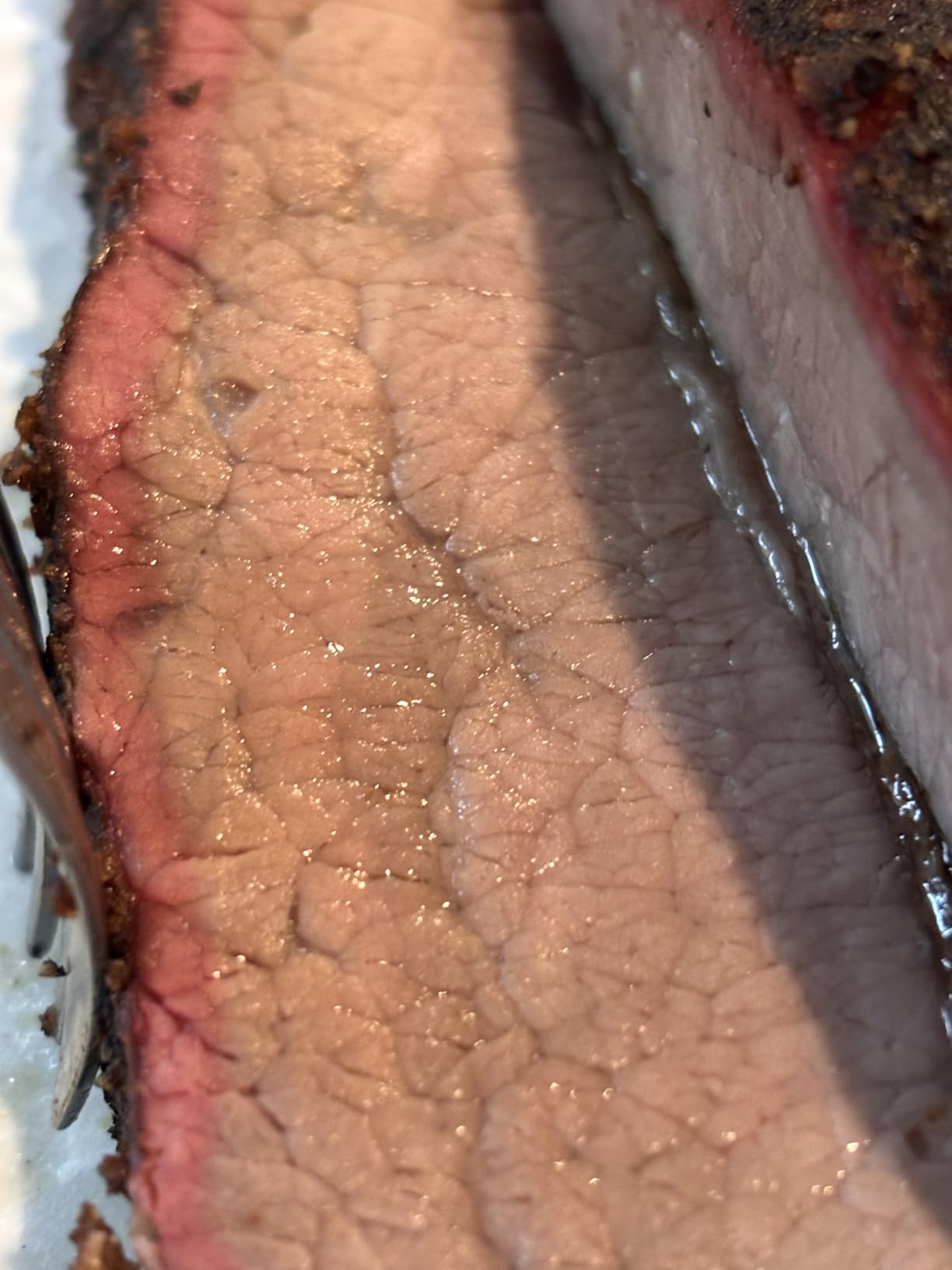
The weakness everyone reports is range, and it is a misunderstanding rather than a fault. The advertised 165 feet is measured to the bamboo base, not to the probe. If the base is in the garage with the cooker and the phone is in the house, the phone still reaches the base over Bluetooth. Put the base on the same side of the wall as the phone and it works. Owners who report dropouts are usually pairing the probe to the phone directly and skipping the base step.
There is no battery-level readout on the probe itself, so a flat charge only shows up when you open the app at the start. And with one probe in the box, you cannot watch a pork butt and a rack of ribs at the same time without buying a second unit.
Verdict for a 225F overnight cook: yes. The probe body sits inside the meat and the ambient channel is rated well past pit temperature. The one thing to manage is base placement.
How it behaves at hour eight of an overnight brisket
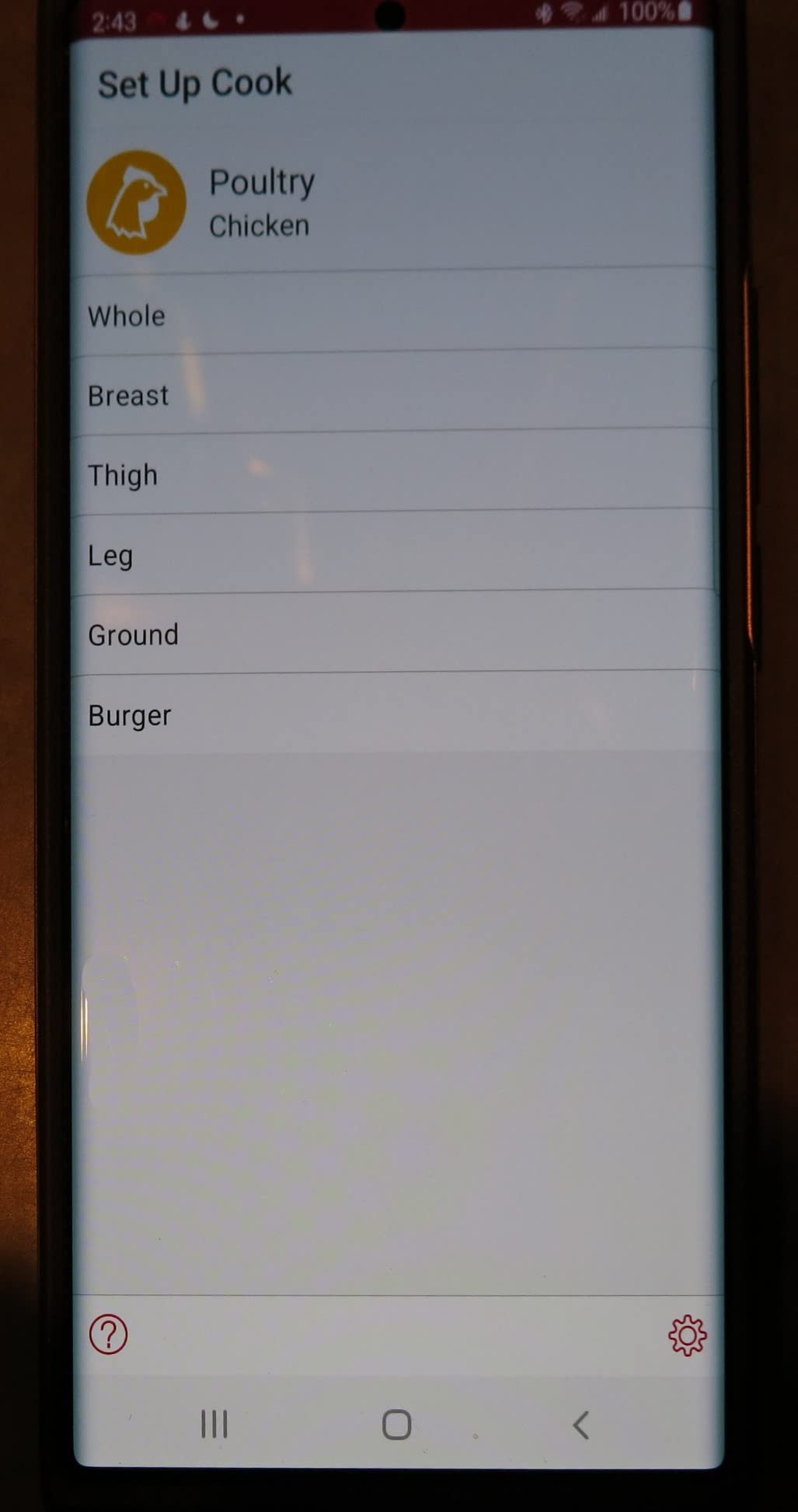
The recurring owner report is that the app keeps updating through a long stall and recovers its estimate afterward. Charging is a five-minute top-up for roughly two hours of cook, so a top-up during a rest period is realistic if you started low. Range is where it disappoints, so treat the base as the antenna and give it a clear path to your phone.
Where this pick will frustrate you
Single-probe owners who cook two cuts at once, and anyone who wants a physical temperature readout without a phone. There is no screen on the base at all. Forum users also flag Meater as the most-named problem brand in long-cook threads, and the recurring complaints are pairing order and dropouts rather than accuracy. Pair it correctly through the base and most of that history stops applying.
2. INKBIRD IBT-4XS – four channels and about 40 hours per charge
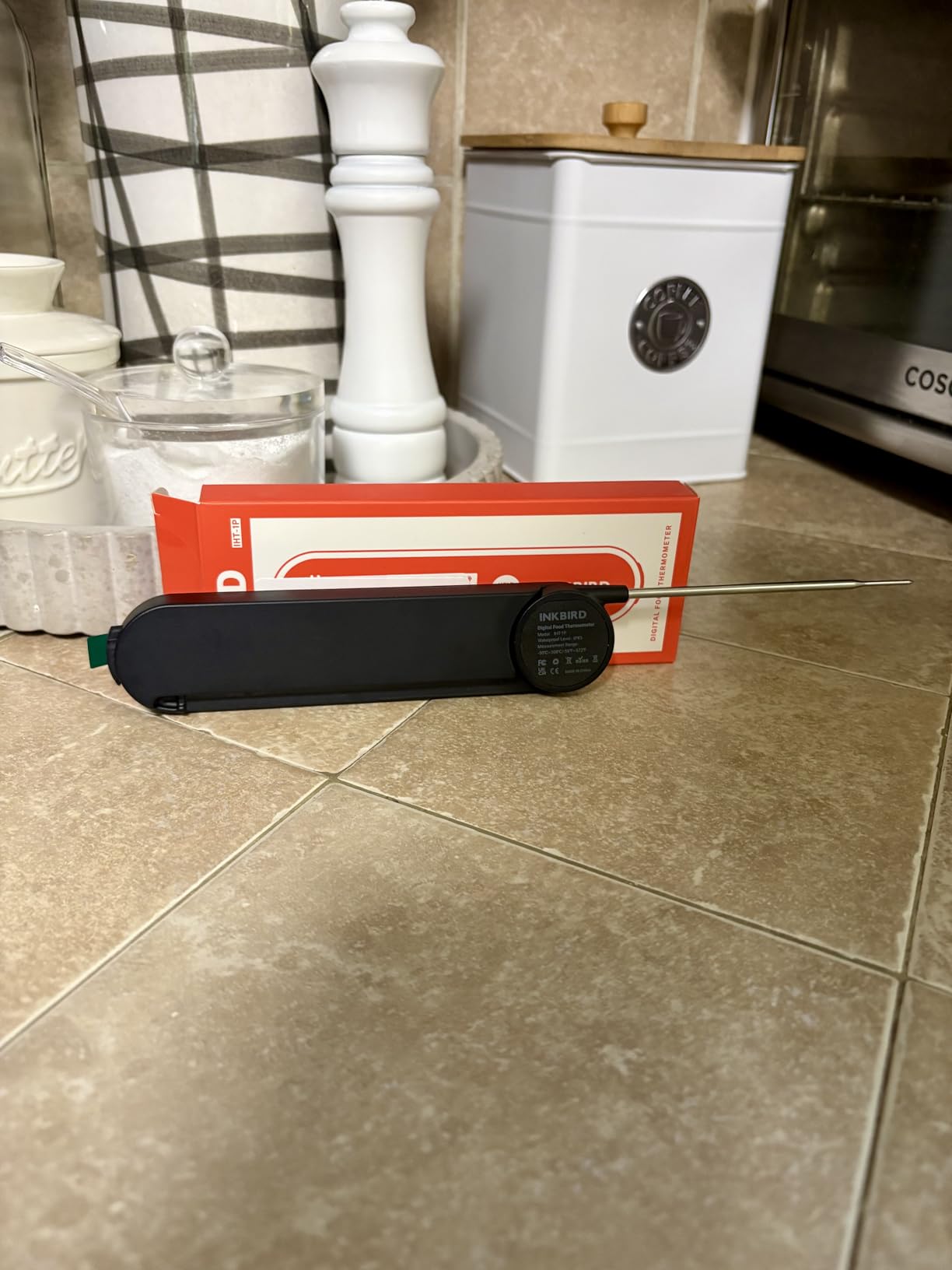
INKBIRD Bluetooth Digital Wireless Food Meat Thermometer IBT-4XS, 4 Probes
3 meat probes plus 1 ambient
About 40 hours per charge
150 ft Bluetooth
32F to 572F range
Pros
- Four channels for meat and pit together
- Long runtime covers long smokes without a top-up
- Magnetic rotatable LED display
- App graph for reviewing the whole cook
- Reads to 572F ambient
Cons
- Probes must be fully seated or readings spike
- Probe cables need managing at the cooker
- Rated primarily for outdoor use
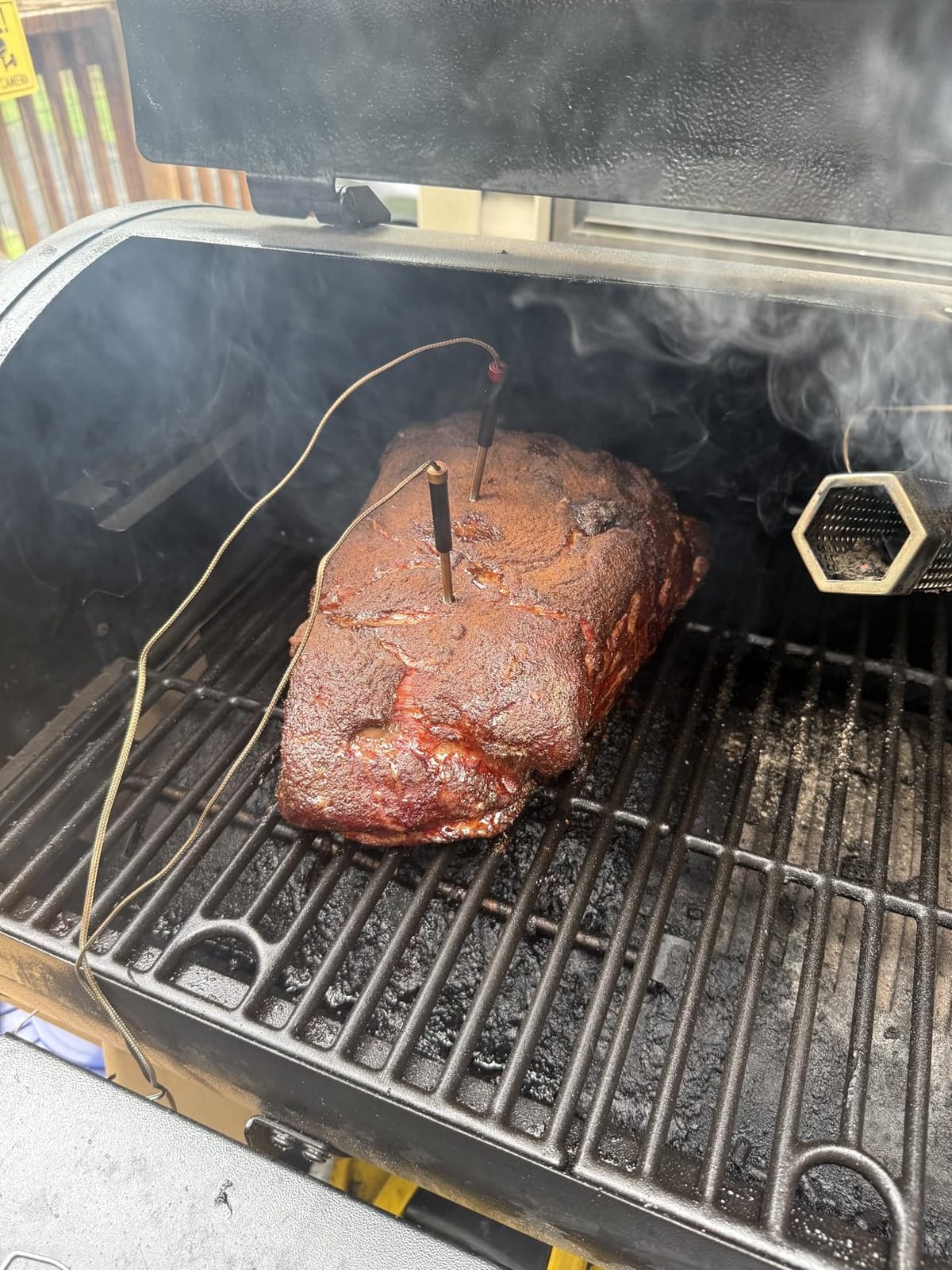
This is the one I would hand someone running a competition category with two or three cuts on the pit at once. Three meat probes plus a dedicated ambient probe means you get pit temperature and every piece of food on one screen, which is exactly the view you want at hour six when a butt is stalling and you need to know whether the pit is holding.
Rated runtime is about 40 hours on a full charge, which comfortably covers an 18-hour cook without a mid-session top-up. That is the number most people buying a Bluetooth thermometer for long cooks actually need, and almost nobody publishes it. Response time of one second is quick enough that you can see a sear develop rather than watch a lagged average.
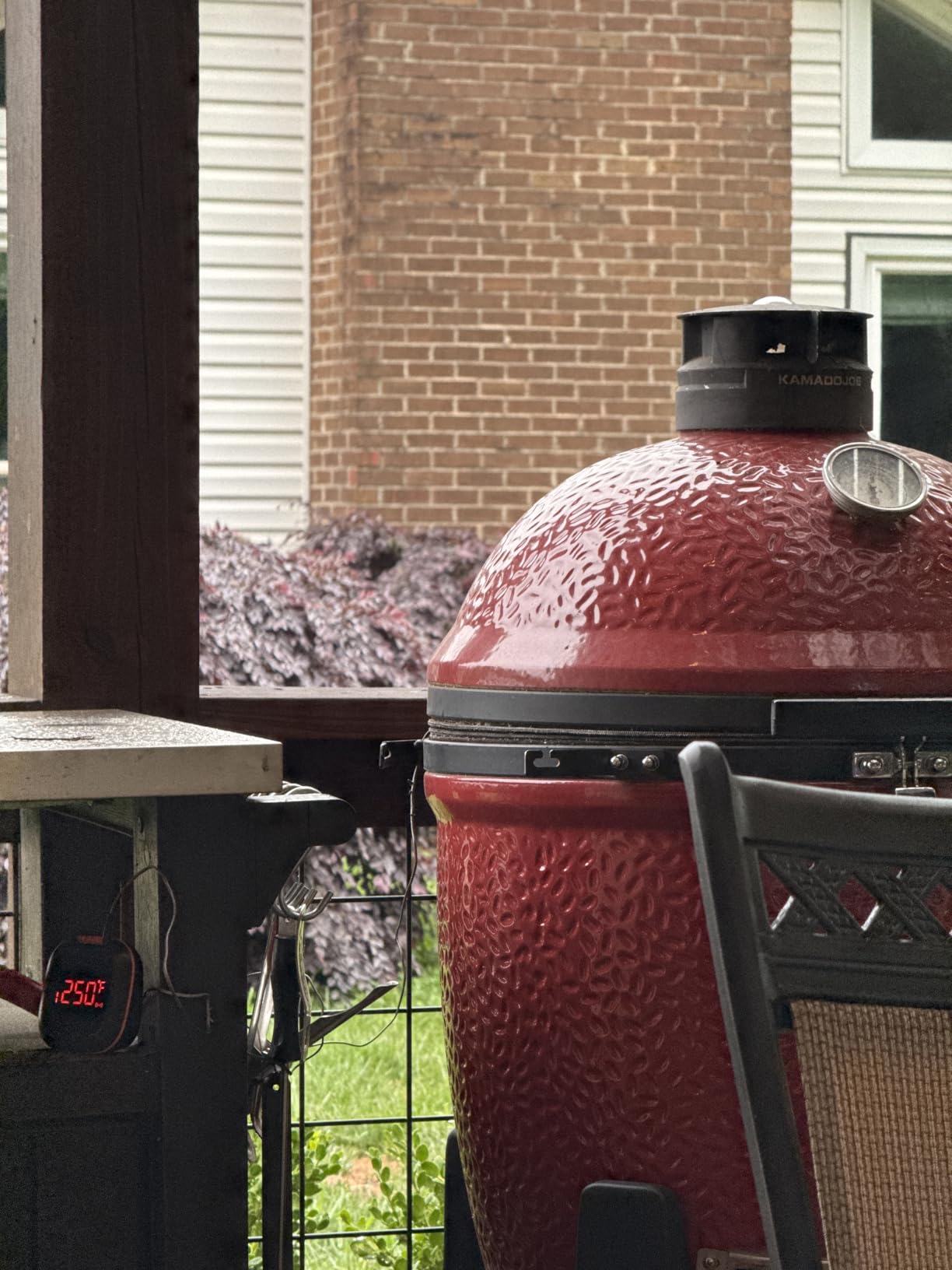
The catch is probe seating. Owners report readings that jump to implausible values near the top of the range when a probe is not clicked fully into its port. It sounds like a defect and it is not, but it will cost you a cook if you do not check each connection before closing the lid. The probes are wired to the base, so you also need to route cable out of the cooker and leave it slack.
The 2.2 inch magnetic body with a rotating LED display is genuinely useful at the pit, because you can read it without an app and without unlocking anything. Rated for outdoor use, which covers a smoker in the yard but tells you nothing about an indoor oven.
Verdict for a 225F overnight cook: yes. The ambient probe is rated to 572F and sits outside the cooker, so pit heat is well inside its rating.
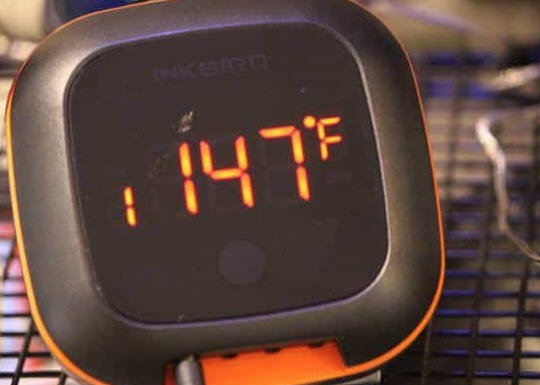
Whether four channels actually change how you cook
Yes, and the first time is usually the stall. With a dedicated ambient channel you can tell the difference between a butt that has plateaued and a pit that has lost heat, which is the difference between waiting and intervening. The app graph also lets you read the whole temperature curve the next morning instead of relying on memory.
What to watch out for
Push every probe home firmly and confirm the display shows a plausible number for each channel before you close the lid. Cable strain at the cooker door is the other recurring issue, so leave a service loop rather than pulling taut when you open the pit.
3. TempPro TempSync 650 ft – two probes and a display you can read at the pit
TempPro TempSync 650 ft Bluetooth Meat Thermometer with 2 Probes for Grill
2 probes
650 ft claimed range
Plus or minus 1.8F
14F to 572F
Pros
- Two probes cover meat plus pit temperature
- Loud alarm that carries across a yard
- Rechargeable cell handled multi-hour smokes
- Dual readout on the base unit
- Resolution of 0.1F
Cons
- App has no session start or stop and no history
- Wired probes need cable care
- Indoor range falls short of the claim
- Setup QR code points at another model's app page
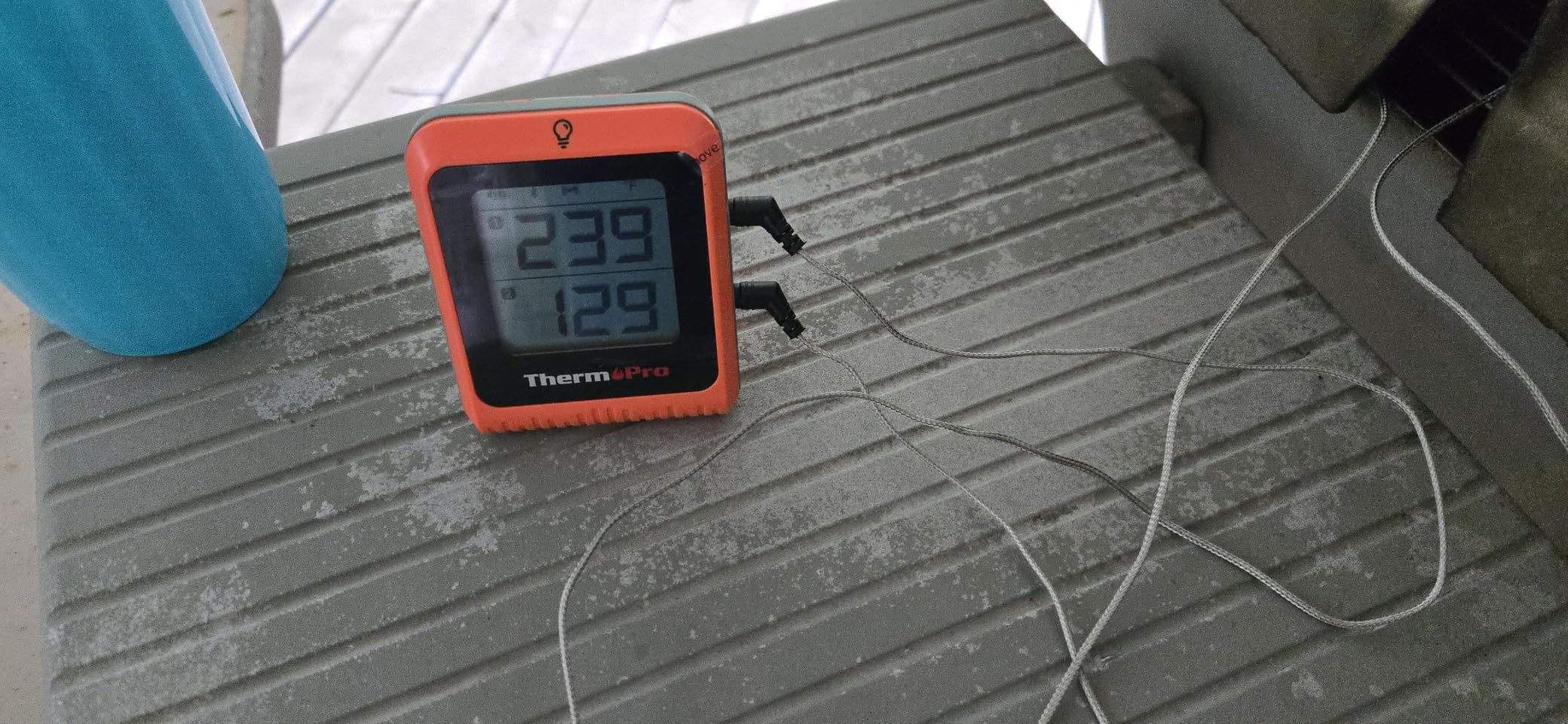
Two probes is the practical minimum for a long cook, and this unit does one meat and one pit without any fuss. Accuracy is published at plus or minus 1.8F across a 14F to 572F range, which covers both a cold preheat and a hot pit. Multiple owners specifically describe buying it after repeated dropouts with a wireless probe, which tells you what problem it solves.
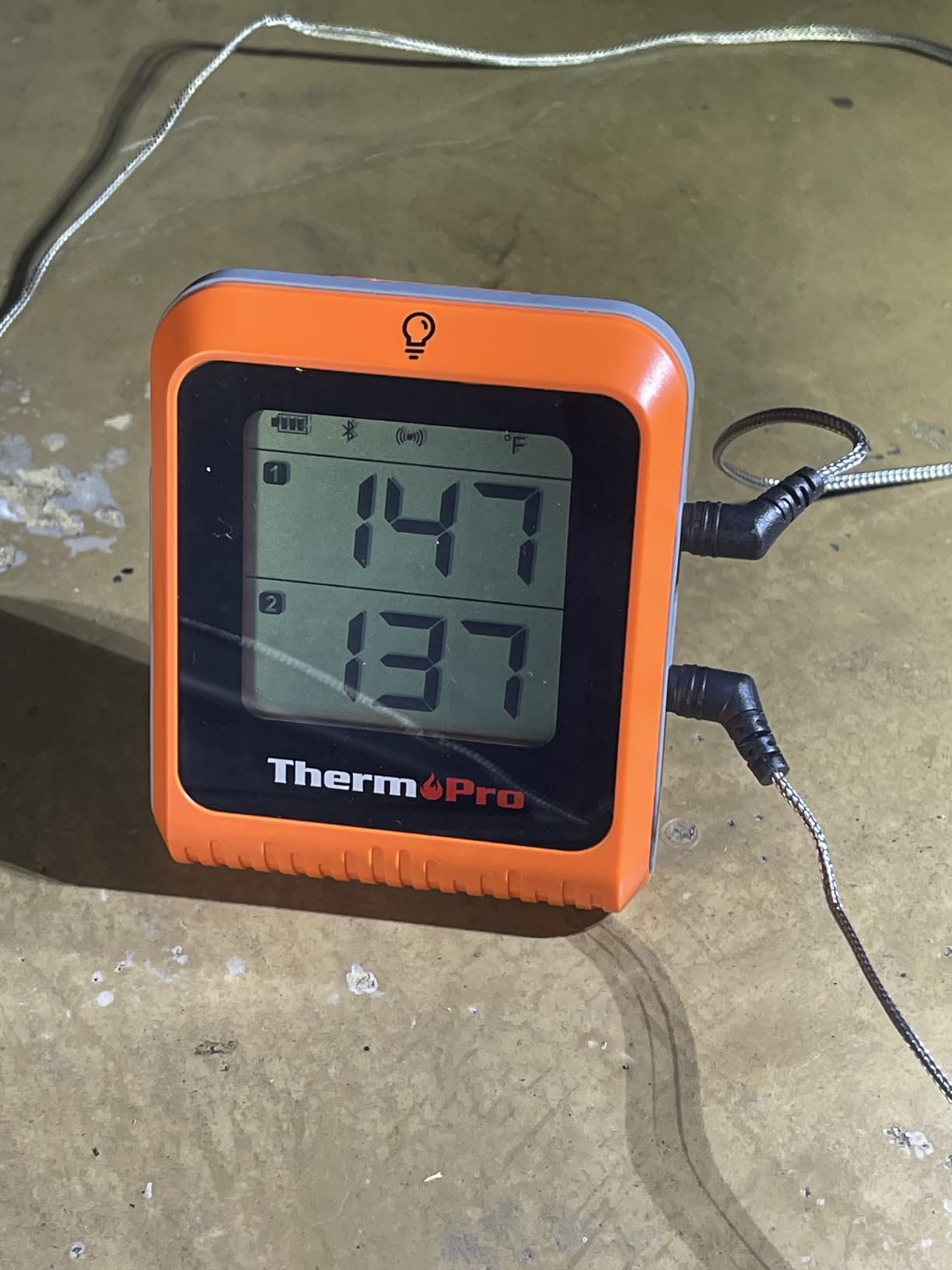
The base unit shows both channels at once, so you can check temperatures without opening the app. That matters more than it sounds like it would at hour three in the morning. The alarm is loud enough that owners mention it as a feature rather than a complaint, though a few describe it as startling.
The app is the weak point. It has no session start or stop and does not store cook history, so there is no stored temperature curve to review in the morning. You get live readings, presets and alerts, and nothing more. That is a real limitation if your instinct is to look back at yesterday’s plateau to plan today.
Owners also report that the 650 ft figure drops off sooner than expected indoors, which is the usual Bluetooth behaviour through house structure. One long-term owner had a backlight button failure after about three years, and the setup QR code has been known to point at a different model’s app page, which complicates pairing on first run.
Verdict for a 225F overnight cook: yes. The probe range extends to 572F, far beyond pit temperature.
Two probes versus four at a six-hour mark
Two probes is enough for a single cut plus pit temperature, which covers most overnight cooks. You give up the ability to run a second rack of ribs alongside, and you give up per-channel alarms. For a weekend butt or brisket, the simplicity wins.
Where the app will disappoint you
If you want a temperature graph you can scroll through the next morning, this is the wrong unit. Session logging simply is not there. Everything else about the base unit is deliberately simple, so treat this as a live-monitor rather than a cook-recording device.
4. Govee Bluetooth H5055 – the battery that never runs out mid-smoke
Govee Bluetooth Meat Thermometer Digital with Smart App Timer and Alerts
Up to 200 hours on 2 AA
40 inch stainless probes
IPX7 probes
Plus or minus 1.8F under 302F
Pros
- Enormous AA battery life removes mid-cook anxiety
- Simple app with USDA presets
- Long 1 m probes reach deep into a cut
- Magnet
- stand and hanging hook for placement
- Backlit display readable at night
Cons
- Range falls off quickly through walls
- Push notifications often need an app refresh
- Some units cannot be calibrated
- Probe jacks are proprietary
This is the only unit here where battery life simply stops being a factor in your decision. Stated runtime of 200 hours on two AA cells means an 18-hour overnight cook is not even a meaningful fraction of the charge, and you can swap cells at any point instead of charging. Govee customer support has also been reported replacing units that drifted, which removes a common long-term worry.
The 40 inch probes are long enough to reach the centre of a thick cut without the cable outside the meat having to be absurdly long, and the IPX7 rating survives a rinse. Accuracy is stated at plus or minus 1.8F below 302F, which covers pull temperatures for beef and pork.
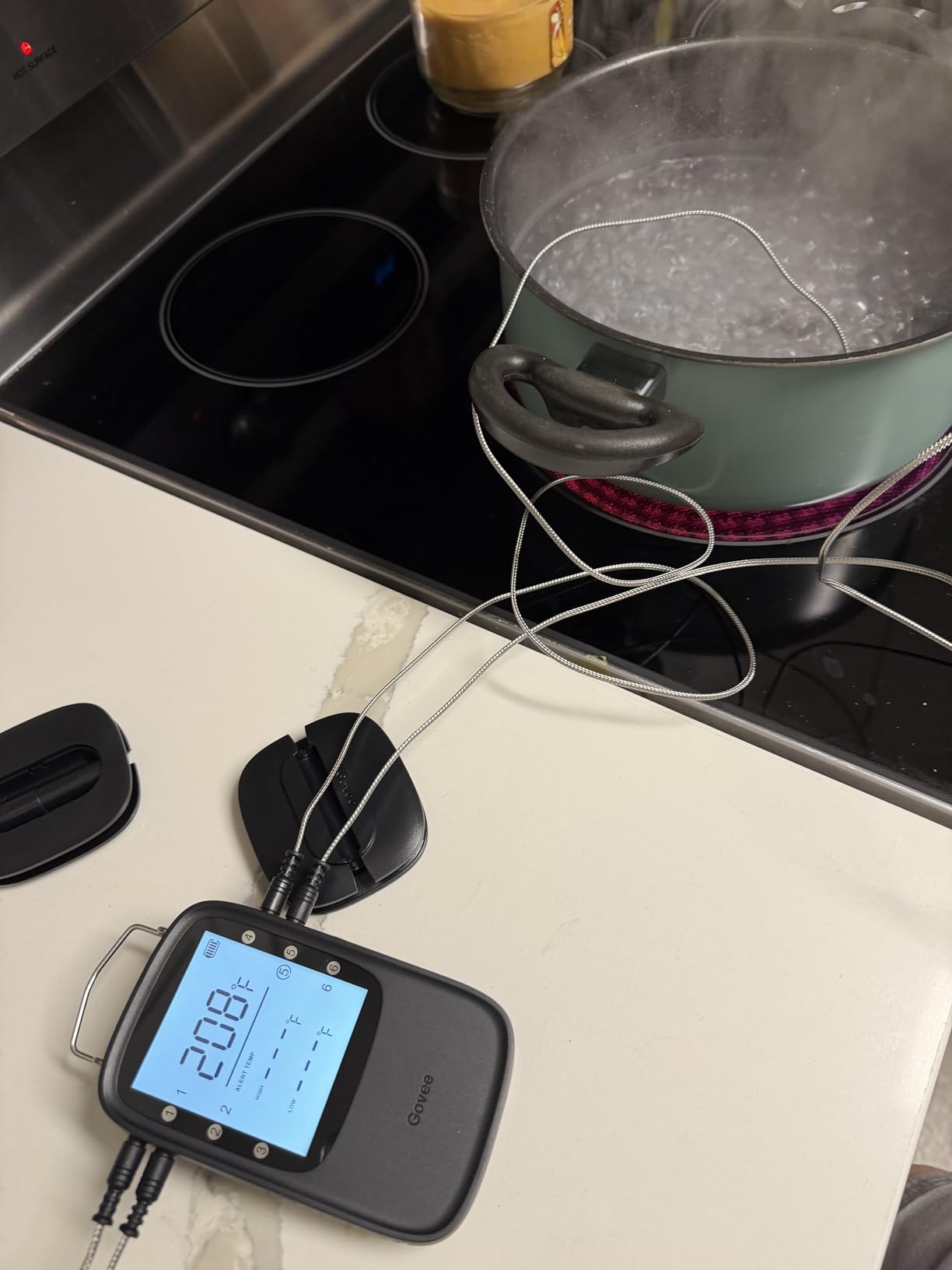
What weakens it for long cooks is the radio, not the hardware. Owners consistently report that the advertised 230 ft drops off quickly behind walls, so a closed-lid cooker in a garage with the phone in the house is exactly the situation where this unit performs worst. Notifications are the second soft spot: the audible beep happens at the unit, while the phone alert often fails to surface until you open and refresh the app.
A minority of buyers received units that could not be calibrated, and the probe jacks are a proprietary size, so replacement probes from other brands will not fit. Given the 200-hour figure, we would budget for replacing the AA cells rather than planning around charging.
Verdict for a 225F overnight cook: yes on heat, conditional on signal. Probes are rated to 572F. If your cooker sits far from your phone with walls in between, this is not the pick.
Whether AA power beats rechargeable for a long cook
For unattended cooks, yes. There is no charging step, no adapter at the pit, and no risk of discovering a flat battery after the probe is already in the meat. The trade-off is that the radio is less capable than the flagship wireless units here, so you are accepting a shorter effective range for a much longer runtime.
Where it falls short
Notifications are the practical failure. If you are relying on your phone to wake you when the brisket hits temperature, test it during a short cook first. Watch for units that arrive unable to calibrate, and keep the fact that probe jacks are proprietary in mind before buying a spare.
5. TempPro TempSync 1000 ft – four probes on RF, no phone required
TempPro TempSync 1000FT Wireless Meat Thermometer for Grilling and Smoking
RF transmission, not Bluetooth
4 color-coded probes
1000 ft range
14F to 572F
Pros
- RF holds up for all-day smokes where Bluetooth struggles
- No app
- account or phone needed
- Four color-coded probes cut confusion
- Ice-bath and boiling tests agreed within 1-2F
- Per-channel high and low alarms
- One-year warranty extendable to three
Cons
- RF not Bluetooth
- so no phone app or graphing
- Probe wires kink easily
- A few probes reported failing after a few cooks
- Receiver must be carried around
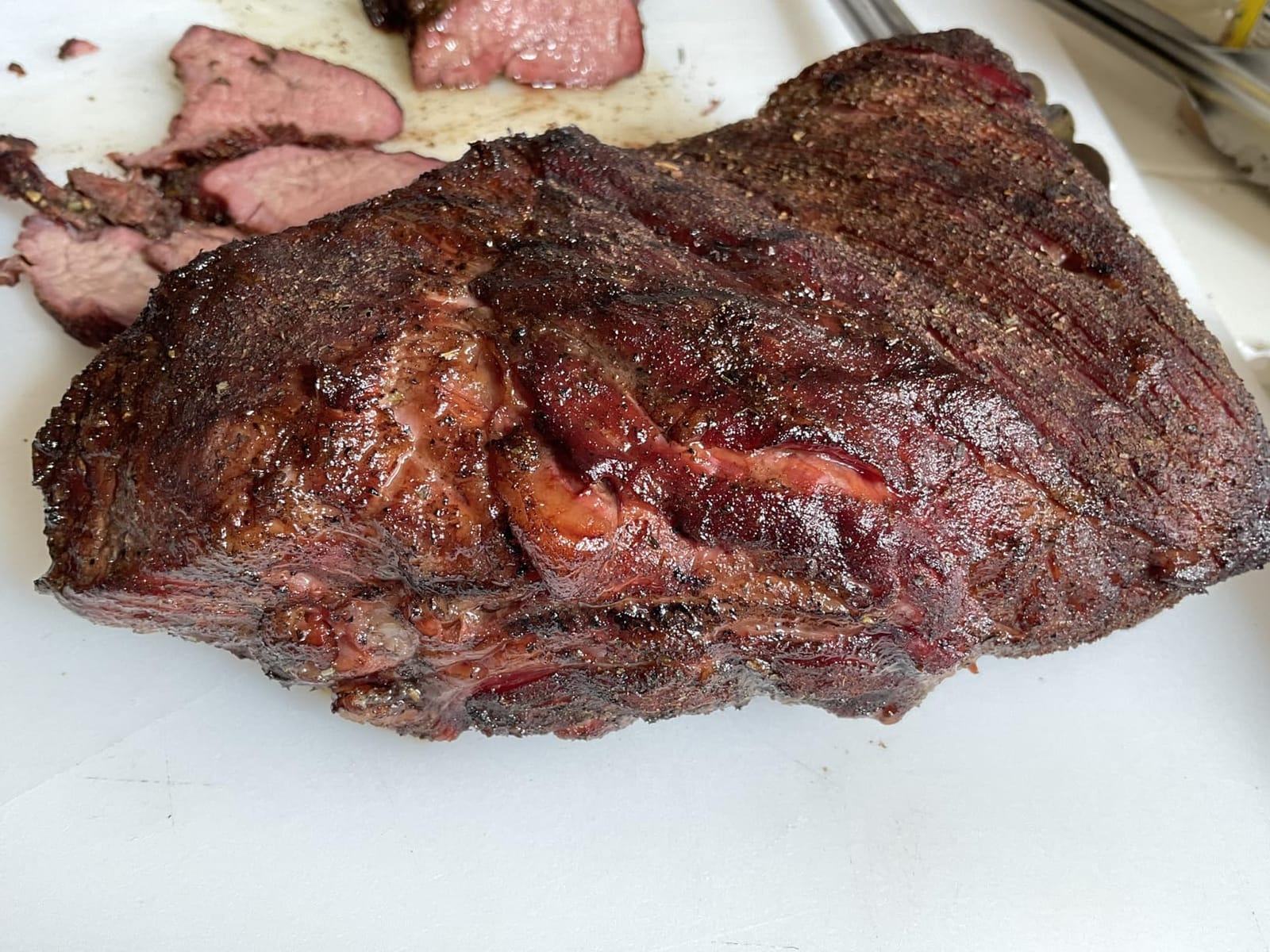
This is not a Bluetooth thermometer and we are not going to pretend otherwise. It transmits on RF, which is why owners who were burned by flaky wireless probes specifically chose it for long cooks. Several of those reviews describe the same relief: no app, no login, no pairing order, and a signal that does not care that a metal lid is closed.
Four color-coded probes with individual alarms let you track a high-temp pull and a rest window on separate channels, which is genuinely useful during the last two hours of a cook. Calibration checks in ice water and boiling water show the four probes agreeing within a degree or two of each other, which matters after several owners returned other brands for drift.
What you give up is the phone. There is no temperature graphing, no session history and no notifications, because there is no app at all. You carry the receiver or mount it where you can see it. Some long-cook purists consider that a feature, since it removes the phone from the loop entirely.
Probe wire durability is the most cited complaint, with kinking reported after repeated use, and a few owners reported individual probes failing within months of closed-lid cooking. That is the honest risk to weigh: the radio is the most reliable thing here, the probe wires are the least.
Verdict for a 225F overnight cook: yes, with the most confidence of any unit on this list. Probes are rated to 572F and the radio is not dependent on 2.4GHz propagation.
Why experienced pitmasters keep choosing RF over Bluetooth
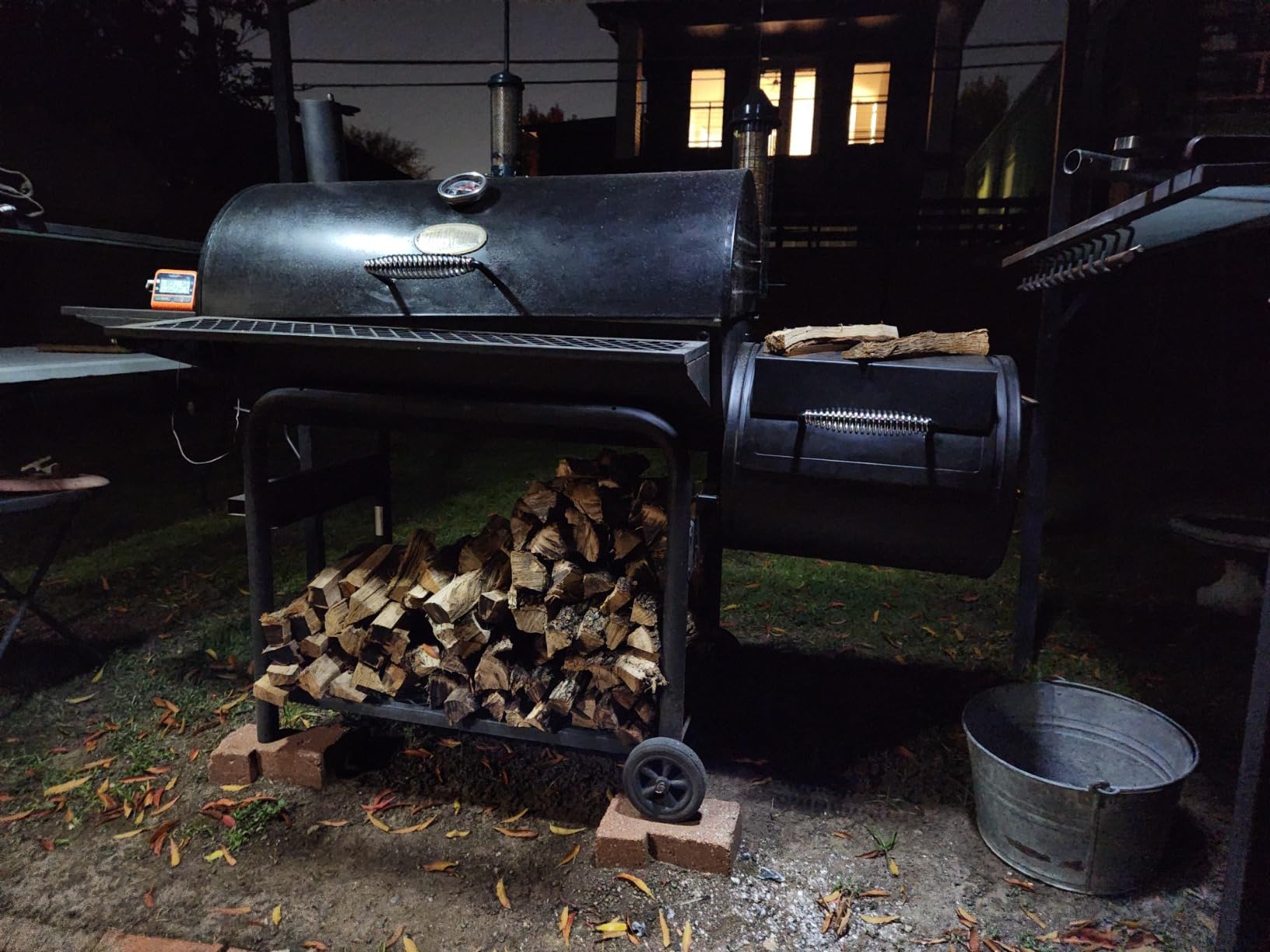
The reason is physical. Metal attenuates 2.4GHz, and an offset smoker or a double-walled electric unit is mostly metal between the probe and the phone. RF units in the sub-GHz range hold their link under exactly those conditions. If your cooker is a heavy steel box and your phone is inside the house, that difference decides the outcome.
What you have to give up
Graphing and notifications, entirely. If your process depends on reading a temperature curve after the cook or getting an alert while you are doing something else, this is not for you. Also check your probe wires regularly, because kinking is the failure mode owners report.
6. BFOUR six-probe – six channels at a budget price
BFOUR Bluetooth Meat Thermometer Wireless Meat Thermometer, Wireless Digital Grill Thermometer with 6 Temperature Probes, Large LCD Display, Bluetooth Thermometer for Grill, Smoker, Oven and BBQ
6 probe channels
Bluetooth 5.2
328 ft outdoors
33F to 572F at plus or minus 1.8F
Pros
- Six channels is more probe capacity than any other unit here
- Bluetooth 5.2 with 328 ft outdoor range
- Large backlit LCD shows signal and power
- App includes graphs
- presets and custom alarms
- Two-year warranty
Cons
- Display cycles through channels one at a time
- Must be wiped rather than soaked
- Long wired probes need routing out of the cooker
- AAA batteries rather than a rechargeable cell
- One of the two lowest average ratings here
Six channels is unusual at this price and it is the reason to consider this unit. If you run a party, a competition round, or a whole turkey plus a pork butt, six probes cover more than any other model we looked at, and Bluetooth 5.2 gives 328 ft outdoors and 150 ft indoors.
The app is better than you would expect from the price, with USDA presets, custom alarms, timers and temperature graphs. The backlit display shows signal strength, power, current and target temperature along with a progress indicator, which is a lot of useful state on one screen.
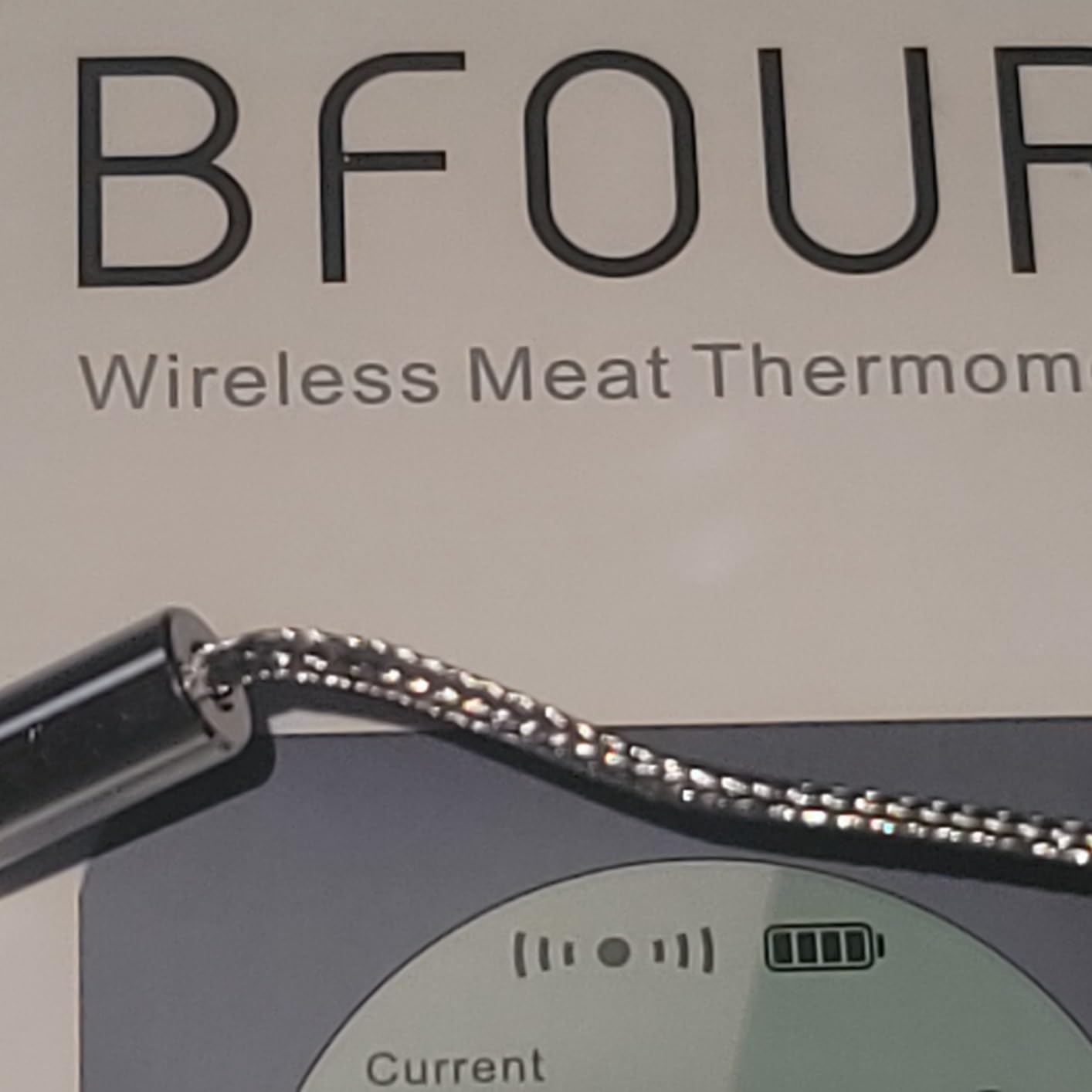
The weakness is how that information is presented. The screen cycles through channels one at a time rather than showing them all, so at hour six you are pressing a button to find out what the second rack is doing. That is workable but tiresome over a long cook.
This unit also sits among the two lowest average ratings in the group, with a single-digit percentage of one-star reviews, which usually points at build or consistency issues rather than accuracy. Care instructions are wipe-clean only for the body, and the probes are wired, so plan cable routing before the cook starts.
Verdict for a 225F overnight cook: yes. Probes are rated to 572F ambient at plus or minus 1.8F.
Whether six channels change a long cook
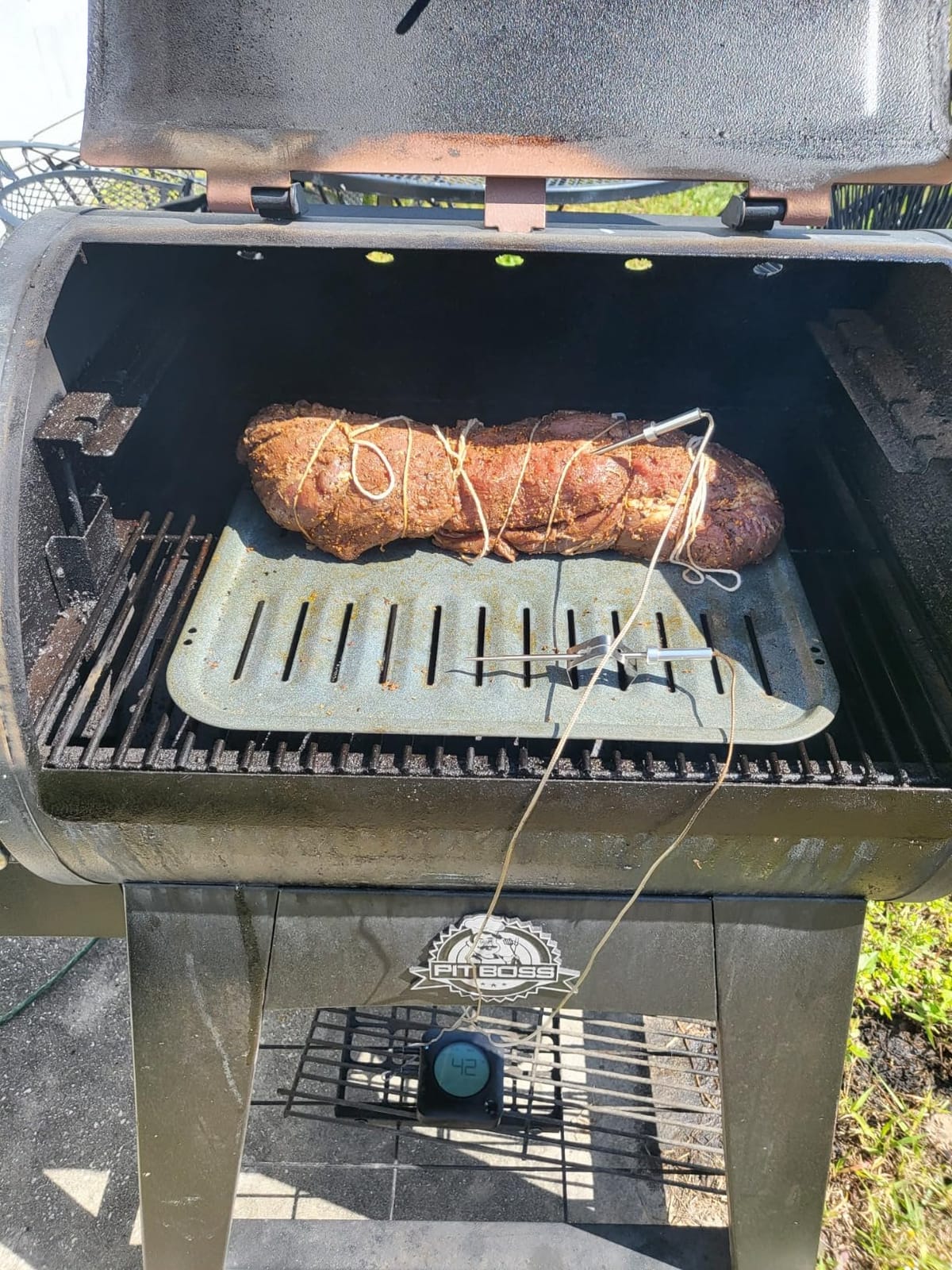
Only if you actually cook that many things at once. For a single brisket, six channels are spare capacity. For a holiday spread with a turkey, a ham and two racks of ribs, nothing else here covers it without a second base unit, and reading each channel by pressing a button is a small price for that.
Where the compromises show
The single-channel cycling display and AAA batteries both add friction to unattended cooking. Check probe seating carefully, since six loose probes is six chances to read a number that has drifted away from the food. Wipe the body rather than soaking it.
7. Inkbird four-probe WiFi and Bluetooth – three connectivity modes
Wireless Meat Thermometer with 4 Probes, INKBIRD WiFi Meat Thermometer Digital Wireless for Rotisserie Grill Oven,Unlimited Range Dishwasher Waterproof Bluetooth Thermometer for iOS & Android
WiFi, Bluetooth and offline modes
4 dual-sensor probes
About 25 hours per charge
14F food, 32F to 572F ambient
Pros
- Three modes
- including WiFi and a no-phone offline mode
- Four probes with head and tail sensors reading internal and ambient
- Per-probe calibration plus an ice-water routine
- Charging base shows all four probes at once
- IP67 dishwasher-safe probes
Cons
- Some owners report erratic wireless links close to the smoker
- App caps the settable ambient maximum near 203F
- Reported 10-15F probe-to-probe spread on some units
- Plastic housing rated only to about 176F
- Bluetooth blocked by foil wrapping late in a cook
This is the most interesting answer to the connectivity question on the list. It runs 2.4GHz WiFi for effectively unlimited range, Bluetooth for around 300 ft, and an offline base mode that shows all four probes on a charging stand without a phone at all. Owners of double-walled smokers and insulated garage setups report that the WiFi mode removes dropouts entirely.
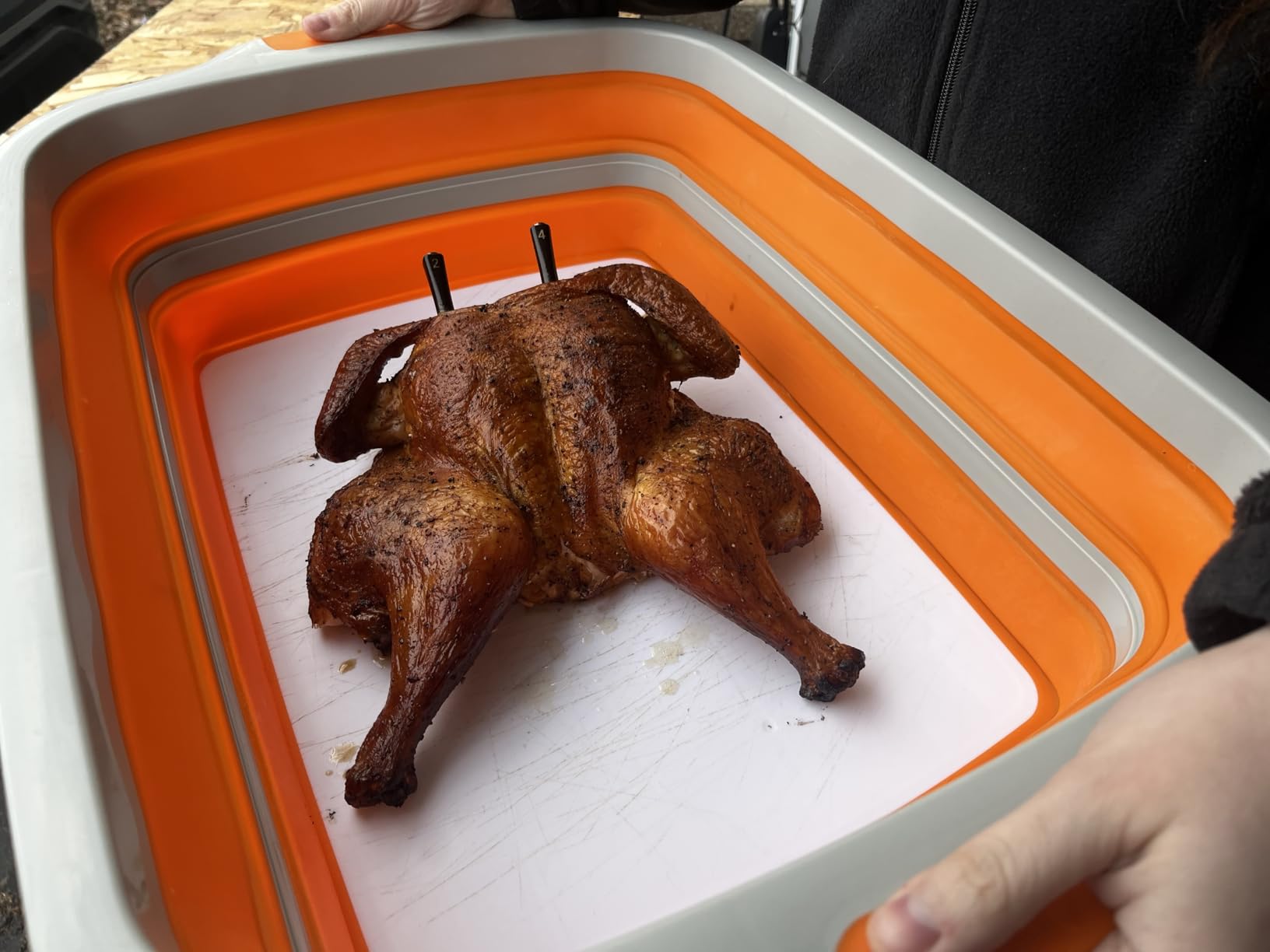
Each of the four probes carries head and tail sensors, so you get internal and ambient readings from a single probe rather than dedicating a channel to pit temperature. Calibration is adjustable per probe within plus or minus 12.6F, and the base stores about 30 minutes of cook data on its own.
It is also the most divided unit here by owner feedback. The same people who praise the WiFi mode are the ones reporting the wireless link dropping while standing next to the smoker, and the highest share of one-star reviews in this group belongs to it. Reported probe-to-probe spread of 10-15F on some units would be a serious problem on a long cook if true.
Two practical limits deserve attention. The app caps the settable ambient maximum around 203F and locks higher values behind a probe-damage warning, which is sensible but will surprise you. And the plastic housing is rated to roughly 176F, so it must stay out of direct high heat, which is a constraint the metal-bodied units here do not have.
Verdict for a 225F overnight cook: yes on the probe, with the base kept clear of direct heat. Keep the plastic housing outside the cooker and above ambient pit temperature.
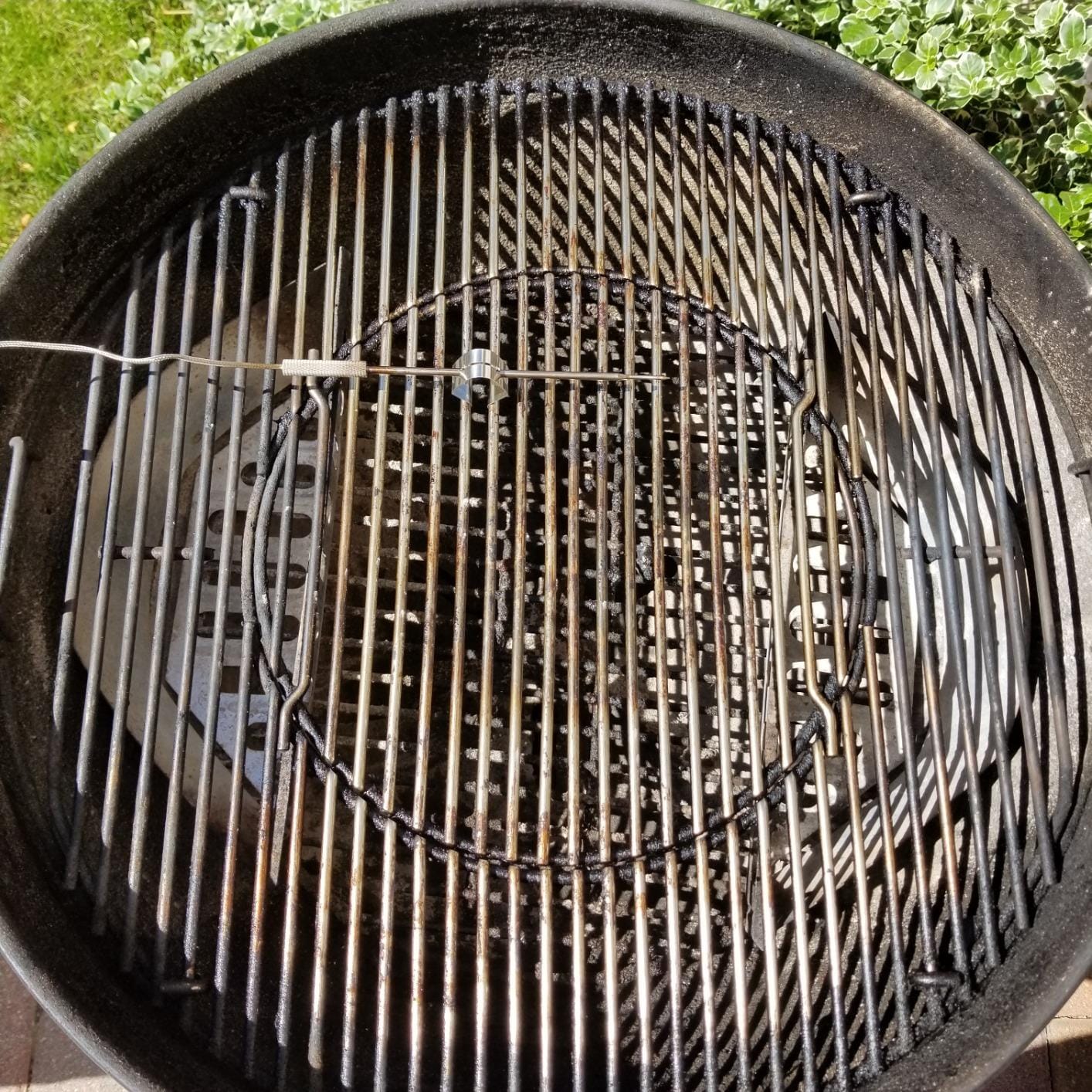
Whether WiFi mode is worth the setup
If your cooker is in a garage, a basement or a detached shed, WiFi mode is the feature that changes the outcome, and it is the reason several owners here upgraded from a Meater Block. The offline base mode is a useful fallback: four probes on a screen, no phone, no signal required.
What to verify before committing to a long cook
Run a short cook first and compare all four probes against a known-good thermometer. Watch the ambient cap in the app so you are not fighting it at hour six. Avoid wrapping tightly in foil late in the cook, since owners report that blocking the signal.
8. TempPro TempSpike CORE – the highest-rated probe with the toughest handle
TempPro TempSpike 500ft Wireless Meat Thermometer with Upgraded Meat Probe
RF plus Bluetooth 5.2
1050F ceramic handle
IPX8 probe
14F to 572F at plus or minus 1.8F
Pros
- Highest average rating in this group at 4.6 with only 4% one-star reviews
- RF plus Bluetooth 5.2 holds signal through structure
- Arrives pre-paired with no account or WiFi setup
- Calibration checks landed within about a degree
- Connects to an Apple Watch and phone at once
- Low battery alert built in
Cons
- Battery access requires prying off a glued magnet
- No user-adjustable calibration
- Probe tip is short for very large cuts
- One reviewer questioned ambient readings against an air fryer set temperature
This is the pick I would put on a 14-hour overnight cook without hesitating. It combines RF with Bluetooth 5.2 for a link rated to 500 ft, and the probe handle is a ceramic part rated to 1050F, which is the highest heat tolerance published by anything in this roundup by a wide margin.
Owners consistently note that it arrives pre-paired, so there is no account, no WiFi configuration and no pairing-order ritual. Calibration checks reported in ice water and boiling water came in within about a degree of expected values, and at a 4.6 average with 4% one-star reviews it has the cleanest feedback distribution of the ten.
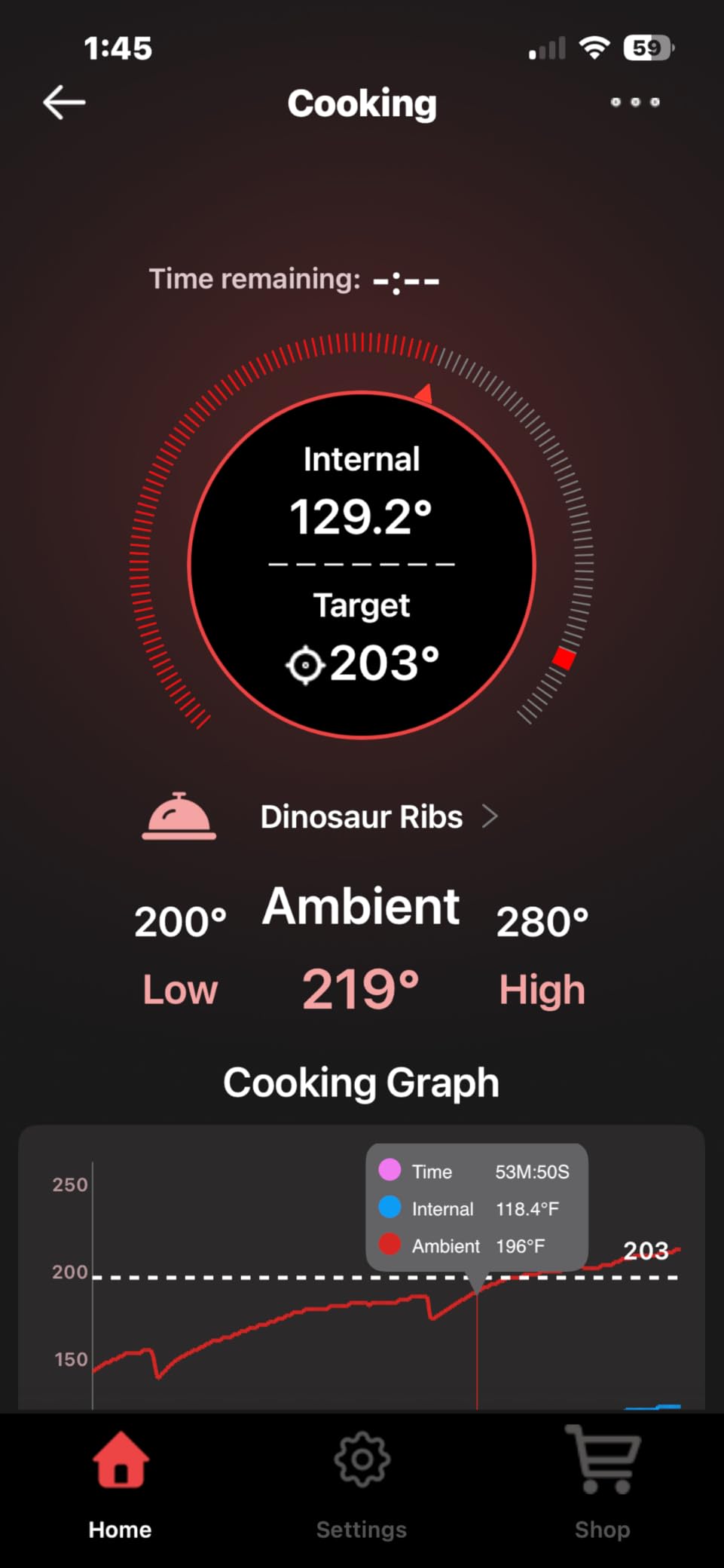
For long cooks specifically, the RF element means the closed metal lid matters much less than it does on a Bluetooth-only unit. It will also send alerts to an Apple Watch and a phone at the same time, which is the setup most useful when you are not holding your phone.
Two minor irritations. Reaching the battery means prying off a magnet glued over the CR2032 cell, which is awkward on a dark patio. And there is no user calibration, so if a probe drifts you have no software adjustment available. The tip is also on the short side for very large cuts, so keep that in mind for a full packer brisket.
Verdict for a 225F overnight cook: yes, and it is the most heat-tolerant probe here. A 1050F ceramic handle gives you enormous margin at pit temperature.
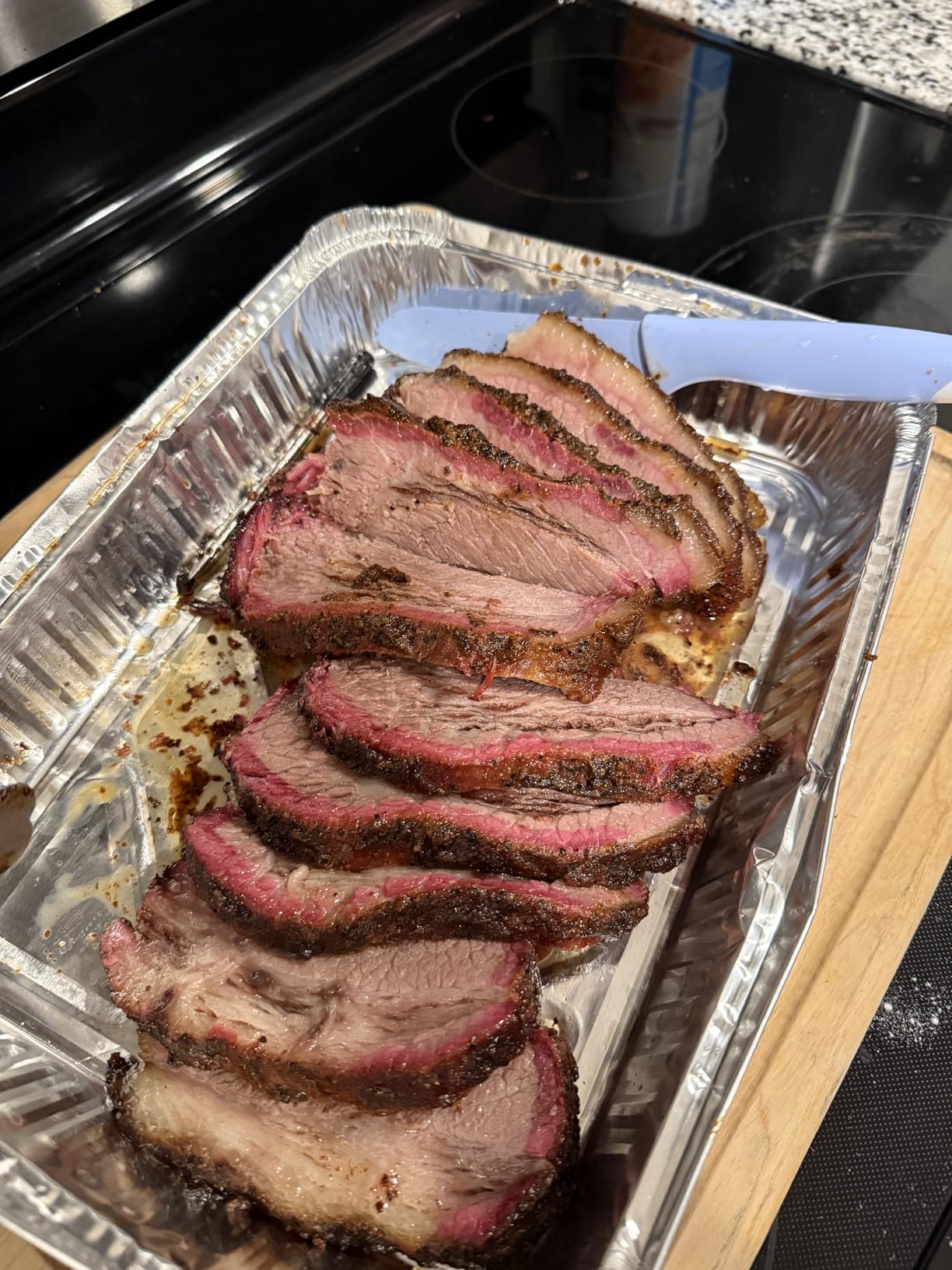
Whether the handle rating matters at 225F
More than expected. Most failures in long cooks come from the part outside the meat, and a 1050F ceramic handle is not something a 225F pit can degrade. Combine that with RF plus Bluetooth and this is the unit most likely to still be reporting at hour fourteen.
What to live with
The glued magnet over the battery cell, and the absence of user calibration. Neither affects cooking accuracy day to day, but both show up when you are changing cells in poor light. Check the probe tip length against your largest cut.
9. ThermoMaven WT11 – NIST-certified precision on a single probe
ThermoMaven Smart Bluetooth Wireless Meat Thermometer with WiFi App
6 sensors, NIST certified
Plus or minus 0.5F
24+ hours base power
32F to 572F
Pros
- NIST-certified accuracy of plus or minus 0.5F across six sensors
- Display base lets you set a target without a phone
- WiFi plus long-range Bluetooth
- IPX8 probe rated to 572F ambient
- 24+ hours of base power covers long smokes
Cons
- Only 480 ratings
- so long-term reliability is not established
- Single probe included
- Wipe-clean care for the base rather than full dishwasher use
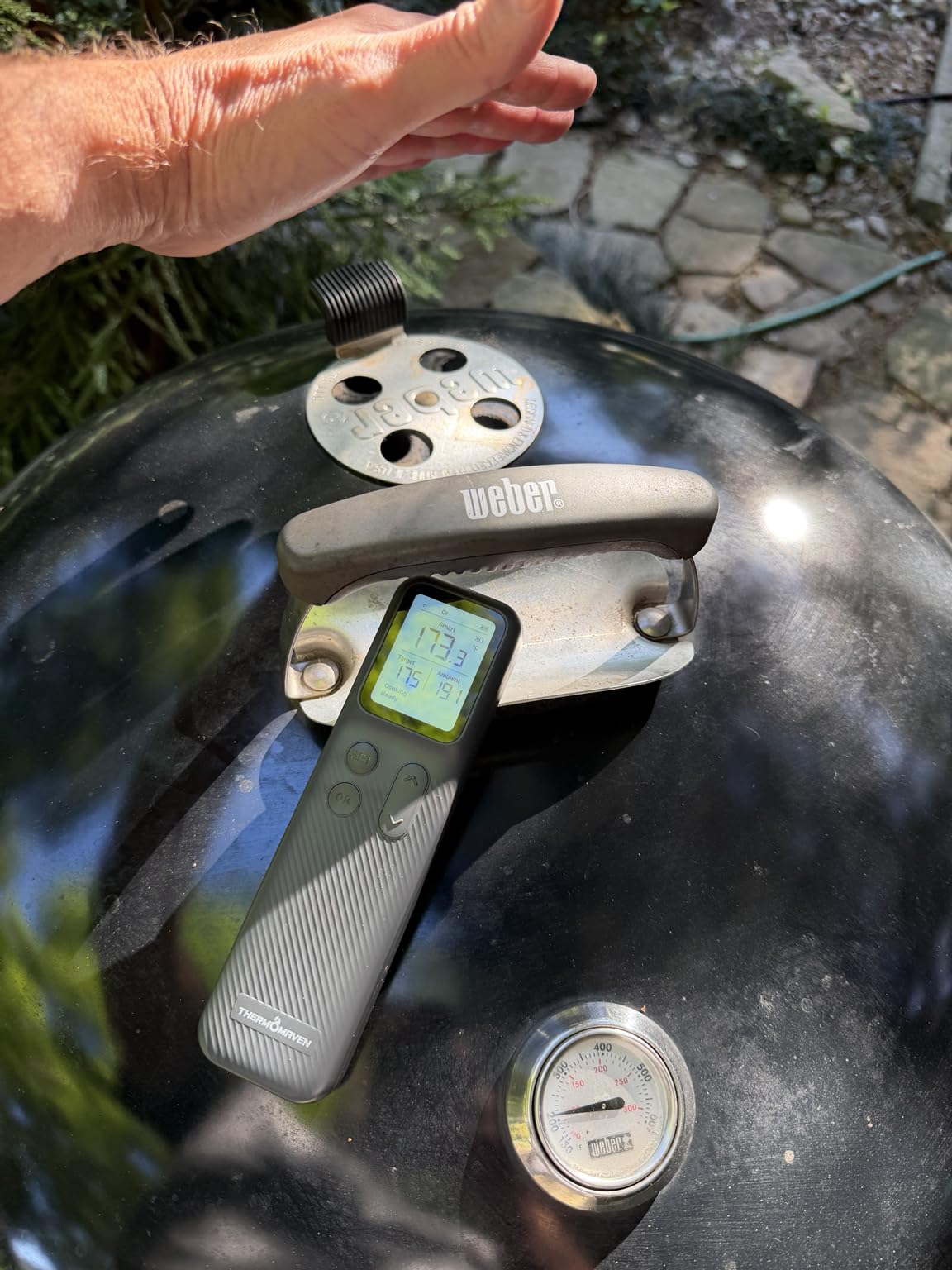
The specification that stands out here is accuracy: six sensors, five internal and one external, with NIST-certified plus or minus 0.5F and 0.01F resolution. That is a tighter figure than anything else in the roundup, and if you are cooking competition brisket where a two-degree difference decides a box, it is the number to care about.
The design choice most owners praise is the display base, which shows real-time temperatures and lets you set a target without touching an app. For a long cook, that means the thermometer still works when the phone is charging in another room. Runtime is 24 hours or more from a two-hour base charge, and the probe itself takes two minutes of charging for up to two hours of cook.
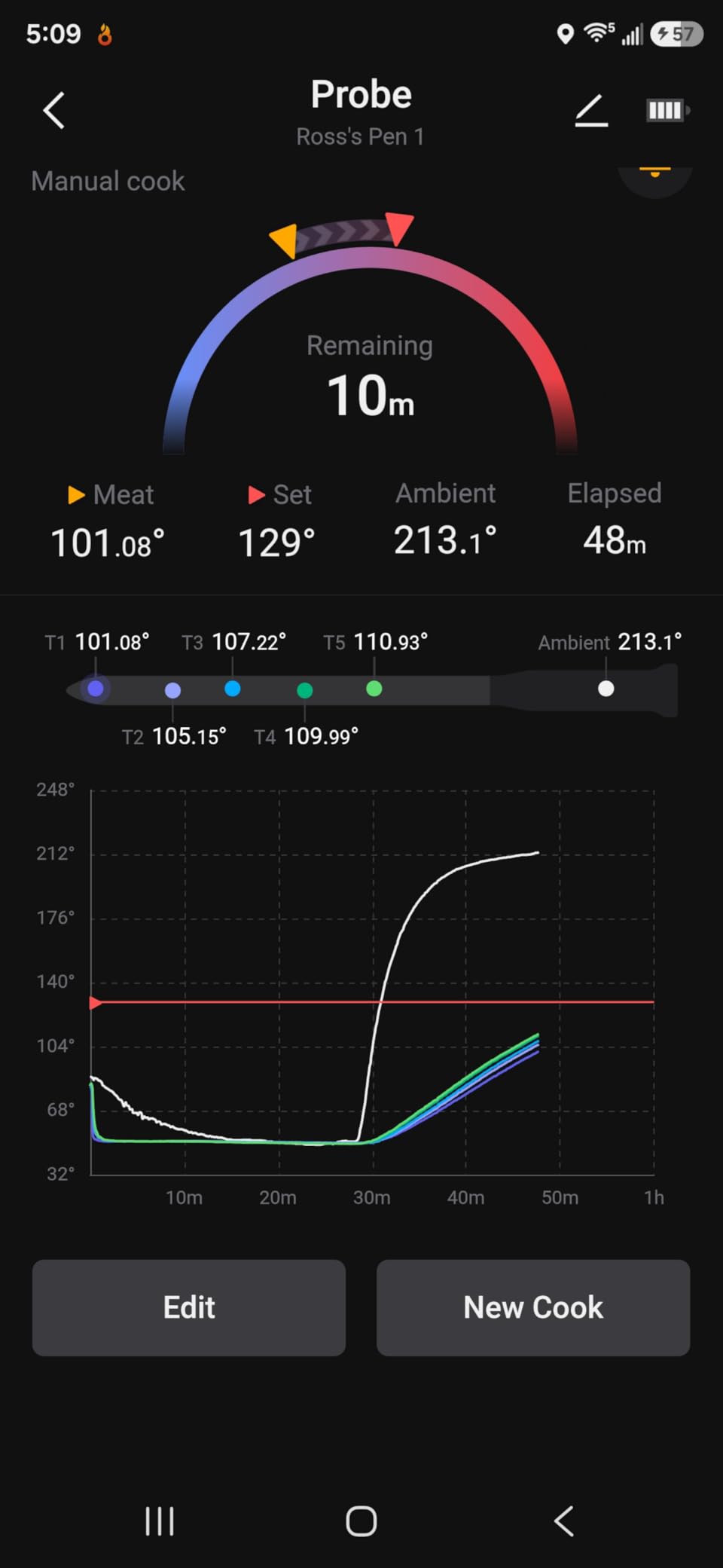
The reason this is not our top pick is the thin evidence base. At 480 ratings, there is not yet a long public record of this unit surviving multiple seasons, and forum users are consistent that brand longevity is one of the things they weigh most heavily after a brand disappears and leaves probes behind. A strong rating with a small sample is encouraging, not proven.
Only one probe is included, so you cannot monitor two cuts at once without buying another unit. The base is wipe-clean rather than fully dishwasher safe, and there is no physical ambient probe separate from the food channel.
Verdict for a 225F overnight cook: yes on accuracy, with a note on the thin track record. The probe is IPX8 and rated to 572F ambient, and 24 hours of base power covers almost any overnight cook.
Whether 0.5F accuracy changes your outcome
For most home cooks, no, because pull temperature windows are wide enough that a two-degree difference sits inside them. For competition entries, or for anyone cooking repeatedly and trying to tighten a process, it is a real improvement and the reason to look here first.
What the small review base means for you
Treat the strong rating as promising rather than proven. Long-cook buyers consistently prioritise brands that will still exist in three years, and a newer unit with 480 ratings gives you less evidence on that point than a 48k-rating model. The single-probe limitation is the more immediate constraint.
10. Inkbird five-sensor WiFi 5G and Bluetooth 5.4 – built for Apple Watch alerts
Wireless Meat Thermometer with WiFi 5G & Bluetooth 5.4, Smart Meat Thermometer for BBQ、Oven, Food Thermometer Digital with 4 Probes & 5 Sensors, NIST Accuracy, Apple Watch Alerts, 25H Use, Waterproof
WiFi, Bluetooth 5.4 and offline modes
4 probes, 5 sensors each
NIST plus or minus 0.5F
25 hours base power
Pros
- Four probes with five sensors each and NIST-certified plus or minus 0.5F
- In-app calibration for each sensor separately
- 30-minute automatic logging that survives a disconnect
- Apple Watch sync for at-a-glance checks
- 330 ft Bluetooth 5.4 plus WiFi and offline modes
- 25 hours of base power
Cons
- Advertised 5GHz WiFi does not work despite the listing
- Some units arrived with a dead probe
- Smallest review base here at 248 ratings
- Case feels less durable than expected
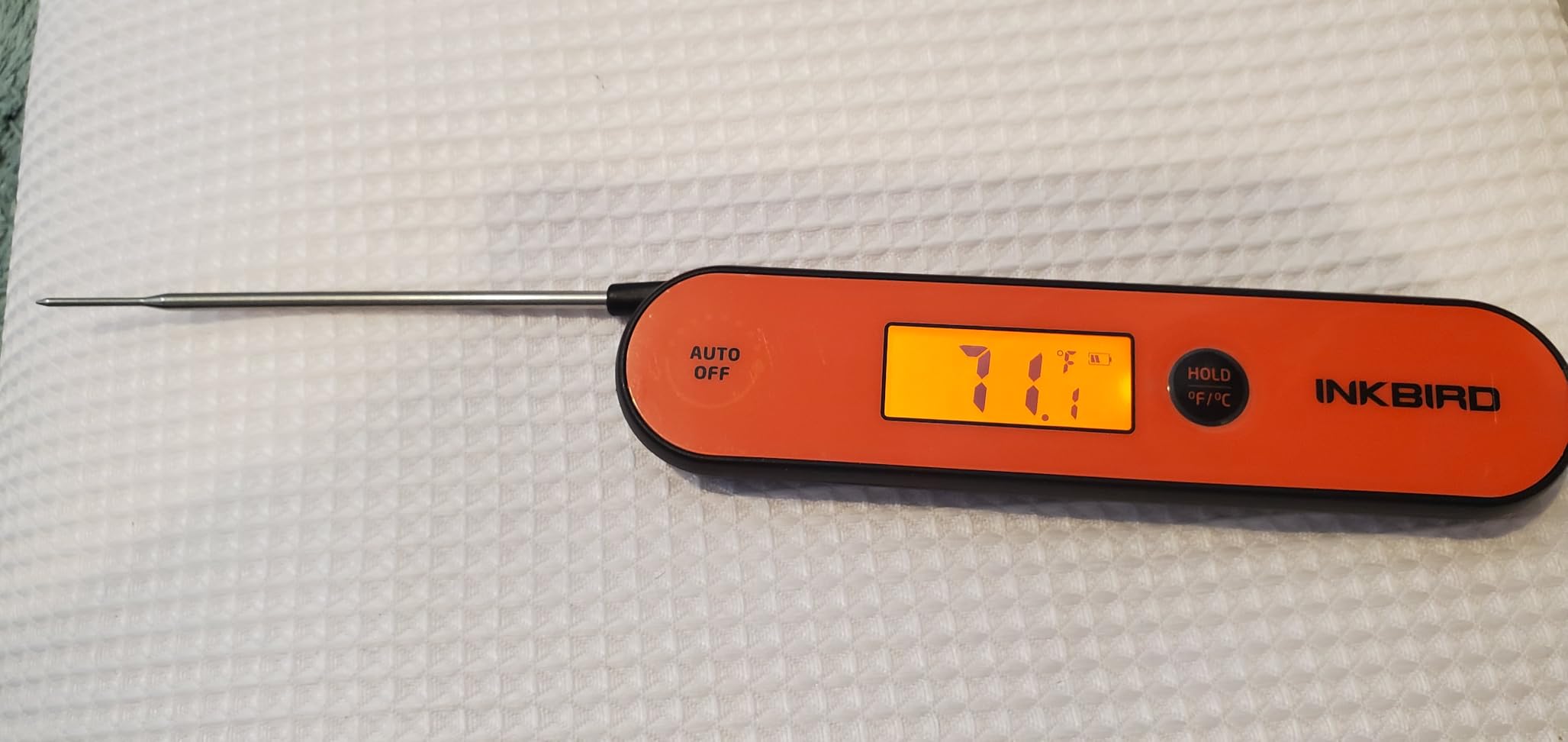
The feature that separates this one is the automatic logging. The base records a data point every 30 minutes and keeps it across app reconnects, which means that even if your wireless link drops repeatedly through a long cook, the temperature curve survives and you can read the whole session afterwards. Owners upgrading from older wireless probes call that upgrade out specifically.
Accuracy is NIST-certified at plus or minus 0.5F across four internal food sensors and one ambient sensor on each of four probes, with calibration adjustable per sensor in the app. Connectivity covers WiFi, Bluetooth 5.4 at 330 ft and an offline base mode, and Apple Watch pairing gives you temperature checks without picking up the phone.
There is a documented discrepancy worth knowing before you buy. One reviewer reports the advertised 5GHz WiFi does not work despite the listing, and the manual contradicts the claim. If you run a 5GHz network, verify the connection during a short cook rather than discovering it at hour one of a brisket.
This also has the thinnest review base of the ten at 248 ratings, so there is limited evidence about how it holds up over a season. Some buyers reported a probe arriving unable to work or charge, which is a simple thing to catch by testing all four channels before the cook.
Verdict for a 225F overnight cook: yes. Probes are IP67 and rated to 572F, and the 3500mAh base holds about 25 hours.
Whether logging that survives a disconnect is worth anything
It is the single most valuable feature on this list for anyone whose phone signal has failed them mid-cook. Every 30-minute checkpoint is stored on the base, so a dropout costs you the live view but not the record. You can rebuild the shape of the cook the next morning, including the stall.
What to check before a long cook
Test every probe channel on arrival and confirm each one charges. Verify WiFi works on your specific router, especially on a 5GHz network. The base case is reported as feeling less durable than expected, so mount it somewhere it will not be knocked rather than leaving it on a shelf edge.
What to Look for in a Bluetooth Grill Thermometer for Long Cooks
Battery runtime in hours, not vague claims
Ask for a number and check what it is measured under. Only a few models here publish runtime at all: 200 hours on AA for the Govee, about 40 hours for the INKBIRD IBT-4XS, around 25 hours for the two Inkbird base units and 24 hours or more for the ThermoMaven. Anything under 12 hours of stated runtime is a warning sign for an overnight cook, because that leaves no margin for a probe that has already had a season of use.
Forum users also raise battery decay across a season, which is a fair point that spec sheets ignore. Rechargeable cells tend to hold up better than the disposable-cell units over a year of regular smoking.
Signal behaviour with the cooker lid closed
This is the question asked most often in long-cook threads, and it is the one most spec sheets dodge. Bluetooth is 2.4GHz, and 2.4GHz is the band most easily absorbed by metal and by water in concrete and insulation. Owners report running cables out through the smoker stack purely to get around this, and that workaround still works with any of the wired probes here.
Where your choices are, an RF unit ignores the problem almost entirely, a WiFi mode routes around the cooker entirely if your phone and cooker share a network, and a Bluetooth-only unit depends on where the base sits. If your cooker is a steel offset in the yard and your phone is in the house, weighting that factor heavily is not over-cautious.
Probe count and whether ambient readings are separate
For a long cook you need two things at once: how hot the meat is, and how hot the pit is. One dual-sensor probe that reports both is better than two single-purpose probes, and four channels is the practical floor for anyone cooking more than one thing. Six channels, as on the BFOUR, only matters if you genuinely run that many cuts at once.
Probe handle and base heat tolerance
The part outside the meat is what fails first in an overnight cook. Only one product here publishes a handle rating: the TempSpike CORE’s ceramic handle is rated to 1050F. The Inkbird four-probe set has a plastic housing rated to roughly 176F, which means it must stay clear of direct heat. Everything else publishes a probe range of 572F but no handle rating at all, so treat that figure as a probe spec rather than a promise about the housing.
If you sear, check probe bulk as well. A bulky sensor housing cannot sit in direct heat, which is why these units suit thick cuts far better than thin steaks or chicken wings.
Bluetooth vs RF vs WiFi, and whether Bluetooth-only is a downgrade
Bluetooth is a phone-shaped choice. It needs no network, no account and no hub, it costs less, and it is fine for a grill in line of sight with your phone. For a closed metal cooker it is the weakest of the three, because it is the radio most affected by metal.
RF avoids the phone entirely and is the most dependable through a closed cooker, at the cost of graphs and notifications. WiFi gives unlimited range and full app features, and it is the right answer for garage or basement setups. So Bluetooth-only is a mild downgrade for long cooks, not a disqualifier, as long as you place a base or booster within clear reach of where your phone sits.
App alerts, session logs and brand longevity
Test the notification path during a short cook before trusting it overnight. Owners of budget Bluetooth units report alerts that only surface when the app is opened and refreshed, which defeats the purpose of an unattended cook. Session logging is worth paying up for if you want to review a temperature curve afterwards, and the 30-minute onboard logging on the Inkbird five-sensor set is the most robust version of that idea here.
Finally, weigh the brand. Users in long-cook forums consistently fear brands that disappear and leave probes with no app behind them. Our indoor grill pan guide covers the other half of a cook, but the same logic applies here: a model with tens of thousands of active owners gets its app problems fixed, and a model with a few hundred may not exist in three years.
Who This Is Not For
If you are searing a 15-minute steak, none of this matters. An instant-read thermometer gives you a number faster, costs less and survives being left in a hot pan, which none of these leave-in probes can do. Long-cook reliability is a concern that only exists when a cook runs past about four hours.
This roundup is also not for anyone who wants graphs above all else, since two of the most reliable radios here deliberately skip the app. If temperature curves are your main interest, you want a WiFi or app-based model and you should accept the extra signal fragility.
Frequently Asked Questions
What is the best Bluetooth thermometer for grilling?
The MEATER Plus is the best Bluetooth thermometer for long grilling sessions, because its wire-free probe and bamboo charging base act as a Bluetooth repeater, so the signal reaches your phone even with the cooker lid closed. Its app keeps re-estimating finish time through a long stall instead of dropping the session.
How long do wireless meat thermometer batteries last?
It depends on the model and on whether the probe is transmitting. Published figures in this roundup range from about 24 hours on the ThermoMaven base to about 40 hours on the INKBIRD IBT-4XS and up to 200 hours on AA cells in the Govee. For an 18-hour cook, anything under 12 hours of stated runtime is thin margin.
Are wireless meat thermometers worth it?
For any cook longer than about four hours they are worth it, because alerts and a cook log mean you stop opening the lid to check a dial and stop losing heat every time you do. For a 15-minute sear they are not worth it, since an instant-read thermometer gives you a number faster and cheaper.
Can you use a wireless meat thermometer on a grill?
Yes, and Bluetooth units are especially useful on a grill because you can walk away from a hot cooking surface and still watch the temperature from your phone. RF and WiFi models work equally well. What no leave-in probe suits is direct searing heat on the sensing tip.
Can you leave a thermometer in meat while grilling?
Yes, that is exactly what a leave-in probe is designed for, and it is safe during a long cook as long as the probe stays in the food and the handle stays outside the heat. Check the handle rating, since a plastic housing rated near 176F must be kept clear of direct high heat.
What is the most accurate wireless meat thermometer?
Among the units we scored, the ThermoMaven WT11 carries the tightest published figure at NIST-certified plus or minus 0.5F across six sensors. The Inkbird four-sensor WiFi set also claims NIST-certified plus or minus 0.5F. For budget models, published accuracy commonly sits at plus or minus 1.8F.
How far away can a Bluetooth meat thermometer reach?
Published claims in this roundup run from 150 ft to 650 ft for Bluetooth models, plus 330 ft on one Bluetooth 5.4 set, and owners report that indoor range falls off well before the stated figure. Metal cooker walls shorten it further, so place any base or booster on the phone’s side of the wall.
Do I need Bluetooth or WiFi for a meat thermometer?
Bluetooth is enough if the phone is within clear range of the cooker or of a base unit. WiFi is worth it when the cooker sits in a garage or basement, and RF is the most dependable through a closed metal lid because it does not depend on 2.4GHz propagation. WiFi adds graphs and alerts that RF units lack.
Which Bluetooth Grill Thermometer Should You Buy?
For an 8-to-18-hour cook, the MEATER Plus remains the best Bluetooth grill thermometer on our list: a genuinely wire-free probe, a bamboo base that solves the range problem most owners hit, and the most widely used app in this group. If you want the most reliable radio through a closed metal lid and can accept having no app, take the TempPro TempSync 1000 ft, which runs on RF for exactly that reason. If you want the highest published accuracy and the most heat-tolerant handle, the TempPro TempSpike CORE is the one, and its 4.6 average is the best in the roundup.
Match the pick to the cook. Under four hours, any of the budget Bluetooth units will do the job. Between four and eight hours, prioritise runtime and a second probe channel. Beyond eight hours, prioritise the radio and the handle rating over everything else, because those are the two things that decide whether you get a reading at hour twelve.
Before any long cook, run a short one. Check every probe channel against a known-good thermometer, confirm your notifications actually arrive, and place the base where the phone can see it. Ten minutes of setup prevents most of the disappointment people report after a full night of smoke.