
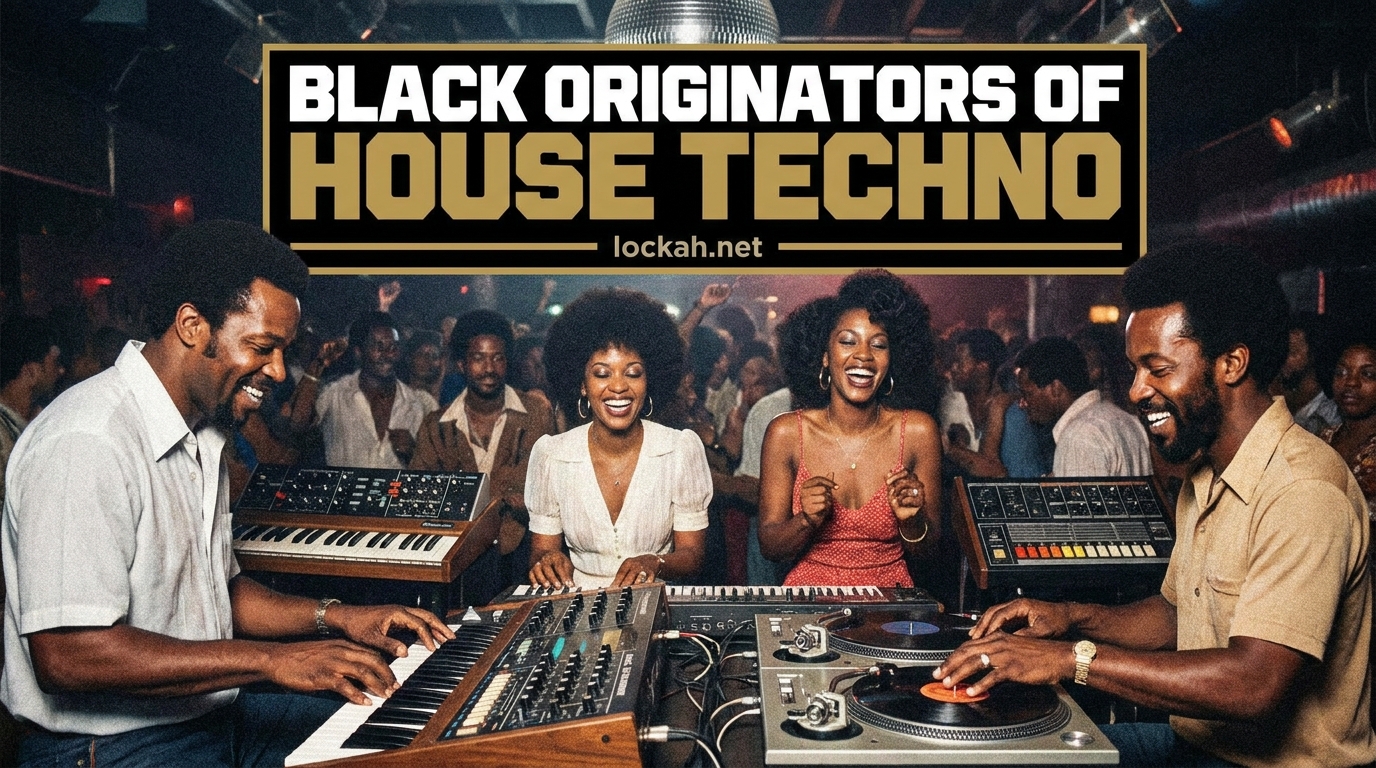
When you step onto a dance floor anywhere in the world today, you’re stepping into spaces created by Black visionaries who revolutionized sound in the late 1970s and 1980s. The black originators of house techno and electro built the foundation of electronic dance music from warehouses, basements, and community centers in Chicago and Detroit. These pioneers transformed drum machines and synthesizers into instruments of liberation, crafting beats that united Black, Latinx, and LGBTQ+ communities when mainstream society rejected them.
In this guide, I’ll walk you through the architects of house, techno, and electro. You’ll meet the DJs who turned disco decline into house ascendancy. You’ll discover how three teenagers from suburban Detroit birthed techno. And you’ll understand why these genres remain fundamentally Black music, regardless of how commercial EDM has evolved.
Whether you’re a longtime crate digger or just discovering electronic music’s roots, this is the definitive resource for understanding who actually built the culture.
The Black Originators of House Techno and Electro: A Complete Overview (2026)
Electronic dance music as we know it emerged from three distinct but interconnected movements. Chicago gave us house music through the Warehouse and Paradise Garage scenes. Detroit birthed techno through the Belleville Three and their futuristic vision. New York and the Midwest developed electro through Afrika Bambaataa and Arthur Baker’s genre-blending experiments.
Each movement shared common DNA: marginalized communities using technology to create spaces of joy and resistance. The Roland TR-808 drum machine, the TB-303 bass synthesizer, and turntables became tools of cultural production in Black hands. What emerged wasn’t just new music genres. They were sonic revolutions.
Here are the foundational genres and their key pioneers:
- Chicago House: Frankie Knuckles, Ron Hardy, Larry Levan (influential through Paradise Garage)
- Detroit Techno: Juan Atkins, Derrick May, Kevin Saunderson (the Belleville Three), Underground Resistance
- Electro: Afrika Bambaataa, Arthur Baker, Cybotron
- Key Spaces: The Warehouse (Chicago), Paradise Garage (New York), The Music Box (Chicago)
The Disco Demolition Backlash: How White America Created House Music?
House music was born not just from creative inspiration but from necessity. Disco had dominated American pop culture throughout the 1970s, reaching its peak with Saturday Night Fever and the rise of Studio 54. Black and LGBTQ+ communities found freedom and self-expression on disco dance floors in ways they couldn’t elsewhere in society.
But by 1979, white mainstream America had turned against disco. The “Disco Demolition Night” at Comiskey Park in Chicago on July 12, 1979, marked the turning point. Disc jockey Steve Dahl encouraged tens of thousands of fans to bring disco records to a White Sox game, then blew them up in a massive explosion between games. The promotion was explicitly coded as anti-Black and anti-gay. “Disco sucks” became a rallying cry for white suburban teenagers threatened by the genre’s multiculturalism and queer aesthetics.
Radio stations across America switched formats overnight, dropping disco for rock. Record labels canceled disco contracts. The genre that had dominated the charts vanished from mainstream visibility. But in Chicago, Black and queer communities weren’t ready to stop dancing. They went underground.
The Warehouse and other Black-owned clubs became the only places where disco culture survived. Frankie Knuckles and other DJs began extending mixes, stripping away orchestral arrangements, and adding drum machine precision to keep the dance floor moving. They weren’t trying to create a new genre. They were trying to preserve the culture white America had tried to destroy. The music that emerged from this resistance became house.
The name “house” itself comes from The Warehouse, the Chicago club where Frankie Knuckles held residency. When record stores began selling the extended mixes and edits DJs were making, they labeled them “house music” — music from the Warehouse. The genre was literally named after the Black queer space that preserved disco culture after the mainstream rejection.
Chicago House Music Originators: The Warehouse Legacy
House music was born in Chicago, specifically at a club called The Warehouse. When disco died in the mainstream, Chicago’s Black and gay club communities refused to let the dance die. They stripped disco down to its essentials, added drum machine precision, and extended mixes to create hypnotic, repetitive grooves that would last all night.
Frankie Knuckles: The Godfather of House Music
Frankie Knuckles stands as the undisputed godfather of house music. Born in the Bronx, he moved to Chicago in 1977 to DJ at The Warehouse, the club that would give house music its name. Knuckles didn’t just play records. He created an atmosphere of inclusion where Black, white, straight, and LGBTQ+ dancers found common ground on the floor.
His technical innovations were equally important. Knuckles was among the first DJs to use drum machines and reel-to-reel editing to extend songs and create seamless transitions. He would add percussion over records using a Roland TR-707, essentially remixing live. This technique became foundational to house production.
Knuckles’ residency at The Warehouse (1977-1982) and later at his own club, The Power Plant, established the blueprint for house music culture. His 1986 production “Your Love” with Jamie Principle is considered one of the first true house records. When Chicago renamed the street outside the old Warehouse “Frankie Knuckles Way” in 2004, it cemented his status as a cultural icon.
Larry Levan and the Paradise Garage Influence
While Frankie Knuckles built house in Chicago, his friend Larry Levan was creating parallel magic in New York. Levan’s Saturday night sets at Paradise Garage (1977-1987) are legendary in dance music history. He was a perfectionist who treated the dance floor as sacred space, using the club’s custom sound system to create immersive sonic experiences.
Levan’s influence on Chicago house DJs cannot be overstated. Knuckles and others would visit New York specifically to hear Levan play. The Garage’s emphasis on community, its predominantly Black and LGBTQ+ membership, and its all-night party ethos directly influenced Chicago’s Warehouse culture.
Levan was also a crucial bridge between disco and house. His remixes for acts like Gwen Guthrie and Inner City helped define the sound of post-disco dance music. When house music historians speak of the “Garage sound,” they’re referencing Levan’s emotionally intense, soulful approach to DJing.
Ron Hardy: The Music Box and Raw Chicago Energy
If Frankie Knuckles represented house music’s polished, soulful side, Ron Hardy embodied its raw, experimental edge. Hardy took over The Music Box in Chicago after Knuckles left for New York, and his approach was completely different. Where Knuckles was smooth and controlled, Hardy was chaotic and unpredictable.
Hardy would play records at the wrong speed, layer multiple songs simultaneously, and push the club’s sound system to distortion. He embraced the strange and the experimental, championing early acid house tracks when other DJs dismissed them. His willingness to take risks made The Music Box a laboratory for new sounds.
The contrast between Knuckles and Hardy shows the range within early house. Knuckles brought elegance and soul. Hardy brought danger and experimentation. Together, they covered the full spectrum of what house could be.
The Clubs That Built House Music: Sacred Spaces of Sound
House music wasn’t just created by DJs. It was created by specific physical spaces where marginalized communities could gather, dance, and be free. These clubs were more than venues. They were sanctuaries.
The Warehouse: Where House Got Its Name
The Warehouse opened in 1977 at 206 South Jefferson Street in Chicago. Owner Robert Williams specifically wanted to create a space for the Black gay community that had nowhere else to go. The club’s name wasn’t marketing. It was literally a converted warehouse, three stories of raw industrial space that Frankie Knuckles transformed into a cathedral of sound.
The Warehouse operated from midnight to noon on Saturdays, giving dancers a full twelve hours to lose themselves in music. The club had no liquor license, which kept the focus purely on dancing. Membership was required, creating an exclusive community feel. By 1982, The Warehouse was attracting over two thousand people every weekend.
When Knuckles left in 1982, the club continued for a few more years before closing. But the music that emerged from those walls had already spread to record stores across Chicago, labeled simply as “house music” — music from The Warehouse. Today, the building at 206 South Jefferson is marked by a commemorative plaque, and the street outside is officially “Frankie Knuckles Way.”
The Music Box: Chicago’s Experimental Laboratory
If The Warehouse was house music’s church, The Music Box was its laboratory. Located on the South Side of Chicago, this smaller venue became Ron Hardy’s domain after Knuckles departed for New York. Hardy transformed the space into something wild and unpredictable.
The Music Box was infamous for its extreme atmosphere. Hardy would sometimes play the same record for hours, exploring every possible variation. He pioneered the technique of playing records at wrong speeds, discovering that pitched-down vocals and sped-up drums created entirely new effects. The club’s sound system was pushed to its limits, creating a distorted, raw aesthetic that became part of house’s DNA.
The Music Box was also where acid house was born. When Phuture released “Acid Tracks” in 1987, Hardy was the only DJ willing to play the strange, squelching TB-303 bass line. He played it for an entire night, testing whether the crowd would embrace it. They did. Acid house spread from The Music Box to the world.
Paradise Garage: New York’s Temple of Dance
While not a Chicago club, Paradise Garage in New York deserves mention as perhaps the most influential dance club in American history. Operating from 1977 to 1987, the Garage was Larry Levan’s domain, and it set standards that house clubs still aspire to today.
The club was membership-only, predominantly Black and LGBTQ+, and completely focused on dancing. There was no liquor served, eliminating the bar as a social focal point. The custom sound system, designed by Richard Long and costing over a million dollars, was the best in the world. Dancers would come just to feel the bass through the floor.
Levan’s Saturday night sets would last eight to ten hours, building from gospel-influenced openers to peak-time anthems to emotional closers that would leave dancers in tears. The Garage proved that dance music could be a transcendent experience, not just entertainment. When it closed in 1987, the building was converted to storage. But its influence lives in every house club that prioritizes sound quality and community over profit.
Detroit Techno Founders: The Belleville Three and Beyond
While Chicago was developing house, Detroit was creating something entirely different. Techno emerged from the economic devastation of 1980s Detroit, when the auto industry collapsed and the city faced massive unemployment. Three Black teenagers from Belleville, Michigan, channeled this post-industrial anxiety into a new sound that was cold, mechanical, and futurist.
The Belleville Three: Juan Atkins, Derrick May, and Kevin Saunderson
The Belleville Three are the foundational trinity of Detroit techno. Juan Atkins, Derrick May, and Kevin Saunderson met as teenagers in Belleville, a suburb of Detroit, bonding over their love of Kraftwerk, Parliament-Funkadelic, and local radio DJ The Electrifying Mojo. Together, they would create and popularize the techno sound.
Juan Atkins is often credited with coining the term “techno” itself. Under his Cybotron project (with Richard Davis), he released “Alleys of Your Mind” in 1981 and “Clear” in 1983, tracks that fused electro, funk, and synthesizer music into something new. Atkins studied electronic music at Washtenaw Community College and brought technical sophistication to the genre. His philosophy was deeply influenced by Afrofuturism and Alvin Toffler’s futurist writings.
Derrick May became techno’s greatest ambassador. His 1987 track “Strings of Life,” created under his Rhythm Is Rhythm alias, is widely considered techno’s masterpiece. May brought emotional depth to mechanical sounds, layering piano strings over drum machine patterns in ways that moved listeners to tears. He was also crucial in bringing techno to Europe, particularly to the UK and Germany.
Kevin Saunderson bridged techno and mainstream dance music. Under his Inner City project, he scored massive hits with “Good Life” and “Big Fun,” bringing techno sensibilities to pop audiences. Saunderson founded KMS Records and developed a production style that was both accessible and innovative. His work proved techno could work on radio without losing its soul.
The Electrifying Mojo: Detroit’s Sonic Architect
No single figure was more important to the development of Detroit techno than Charles Johnson, known on air as The Electrifying Mojo. Broadcasting from WJLB from 1977 through the mid-1990s, Mojo created a radio show unlike anything else in America. He didn’t just play records. He constructed sonic journeys.
Mojo’s show, called the “Midnight Funk Association,” would begin at midnight and often continue until dawn. He refused to follow radio conventions. There were no playlists, no station-approved rotations, no commercial interruptions during his sets. He would play Prince’s “Purple Rain” followed immediately by Kraftwerk’s “Trans-Europe Express,” followed by Parliament’s “Flashlight,” followed by European synth-pop that no other American DJ knew existed.
This genre-hopping approach was revolutionary. In an era when radio was strictly segregated by format, Mojo proved that Black audiences would embrace electronic music if presented with passion and context. He was among the first American DJs to play Kraftwerk regularly, introducing Detroit teenagers to the German group that would become techno’s primary influence.
The Belleville Three have all cited Mojo as their primary musical education. Juan Atkins has said he never would have discovered synthesizer music without Mojo’s show. Derrick May called him “the person who made me want to make music.” Kevin Saunderson described his show as “like going to music school every night.” Without The Electrifying Mojo, Detroit techno simply would not exist.
Mojo’s influence extended beyond the Belleville Three. He supported local artists, playing early Cybotron tracks before anyone else would touch them. He created a community around his show, with listeners calling in and sharing discoveries. The Midnight Funk Association wasn’t just a radio program. It was a cultural movement.
The Midnight Funk Association: Building Detroit’s Sonic Community
The Midnight Funk Association wasn’t just The Electrifying Mojo’s radio show. It was a collective of DJs, producers, and music lovers who shared a vision of electronic music as Black music. The name itself referenced Parliament-Funkadelic’s “Mothership Connection,” connecting Detroit’s electronic future to its funk past.
Beyond Mojo, the Association included figures like The Wizard (Jeff Mills before he became a techno legend), who pioneered the fast-cutting DJ style that would define Detroit techno mixing. It included radio personalities who championed local electronic music when commercial stations wouldn’t touch it. It included the record store owners who stocked imports from Europe and the producers who made the tracks that filled those stores.
The Association created a network for sharing music in a city that desperately needed cultural outlets. In the 1980s, Detroit was experiencing economic collapse, white flight, and the crack epidemic. The Midnight Funk Association offered an alternative vision, one where technology and creativity could build futures where traditional industries had failed.
This community-building aspect was crucial. While house music developed in physical clubs, techno developed through radio, mixtapes, and word-of-mouth networks. The Midnight Funk Association was the hub that connected isolated producers and listeners. It proved that electronic music could build community even without physical club spaces.
Underground Resistance: Techno’s Militant Wing
While the Belleville Three brought techno to the world, Underground Resistance kept it rooted in Detroit’s revolutionary tradition. Formed in 1990 by Mike Banks, Robert Hood, and Jeff Mills, UR represented techno’s militant, underground side. They rejected commercial success in favor of community building and political messaging.
UR’s music was harder, faster, and more confrontational than the Belleville Three’s work. Tracks like “Riot” and “The Final Frontier” explicitly addressed police violence, economic inequality, and Black empowerment. They also maintained strict anonymity, wearing masks in publicity photos and rarely giving interviews. The message was clear: this music belongs to the people, not to corporations.
Underground Resistance also founded Submerge Distribution, ensuring Detroit techno could reach global audiences without major label interference. Jeff Mills, after leaving UR, became one of techno’s most respected solo artists. Robert Hood developed minimal techno. Mike Banks continued UR’s mission into the 2026s. Their influence on underground electronic music is immeasurable.
1980s Detroit and Chicago: Cultural Context of Electronic Music’s Birth
To understand why house and techno emerged when they did, you have to understand the cities that birthed them. Both Chicago and Detroit in the 1980s were experiencing severe economic crisis, white flight, and the collapse of the industrial economy that had built Black middle classes in the post-war era. These weren’t just musical movements. They were survival strategies.
Detroit was hit particularly hard. The auto industry, which had drawn hundreds of thousands of Black workers from the South during the Great Migration, was collapsing. Factories closed. Jobs disappeared. The city’s population dropped by over 200,000 during the 1980s. For Black teenagers like the Belleville Three, traditional pathways to success had vanished.
Technology became the escape. When the traditional economy failed, electronic instruments offered a new kind of work. Drum machines and synthesizers were expensive, but not as expensive as traditional instruments. You could create entire tracks in your bedroom. The Belleville Three weren’t just making art. They were building careers in an economy that offered them nothing else.
The post-industrial aesthetic of techno reflected this reality. The machine sounds, the cold futurism, the emphasis on technology over human performance. These weren’t abstract artistic choices. They were direct responses to an environment where industrial machinery had failed an entire generation. Techno imagined futures where machines and humans could coexist, where technology served liberation rather than exploitation.
Chicago faced similar challenges. The manufacturing jobs that had drawn Black workers to the city during the Great Migration were disappearing. Neighborhoods on the South and West Sides experienced devastating disinvestment. Against this backdrop, house music offered community, income for DJs and promoters, and spaces where Black and queer people could find dignity.
The disco backlash of 1979 wasn’t just about music. It was about white America rejecting Black and queer culture’s mainstream success. House music’s emergence was a refusal to accept that rejection. Frankie Knuckles and Ron Hardy kept disco culture alive through sheer will, creating a parallel economy of clubs, record pools, and independent labels that didn’t need mainstream approval.
This economic context explains why house and techno developed such strong DIY traditions. Both genres emerged from communities that couldn’t rely on major labels or mainstream institutions. They built their own distribution networks, their own clubs, their own radio shows, their own record pools. This entrepreneurial spirit is as much a part of the genres’ Black heritage as the music itself.
Electro Pioneers: Arthur Baker, Afrika Bambaataa, and Planet Rock
Before house and techno fully crystallized, electro provided the bridge between disco, hip-hop, and electronic music. This genre, emerging primarily from New York in the early 1980s, combined rap with synthesized beats and European electronic influences. It laid the groundwork for both Detroit techno and Chicago house while establishing its own distinct culture.
Afrika Bambaataa and the Birth of Electro-Funk
Afrika Bambaataa was already a legend in Bronx hip-hop when he released “Planet Rock” in 1982. The track, produced with Arthur Baker and the Soulsonic Force, changed everything. It sampled Kraftwerk’s “Trans-Europe Express” and “Numbers,” layering electronic beats with Bambaataa’s chanted vocals. The result was electro-funk, a genre that proved hip-hop and electronic music were natural partners.
Bambaataa’s Zulu Nation collective embraced futuristic aesthetics and science fiction themes, directly influencing the Afrofuturist vision that would define Detroit techno. His track “Looking for the Perfect Beat” further developed the electro sound, with complex drum programming and synthesizer lines that pushed the Roland TR-808 to its limits.
The influence of “Planet Rock” cannot be overstated. It reached number four on the Billboard Hot 100 and sold over 650,000 copies. More importantly, it proved that electronic music could be Black music. The Belleville Three have all cited Bambaataa as a major influence. Without “Planet Rock,” Detroit techno would sound very different.
Arthur Baker and Tommy Boy Records
Arthur Baker was the white producer behind many of electro’s greatest moments, but his work was deeply embedded in Black musical traditions. As house producer for Tommy Boy Records, Baker worked with Afrika Bambaataa on “Planet Rock” and continued developing the electro sound through the mid-1980s.
Baker understood that electronic drum machines could have soul. His productions for Streetwise Records and Tommy Boy emphasized the human element in mechanical sounds. He wasn’t afraid to experiment, combining rock guitar with 808 beats, or layering synthesizers over breakbeats.
While Baker himself was not Black, his work with Bambaataa and other Black artists helped establish the collaborative tradition that defined early electronic music. Electro was a space where racial boundaries blurred in pursuit of the perfect beat.
Cybotron: Detroit’s Electro Foundation
Before techno, there was Cybotron. Formed by Juan Atkins and Richard Davis in 1980, this duo fused electro, funk, and Kraftwerk-inspired synthesizer music. Their 1983 track “Clear” is a blueprint for Detroit electronic music, combining robotic vocals, 808 drums, and futuristic themes.
Cybotron’s work shows how electro and techno are siblings, not separate genres. The same technological toolkit, the same Afrofuturist vision, and the same Detroit context produced both. When Atkins eventually moved toward pure techno, he was building on foundations he and Davis had already laid.
“Clear” remains a touchstone for electronic music producers. It has been sampled and referenced countless times, most notably in Missy Elliott’s “Lose Control.” Cybotron proved that Detroit could compete with New York and Europe in the electronic music space.
Pioneering Tracks That Changed Electronic Music Forever
Individual tracks shaped the development of house, techno, and electro as much as the DJs who played them. These songs became templates, anthems, and cultural touchstones that defined what electronic music could be.
“Your Love” by Frankie Knuckles and Jamie Principle (1986)
“Your Love” is widely considered the first true house record. Jamie Principle wrote the song, but it was Frankie Knuckles’ production and his constant playing at The Power Plant that made it a phenomenon. The track combined Principle’s haunting vocals with a drum machine beat and simple synthesizer bass line.
What made “Your Love” revolutionary was its structure. Unlike disco tracks with their orchestral builds and breakdowns, “Your Love” was minimal and repetitive. The drum machine provided steady momentum. The vocals were sparse and emotional. The track could play for eight minutes without losing energy. This became the house music template.
Principle recorded “Your Love” in his bedroom using basic synthesizers and drum machines. It was a demo that Knuckles heard and began playing. The track spread through Chicago before ever being officially released. This DIY origin story became part of house music mythology. You didn’t need a studio. You needed vision.
“Strings of Life” by Derrick May (1987)
If “Your Love” defined house, “Strings of Life” defined techno. Released under Derrick May’s Rhythm Is Rhythm alias in 1987, the track remains techno’s masterpiece. May created it using a Roland TR-909 drum machine and a sequencer programming rapid-fire piano chords over a driving beat.
The track’s power comes from its emotional intensity. Techno is often stereotyped as cold and mechanical, but “Strings of Life” proves the opposite. The piano line is almost frantic in its beauty. The drums pulse with urgency. When May first played it for other Detroit producers, some cried. It was that powerful.
“Strings of Life” also became techno’s ambassador to the world. British DJs discovered it and made it the anthem of the UK’s emerging rave scene. It crossed over to rock and pop audiences. It proved that techno could move people who had never been to Detroit. May has said he created it in a single night, not knowing it would define his career and his genre.
“Planet Rock” by Afrika Bambaataa and the Soulsonic Force (1982)
No track did more to establish electronic music as Black music than “Planet Rock.” The song fused hip-hop, electro, and European synthesizer music in ways that hadn’t been attempted before. It sampled Kraftwerk directly, making the German group’s robot aesthetic accessible to American audiences.
The cultural impact of “Planet Rock” extended far beyond its chart performance. It established electro as a genre. It proved that drum machines could replace live drummers without losing energy. It introduced the 808 sound that would define hip-hop and electronic music for decades. It created the template for genre-blending that house and techno would follow.
For the Belleville Three, “Planet Rock” was a revelation. It proved that Black artists could make electronic music without sacrificing identity. It showed them that synthesizers weren’t just for Europeans. It gave them permission to experiment. When they started making music, “Planet Rock” was their reference point.
“Acid Tracks” by Phuture (1987)
“Acid Tracks” didn’t just create acid house. It demonstrated how a single piece of equipment could birth an entire genre. The track was created by Phuture, a Chicago trio consisting of DJ Pierre, Spanky, and Herb J. They discovered that the Roland TB-303 bass synthesizer, when manipulated with its filter and resonance controls, produced a squelching, liquid sound unlike anything else.
The 303 was originally designed as a bass accompaniment for guitarists practicing at home. It was a commercial failure. But in Phuture’s hands, it became an instrument of psychedelic exploration. “Acid Tracks” was eleven minutes of 303 manipulation over a simple drum machine pattern. Ron Hardy was the only DJ who would play it.
The track created a sensation at The Music Box. Dancers were confused at first, then entranced. The acid sound spread through Chicago, then to the UK, then to the world. By 1988, acid house was a global phenomenon. All from a failed bass machine and a DJ willing to take risks.
“Clear” by Cybotron (1983)
Before techno had a name, Cybotron’s “Clear” established the template. The track combined robotic vocals, mechanical drum patterns, and synthesizer lines that sounded like they came from another world. It was electro, but it pointed toward something more futuristic.
Juan Atkins has said “Clear” was inspired by Kraftwerk and Alvin Toffler’s futurist writings. The lyrics imagine a post-human world where technology has transformed society. This Afrofuturist vision would become techno’s defining aesthetic. The track’s influence can be heard in everything from electro to techno to modern EDM.
“Clear” also established Detroit as a center for electronic music innovation. Before the Belleville Three became famous, Cybotron proved that Midwestern Black artists could compete with New York and European producers. The track’s legacy continues today. Missy Elliott’s “Lose Control” samples it directly. New producers still study its arrangement and sound design.
The Role of Black Queer Clubs in Electronic Music History
To understand house, techno, and electro, you must understand the role of Black queer spaces. The Warehouse was a gay club. Paradise Garage was a gay club. The Music Box was a space where Black and queer communities mixed freely. These were safe spaces in a world that offered little safety to marginalized people.
The extended mix, the DJ as spiritual guide, the all-night party, the emphasis on community over commerce. These elements emerged from the particular needs of Black queer dancers who couldn’t find acceptance elsewhere. Frankie Knuckles spoke of his DJ booth as a pulpit. Larry Levan treated his sets as religious experiences.
This heritage continues to shape electronic music culture. The concept of the “safe space” in club culture comes directly from these Black queer pioneers. The idea that dance floors can be sites of liberation, that music can heal and unite, that the DJ is a community leader. These are contributions from Black originators of house, techno, and electro that mainstream EDM often forgets.
Cultural Appropriation and Recognition: Why This History Matters?
By the 1990s, electronic music had gone global. House and techno spread to Europe, where German and British DJs and producers became the public face of the genre. Raves exploded in the UK. Berlin became the new techno capital. The Black American originators of these genres were increasingly written out of their own story.
This erasure was economic as well as cultural. As EDM became a billion-dollar industry, the Black communities that created the music saw little of that wealth. The Warehouse was closed by police. Paradise Garage was demolished for development. Detroit clubs struggled while European festivals booked white DJs playing Detroit sounds.
Understanding the black originators of house techno and electro is an act of cultural justice. It’s about recognizing that the music playing in clubs worldwide exists because of Frankie Knuckles, the Belleville Three, Afrika Bambaataa, and countless other Black pioneers. It’s about acknowledging the queer clubs that gave the culture its values.
Today, there are movements to restore this history. Black Electronic Music Month, founded in 2020, celebrates the genre’s Black roots. DJs and producers of color are reclaiming space in a scene that owes them everything. The story is finally being told, but it took decades too long.
Modern Black Electronic Artists Carrying the Legacy into the 2026s
The originators built the foundation, but the story doesn’t end in the 1980s. A new generation of Black electronic artists understands they’re standing on the shoulders of giants, and they’re expanding what house, techno, and electro can be while honoring where they came from.
The Continued Pioneers: Mills, May, and Saunderson
Jeff Mills never stopped innovating. After leaving Underground Resistance, he founded Axis Records and began creating some of techno’s most ambitious conceptual works. His live performances became legendary, with Mills mixing records using up to four turntables simultaneously. He developed immersive multimedia shows that brought Afrofuturist aesthetics to festival stages worldwide. His 2001 album “Metropolis” was inspired by Fritz Lang’s film and remains a touchstone for cinematic techno.
Derrick May continues as techno’s ambassador, though his output slowed in the 2000s. His DJ sets remain masterclasses in track selection and mixing. He founded LowKey records and continues mentoring younger Detroit artists. May’s role in establishing the Detroit-Berlin connection remains crucial. German techno culture exists largely because May brought Detroit records to Berlin clubs in the late 1980s.
Kevin Saunderson kept Inner City active through multiple decades, adapting his sound while maintaining techno’s core values. He founded the Inner City Music School in Detroit, teaching production to young people from underserved communities. His “History Elevate” project documents techno’s Black origins through interviews and archival materials. Saunderson proves that commercial success and cultural integrity aren’t mutually exclusive.
The New Generation: Jay Daniel, Kyle Hall, and Detroit’s Youth
Jay Daniel emerged from Detroit’s new generation with a sound that honors tradition while pushing forward. His 2013 debut “Scorpio Rising” announced him as a serious talent. Daniel’s production style combines classic Detroit techno elements with jazz influences and contemporary electronic textures. He co-founded the collective and label 1432 R with his mother, establishing Detroit-focused distribution networks.
Kyle Hall represents perhaps the most direct link to the originators. He started producing at age eleven after meeting Mike Banks from Underground Resistance. Hall founded the label Wild Oats at age seventeen, releasing his own tracks alongside those of other Detroit producers. His style blends classic techno with house and experimental electronics. He’s spoken openly about the challenges of being a young Black producer in a scene increasingly dominated by white Europeans.
Other Detroit voices worth following include Dez Andrés, who combines techno with house and Latin music influences. DJ Stingray, who emerged from the electro scene and maintains connections to both Detroit and European electronic communities. And DJ Minx, founder of Women on Wax, who champions female and non-binary producers in a male-dominated genre.
Chicago’s New House Guard
Celeste Alexander carries forward Chicago’s house tradition with a focus on queer Black community. Her DJ sets blend classic Chicago house with contemporary club sounds. She founded the party series “Softies” to create inclusive spaces that honor house music’s roots. Alexander speaks frequently about the need to center Black queer voices in electronic music discourse.
Theaster Gates, though primarily known as a visual artist, has become a crucial house music archivist through his Rebuild Foundation. His Black Madonna collection preserves thousands of Chicago house records and ephemera. Gates has organized exhibitions and events that bring house music history to museum audiences.
Other Chicago voices include DJ Heather, who has held residencies at Smart Bar and championed house music’s queer roots. Honey Dijon, who bridged Chicago and New York house cultures. And DJ Lady D, who continues Frankie Knuckles’ legacy through her Soul Foundation party series.
Global Voices: Black Coffee and the African Diaspora
Black Coffee brought South African house music to global audiences through his DJ career and his Soulistic Music label. His sound blends traditional South African rhythms with electronic production, creating something distinct from Chicago or Detroit while honoring those roots. He’s played major festivals worldwide and collaborated with mainstream artists while maintaining underground credibility.
The connection between South African house and Chicago/Detroit electronic music runs deep. During apartheid, South African DJs discovered house and techno through import records. They adapted the sounds to local contexts, creating genres like Kwaito that blend house with hip-hop and traditional African music. This exchange continues today.
Oskido became one of South Africa’s most important house producers and label founders. His Kalawa Jazmee label launched dozens of careers. He adapted American house music to South African contexts while maintaining connections to the originators. The exchange between American and South African electronic music scenes represents a crucial but often overlooked part of house and techno’s global spread.
Academic and Activist Voices
DeForrest Brown Jr., who performs as Speaker Music, creates politically charged electronic work while writing extensively about Black techno’s history. His writing for outlets like Pitchfork and his book “Assembling a Black Counter Culture” establish him as a crucial voice in electronic music scholarship. Speaker Music’s productions combine techno with noise, jazz, and spoken word.
Jasmine Infiniti founded the New York Trans* Energy collective, bringing trans voices to the center of electronic music. Her DJ sets and productions emphasize the connection between techno and Black queer liberation. She’s spoken about the need to reclaim techno from its European commercialization.
These modern artists prove that house, techno, and electro remain living Black cultures, not museum pieces. They’re building on foundations laid by the originators while creating new futures. The music continues to evolve, but its Black roots remain central.
Frequently Asked Questions About Black Originators of House, Techno, and Electro
Who are the black techno artists?
The foundational Black techno artists are the Belleville Three: Juan Atkins, Derrick May, and Kevin Saunderson from Detroit. Other crucial figures include Underground Resistance members Mike Banks, Robert Hood, and Jeff Mills. Modern Black techno artists include Jay Daniel, Kyle Hall, and DeForrest Brown Jr. (Speaker Music).
Did Black people start electronica?
Yes, Black people pioneered multiple electronic music genres. House music was created by Black DJs in Chicago, particularly Frankie Knuckles, Ron Hardy, and Larry Levan. Techno was invented by the Belleville Three (Juan Atkins, Derrick May, Kevin Saunderson) from Detroit. Electro was pioneered by Afrika Bambaataa and Arthur Baker. These genres emerged from Black communities using drum machines and synthesizers in the late 1970s and 1980s.
Who are the founding fathers of techno?
The founding fathers of techno are Juan Atkins, Derrick May, and Kevin Saunderson, known collectively as the Belleville Three. They met as teenagers in Belleville, Michigan, and began experimenting with synthesizers and drum machines in the early 1980s. Juan Atkins coined the term ‘techno’ and released early tracks as Cybotron. Derrick May created ‘Strings of Life,’ techno’s most famous track. Kevin Saunderson brought techno to pop audiences through his Inner City project.
Who invented house music?
House music was invented by Black DJs in Chicago, with Frankie Knuckles as the most prominent figure. Knuckles developed the sound at The Warehouse club in Chicago in the late 1970s and early 1980s. He used drum machines to extend disco records and create seamless transitions. Ron Hardy at The Music Box and Larry Levan at Paradise Garage in New York were also crucial figures. The genre emerged from the need to keep disco culture alive after the mainstream disco backlash.
Who invented techno music?
Techno music was invented by Juan Atkins, Derrick May, and Kevin Saunderson from Detroit, known as the Belleville Three. They began experimenting with electronic music in the early 1980s, influenced by Kraftwerk, Parliament-Funkadelic, and local radio DJ The Electrifying Mojo. Juan Atkins coined the term ‘techno,’ and the trio released the first true techno records in the mid-1980s, including ‘Strings of Life’ by Derrick May.
Why is techno Black music?
Techno is Black music because it was created by Black artists from Detroit as an expression of post-industrial Black experience. The Belleville Three developed techno in Black communities using technology to create futures where traditional industries had failed them. The Afrofuturist aesthetic, the emphasis on community over commerce, and the roots in Black electronic music traditions (via electro and The Electrifying Mojo) make techno fundamentally Black music, regardless of its global spread.
Conclusion: Honoring the Black Originators of House Techno and Electro
The story of electronic dance music is inseparable from the story of Black innovation in the face of marginalization. Frankie Knuckles, the Belleville Three, Afrika Bambaataa, and countless other Black originators of house techno and electro didn’t just create new genres. They built communities, safe spaces, and visions of the future where marginalized people could thrive.
When you dance to house, techno, or electro anywhere in the world 2026, you’re participating in a culture these pioneers built. The 808 kick that shakes your chest, the synthesizer line that sends shivers down your spine, the extended mix that carries you through the night. These are gifts from Black visionaries who saw possibility in machines others dismissed as toys.
The best way to honor these originators is to learn their names, listen to their music, and share their story. House, techno, and electro belong to Black culture. The sooner the world acknowledges this, the more honestly we can celebrate the music we love.