
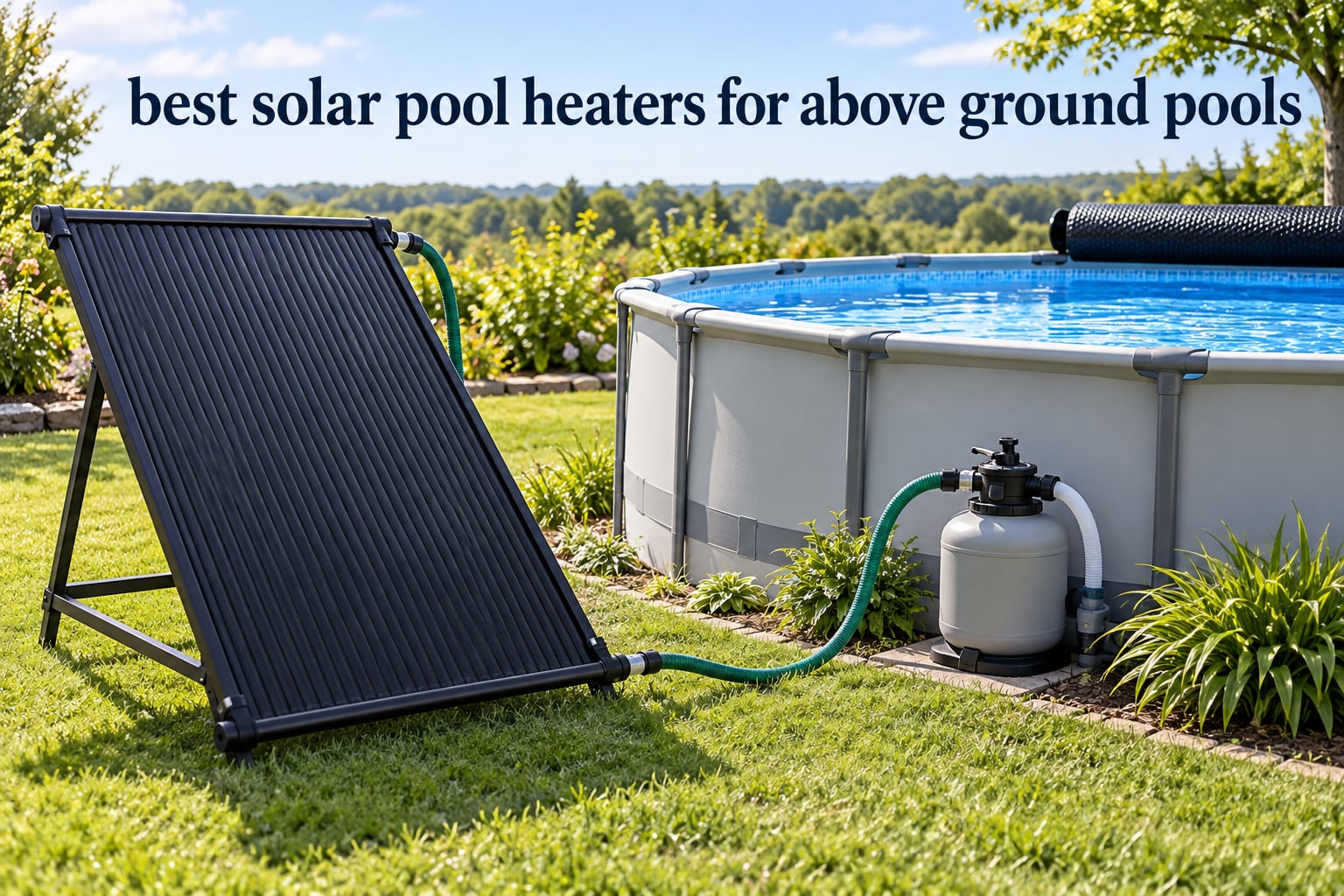
Yes, solar heaters for above ground pools work, but the collector size and your pump’s flow rate decide whether you get a few extra comfortable weeks or a disappointing week of lukewarm water. Most failures we read about trace back to the same three things: a collector far too small for the pool’s surface area, no cover to hold the heat overnight, and a heater left running after sundown.
That is why this guide is scoped tightly to frame pools. Everything below is sized for above ground setups from a 12×22 metal frame through an 18 ft round, whether it is an Intex Easy Set, a Bestway Steel Tech or a straight-sided frame with a basic cartridge filter pump. We excluded the in-ground-only panels that dominate most solar heater roundups, and we excluded the gas and electric heaters that would have needed a gas line or a dedicated circuit.
We spent a full season in 2026 reading owner reviews across the ten products below, comparing the collector surface area each one actually offers against the pool surface area it has to heat, and checking the pump horsepower and pressure limits printed on each spec sheet. The short version: the best solar pool heaters for above ground pools in this list are the ones whose stated flow requirements your existing filter pump can already meet without a rebuild.
Above ground pools lose heat faster than in-ground pools because there is no earth insulation around the shell. That single fact is why collector square footage matters more here than anywhere else, and it is why a solar cover is not an accessory but part of the heating system. If your pool also has to share space with a dog, our guide to the best dog swimming pools covers the sizing side of that setup.
Last thing before the picks. The temperature-rise numbers on the retail pages are laboratory-style claims, not pool-level results. What you will actually feel is a collector running several degrees warmer than your pool water on a sunny afternoon, and a pool that gains a few degrees across a full sunny day, then holds them overnight only if something covers it. We quote the claimed figures throughout and tell you where the real-world reports land.
Top 3 Picks for Above Ground Pool Solar Heating (September 2026)
Our top three cover the three most common above ground situations: a full-frame pool with a decent filter pump, a small weekend pool on a tight budget, and an owner who wants real collector area without a roof project. The Bestway pad takes the top slot on the strength of the strongest owner consensus in the group, and the Goplus panel set earns the middle spot because it does the most actual heating per dollar once you control the flow.

Bestway Solar Heating Pad
- Raises water 5-9 F
- Connects inline to filter pump
- 1.25 and 1.5 in adapters
- 4.1 stars from 311 reviews

Intex 11 sq ft Solar Mat
- 11 sq ft absorber laid on the water
- 5-9 F on sunny days
- Folds flat for storage
- 3.2 stars from 5458 reviews

Goplus 2.5 x 10 Panel Set
- Two 2.5 x 10 ft collectors
- 10.8 F rise up to 3408 gallons
- Roll-up portable
- 3.7 stars from 119 reviews
10 Best Ground Pool Solar Heaters at a Glance in 2026
Every collector below is a black, un-glazed design, which is the standard for residential pool heating because it absorbs sunlight directly with no glass layer in the way. The right-hand column tells you which of the ten is built for above ground use and which is a general collector that works well within that use.
| Product | Specifications | Action |
|---|---|---|
| Bestway Solar Heating Pad |
|
Check Latest Price |
| Intex 11 sq ft Solar Mat |
|
Check Latest Price |
| Goplus 2.5 x 10 Panel Set |
|
Check Latest Price |
 Solar Sun Rings 60 Inch Solar Sun Rings 60 Inch |
|
Check Latest Price |
 Goplus Solar Dome Heater Goplus Solar Dome Heater |
|
Check Latest Price |
 VINGLI Domed Pool Heater VINGLI Domed Pool Heater |
|
Check Latest Price |
 Doheny’s 2.5 x 20 Collector Kit Doheny’s 2.5 x 20 Collector Kit |
|
Check Latest Price |
 IRONMAX 2.5 x 16.5 Panel Set IRONMAX 2.5 x 16.5 Panel Set |
|
Check Latest Price |
 DORTALA Solar Dome Heater DORTALA Solar Dome Heater |
|
Check Latest Price |
 SolarPoolSupply 2-4×12 DIY Kit SolarPoolSupply 2-4×12 DIY Kit |
|
Check Latest Price |
1. Bestway Solar-Powered Pool Heating Pad – Best Overall for Above Ground Pools
Bestway | Solar-Powered Pool Heating Pad
Raises water 5-9 F
Needs 2,500 gal cartridge flow
1.25 and 1.5 in adapters
Pros
- 4.1 stars with 59% of reviews at five star
- Connects inline between filter pump and pool return
- Lays flat in full sun with no frame or roof work
- Owners confirm measurable warming
Cons
- A few units arrive with a pinhole already in the pad
- Too few gaskets supplied when chaining pads
- Can slow filter circulation
The Bestway heating pad is the one we kept coming back to, because it asks the least of an above ground pool owner. It plumbs straight into a filter pump you already own, needs no frame and no roof work, and it holds a 4.1-star average across 311 reviews with 59% of those reviews at five star.
It sits inline between your cartridge filter pump and the pool return, so there is no new plumbing run to plan. You lay it in the ground in full sun, hook up the two hoses and it starts working. Bestway rates it for cartridge filter pumps of 2,500 gallons and above, and sand filter pumps of 2,200 gallons per hour and above, with adapters supplied for both 1.25 inch and 1.5 inch connections.
What to check before you buy
The stated gain is 3-5 degrees Celsius, or 5-9 degrees Fahrenheit, depending on weather. That is a collector figure rather than a pool figure, and the reviews that mention temperature almost always pair it with a solar cover, which is where most of the pool-level benefit comes from.
Pump capacity is the real gate. If your filter pump is rated below 2,500 gallons per hour of cartridge flow, this pad is not going to move enough water to do anything useful, and no adapter will fix that.
Where owners report trouble
Its 10% one-star share sits well below the 20-29% logged by the domes and the mat, and the complaints it does attract are about units arriving with a pinhole rather than about the heating failing. The gasket count supplied is also thin if you plan to chain two pads, so pick up a spare gasket kit before you connect anything.
It can also slow your filter circulation enough that owners with fine-sand filters add a transfer pump for control. If your filter pressure climbs noticeably, a bypass line is the clean fix. We rated it the best solar pool heater for above ground pools because the hardware is simple, the gain is real, and the review base is the healthiest in the group.
2. Intex 11 sq ft Solar Pool Mat – Best Budget Pick
Intex Solar Pool Water Heater Mat for Above Ground Swimming Pools
11 sq ft UV-stabilized PVC mat
5-9 F depending on weather
1.25 in inlet, 1.5 in adapters
Pros
- Easy entry point into solar pool heating
- Large 11 sq ft absorber laid directly on the water
- Bypass valve plus both hose adaptors in the box
- Folds flat for winter storage
Cons
- Needs an in-line filter pump of at least 2000 GPH
- Capped at above ground pools of 8000 gallons
- Mat sits in the water where swimmers can damage it
This is the mat most above ground owners try first, and it carries more owner feedback than anything else on this list at 5.4k reviews. That feedback is a warning as much as a recommendation: the 3.2-star average is dragged down by 27% one-star reviews, and those negatives cluster around sizing rather than workmanship.
What you get is an 11 square foot absorber that floats on the surface of the pool, 47.25 inches on a side, with a bypass valve, a 1.25 inch attachment point and adaptors for 1.5 inch hose. Intex rates it for above ground pools up to 8,000 gallons and for filter pumps up to one third horsepower, or a flow rate under 2,000 gallons per hour.
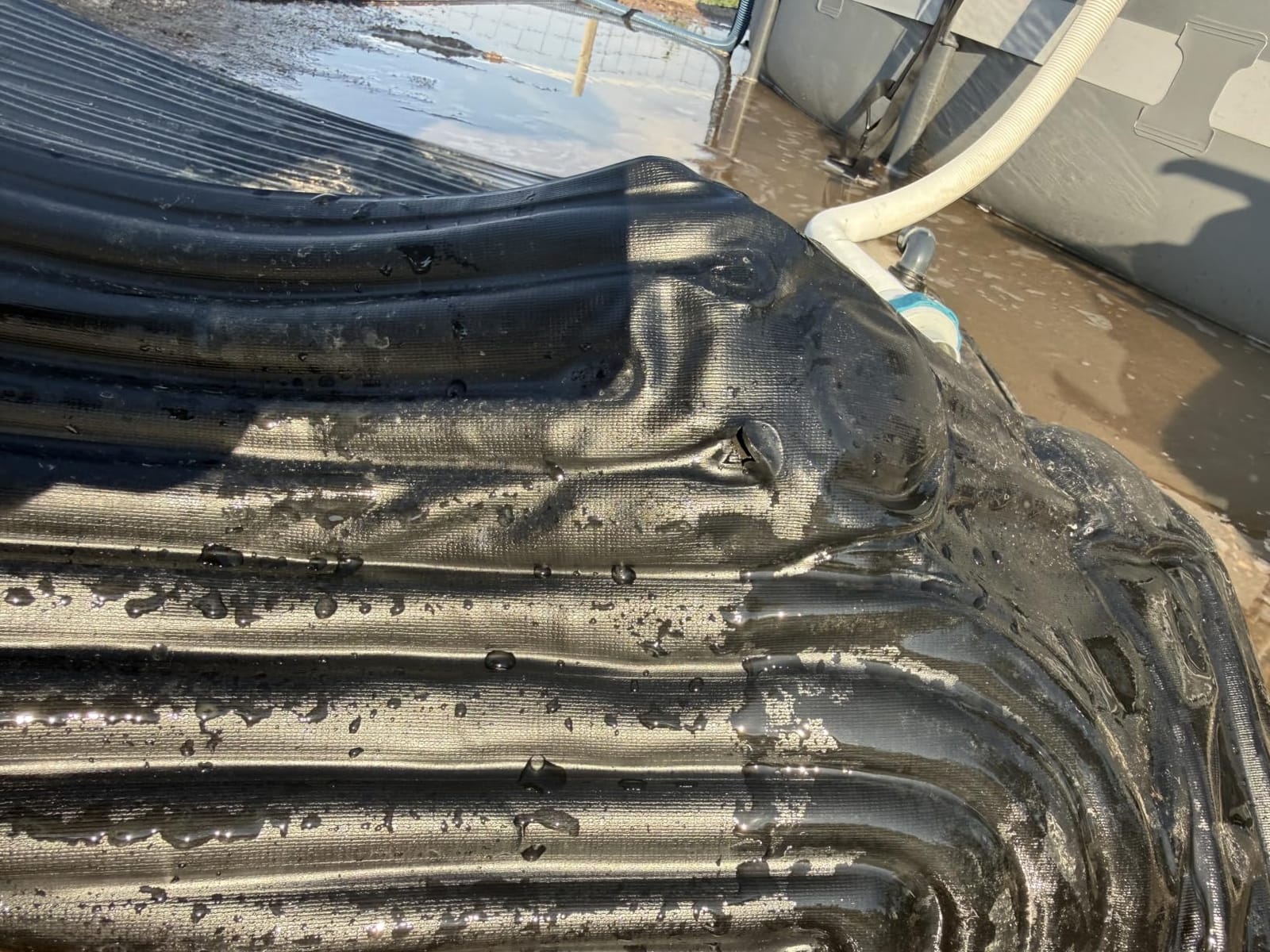
Why the mat only suits small pools
Eleven square feet is the whole problem. For a 12×22 frame pool with 264 square feet of surface, that is about 4% coverage, far below the 20-30% of pool surface area that collectors generally need to make a real dent. It works far better on a small pool or a spa, where the ratio is closer to reasonable.
The positive reviews follow a pattern we have seen in a lot of r/AboveGroundPools threads: owners run the mat, touch the return water, find it hot, and are pleased. The more careful posts add the part that matters, that the pool itself moves a few degrees across a day rather than getting dramatically warmer.
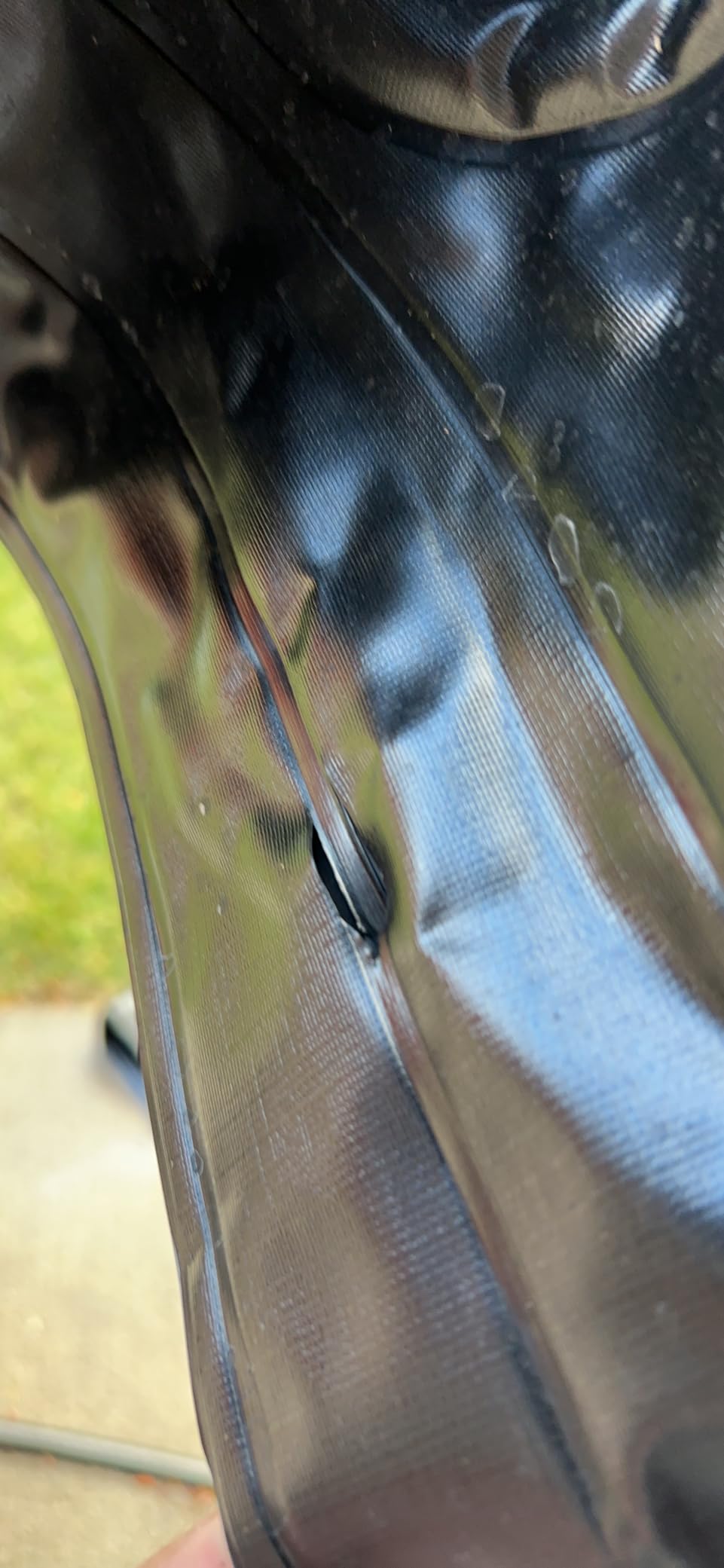
What to watch out for
Because the mat lies in the water, it takes the abuse. Swimmers kick it, dogs scratch it, and an ageing mat tears and stops circulating properly. Owners of older units report the PVC stiffening in the sun until the mat no longer lies flat.
It also cannot handle a larger pool or a bigger pump. If your filter pump exceeds one third horsepower, the mat is outside its rated flow, and you need to look at a pad or a panel instead. Storage is its one genuine win: at 5.3 pounds and half an inch thick, it folds into a closet in seconds.
3. Goplus 2.5 x 10 ft Collector Panel Set – Best Value for Real Collector Area
Goplus 2.5FT x 10FT/ 20FT Solar Pool Heater for Above Ground Pool Inground Pools, Swimming Pool Solar Panel Heating System, Weatherproof Pool Warmer (2.5FT x 10FT)
Two 2.5 x 10 ft collectors
10.8 F on 3,408 gallons
PE rated -1 to 194 F
0.75 HP, 21 PSI max
Pros
- Best rating among imported collector panels at 3.7 stars
- 25 sq ft of combined collector area
- Strong results reported when flow is controlled with a bypass
- Clear setup instructions with good illustrations
- PE channels stay flexible in cold weather
Cons
- Included hose clamps are the most common failure point
- Rubber fittings can pop off at full pump pressure
- No mounting brackets for sloped or roof installs
- Needs a 0.75 HP pump that is not included
When we lined up collector square footage against pool surface area, this set stood out. Two 2.5 by 10 foot panels give you 25 square feet of un-glazed collection, and Goplus rates the pair at a 10.8 degree Fahrenheit rise for pools up to 3,408 gallons. For a 12×24 frame pool that is a meaningful ratio rather than a token gesture.
Construction is a tube-on-web design in PE, rated from minus 1 degree Fahrenheit to 194 degrees Fahrenheit, and suitable for rooftop mounting. The panels roll up for storage, so unlike a fixed-rack kit they can come out of the way in winter without being dismantled.
How to get the rated gain
The 10.8 degree figure assumes you do not simply push full filter pump flow through a low-pressure collector. Goplus caps the system at 21 PSI and specifies a pump of at least 0.75 horsepower. Run a high-output pump flat out into it and the rubber connectors will leak or blow off, which is exactly what the negative reviews describe.
Owners who succeed set up a bypass and throttle the collector flow. One reviewer reports a 3,000 gallon above ground pool up roughly 20 degrees within a couple of sunny days, and reviews of the same panel set in parallel or series report even flow across both collectors.
The hardware problem you should plan for
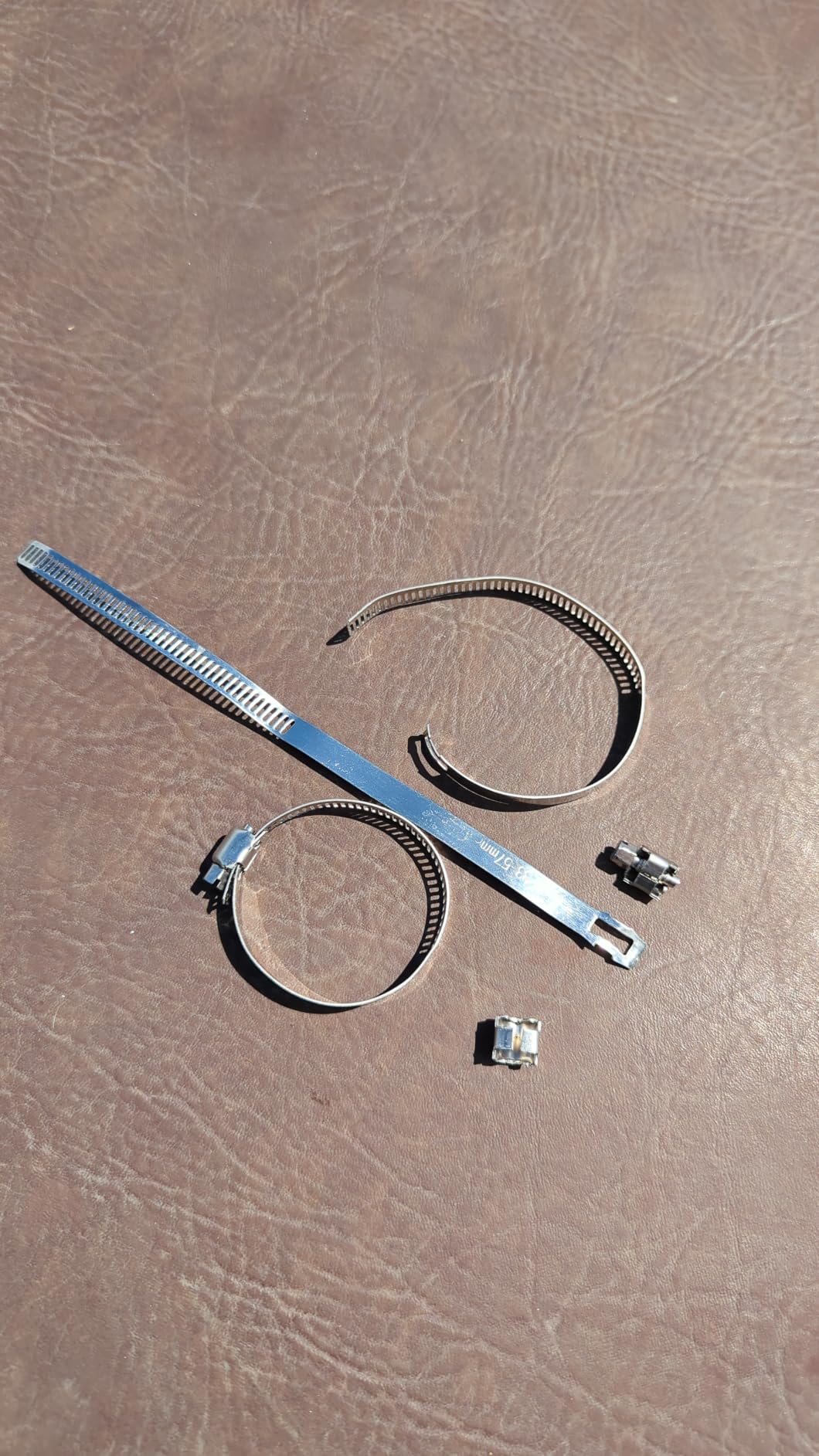
The included hose clamps are the single most common complaint, described as soft metal and poorly designed, with several owners reporting failures before they were even fully tightened. The fix is unglamorous: buy a pack of better clamps and fresh rubber gaskets on the same day you order the panels.
There are no mounting brackets in the box for a sloped or roof installation either, and extra hose is often needed to reach the panels from the pump. The kit does include end caps, connector hoses, elbow connectors and adaptors, which is more than most kits at this level manage, but it is not a complete install.
4. Solar Sun Rings 60 Inch – Best for a Setup With No Plumbing
Solar Sun Rings 60-Inch UV Resistant Solar Pool Heater │ Above Ground & Inground Pools & Spas │ Sunburst │ 1-Pack
UV-resistant vinyl float
60 inch ring
Overnight thermal blanket
Magnets join rings
Pros
- No pump
- plumbing or electrical hookup at all
- Heats by day and insulates at night in one product
- Rings separate on contact to reduce entrapment risk
- Magnets join multiple rings into a continuous cover
Cons
- Surface heating only
- so it adds less heat than a pumped collector
- One ring covers a small share of a typical pool
- Must be stored out of direct sunlight or it scorches what is beneath
- Magnets can drift in wind and bunch the cover
Everything else on this list needs hoses, fittings and a pump decision. This one floats on the water and does nothing else. It holds 3.1k reviews at a 3.4-star average, a useful gauge of what above ground owners actually think about surface heating.
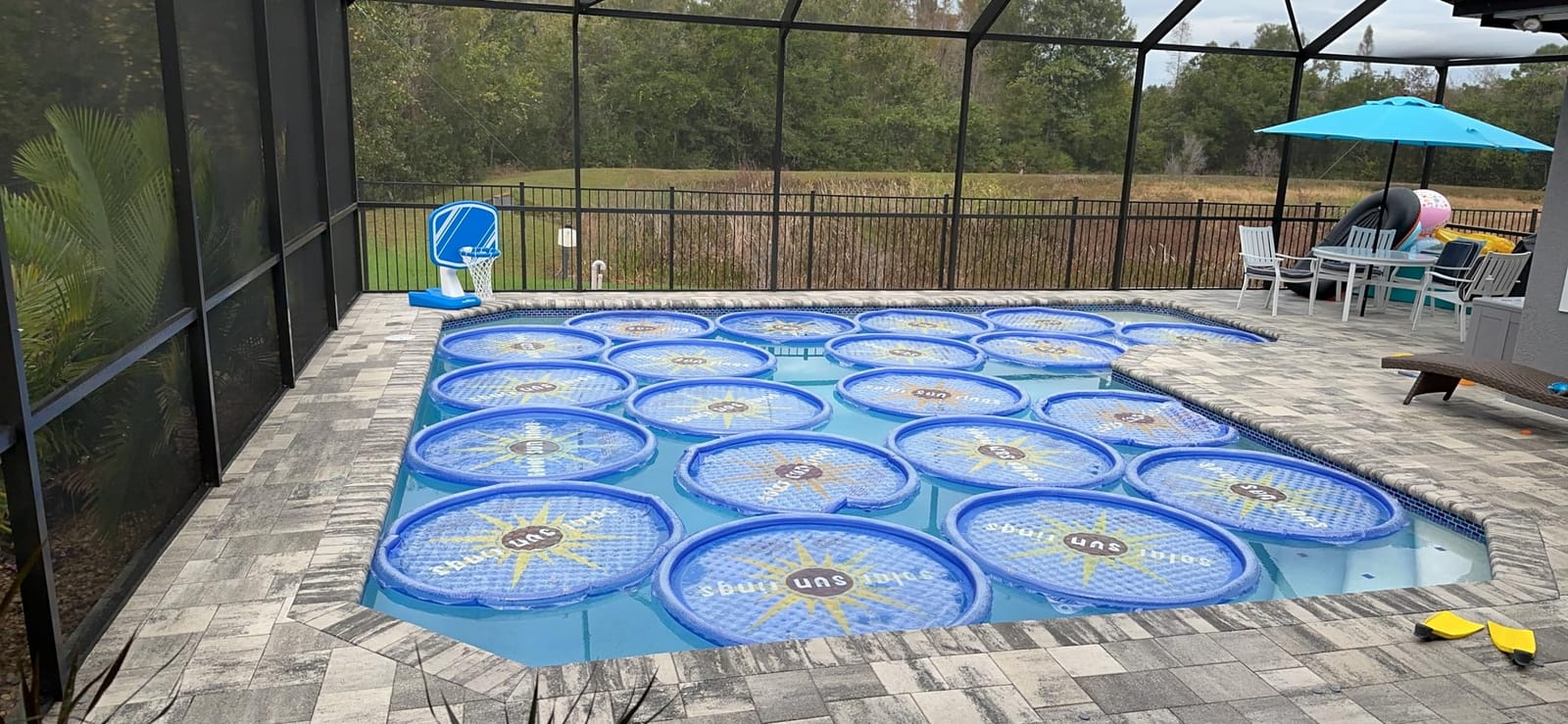
The design is two layers of UV-resistant vinyl with encapsulated magnets. In the sun the rings absorb heat and warm the top layer of water. At night the same rings act as a thermal blanket, cutting evaporation and slowing overnight heat loss, which is the same job a solar cover does for a frame pool.
What one ring actually covers
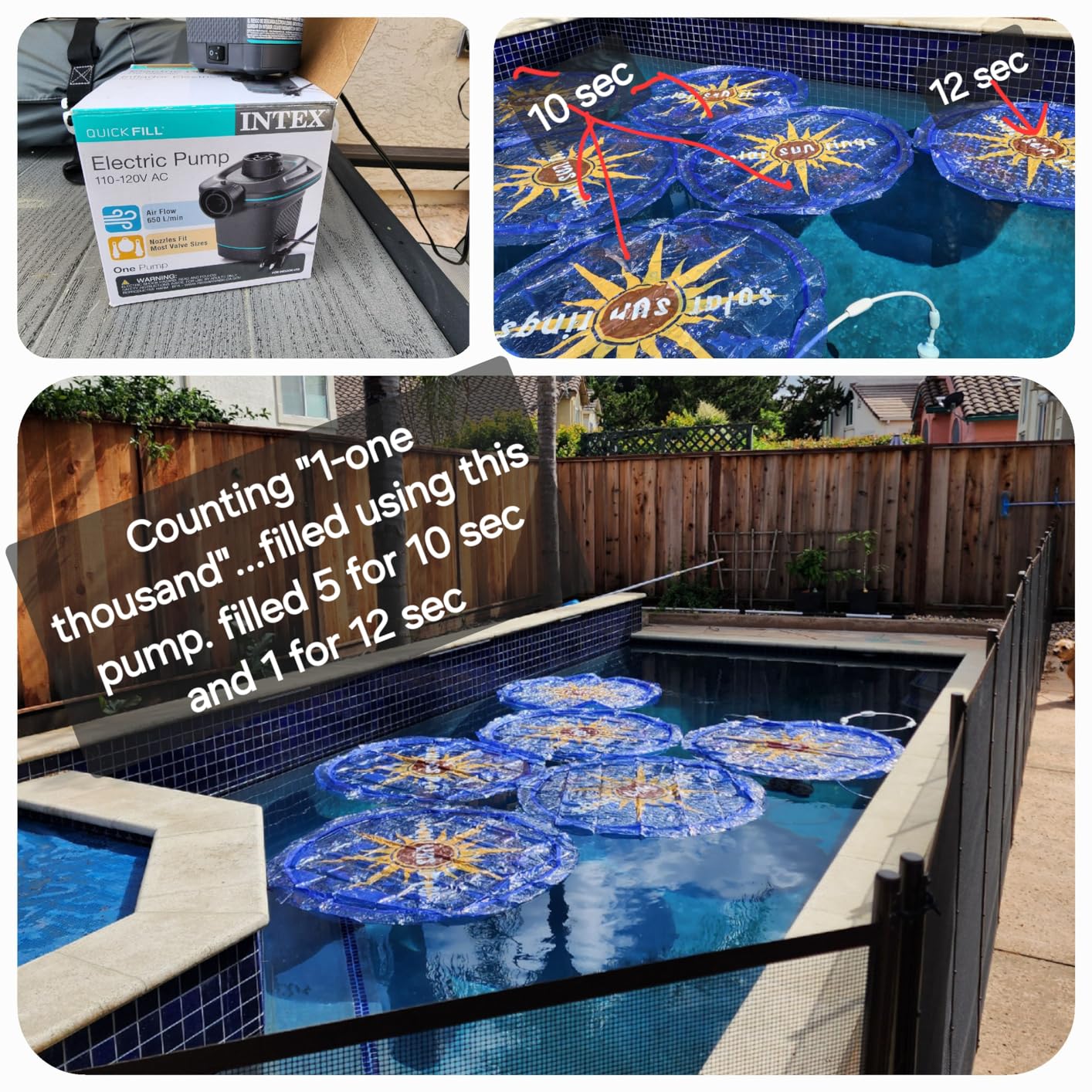
A 60 inch ring is about 19.6 square feet. On a 12×22 pool with 264 square feet of surface, one ring covers around 7% of the pool, so you would need a set of eight or more to cover the whole thing. The listing is a single ring, and most owners buy multiples over time rather than committing at once.
The gain is modest next to a pumped collector, and the reviews say so plainly. Owners describe it as a way to take the chill off on a mild day and to hold temperature overnight, not as a way to heat a pool from cold.
The details that trip people up
Rings separate on contact to reduce entrapment risk, and drainage grommets stop them sinking, which are sensible safety choices for a pool with children. In wind, though, the same free movement lets rings slide and bunch, concentrating heat on one patch and leaving bare water elsewhere.
Store them out of direct sunlight when not in use, because the rings can scorch whatever is stacked underneath. It is the best solar pool heater for above ground pools if you have no plumbing, no pump headroom and no patience, and the least useful one if your goal is a measurable temperature rise in a large pool.
5. Goplus Solar Dome Pool Heater – Best for Small Yards
Goplus Solar Dome Swimming Pool Heater Above Ground, Inground Pool Warmer Equipment w/Hose Connector for Home Outdoor
22.5 in dome collector
Up to 2,641 gallons
Foldable sun legs
1-1.25 in fittings
Pros
- Installs in minutes with no fuel or electricity
- Dome concentrates heat in a very compact footprint
- Cover keeps the coil clean and shields users from the hot surface
- Chain two or three together for larger pools
Cons
- Supplied hoses are the most common failure point
- Nothing in the box holds the unit off the ground
- 1-1.25 in connectors dominate and 1.5 in adapters are not included
- Build quality is described as cheap
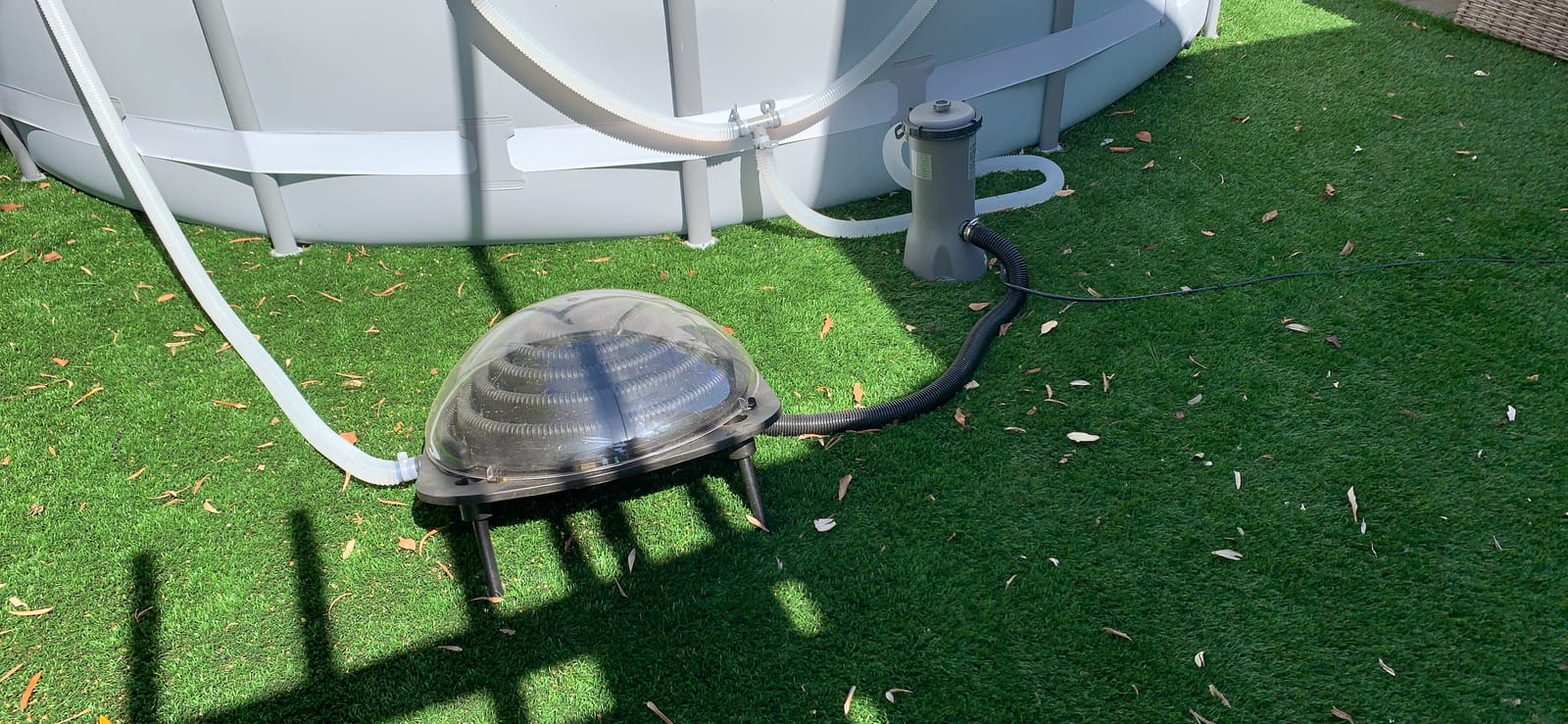
A dome is the answer when yard space is the constraint. At 22.5 inches square, this one occupies a patch of lawn about the size of a kitchen chair, and the curved shape concentrates sunlight onto the black coil without needing a flat panel area at all.
Goplus rates it for pools up to 2,641 gallons, which puts it squarely in small-above-ground territory. Two foldable legs prop the coil toward the sun during the day and fold flat for storage, and a high-intensity polycarbonate dome protects the coil from debris and stops anyone touching the hot surface.
Why owners run two or three
Because 2,641 gallons is a small pool, the reviews cluster around people who chained units together. Owners running two or three report 8-10 degree gains against a neighbouring unheated pool on a sunny day, which is the pattern you would expect when you multiply the collector area.
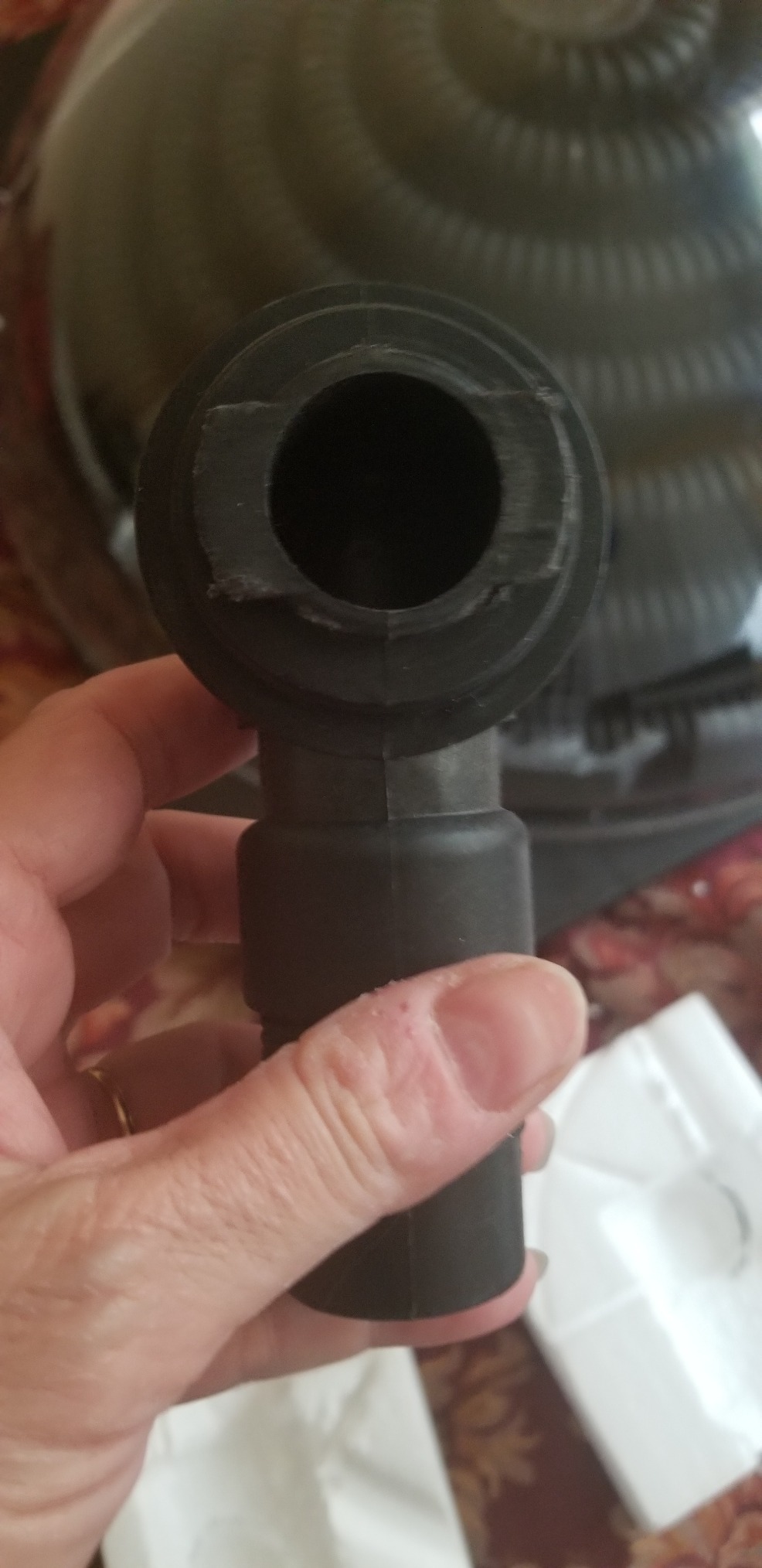
Plumbing them together means adding hose between each dome. The supplied connectors are predominantly 1-1/4 inch, and a 1-1/2 inch pool setup needs adaptors that are not in the box and can be awkward to source. Plan the fitting list before you start.
What fails and what is missing
The hoses are the weak point. Across the dome products in this category, reviews repeatedly report pinhole leaks and hoses slipping off fittings once hot, and this model is no exception. Several owners replace the supplied hose with their own on the first weekend, which removes most of the complaints.
There is also no stand included. Owners improvise frames, pavers or a piece of timber, and the dome cover itself is described as loosening in wind. It is a sensible pick for a compact yard or a spa, and a frustrating one if you expect a permanent, hands-off installation.
6. VINGLI Domed Pool Heater – Best for Chaining Multiple Collectors
VINGLI Solar Pool Heater Above Ground Domed Solar Powered Swimming Pool Heater Contour Pool Heating Coil (1 Pack)
Domed coil,23.23 in square
15.87 lb, foldable legs
1-1.25 in fittings
1-year warranty
Pros
- Confirmed to heat an 18 ft round pool in full sun
- Assembles in about five minutes for several buyers
- One
- two and three-packs available for chaining
- Manufacturer offers replacement hoses and a 1-year warranty
Cons
- Included hoses split
- crack or spring pinhole leaks when hot
- Rubber seals needed at every connection or joints leak
- 1-1.25 in design means 1.5 in setups need extra reducers
- Can reduce pump suction and make vacuuming harder
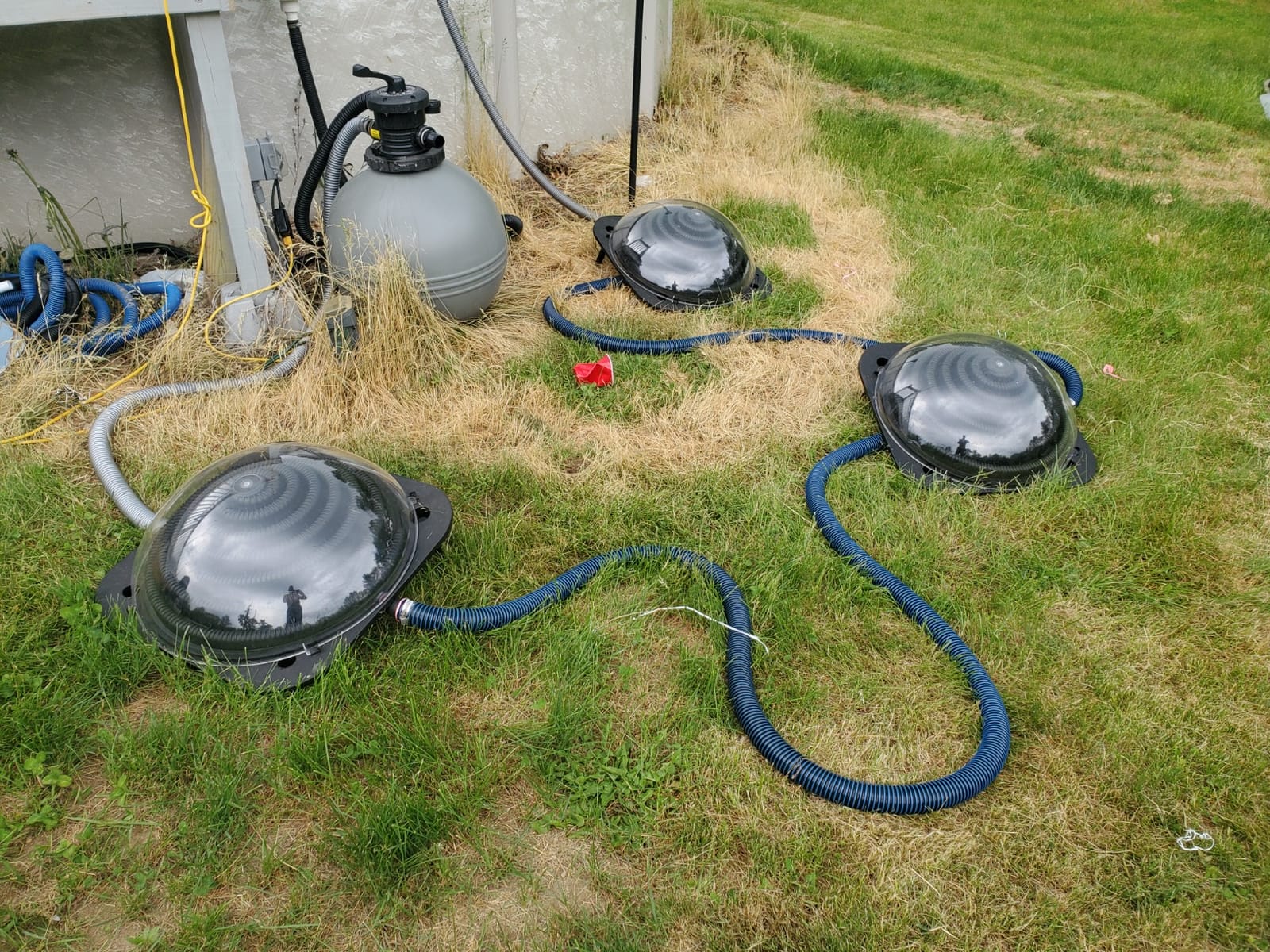
This dome is sold in one, two and three-packs, and the multi-pack is the point. Owners who run three units on a large above ground pool report a strong effect, while single-unit owners find the gain modest. The 3.2-star average comes almost entirely from hardware complaints rather than from disappointment about the heating.
It measures 23.23 inches square, weighs 15.87 pounds and has two foldable legs for angling the coil. The dome cover is removable, and the manufacturer’s own advice is to take it off for faster heat gain once the coil is up to temperature.
The split in the reviews
Reviews divide almost perfectly into two camps. Owners who replaced the supplied hoses with their own and added rubber seals report a working heater. Owners who used the tubing as supplied report splitting, cracking and pinhole leaks, and that camp accounts for most of the 29% one-star share.
That remedy is not complicated, but it does cost you a few dollars in parts. Budget for a length of reinforced hose and a pack of seals before the first fill, and expect to re-do connections a few times while you get the seal right.
Suction and fitting issues
One practical drawback that gets overlooked: a coil in the return line can reduce pump suction enough that the pool vacuum struggles. On an above ground pool with a basic cartridge pump, that can show up as a vacuum that will not stay attached to the bottom.
The instructions are also described as poor, and the fittings are built around 1-1/4 inch hose, so a 1-1/2 inch pool plumbing set needs extra reducers and clamps. The upside is the 1-year warranty and the offer of replacement soft hoses, which several owners say was handled quickly by the manufacturer.
7. Doheny’s 2.5 x 20 ft Collector Kit – Best for Roof or Rack Mounting
Doheny’s Solar Heating Systems for Above Ground Swimming Pools (2.5′ x 20′ Collector Kit)
50 sq ft collector,40,000 BTU
2.5 x 20 ft panel
24 lb
Rack or roof kit extra
Pros
- Owners report genuinely warmer return water and roughly a 5 degree gain in a few hours
- Published BTU chart makes panel count easy to match to pool size
- Diverter valve lets you shut collectors out at temperature
- Manufacturer support is described as fast
Cons
- Not plug and play
- needs a frame and plumbing skill
- 1-1.25 in connections need adapters for 1.5 in plumbing
- Must be fully drained in fall or trapped water cracks the channels
At 2.5 feet by 20 feet, this is a 50 square foot collector rated 40,000 BTU, and the only one in the group supplied as a long panel rather than a roll-up set. It is also the most installation-heavy, and the reviews are almost entirely about that: multiple owners confirm measurable gain once it is plumbed and mounted, and nearly every one of them describes the mounting and plumbing work first.
It mounts on a plywood deck beside the pool or on a roof, with roof and rack hardware sold as a separate kit containing five six-foot straps, fifteen stainless brackets and fifteen screws. The kit includes a two-way diverter valve and spacer, which you plumb into the filter circuit as an on-off switch for the collector loop.
Using the sizing chart properly
Doheny’s publishes one of the more useful sizing guides in this category. Twelve to fifteen foot round pools take the 2.5 by 20 collector. Eighteen to twenty-four foot rounds, and 15×30 or 16×32 ovals, need the 5 by 20 collector at 80,000 BTU. Twenty-seven and twenty-eight foot rounds, and an 18×34 oval, need both panels for 120,000 BTU.
Because our roundup is scoped to above ground pools, most readers will land in the first or second row. Use the chart rather than the marketing claim, and note that a 5×10 space-saver version exists at 40,000 BTU for tighter sites.
Winterizing and connection issues
Trapped water is the real enemy. The channels must be fully drained in autumn because expanding water cracks them, and that single maintenance habit decides whether this collector is still intact next spring. Owners who drained it report no freeze damage.
All connections are 1-1/4 inch, so 1-1/2 inch pool plumbing needs adaptors. Some owners also report header end caps that do not seat and seal properly, causing leaks, and newer multi-section layouts are harder to hang flat than older single-piece designs. PVC or flex pipe is not included for roof runs, so count on buying it.
8. IRONMAX 2.5 x 16.5 ft Solar Pool Heater – Best Two-Panel Starter Kit
IRONMAX 2.5 x 16.5 Feet Solar Pool Heater for Above Ground & Inground Pools
Two panels,41.25 sq ft
10.8 F to 3,408 gallons
PE rated -1 to 194 F
0.75 HP, 21 PSI max
Pros
- Two panels per pack so collectors can be chained to match pool size
- Tube-grid surface and PE channels suit rooftop exposure
- Roll-up format stores easily between seasons
- End caps
- clamps
- adapters and elbows included
- Published sizing guide for round and rectangular pools
Cons
- Only 75 reviews
- so long-term durability is largely unverified
- Needs a 0.75 HP pump that is not included
- Leaking fittings are the recurring theme in this product class
- Larger pools need more panels and more plumbing
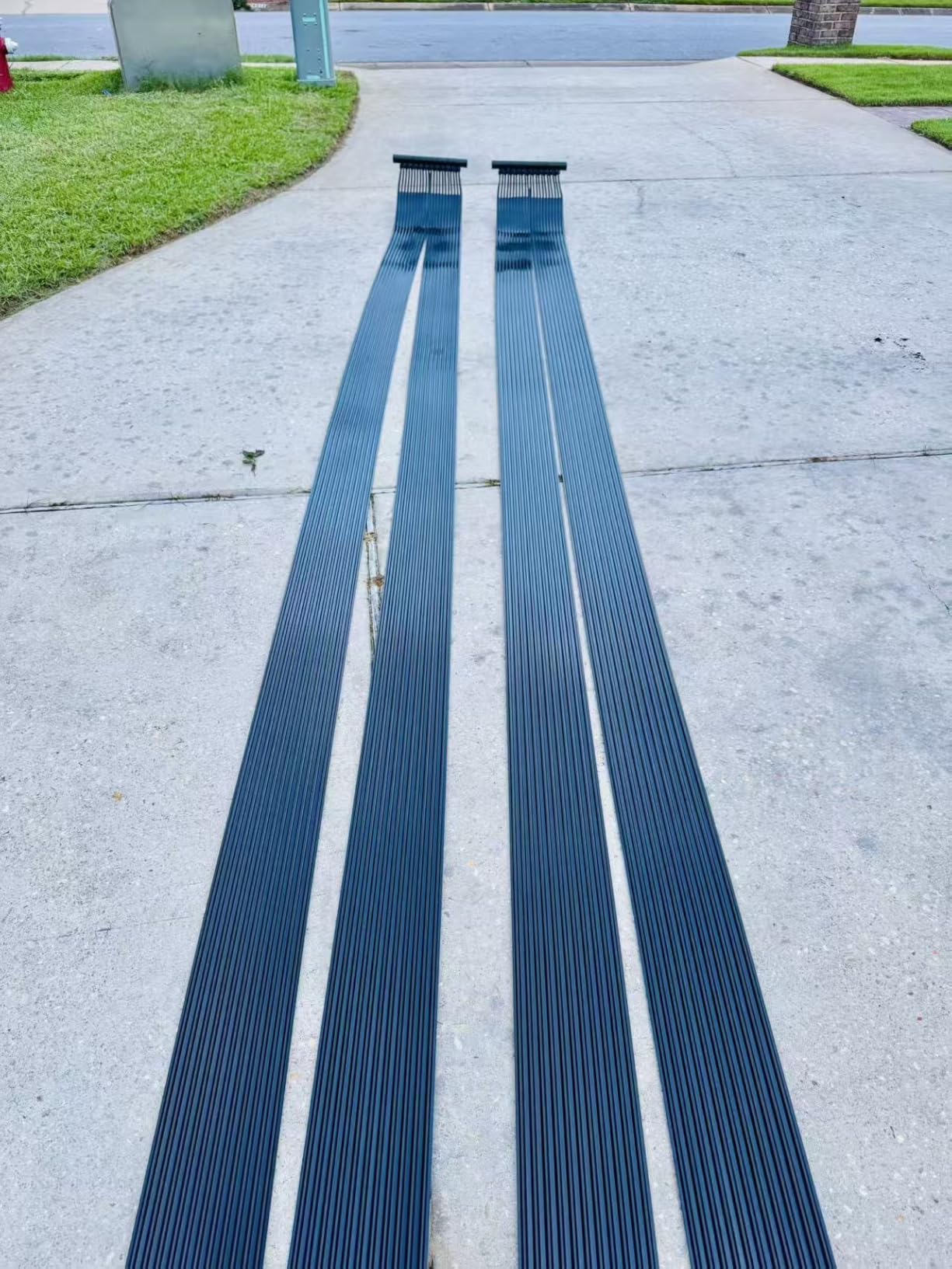
This two-pack gives you 41.25 square feet of coverage area and the same 10.8 degree stated rise for up to 3,408 gallons. The 2.5 foot width makes each panel narrow enough to mount side by side on a frame or lay along a fence, which suits the narrow side yards that come with frame pools.
Like the Goplus set, it is a roll-up design in PE rated from minus 1 to 194 degrees Fahrenheit, and both panels connect to your existing pump through the included end caps, clamps, adapters and elbow connectors. The box is more complete than most kits of this size.
What the sizing guide recommends
One 16.5 foot or 20 foot heater covers 12 to 18 foot round pools and 12×24 foot rectangular pools. Two heaters are recommended for 21 to 24 foot rounds, 16×30 and 16×25 foot pools. For most above ground frames, one unit is the correct starting point.
Minimum pump requirement is 0.75 horsepower and pressure must stay under 21 PSI, the same ceiling as the Goplus panels. Build a bypass rather than forcing full filter flow through the collectors.
Read the rating with caution
The 3.5-star average sits on only 75 reviews, so treat it as provisional. The specification set is unusually complete, with published temperature tolerances and a sizing chart, but the long-term durability evidence simply is not there yet.
Fitting leaks are the recurring theme in the feedback, as they are across this whole product class. Panels also need regular cleaning to keep solar absorption up, and the PE channels pick up dust and pollen fast if they sit face-up in a lawn. If you want a documented long-term record rather than a specification sheet, move up one slot in this list.
9. DORTALA Solar Dome Heater – Best for Spas and Small Pools
DORTALA Solar Pool Heater, Dome Swimming Pool Water Heater for Above Ground & Inground Pool with Black Heating Coil, Foldable Legs, Rotatable Hose Connector
Convex dome,23 in round
5.4-7.2 F rise
1-2 HP pump, up to 16 GPM
Hose included
Pros
- Reported 5-7 degree gains from morning to late afternoon on a spa
- One owner moved a large pool from high 60s into the mid 70s
- Foldable legs make sun angling and storage easy
- Hose connector rotates 90 degrees and fits 1.5 and 1.25 in joints
Cons
- Leaky joints are the dominant complaint
- Thin supplied piping needs step-down parts for non-standard setups
- Hoses can pop off if the pump runs high
- Needs several sunny days to move a large pool
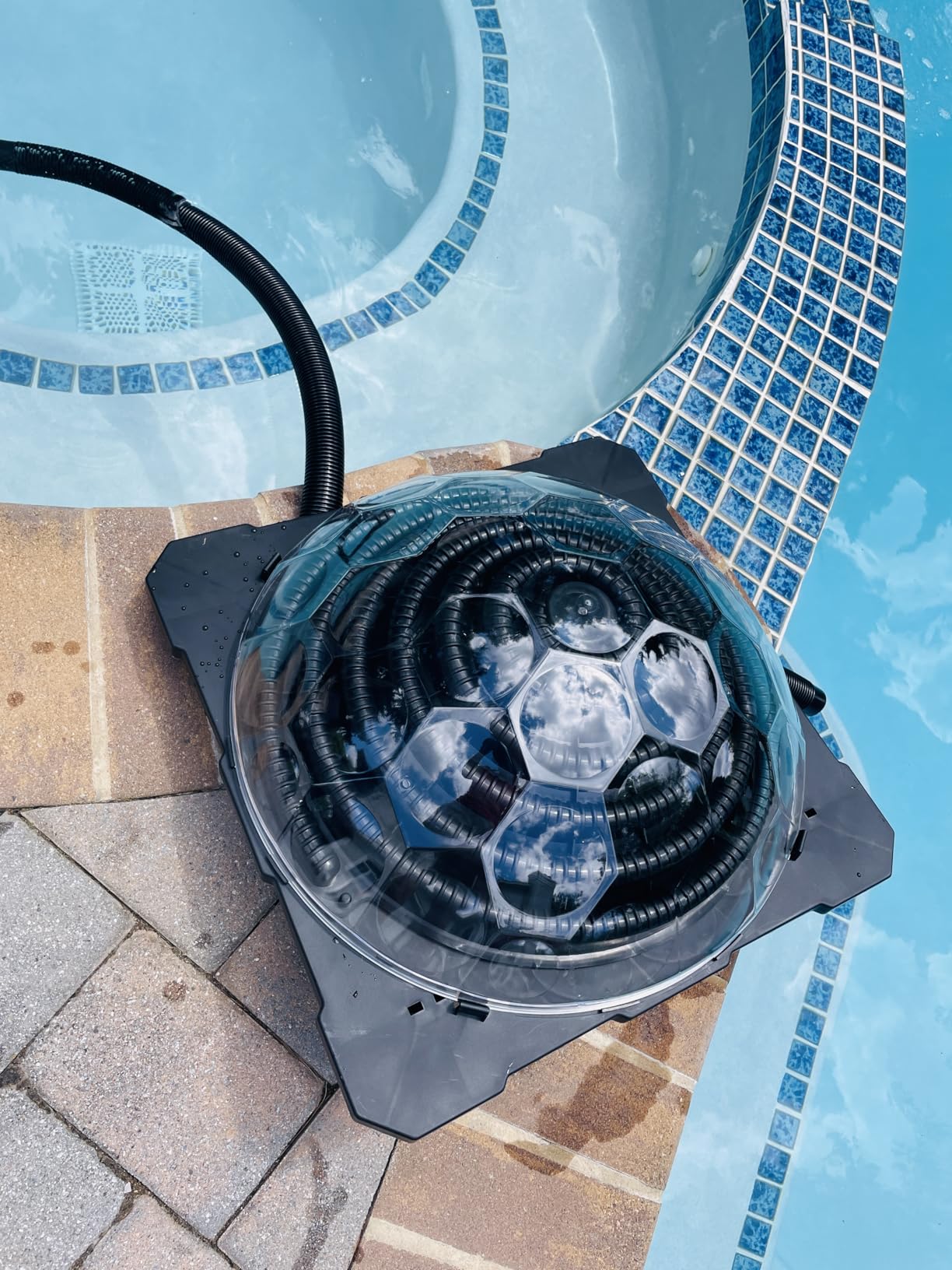
The DORTALA is the smallest collector here, a 23 inch round dome with a transparent convex cover over a black coil, and it is pitched at spas and small pools. The stated gain is 5.4 to 7.2 degrees Fahrenheit, which spa owners describe as real and achievable across a day.
It is also one of the few units that states a flow rate rather than just a horsepower figure: it works with a 1-2 HP pump moving up to 16 GPM. That clarity matters, because it tells you the collector can absorb a serious flow rate without splitting its connections.
The best setup advice in the reviews
Across the reviews, the single most repeated piece of advice is to bypass the heater at night and reopen it around mid-morning, once the collector is warmer than the water. One owner runs it through a bypass valve set near 50/50 to moderate the flow and reports steady gains.
Owners also like the rotatable connector, which turns 90 degrees so the hoses can run either direction, and the fact that it accepts both 1.5 inch and 1.25 inch fittings. That is more flexibility than most domes at this size.
Where the reviews get frustrated
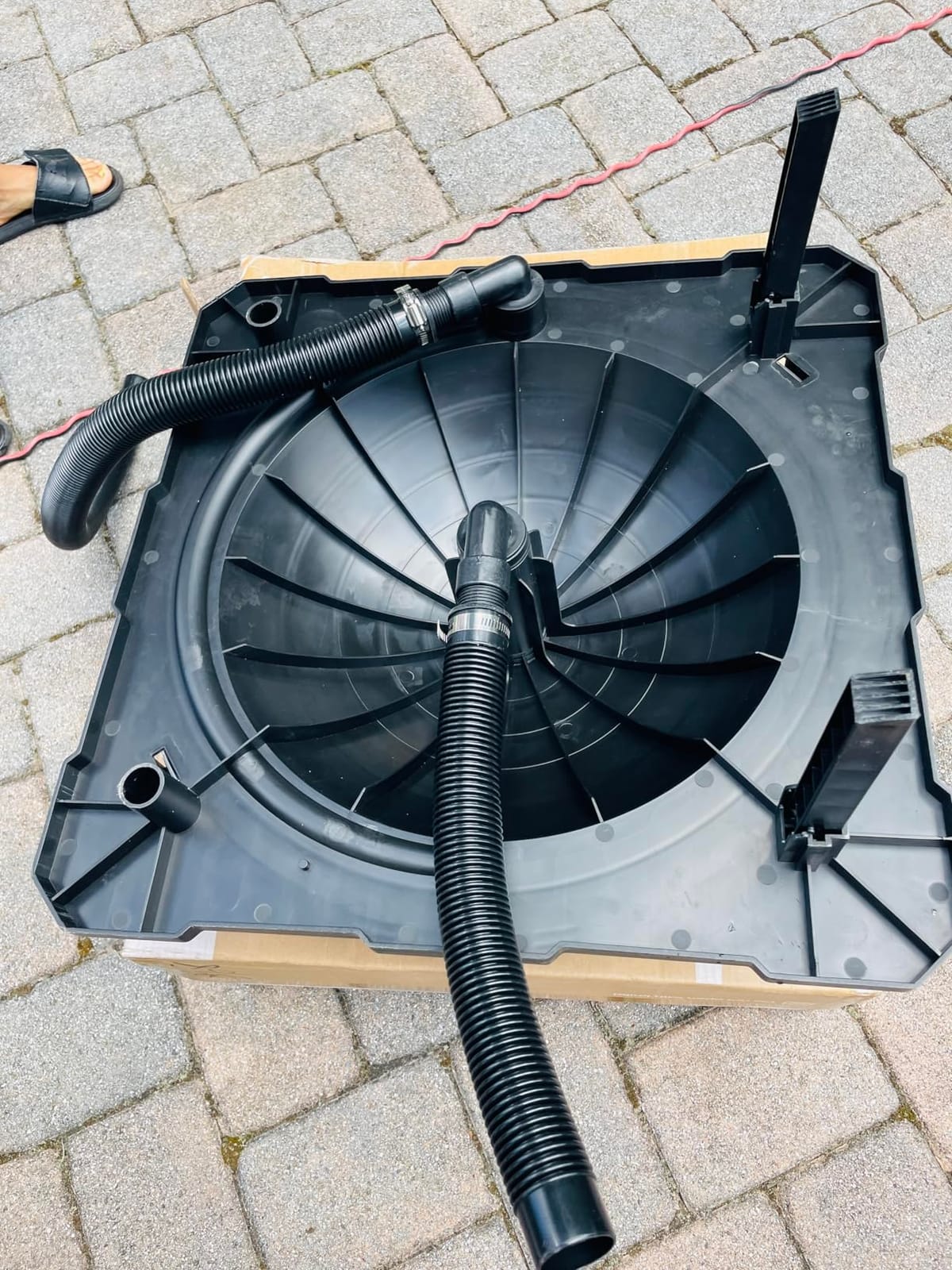
Leaky joints dominate the negative feedback, with owners spending days sealing fittings and losing water. The included piping is thin, and non-standard hose sizes need PVC step-down parts that are not supplied.
That is the most useful thing in this guide for a small spa, and it stays a lot cooler than a spout of warm water. The figure also does less for a large pool: owners of big pools describe the lift as modest and slow, needing several sunny days to show a measurable change, and the pump is not included either, so add that to the parts list. If your pool is small and warm water matters more than volume, this is the right pick.
10. SolarPoolSupply 2-4×12 DIY Solar Pool Heater Kit – Best for a 15-20 Year Lifespan
Highest Performing Design – DIY Solar Pool Heater Kit – 15-20 Year Life Expectancy (2-4×12 / 1.5″ I.D. Header)
Two 4 x 12 ft collectors
1.5 in header
SwimEasy over-molded header
15-20 year life
Pros
- 4.7 stars with 87% of reviews at five star
- Over-molded header and absorber design maximize flow into every tube
- Single-piece header reduces leak points
- Complete kit with hardware
- straps
- plumbing parts and support
Cons
- By far the most expensive option here
- Requires a serious DIY plumbing and mounting project
- Full-size array is sized for larger pools than most small above ground setups
- Only 69 reviews
This is the only product here with a 4.7-star average and 87% five-star reviews, and the praise is unusually specific. Owners point to the header flow engineering, the US manufacturing, the UV stabilization and the 15 to 20 year service life claim, and they acknowledge the same tradeoff: it costs the most and asks the most of you to install.
The technical difference is the header. Each absorber tube feeds into a single-piece header moulded around the tubes, which removes flow barriers and the manufacturing variance that causes leaks in multi-part headers. More flow through the panel means more heat transferred to the pool, which is the physical argument the whole category gets wrong.
What the kit actually includes
Unlike most competitors, this one includes the mounting hardware, panel interconnects, tie-down straps and supply and return connection parts, plus a step-by-step manual and unlimited expert installation support. You still supply the plumbing skills and the roof or rack structure, but you are not hunting for fittings.
There are 51 size and header configurations available, from a 2-4×8 up to a 10-4×12, with either 1.5 inch or 2 inch headers. That range matters for above ground owners because it lets you right-size to a 12×24 rather than forcing a full-size array onto a small pool.
Is it right for an above ground pool?
It works with an existing pump and filtration system, and a 1.5 inch header is well matched to a typical frame pool. But the array shown is two 4 by 12 foot panels, which is generous for a small above ground setup, and you are paying for build quality you might not extract from a 500 gallon spa.
Our view is that it makes sense if you intend to keep the pool for a decade or more, and that it is overkill for a seasonal frame. Choose it when you want the strongest owner consensus in the entire group, not when you want the shortest path to a few extra weeks of swimming.
Sizing: Match Collector Square Footage to Your Pool Surface Area
Sizing is the whole game. The working rule of thumb is to cover 20% to 30% of your pool’s surface area with un-glazed collector, and above ground pools sit at the higher end because the shell loses heat straight to the air with nothing insulating it. Measure the pool’s length times width, then multiply by 0.25 to get a target collector area.
For a 12×22 frame pool that is 264 square feet of surface, so about 66 square feet of collector. A 12×24 gives 288 square feet and roughly 72 square feet of collector. A 16×32 oval gives 512 square feet and closer to 128 square feet, which is where you are genuinely stacking panels. An 18 foot round pool has about 254 square feet of surface and wants around 64 square feet of collector.
If that number is larger than any single product in this list, that is your answer: buy two. The Goplus set at 25 square feet and the IRONMAX pack at 41.25 square feet are both built to be chained for exactly this reason, and the Doheny’s sizing chart assumes multiple collectors for pools in the 18 to 24 foot range.
Judge the ratio against the units on the page, not against the headline. The Intex mat is 11 square feet, which is a sensible ratio for a small spa and a negligible one for a 16×32. Domes are efficient per square foot of ground space, but their rated gallon ceilings of 2,641 and 3,408 gallons assume one unit, not a chain.
One more sizing variable that decides everything for above ground pools: whether you can put a cover on. Owners on r/pools are blunt that not every pool can take one, and a coverless pool needs considerably more collector area to hold what it gains. If yours is open to the sky, size toward the top of the range.
Flow Rate and Pump Horsepower: When You Need a Bypass Kit
Here is the number that decides whether a solar heater works for you. A poolforum veteran put it better than any spec sheet: a very heavy, strong flow that is only one degree warmer than your pool will still heat it faster than a trickle of hot water. Solar heating is about moving gallons, not about producing one shocking-hot outlet reading.
That means the wrong pump can ruin an otherwise good collector. Push a high-output filter pump hard into a low-pressure panel and you get leaking rubber fittings, blown-off connectors and, on some designs, reduced suction that makes cleaning harder. The panels in this group with a 21 PSI ceiling and a 0.75 HP minimum are built for controlled flow, not for maximum flow.
Check your filter pump’s rated flow before you buy, and compare it against what the collector wants. The Intex mat needs the least, at under 2,000 GPH, which is why it is a poor match for a modern high-flow pump and a good match for a small one. The Bestway pad needs 2,500 gallons of cartridge flow or 2,200 gallons per hour of sand flow. The DORTALA dome is the most explicit, stating a recommended pump of 1-2 HP moving up to 16 GPM.
A bypass kit solves the mismatch. It lets you route water around the collector when the water is already warmer than the panel, and it lets you throttle flow during the day and shut the loop down at night. A diverter valve does a simpler version of the same job, and the Doheny’s kit includes one. If your pump is stronger than your collector’s rating, plan on buying a bypass as part of the install rather than discovering the leak afterwards.
While you are planning the plumbing, remember the panel competes with the filter for the same pump, and the run outside in the sun needs sun-tolerant hose and clamps. If you are also laying out the yard around the pool, our guide to the best in-ground sprinkler systems covers irrigation planning for the surrounding lawn.
Flat Panel, Dome, Mat or Cover: Which Collector Type Fits
Four designs appear in this guide and they suit very different situations. A flat pad, like the Bestway unit, is the simplest to plumb and holds a thin layer of water close to the sun. A floating mat, like the Intex one, needs no plumbing at all but sits where swimmers and pets can damage it. A dome concentrates sunlight into a small footprint, which solves a tight yard rather than a tight budget. A floating ring or cover heats the surface and insulates overnight without touching your pump at all.
Un-glazed versus glazed is the other question. Everything in this roundup is un-glazed black polymer, because un-glazed collectors absorb sunlight directly with no glass layer and no frame, which is the standard for residential pools. Glazed collectors hold heat better in cold and cloudy weather but cost more, need a frame, and are rarely the right answer for a frame pool in a mild climate.
Portable options win on storage. Mat and ring designs fold or stack away in seconds, and roll-up panels go into a garage without being taken apart. Fixed rack and roof kits collect more heat because they hold a steeper angle to the sun all day, but they are a permanent structure on your property and they must be drained before winter. If you want portable heaters for above ground pools you take down in autumn, the mat and the rings are the practical answers.
If you are planning a full outdoor setup, it is worth getting the details right alongside the heating, including how to pick weatherproof speakers for pools that stay out through the season. Heating is what makes the water bearable; everything else determines whether anyone is out there to use it.
Run It by Day, Bypass It at Night
Yes, turn your solar pool heater off at night. This is the single most important operating habit with a solar collector, and it is the one most first-time owners get wrong by leaving the loop open overnight.
A black un-glazed collector loses heat to the night sky through radiation, and after sundown the panel is colder than the pool water. Water passing through it comes out cooler than it went in, so a collector left in the circuit overnight slowly pumps heat out of the pool. That is reverse cycling, and on a frame pool with no earth insulation, the loss is real.
The fix is mechanical rather than attentive. Close the bypass valve at dusk, or set a diverter to the pool return only, and reopen it in the morning once the collector is warmer than the water, usually around mid-morning. Owners running the DORTALA dome report that a bypass valve set near 50/50 during the day and closed overnight produced the most consistent results of any setup in their reviews.
Cloudy days are different and worth a note. On a heavily overcast day the collector may sit close to air temperature, so the water passing through loses a little heat rather than gaining any. It is a small effect, and leaving the loop open is less costly than leaving it open all night, but if you are chasing every degree, close it up when the sky is flat grey.
Pairing a Solar Cover With Your Above Ground Pool Heater
A solar cover is functionally part of the heating system, not an accessory. The single most repeated piece of advice across pool forums for this exact topic is that overnight retention is what makes daytime heating worth paying for, and the same people point out that it also stops evaporation, which is a heat loss you cannot size your way around.
Use a cover that fully covers the pool surface, and expect a meaningful reduction in overnight cooling. If your budget stretches to one purchase after the heater, make it the cover. A half-covered pool gives you a half-sized result from the collector you already paid for.
On thickness, the practical difference is durability rather than heat output. Thinner covers are lighter and easier to handle over a frame pool rim, but they degrade faster under chlorine and UV and shift more readily in wind. Thicker covers tolerate more abuse and last longer, so the one that survives your summer wins.
Frame pools also have a sizing quirk worth checking before you order. Not every above ground frame takes a full-size cover, and the rim profile decides how well a cover seats. The floating ring designs in this guide sidestep the fitting problem entirely, which is part of why they pair so well with smaller pools.
Why Your Solar Pool Heater Is Not Heating
Owners post the same complaint over and over: the water coming out of the collector is hot, and the pool temperature has not moved. That is usually not a broken heater. It is one of five things, and you can check all of them in an afternoon.
First, orientation. A collector pointed east or west, or sitting in a yard with less than six hours of direct sun, will produce very little. That is exactly what happened in one Facebook above ground group thread, where a member installed a panel heater, could not see a difference, and then found it was aimed east the whole time.
Second, undersized collectors. This is the most common mismatch by a distance. An 11 square foot mat sold for a 12 to 16 foot pool is the textbook example, and it is why the same mat can be a five-star spa accessory and a one-star pool disappointment.
Third, no cover. Without one, the heat you added during the day leaves overnight, and the pool settles into a repeating cycle that never accumulates. Fourth, pump flow that is too low or too high for the collector. Fifth, and most embarrassing, running the loop at night.
There is also the expectation problem. A self-built rooftop collector in one forum thread measured roughly a 3 degree Celsius rise over twelve hours at about 20 degrees Celsius ambient. That is a realistic figure. Manufacturer claims of 10 to 15 degrees describe the water leaving a collector on an ideal afternoon, not a pool that has moved 10 degrees. Setting the expectation at the low end is the fastest way to feel satisfied with a solar heater.
One last practical item: fittings leak, and leaks waste your pump’s output. If the connections are weeping, the circulation is lower than the pump rating suggests, and no amount of sun will fix it. Tape the joints and check them after a full day of operation.
Installation, Winterizing and What Is Actually in the Box
Plumbing a solar collector into an above ground pool is a short job, and it is the same job on every unit in this roundup. Cut two lengths of hose, cut into the pool return line, plumb the collector in series with a bypass valve, secure the collector in full south-facing sun, then run the pump and check every joint for weeping.
Start by identifying the return line, which is the pipe going back to the pool from the filter. Shut off the pump, cut the return line, and fit a tee. One branch runs to the collector inlet, the other becomes the bypass, and the collector outlet returns to the pool through a second connection. Add a two-way valve on the bypass so you can shut the collector out at night and at the end of the season.
Secure the collector on a simple south-facing frame or rack, tilted toward the sun. The domes do this with their foldable legs. The pads and mats just lie in the sun. The panel kits need a frame, and the two panel products in this list do not include brackets for a sloped or roof install, so budget for lumber or a proper rack.
For the box contents, the pattern across owner reviews is consistent: fittings and mounting hardware are what go missing. The Doheny’s kit explicitly excludes PVC or flex pipe, and the roof and rack kit is a separate purchase. The Goplus dome includes no stand. The roll-up panel sets include end caps, clamps and elbow connectors but not brackets. The SolarPoolSupply DIY kit is the outlier that includes mounting hardware, interconnects, straps and connection parts, plus installation support.
On winterizing, the rule is simple: drain it. Trapped water in un-glazed channels expands when it freezes and splits the panels, which is why the Doheny’s owners who drained their collectors in autumn report no freeze damage. Mats and rings need only to be rolled or lifted out and stored out of direct sunlight. If you leave a collector plumbed through winter, the bypass valve is not optional, because an open loop in freezing conditions is how panels crack.
Frequently Asked Questions
Do solar heaters for above ground pools work?
They do, but only when the collector area is large enough for the pool surface and the flow rate matches your filter pump. Most above ground pools need 20 to 30% of their surface area in un-glazed collector, and most disappointing results trace to an undersized mat, a collector pointed away from the sun, or a loop left running overnight.
What type of heater is best for an above ground pool?
An un-glazed black collector plumbed inline with your existing filter pump. For most frame pools that means a flat panel or pad sized to 20 to 30% of the pool surface area, running at controlled flow through a bypass valve. Portable mats and floating rings suit small pools and spas where there is no plumbing to spare.
What are the best portable pool heaters for above ground pools?
The portable options are the floating Intex solar mat, which folds flat in seconds, and floating vinyl rings that heat by day and insulate overnight with no pump at all. Roll-up panel sets are semi-portable, weighing under 30 pounds and rolling up for storage while keeping far more collector area than either floating design.
What is the cheapest way to heat an above-ground swimming pool?
A floating solar mat or a set of floating rings costs the least and needs no plumbing, but they add heat slowly and only meaningfully in small pools. A flat pad that connects to your existing filter pump is the better value on a mid-size frame pool. Pair any of them with a solar cover, which is where the overnight retention comes from.
Are solar-powered pool heaters worth it?
They are worth it when your goal is a few extra weeks of comfortable water at the start and end of the season, and not when you expect a heated pool in cold weather. There is no fuel cost, no installation and little maintenance beyond draining for winter, but the temperature gain is real only with a correctly sized collector and a cover.
How long do solar pool heaters last?
It depends entirely on the material and on whether you drain them. Quality un-glazed panels with UV stabilizers are commonly rated at 15 to 20 years of service life. Imported roll-up panels and mats degrade faster, especially if they sit in chlorine water or full winter sun, and a panel that freezes with water inside it will crack in a single season.
Should I turn my solar pool heater off at night?
Yes, and do it with a bypass valve rather than by trying to remember. After sundown a black un-glazed collector is colder than the pool water, so leaving the loop open pumps heat out of the pool through reverse cycling. Close the bypass at dusk and reopen it around mid-morning, once the collector is warmer than the water.
How long does it take for a solar heater to heat a pool?
A small pool or spa can shift several degrees across one sunny day. A mid-size frame pool typically needs two to four good sunny days, and owners of large pools report a full week or more of accumulated sun. Set the expectation from a collector reading of roughly 3 degrees Celsius over twelve hours rather than from headline claims of 10 to 15 degrees.
How much warmer will a solar cover make a pool?
The cover does not add heat, it stops heat leaving, which is why it changes the result more than any collector upgrade. Overnight, an uncovered above ground pool sheds heat to the air and to evaporation with no earth insulation to slow it. A fitted solar cover holds the temperature the collector achieved during the day, and it also cuts evaporation.
What are the disadvantages of a solar water heater?
It cannot heat a pool in cold or cloudy weather, and it slows down in winter because the sun angle is low and daylight is short. It only runs while your pump runs, so it adds to pump runtime. It needs collector area and mounting space, it must be drained or bypassed before freezing weather, and a poor match with your pump flow causes leaking fittings.
Our Final Picks by Pool Size and Setup
For most above ground pools, the Bestway solar heating pad is the best solar pool heater for above ground pools in 2026 because it plumbs straight into an existing filter pump, needs no frame or roof work, and draws the most favourable owner feedback of the affordable units here. Pair it with a solar cover and a bypass valve, and it will do exactly what it is designed to do.
Match it to the pool. A 12×22 or 12×24 frame takes the Bestway pad, or step up to the Goplus panel set at 25 square feet if you want more collector area. A 16×32 or 16×33 oval needs more panel than any one product in this guide can supply, so plan on a two-pack plus a second set. An 18 foot round sits in the middle, where the IRONMAX two-panel pack or the Doheny’s collector with a rack both make sense.
For the situations that are not a standard frame pool: a spa or very small pool wants the Intex mat or the DORTALA dome, a yard with no room for panels wants the Goplus or VINGLI dome, and a pool with no plumbing at all gets the floating solar rings. Whatever you choose, replace the supplied hoses and clamps on any dome, drain the collectors before winter, and close the bypass at sunset.