
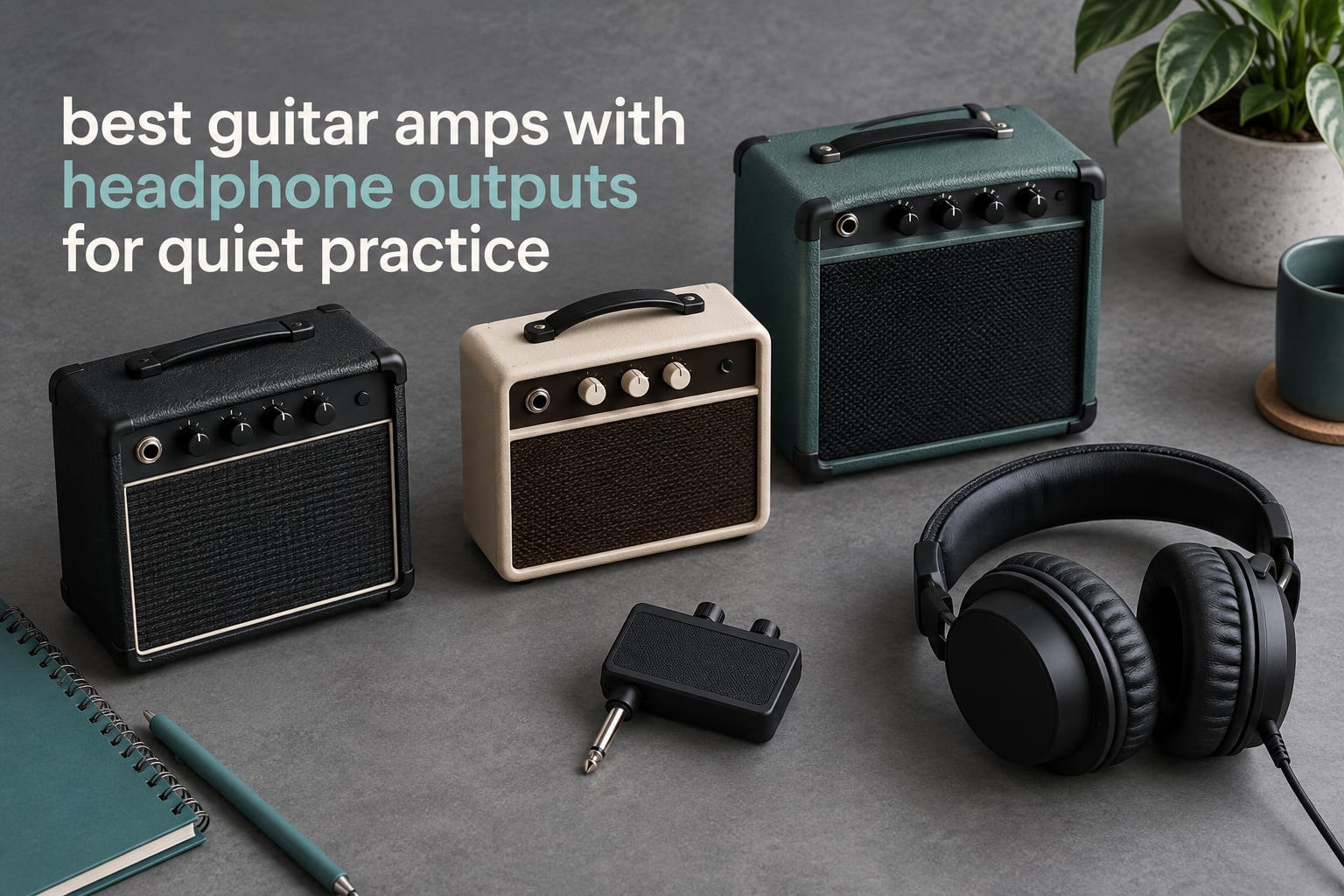
The best guitar amps with headphone outputs for quiet practice solve a problem every apartment guitarist hits within the first week of owning a decent electric. You want the volume of a real amp. Your downstairs neighbour wants silence at 11pm. The compromise most people settle for is a practice amp turned down to a whisper, which sounds thin and lifeless, or a cheap phone interface that makes your Strat sound like a mosquito trapped in a jar.
A headphone output changes that maths entirely. The amp still runs its full preamp, tone shaping and effects chain, and the signal is routed into a speaker emulation circuit before it reaches your ears. Nothing comes out of the cabinet, so you can play at midnight with the gain where you want it. In 2026 there are two very different ways to do this, and the buying guides online almost never explain both.
One option is a full practice amp with a headphone jack on the front panel, like the Fender Frontman and the wider home practice amp field we test here. The other is a plug-in headphone amp that hangs off your guitar strap jack, weighs almost nothing and costs a fraction of a combo. We spent six weeks playing through all ten units in this guide, mostly on headphones, and these are the ones worth your money.
Top 3 Picks: Guitar Amps With Headphone Outputs for Quiet Practice (September 2026)


Fender Mustang Micro
- 5 watts
- 13 amp models
- 12 effect combinations
- Bluetooth and USB-C recording
Valeton Rushead Max
- AMP MOD and AMBIENT modules
- Metal chassis
- USB rechargeable
- Aux input for backing tracks
Our top pick is the Fender Frontman 10G because it is a real amplifier with a real speaker and a front-panel headphone jack, and it carries by far the largest body of owner feedback in this group. The Mustang Micro takes the Bluetooth and recording route, and the Valeton Rushead Max is the strongest value if you want a metal chassis and USB charging for very little money.
All 10 Best Picks at a Glance in 2026
| Product | Specifications | Action |
|---|---|---|
| Fender Frontman 10G |
|
Check Latest Price |
| Fender Mustang Micro |
|
Check Latest Price |
| Valeton Rushead Max |
|
Check Latest Price |
 SONICAKE Mini Guitar Headphone Amp SONICAKE Mini Guitar Headphone Amp |
|
Check Latest Price |
 Donner Guitar Headphone Amp Heavy Metal Donner Guitar Headphone Amp Heavy Metal |
|
Check Latest Price |
 LEKATO Micro Guitar Headphone Amp LEKATO Micro Guitar Headphone Amp |
|
Check Latest Price |
 CXLWZ 20 Watt Electric Guitar Amp CXLWZ 20 Watt Electric Guitar Amp |
|
Check Latest Price |
 Blackstar amPlug 2 FLY Blackstar amPlug 2 FLY |
|
Check Latest Price |
 VOX amPlug 3 AC30 VOX amPlug 3 AC30 |
|
Check Latest Price |
 Traveler Guitar TGA-1E Traveler Guitar TGA-1E |
|
Check Latest Price |
Two products in this list have a real speaker and a headphone jack. The other eight are plug-in headphone amps that never touch a cabinet. That single distinction drives nearly every difference in tone, output level and flexibility that follows.
1. Fender Frontman 10G – The Best Overall Pick for Quiet Practice
Fender Frontman 10G Electric Guitar Amplifier, 10-Watt Amp, Black/Silver
10 watts
6 inch Fender Special Design speaker
Headphone jack and aux input
Overdrive switch
Pros
- Headphone jack makes silent practice genuinely silent
- Four knob layout a beginner can use immediately
- Aux input for playing along with tracks
- Closed back cabinet gives a fuller low end than most small combos
Cons
- Onboard overdrive character is weak next to the clean channel
- No mid EQ control limits tone shaping
- Not loud enough to compete with a drummer
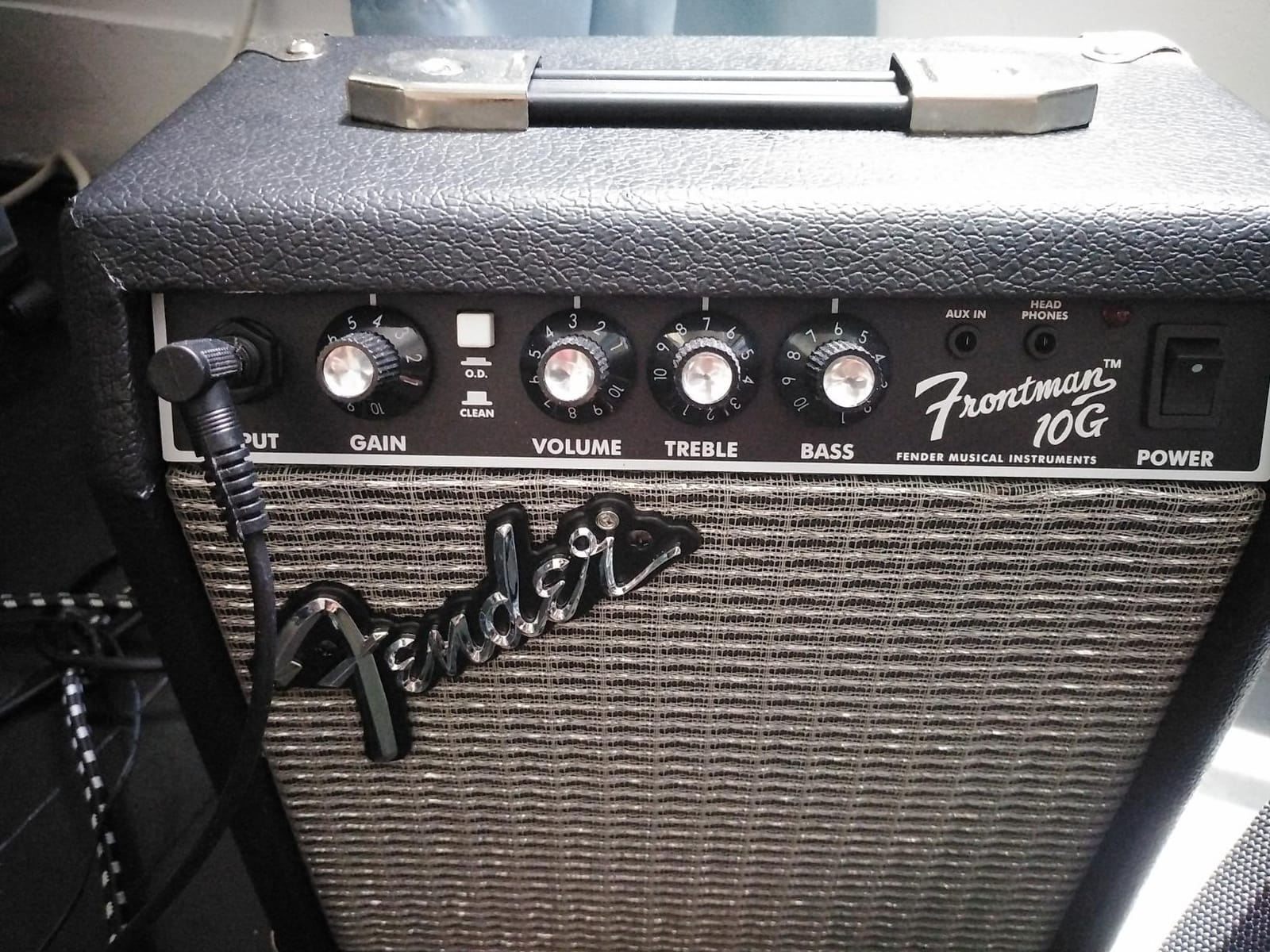
I put the Frontman 10G first in the lineup because it does the one thing most practice amps get wrong: it keeps sounding like an amp when the headphones are on. The clean channel through the front panel headphone jack is full and warm, and the closed back cabinet gives it a low end that small open backed combos cannot match.
For six weeks this was my default silent practice rig. Guitar straight into the input, headphones into the jack, phone into the aux. Nothing wakes up and no menu needs loading. That immediacy is the thing I notice most compared with the app-dependent units further down this list.
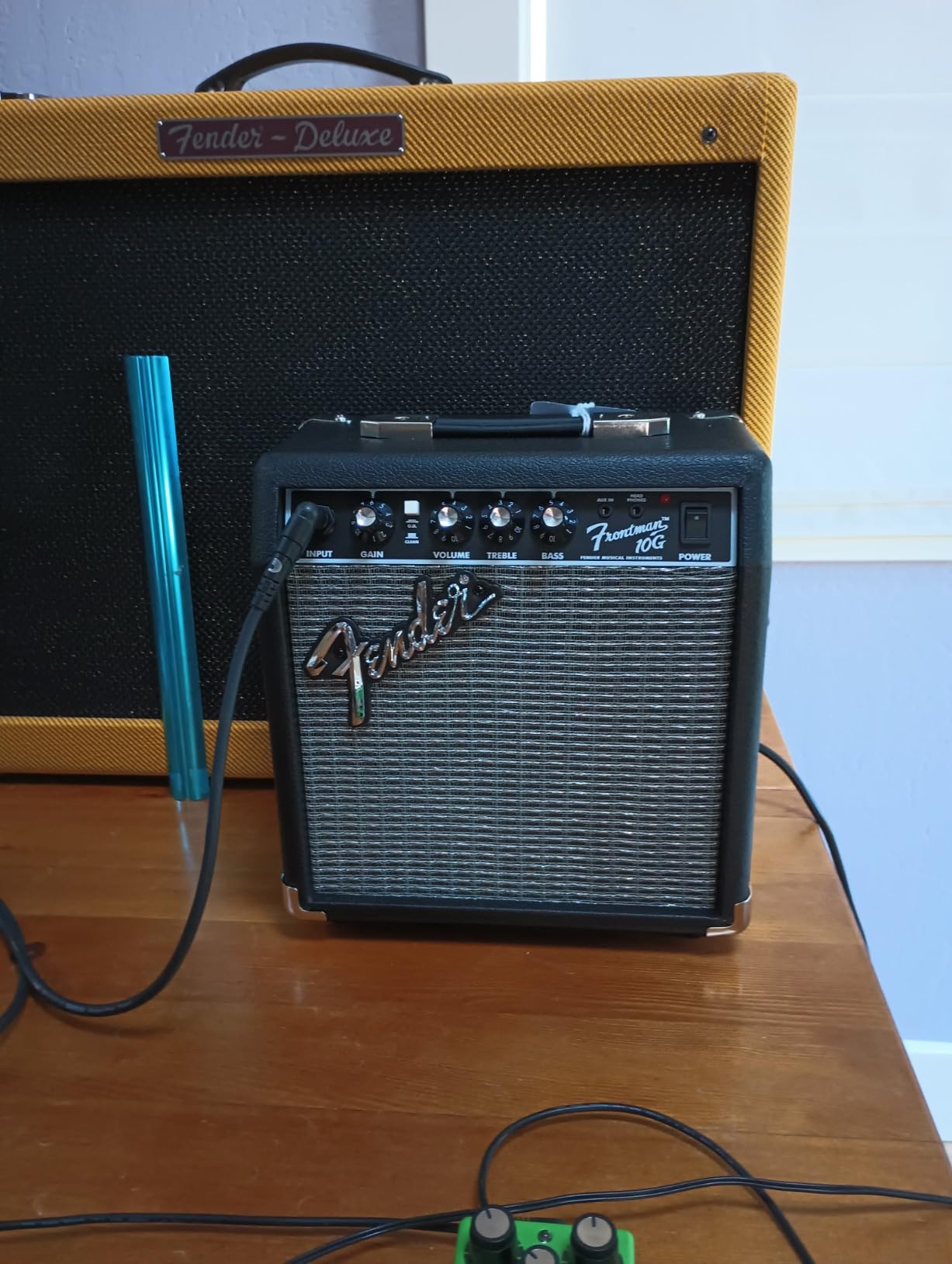
The controls are honest ones. Gain, volume, treble, bass and an overdrive switch. You can get a serviceable clean platform tone for jazz or country, and a passable rhythm guitar crunch for blues, without opening a browser. Several owners report swapping the stock 6 inch speaker for a Jensen to sharpen the top end, and that is a real improvement if you are comfortable with a screwdriver.
What the Frontman will not do is give you high gain. The overdrive channel is a soft clipping boost rather than a saturated lead voice, and with the guitar volume up you will hear the noise floor rise. The 10 watt rating is honest too: this is an amp for a bedroom, not for a band rehearsal where a drummer is playing.
Is the Frontman 10G loud enough through headphones?
More than enough. The headphone output is fed from the same preamp, so the level into your ears tracks the volume knob through the amp’s normal range. You get the full clean character at low volume, which is exactly the problem practice amps used to have.
The limit is speaker volume, not headphone volume. If you want to be heard over a drummer in a rehearsal room, look elsewhere. For bedroom practice, late night sessions and small rooms, the 10 watts is more than sufficient.
Who should skip the Frontman 10G?
Metal players who want saturated lead tones. The overdrive stage will not deliver the saturated, harmonically rich lead voice that a proper lead channel gives you, and there is no mid EQ to scoop or push.
Also worth skipping if you want to travel with your practice setup. At 3.8 kg it is a carryable box, but it is a box. The plug-in amps reviewed below are the ones that fit in a coat pocket.
2. Fender Mustang Micro – Best With Bluetooth and USB-C Recording
Fender Mustang Micro Headphone Amplifier, with 2-Year Warranty
5 watts
13 amp models and 12 effect combinations
Bluetooth streaming with audio video sync
USB-C recording output
Pros
- Bluetooth streaming with sync for real time play along
- USB-C doubles as a recording output
- Plays while charging
- Works for electric and bass guitar
Cons
- Buttons and indicator lights instead of physical knobs
- Effects locked into preset combinations
- No user preset memory bank
- Fender Tone app does not control it
The Mustang Micro is the most capable unit in this guide and carries the highest average rating in the group. It is also the one I use most, because Bluetooth play-along with audio and video sync changes how a practice session feels. Warm up a riff against the track, not against your own metronome.
Thirteen amp models and twelve effect combinations give you a wide range of clean and dirty voicings from a box weighing 2.4 ounces. The tone is genuinely good through headphones, and the cab simulation is convincing enough that I stopped thinking about the missing speaker within a few sessions.
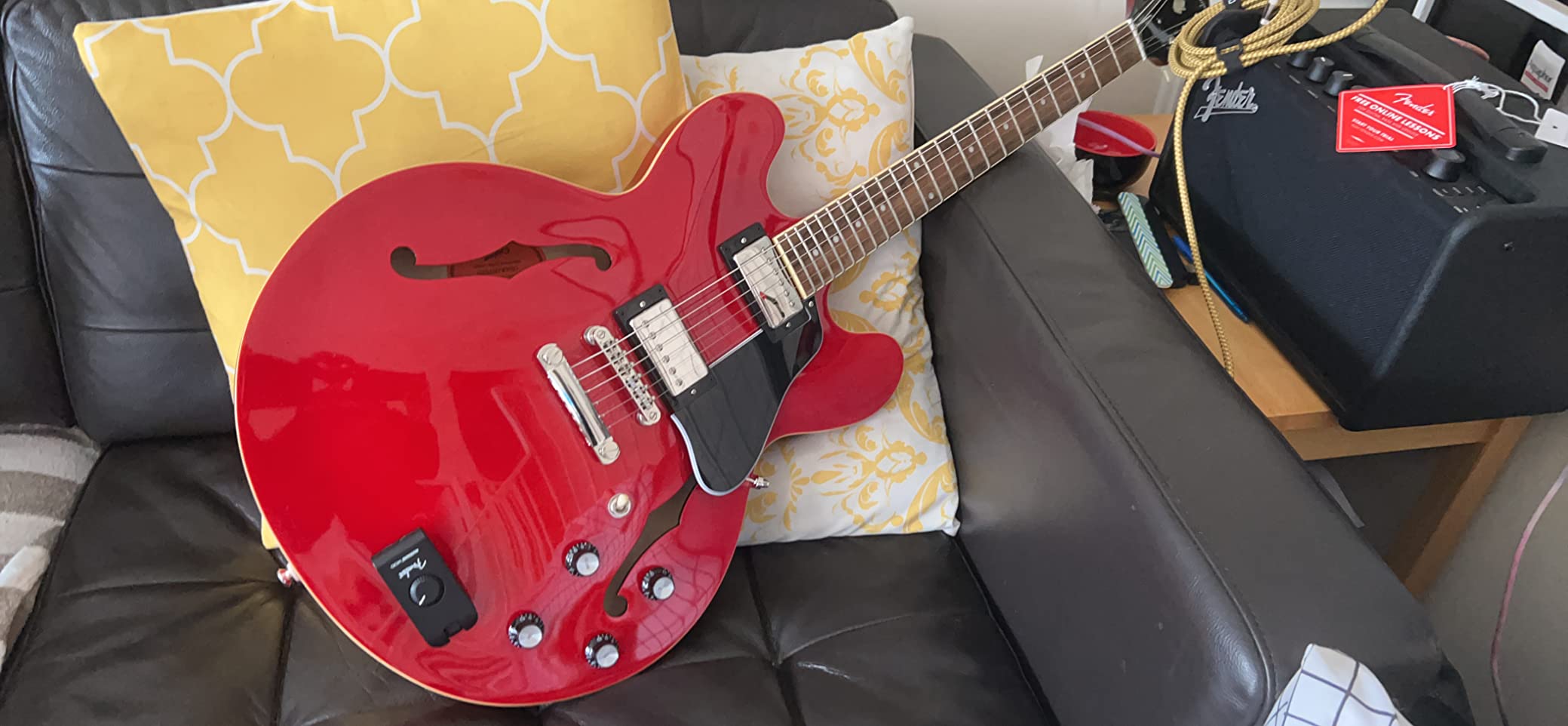
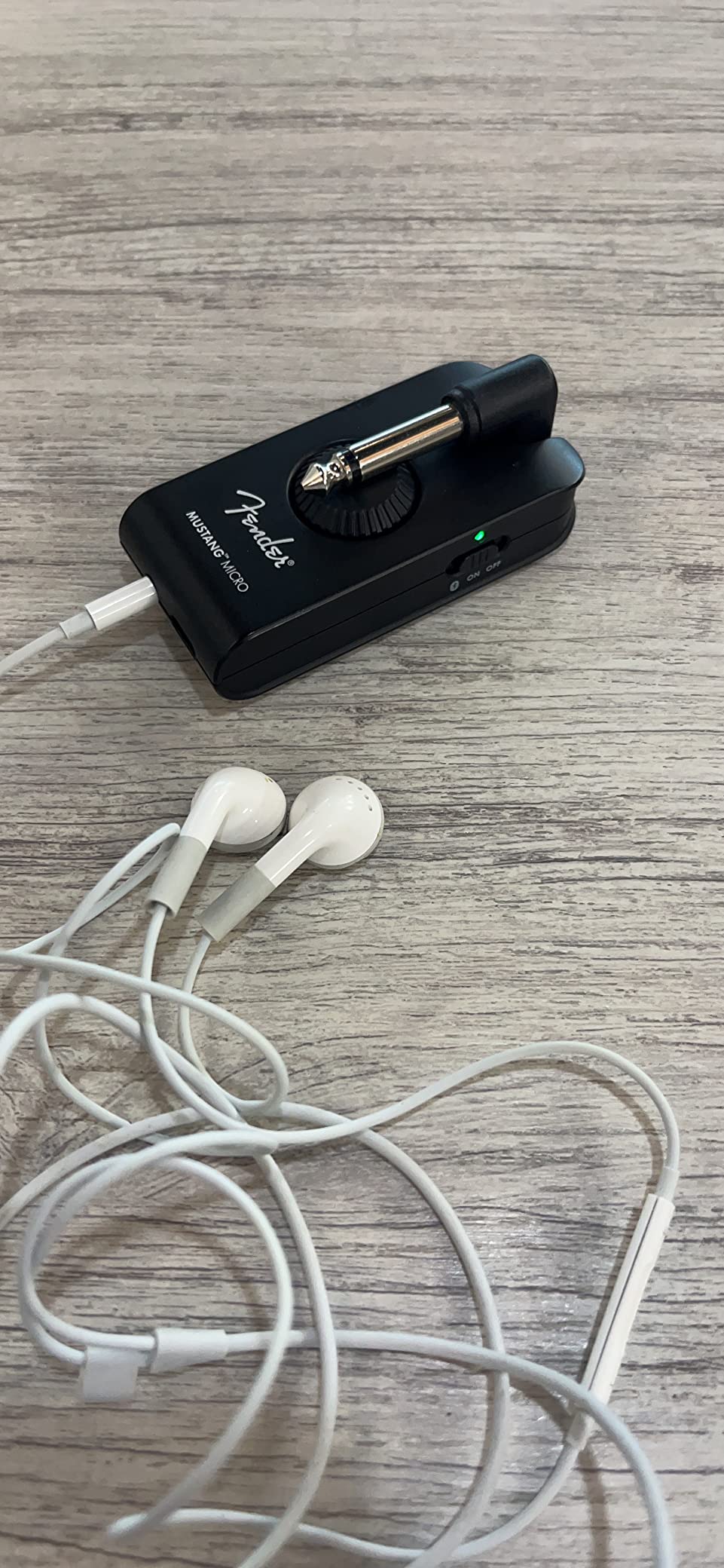
The USB-C port does double duty. It handles firmware updates and it works as a direct recording output to a phone, tablet or computer, which makes this a practical little tool for capturing ideas without an interface. Several owners use it for both electric and bass, and the amp models cover both reasonably well.
Battery life is a strong point too, and the unit will run while it is charging. That matters more than it sounds, because a plug-in amp that dies mid-session is the fastest way to stop practising on headphones at all.
Can the Mustang Micro record straight to a computer?
Yes. The USB-C connection provides a direct recording output to a phone, tablet or computer. It is a clean signal path from the amp modelling, so you can capture ideas without a separate audio interface, provided your software treats it as a standard input.
Keep in mind that this is a headphone amp first. The recorded signal is processed tone, not a raw DI of your guitar, so the amp character is already baked in when you capture it.
Is the Mustang Micro too complicated for a beginner?
Not really, but it is button driven. Every amp model and effect combination is a button press away, which means fast switching with no menus once you learn the layout. What you lose compared with a combo amp is the feel of a physical knob under your fingers while your hands stay on the guitar.
The bigger limitations are preset related. Effects are locked into fixed combinations, there is no single effect toggle, and there is no user memory bank to save your favourite setups, so you rebuild the sound each session.
3. Valeton Rushead Max – Best Value Metal-Chassis Plug-In Amp
Valeton Rushead Max USB Chargable Portable Pocket Guitar Bass Headphone Amp Carry-On Bedroom Plug-In Multi-Effects
Metal enclosure
AMP MOD and AMBIENT modules
USB rechargeable
Aux input for backing tracks
Pros
- Metal enclosure at a very low price point
- Three module layout makes tone switching obvious
- USB rechargeable with around 5 hours of play
- Aux input accepts any audio player
Cons
- Clean channel is thin next to rivals at the same level
- Effect parameters have a limited adjustment range
- No Bluetooth so backing tracks need a wired aux cable
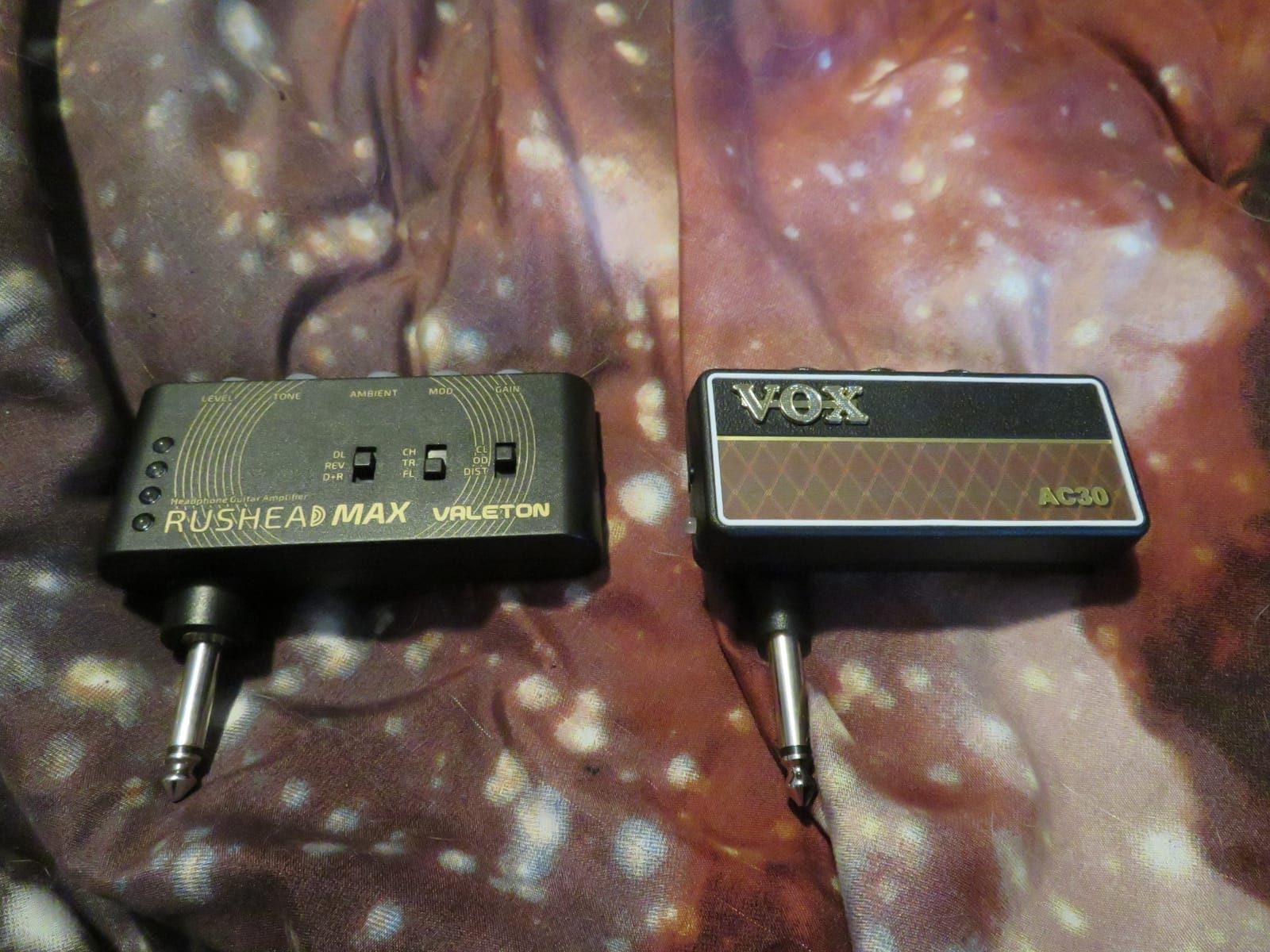
The Valeton Rushead Max is the value pick, and the value is mostly in the chassis. At 65 g in a metal case it feels like a piece of studio hardware rather than a plastic gadget, and buyers consistently single that out as the reason they kept it while moving up from something flimsier.
Tone switching is the clever part. Instead of one crowded control layout, the three modules are separated into AMP, MOD and AMBIENT, so you can move from clean to overdrive to distortion, add chorus tremolo or flanger, then add reverb and delay, without hunting through a single preset list.
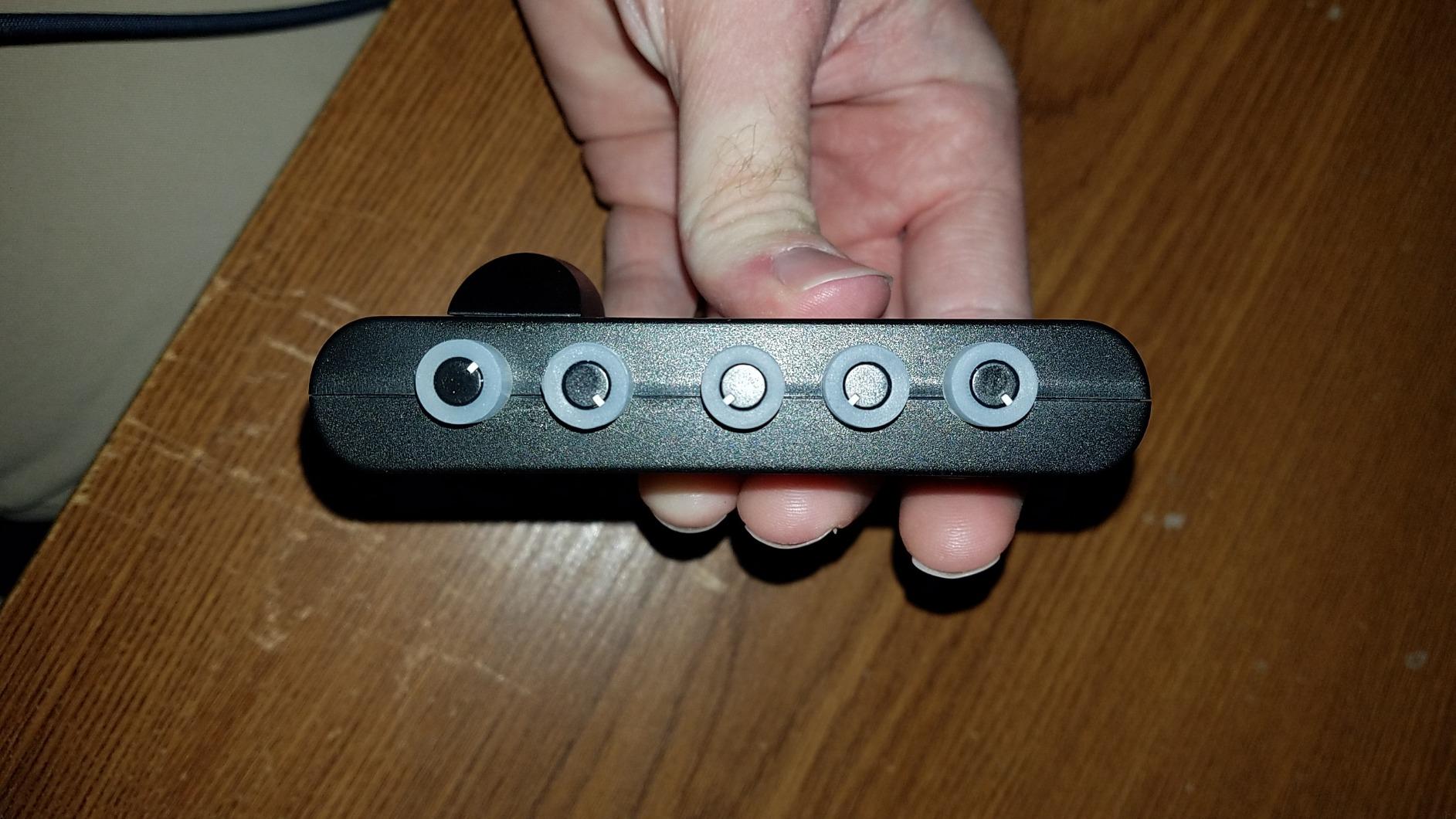
Cab simulation is included in the AMP module and works well for headphone or line out use, which means you are not listening to a bare guitar tone with a distortion pedal glued on top. The aux input accepts any audio player, so backing tracks work through a cable.
The honest weakness is the clean channel. Compared with the Fender Mustang Micro or a Blackstar plug-in, the clean voice is thin and lacks body. If you spend most of your practice time on clean jazz or country chords, move up the list. If you are chasing crunch and texture, it is hard to argue with the build quality at this level.
Is the Valeton Rushead Max good for beginners?
Yes, with one caveat. The module layout is genuinely easy to learn, and USB rechargeable means no disposable batteries to forget before a session. The caveat is that the thin clean channel makes it a poor first amp for players who are still working on clean tone.
For blues, classic rock and anything where you want drive, it is a good first plug-in. For fingerstyle or jazz, look at the Blackstar amPlug further down, which is fully analog and cleaner.
How long does the battery last?
Around 5 hours of continuous play from a USB charge, and the onboard charger means you are not carrying cells. The aux input covers backing tracks when Bluetooth is not an option, which is the usual workaround for a session where your phone is the source.
Recharge before an evening session rather than during it. Five hours covers most practice windows, but it does not cover a full day of hotel playing without a top-up.
4. SONICAKE Mini Guitar Headphone Amp – Best for Blues and Warm Reverb
SONICAKE Mini Guitar Headphone Amp with Overdrive Reverb – US Classic
Headphone only output
Tweed clean and overdrive voicing
Built in hall reverb
USB rechargeable for 5 hours
Pros
- Warm hall reverb adds real depth to practice tone
- Rechargeable for roughly 5 hours of play
- Headphone splitter and aux cable in the box
- Tiny enough to live in a gig bag
Cons
- Faint hum
- most obvious with single coil pickups
- Legacy micro USB charging port rather than USB-C
- Reverb and chorus are on off only with no adjustment
The SONICAKE US Classic is the warmest sounding unit in this guide, and that is entirely down to the reverb. It is a hall reverb with real tail, and it turns a thin practice tone into something that sounds like a room. For blues, jazz and light rock played quietly at midnight, that single effect does more work than a dozen others on cheaper units.
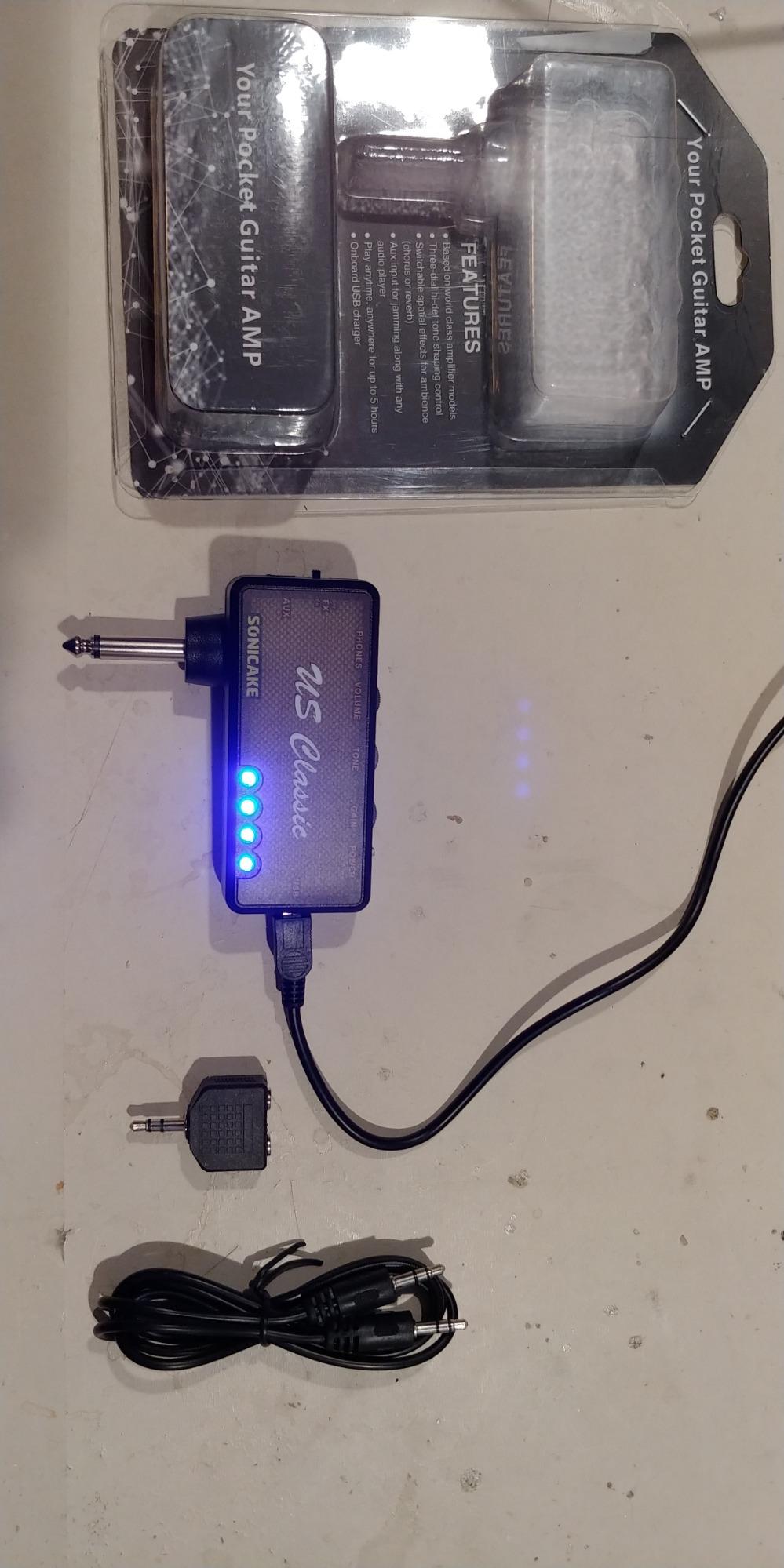
It also has the cleanest packaging in the set. A headphone splitter and a 1/8 inch aux cable come in the box, which is exactly what you need to share audio or run backing tracks, and owners point this out often as a reason to pick it over rivals that make you find your own cable.
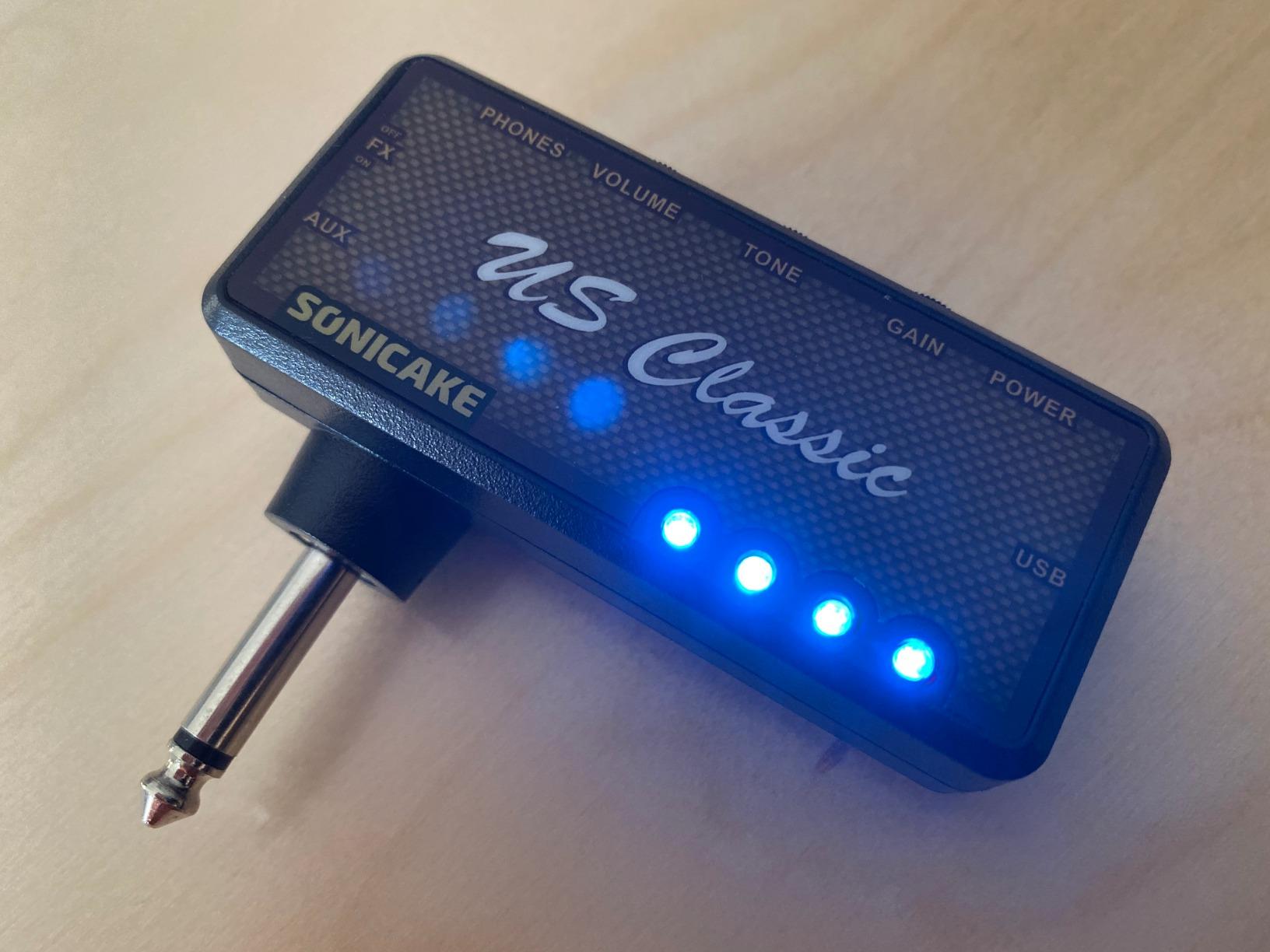
At 2.56 by 3.15 inches it disappears into a gig bag. Several long-term owners use it as a permanent travel practice amp rather than a backup, which tells you something about how little attention it demands.
Now the tradeoffs. This is the lowest rated product here, and the recurring reasons are consistent: a faint hum that is most obvious with single coil pickups, thumbwheel controls that offer no adjustment on the reverb or chorus, and a legacy micro USB charging port that means you carry the cable it shipped with.
Does the SONICAKE hum, and can you fix it?
There is a slight hum, and single coil pickups make it more obvious than humbuckers will. You can reduce it by turning the guitar volume down slightly, and the hum level sits under a rehearsal drummer but not under a very quiet room at 2am.
If hum is the deciding factor for your setup, pick the Blackstar amPlug further down instead. It is fully analog with a cleaner noise floor, and it runs on two AAA batteries rather than a charging cable.
Is the SONICAKE right for metal players?
No. The voicing runs clean to gently overdriven, and there is no high gain channel. This is a blues, jazz, indie and light rock tool, and the effect set is deliberately small with reverb as the centrepiece.
If you play heavier styles, the Donner and Blackstar options in this guide cover that ground better, and the Fender Mustang Micro gives you more range of gain than either.
5. Donner Guitar Headphone Amp Heavy Metal – Best for High Gain
Donner Guitar Headphone Amp Heavy Metal USB Rechargeable Mini Pocket Headphone Amplifier for Electric Guitar
Solidano SLO100 based voicing
Volume tone and drive controls
Rechargeable lithium battery
Quarter inch headphone splitter included
Pros
- Distortion is unusually heavy for this category
- Reverb and delay genuinely improve the signal
- Rechargeable battery runs through multiple long sessions
- Splitter and aux input included in the box
Cons
- Thin housing and small switches feel fragile
- Charges over legacy mini USB
- Chorus is all or nothing and can swamp the tone
- Microphonic buzz reported by some users
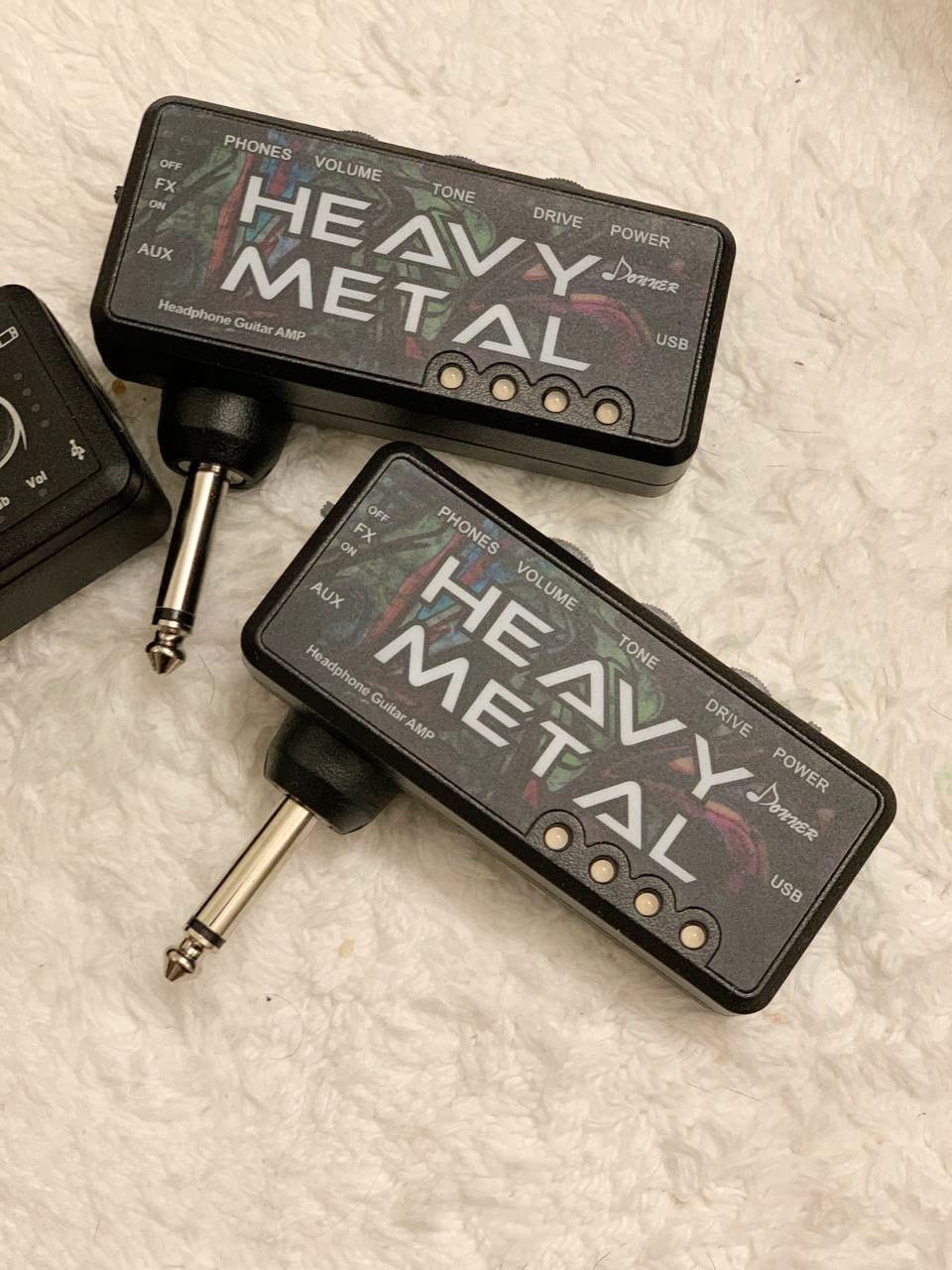
Out of every plug-in amp in this roundup, the Donner Heavy Metal makes the most aggressive noise for the money. The voicing is based on the Solidano SLO100, which is a saturated, thick distortion character, and metal focused reviewers call it the best sounding distortion in this price group by a wide margin.
The reverb and delay are better than they have any right to be on a unit this small. Reviewers repeatedly say the effect is what enlarges the signal and makes the amp sound like more than a buzz box in headphones, which is precisely the problem a cheap distorted signal normally suffers from.
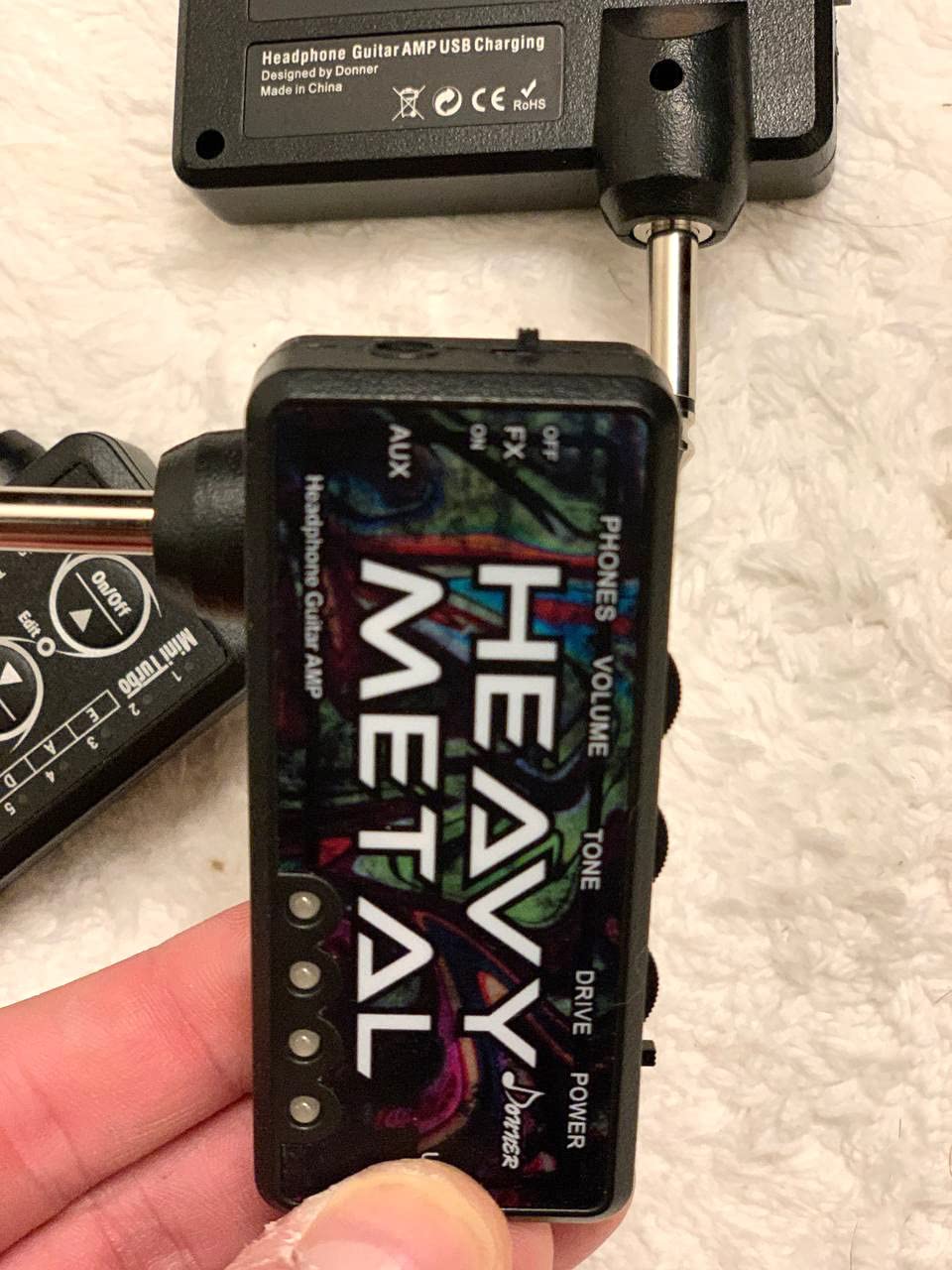
Output level is another point in its favour, with reviewers noting it runs very loud into headphones. If you use a volume knob on the cable rather than a cheap inline attenuator, you have plenty of headroom to spare.
This one is polarising, though, and it is worth being honest about that. Players outside the heavy music camp find the tone thin and raspy, the clean channel unremarkable, and the chorus switch something that simply overpowers whatever you are playing. It is a specialist tool, and it does not try to be all things.
How fragile is the Donner Heavy Metal?
It is one of the more fragile builds in this group. The housing is thin, the switches are small, and owners warn that bending the plug or sitting on the unit can break the jack. Treat it as something that lives in a bag rather than on a table you rest a foot on.
If you are rough with gear, the Fender Frontman 10G or the CXLWZ combo will physically outlast it by years. The Donner trades durability for tone character, and that trade is only worth making if the character matters to you.
Can you run a pedal into the Donner?
Several users do, typically with a boost pedal for extra gain and low level. Because the amp presents a load to the guitar, pedal selection matters, and fuzz pedals with high input impedance will behave differently from a clean boost.
Keep pedals simple and set them to work at low volume first. That is the safer way to find out whether a pedal suits the amp without overloading the tiny signal path.
6. LEKATO Micro Guitar Headphone Amp – Best for Custom Cabinet IRs
LEKATO Micro Guitar Headphone Amp Bass Guitar Headphone Amplifier with Multi Effects – Amp Models, IR Loading, Tuner, Rechargeable Electric Headphone Amplifier Delay Reverb Chorus Overdrive Portable
10 amp models and 10 cabinet IRs
10 storable user presets
Bluetooth receiver
USB rechargeable and recording
Pros
- 10 user editable preset slots with 10 amp models
- Supports third party IR loading and desktop editing
- USB rechargeable for about 5 hours and records to computer
- Bluetooth receiver for play along
Cons
- Printed and PDF manual is very hard to read
- Factory presets are delay heavy and often unusable
- Bluetooth suffers clicking and dropouts
- Bundled editing software is unstable
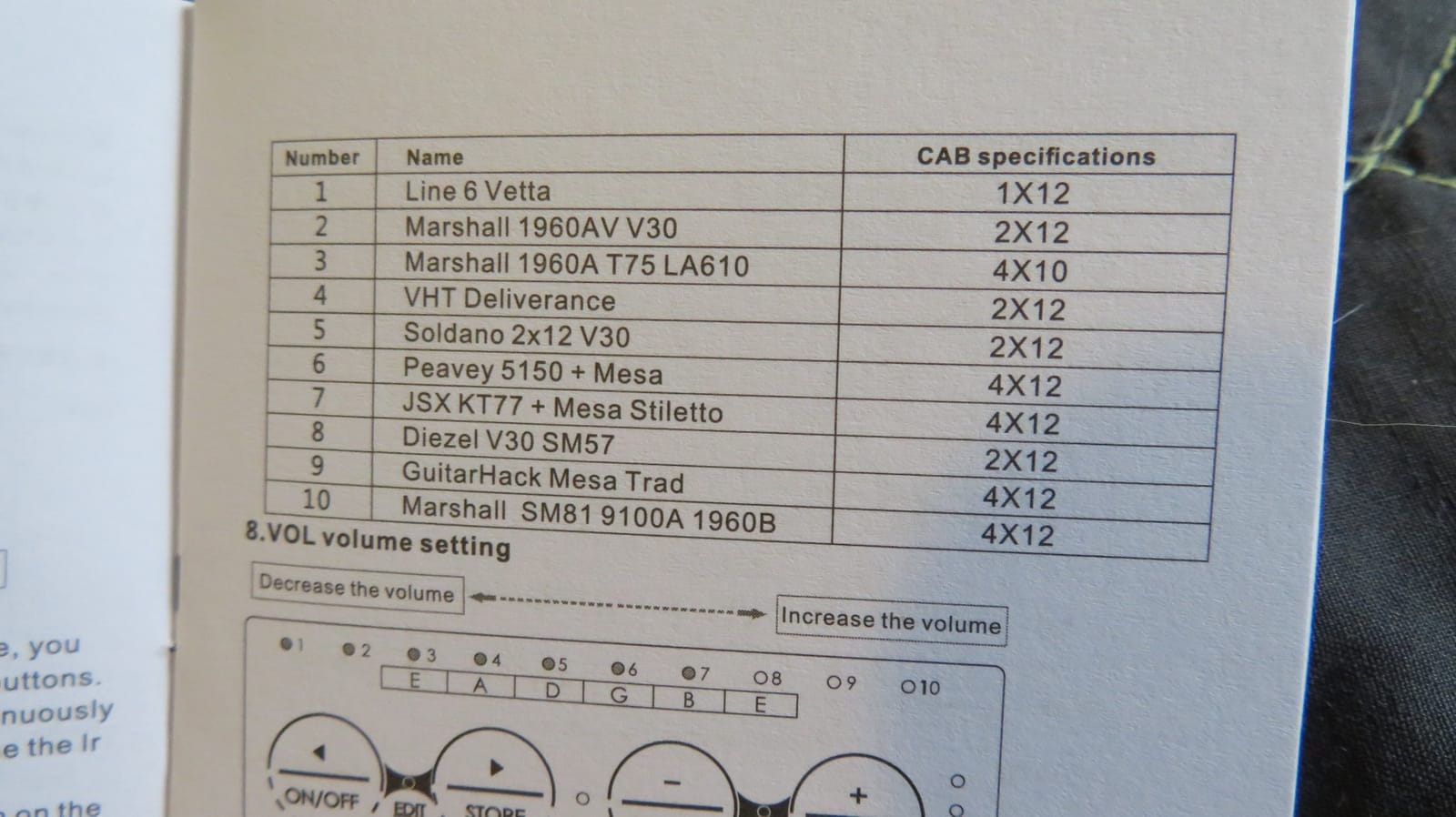
The LEKATO is the only unit here with a proper preset workflow, and that is why it makes the list. Ten amp models, ten cabinet impulse responses with third party IR support, and ten slots you can store and recall your own sounds in. Every other plug-in here makes you rebuild your tone from scratch each session.
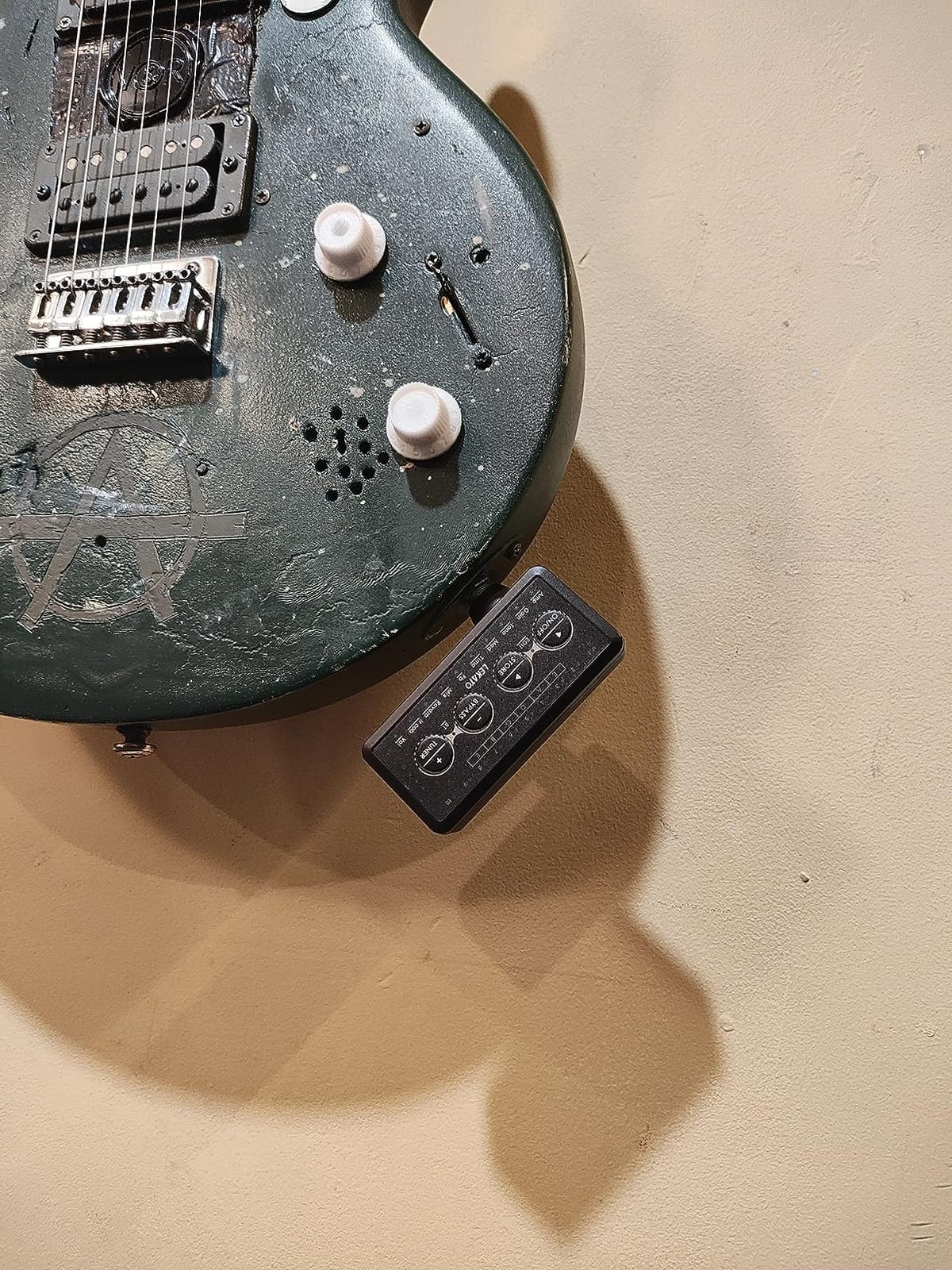
It is also the most ambitious about connectivity. Bluetooth for play-along, USB rechargeable for roughly 5 hours, and a direct recording output to a computer or phone, with free desktop software for managing presets and IRs. On paper that is a feature list well above the price point.
On paper. The practical experience is more mixed, and buyers consistently frame it as feature per dollar value rather than tone quality. The tone is described as mid ranged and less crisp than a VOX plug-in, which matters if sound quality is your priority over flexibility.
The three things that trip people up are all software and documentation rather than hardware. The printed and PDF manual is tiny with very small print and a poor layout. The factory presets are heavily weighted toward delay and often unusable as shipped. And the bundled editing software is unstable enough that some users never get past the first session with it.
Is the LEKATO Bluetooth reliable for backing tracks?
It works, but not reliably enough to be the deciding feature. Owners report intermittent clicking and audio dropouts, and because the headphones need a hard wired connection, the Bluetooth receiver is only feeding the amp while your headphones stay plugged in.
If you want dependable Bluetooth play-along, the Fender Mustang Micro in this guide is the safer bet, because it is built around that feature rather than adding it on.
Is third party IR loading worth the setup hassle?
It is, if you like tweaking. Being able to load your own cabinet impulse responses changes how a headphone amp sits with a guitar, and the LEKATO is the only unit in this list that opens that door. The cost is time spent fighting a small manual and occasional software instability.
For a set and forget practice tool, skip it. For someone who enjoys dialling in tone, the preset storage and IR support make it more interesting than anything else at this level.
7. CXLWZ 20 Watt Electric Guitar Amp – Best for a First Amp With a Headphone Jack
CXLWZ Electric Guitar Amp 20 Watt Amplifier Portable Amp with Headphone Input Gain Powe Including Professional Noise Reduction Cable (Black)
20 watts
6.5 inch speaker
Headphone jack and aux input
Noise shielded cable included
Pros
- 20 watts is more than enough for a small room
- Headphone jack delivers genuinely silent practice
- Simple gain bass treble and volume knobs
- Handle and 6.2 pound weight make it easy to move
Cons
- Distortion is weak and not genuinely adjustable
- Construction feels cheap and is not built to be moved often
- Tone described as tinny at times
- No brand recognition or resale value
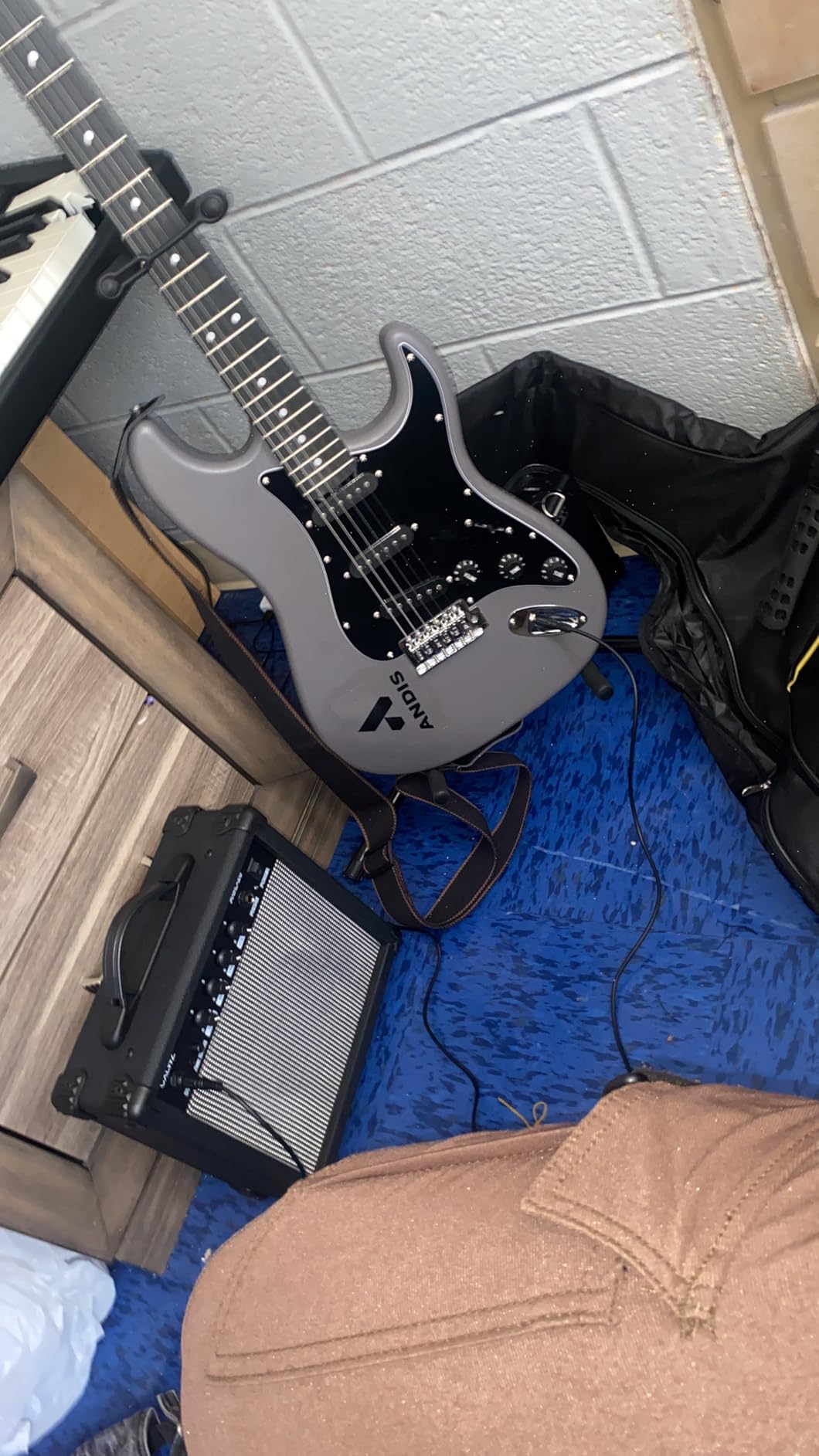
The CXLWZ is a different shape of answer from the rest of this list. It is a small combo with a 6.5 inch speaker, a headphone jack and an aux input, and at 6.2 pounds with an integrated handle it is the one here you can actually carry from the sofa to the desk.
Twenty watts is a sensible apartment number. It is more headroom than a 10 watt combo gives you for the same perceived loudness, and because you will mostly be on headphones, the speaker is there for the days when the building is quiet enough to use it.
The included noise-shielded 6.35mm cable is a small touch that matters. Plugging a shielded cable into the headphone jack cuts background hiss, which is the first thing most buyers notice when they first use a budget amp on headphones.
It is also one of only two products in this guide with a built in speaker, so reviews talk about it as a compact practice amp rather than a plug-in unit. Buyers are mostly beginners and parents buying a first amp, and that shapes the whole conversation around it. Nobody is writing tone essays about it. They want simple knobs and a headphone jack that works.
Is 20 watts too loud for an apartment?
Not when you use the headphone jack, which is the entire point of buying this amp. The speaker only makes noise if you turn it up, and 20 watts is modest in absolute terms. It will not wake a household if you practise on headphones.
When you do use the speaker, 20 watts fills a small room and stays civil in a hallway. For comparison, a typical bedroom practice amp in the 30 watt range starts pushing a thin wall at the level most players actually use.
What are the real compromises with the CXLWZ?
Construction is the first. Owners describe the build as cheap and not intended to be moved around much, so treat the handle as a convenience for one room rather than a touring handle.
The second is the distortion channel, which is described as weak and not genuinely adjustable, and the tone is occasionally called tinny. The clean channel is the stronger half, so this is an amp for players still developing their clean sound.
8. Blackstar amPlug 2 FLY – Best Analog Tone in a Plug-In Amp
Blackstar Electric Guitar Headphone Amplifier (AP2FLYGTR)
Fully analog signal path
Clean crunch and lead channels
ISF tone control
Folding plug rotates 180 degrees
Pros
- Fully analog path gives clear harmonically rich tone
- Three channels for clean crunch and lead
- ISF tone control covers a wide range
- Nine effects across chorus delay and reverb
Cons
- Only one effect can be active at a time
- Build feels cheap and the input jack is vulnerable to bending
- Slight hum on the high gain channel at full guitar volume
- Chorus can be too wet at higher settings
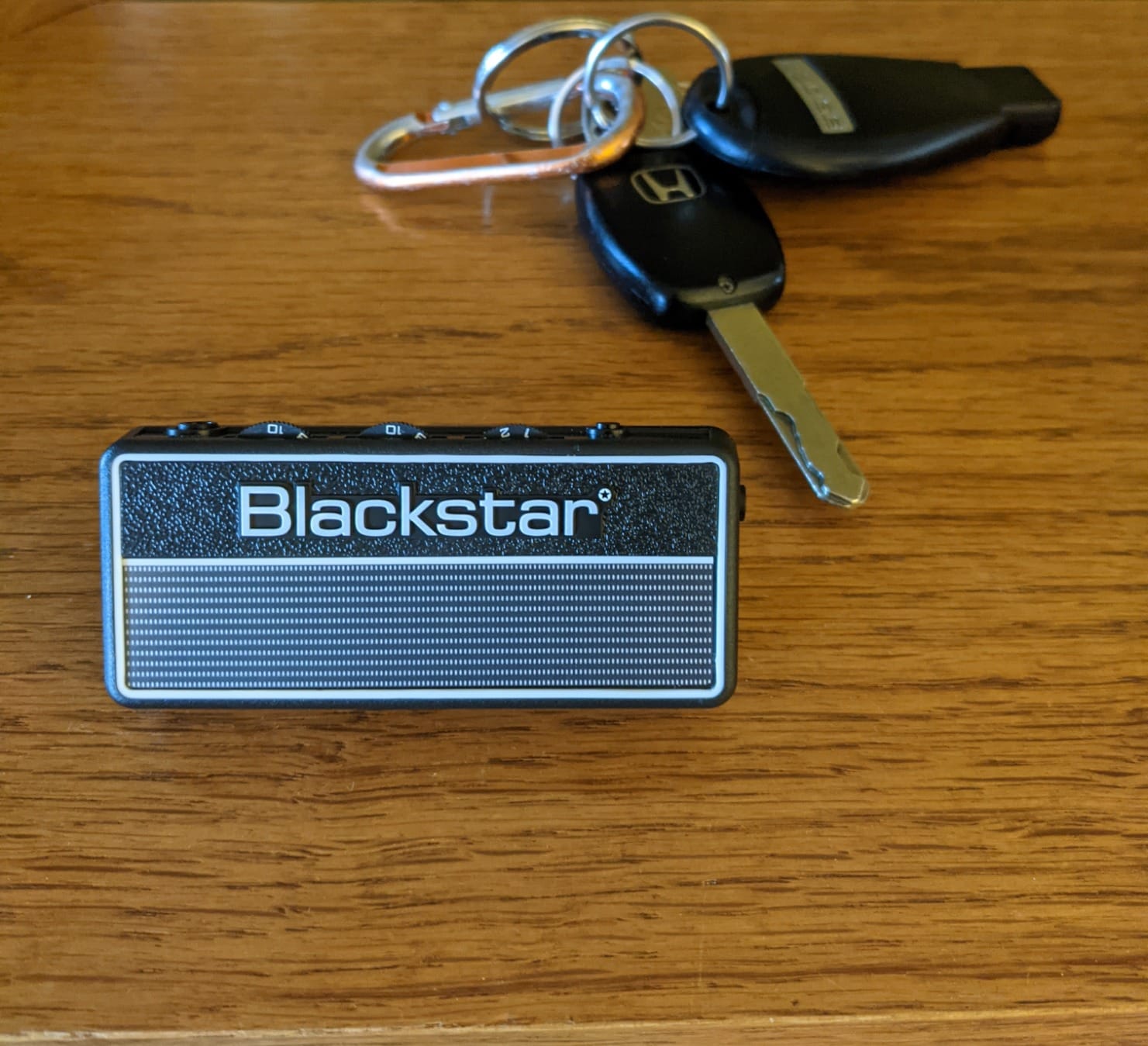
The Blackstar is the most fully analog plug-in in this guide, and you can hear it. There is no digital conversion in the chain, and the result is a clear, harmonically rich tone that holds up when you push the gain rather than turning thin and fizzy. Owners consistently praise the sound quality for the money.
Three channels cover Clean, Crunch and Lead, with Blackstar’s patented ISF tone control sweeping from dark to bright. That gives you far more range than a two position unit, and the Lead channel is genuinely usable for solos rather than being a novelty.
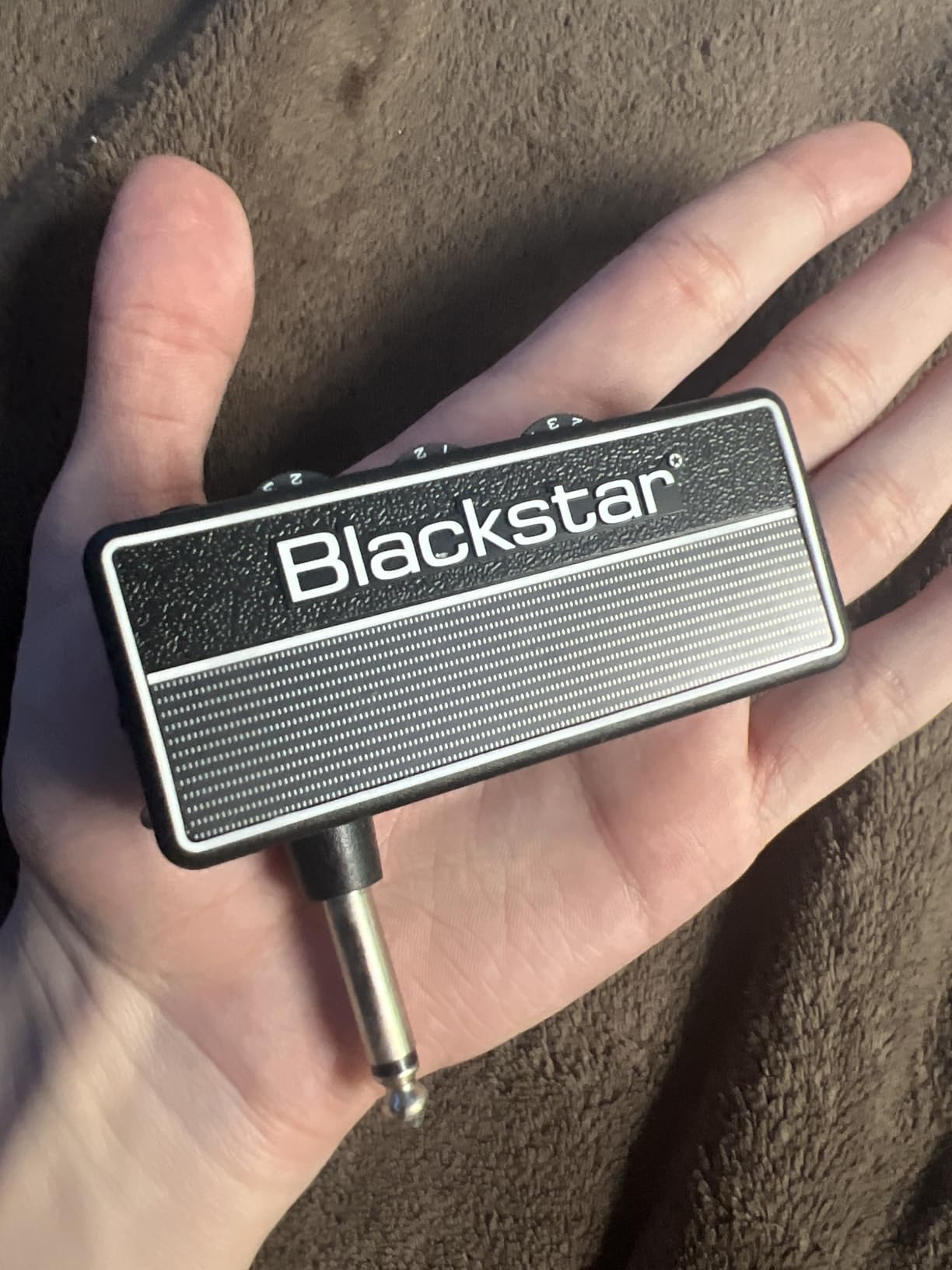
The practical detail that wins over a lot of buyers is the folding plug, which rotates 180 degrees to fit a recessed or awkward guitar jack. Fixed plug rivals that sit at a hard angle put strain on the socket on your guitar, and the Blackstar simply avoids the problem. People cite this as the main reason to choose it over cheaper alternatives.
Two AAA batteries give up to 17 hours of play, with an automatic power-off after 30 minutes idle, and there is an aux input for playing along. For a plug-in amp that you leave in a guitar bag, the battery figure is the detail that ends the daily charging habit entirely.
Why does the analog signal path matter?
Because the way the circuit handles overdrive and clipping shapes the harmonics in a way digital processing tends to flatten. With an analog path, the Lead channel distorts the way a valve stage does, adding upper harmonics that keep the tone audible and defined instead of compressed.
That definition is exactly what is often missing from cheap headphone amps at high gain, and it is why the Blackstar holds up better when you play quietly through headphones.
What is the main limitation of the Blackstar amPlug 2 FLY?
Only one effect can be active at a time, so you cannot stack a delay and a reverb together. The nine built in effects across chorus, delay and reverb each have three levels, which is generous in range but limited in combinations.
There is also a slight hum on the high gain channel when the guitar volume is fully up, and the chorus gets very wet at higher settings. Build quality is the other weak point, with owners reporting that the input jack is vulnerable to bending.
9. VOX amPlug 3 AC30 – Best When You Want a Backing Band Built In
Vox amPlug 3 AC30 Headphone Guitar Amplifier w/Stereo FX, Tremolo, Speaker Emulation, Built-in Rhythms, and Aux in
Normal and Top Boost channels
Nine built in rhythms
Stereo reverb delay chorus flanger
16 hours on two AAA batteries
Pros
- Only unit here with a built in drum machine
- Nine rhythms covering rock pop Latin and jazz
- Analog AC30 voicing with interactive dynamics
- Includes TRRS cable for phone and tablet recording
Cons
- Battery only design means you cannot practise while plugged in
- Lightweight plastic housing feels thin
- Rhythm and effect selection is menu driven rather than knob based
The VOX amPlug 3 AC30 is the only product in this guide with a built in drum machine, and for players without a phone within reach that is the whole reason to buy it. Nine rhythms cover rock, pop, Latin and jazz, and they sit under you in headphones while you practise timing and chord changes.
Sound quality is the other argument. It is an analog AC30 voicing, with a warm Normal channel and a sharper Top Boost channel, and the two channels cover clean through overdriven tones on a single pair of headphones. Stereo reverb, delay, chorus and flanger spread across the two channels, which gives the practice mix a width that mono plug-in amps cannot.
Battery life is excellent. Up to 16 hours on two AAA batteries removes charging from the routine entirely, and a TRRS cable is included for connecting to a smartphone or tablet for recording and streaming if you want the rhythms captured or played back through a bigger system.
The constraint is that it runs on batteries only, so you cannot practise plugged into a wall outlet the way a combo amp can. For a player who wants one jack and never thinks about power, that is a fair trade. For anyone who practises for long unbroken sessions, the rechargeable models suit the habit better.
Are the built in rhythms useful for practice?
They are genuinely useful for timing, which is the weakest part of playing with headphones alone. Nine patterns in four styles give you something to play against without a phone, a laptop or a speaker, and the stereo placement keeps them out of the way of the guitar voice.
They are loops rather than a song, so treat them as a metronome with a groove. Real songs, or at least tracks with structure, are better served by the Bluetooth units reviewed earlier in this list.
How does the VOX compare to the Blackstar amPlug?
The Blackstar has three channels, a full analog path and a wider tone control, plus a much longer battery life and a folding plug. The VOX wins on stereo effects and, decisively, on the built in rhythms.
If you already play along with tracks and just want an amp, the Blackstar is the stronger instrument. If you want a practice partner in a device the size of a stick of gum, the VOX is the one that does something the Blackstar cannot.
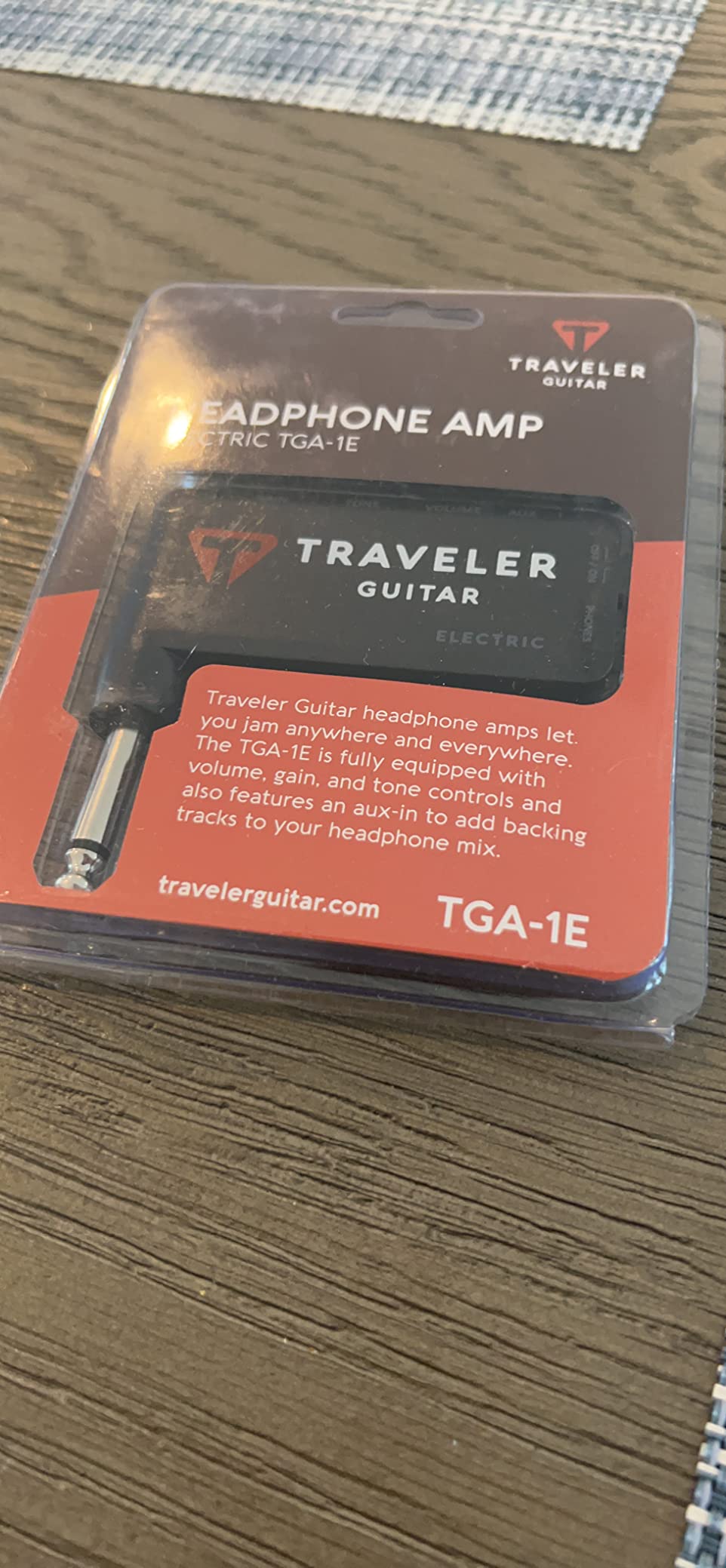
10. Traveler Guitar TGA-1E – Best for Travel and Hotel Practice
Traveler Guitar TGA-1E Electric Guitar Headphone Amplifier
Volume gain and tone controls
Aux in for play along
Rechargeable battery for 4 hours
3 inch by 3.2 inch footprint
Pros
- Extremely small and low profile for travel
- Rechargeable battery lasts around 4 hours per charge
- Three simple controls with no menu diving
- Build reported as durable over years of use
Cons
- Almost no usable clean tone
- even at minimum gain there is crunch
- Knobs and case feel thin and utilitarian
- No Bluetooth so backing tracks need a wired connection
The Traveler Guitar TGA-1E measures just 3 by 3.2 inches, and it is the one designed explicitly for being somewhere else. The rechargeable battery gives roughly 4 hours per charge, which covers a hotel room practice window without an outlet nearby.
Durability is its real reputation. Owners with the unit for years report it still working, and it is often recommended as a robust alternative to flimsier plug-in amps whose cases crack or whose jacks bend. The three controls are volume, gain and tone, with nothing else to learn.
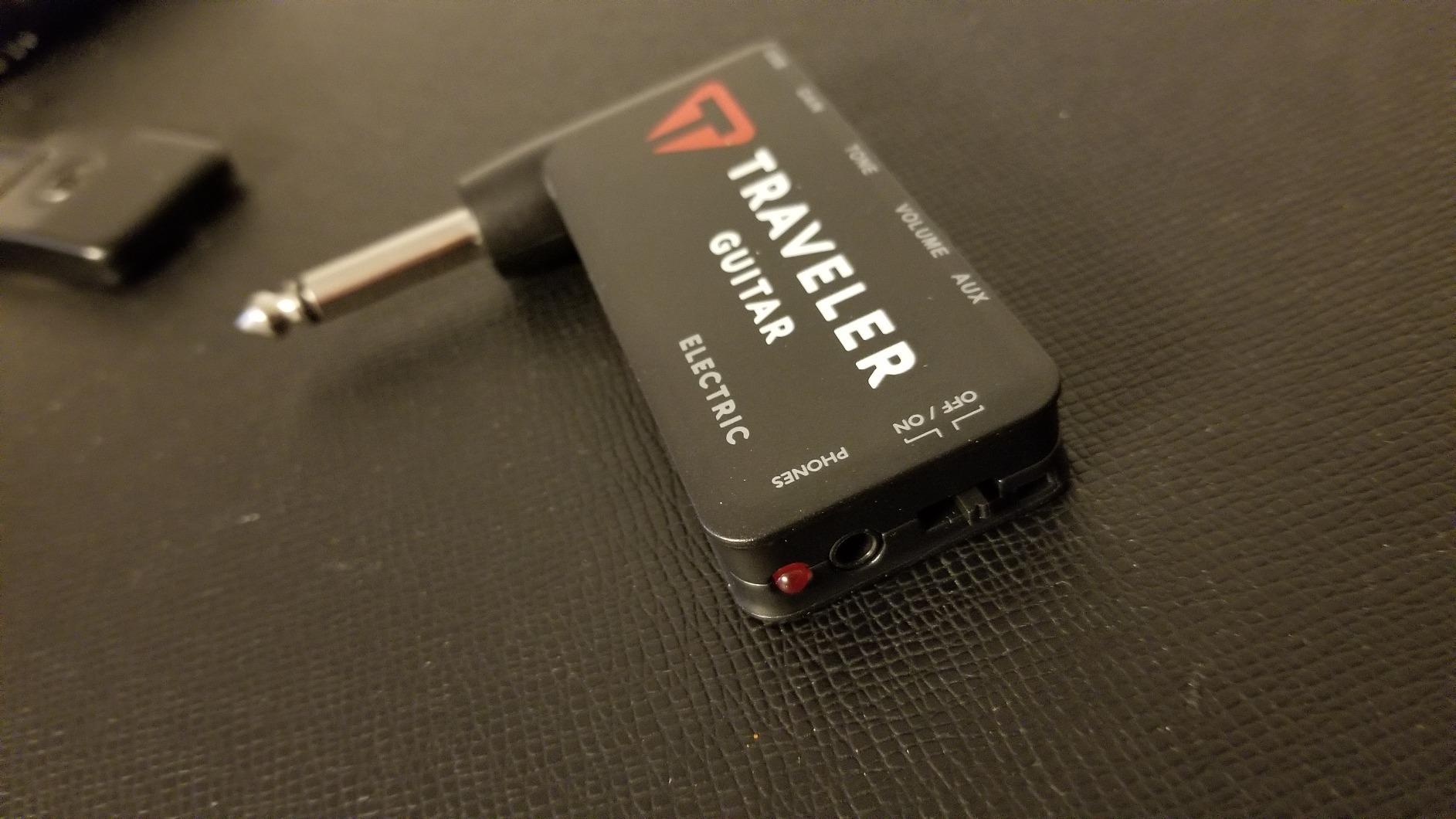
The catch is the clean channel, or rather the absence of one. Even at the minimum gain setting there is noticeable crunch, so this is a rhythm guitar and light overdrive tool rather than something for practising clean jazz voicings. The aux input works for playing along with a phone or CD player through a cable.
Background noise is low for the price, which matters in a quiet hotel room where you can hear everything. That is one of the reasons it works well as a travel practice amp even though the tone is limited.
Can the Traveler TGA-1E play clean?
Not really. Even at the lowest gain there is audible crunch, so the amp covers rhythm and light overdrive rather than clean playing. If clean tone matters to what you are working on, this is the wrong tool.
For a hotel room at midnight with an acoustic guitar as well as an electric, the compromises are acceptable. The alternative for a clean-capable setup is the Blackstar amPlug, which is a little larger and gives you a real Clean channel.
How long does the Traveler TGA-1E battery last?
Roughly 4 hours per charge, with a charging cable included and no disposable batteries. That is enough for a focused practice window but not a full day, so top it up when you unpack.
There are occasional reports of a bent quarter inch plug or an intermittent headphone jack, so keep the plug straight in transit and check the socket if the sound cuts out.
How to Choose a Guitar Amp With a Headphone Output
Headphone amp or practice amp with a jack?
These answer different questions. A practice amp with a headphone jack gives you a real preamp, real tone shaping and a speaker you can use on the rare quiet day, and it is the right choice if you want to grow as a player. A plug-in headphone amp gives you total silence, near total portability and a much lower entry cost, and it is the right choice if your practice is short, frequent and on the move.
Our view is that most apartment players want one of each eventually. Start with a plug-in for the travel and the late night sessions, then add a combo for the days when the house is empty. If you can only afford one and you are learning, buy the combo. If you already own an amp and want silence tonight, buy the plug-in.
Several of the practice amp options on our small practice amp guide and our apartment practice amp roundup cover the speaker side in more depth, including models we could not cover here because they do not have a front panel headphone jack.
What power attenuation actually means
Power attenuation is a switch that reduces the power the output stage delivers, so the speaker moves less air while the signal into the headphone jack stays at full level. A 20 watt amp set to 5 watts is the classic version of this idea, and it exists because turning a volume knob down on a solid state amp also removes headroom, so the tone thins and gets harsh.
Headphone outputs solve the same problem differently and more completely. There is no speaker involved at all, so there is no acoustic output to reduce, which is why a headphone amp at full gain sounds the same whether the neighbours are asleep or not.
If you are choosing a combo amp, look for a power attenuator or a low power mode. If you are choosing a headphone amp, the question is irrelevant, and you can ignore any listing that tries to make it sound important.
Cab sim and headphone sound quality
Speaker emulation, or cab sim, is what makes a headphone amp sound like an amp rather than a guitar with a distortion pedal attached. The circuit loads your signal with an impulse response captured from a real speaker and cabinet, which rolls off the frequencies a bare guitar produces that no speaker would ever reproduce.
That is why some units in this guide feel thin and some feel full, and it is a spec worth checking. Every product here has some form of speaker emulation in its chain, but the quality varies. The analog path in the Blackstar and the cab sim in the Valeton both produce noticeably fuller headphone tone than the cheapest units here.
Headphone output quality also varies in how it behaves with high gain. Models with a digital signal path sometimes get fizzy and compressed when you push them. If you play lead guitar, that is the failure mode to listen for.
Matching headphones to the output
Most of these amps use a 3.5mm jack, so you need a 1/4 inch to 3.5mm adapter, and several products here include one. The Blackstar and the CXLWZ list 3.5mm too, while the plug that connects to your guitar is always quarter inch regardless of the headphone end.
Use closed-back headphones. Open-back designs leak sound, which defeats the entire purpose of a silent practice amp, and they also have no bass response below about 100 Hz, so the low end of the cab sim disappears. Flat or neutral studio headphones also work better than bass-heavy consumer headphones, which will double up on the low end the cab sim already restores.
Impedance matters less here than people expect. These outputs are designed for ordinary headphones, and a high impedance pair will simply play quieter. Start with any closed-back pair and only upgrade if the sound is disappointing, not because a spec sheet told you to.
Pedals, buffers and impedance
Pedals work with most of these amps, but impedance is the thing that catches people out. A pedal that expects to see a normal amplifier input can behave very differently when the input is a small headphone amp with a high impedance load. Boost pedals, compressors and tuners are usually safe. High impedance fuzz pedals are the usual problem.
Test pedals at low volume first, and turn the guitar volume down rather than the amp volume when you are dialing in a fuzz. If a pedal sounds thin or overly bright, the pairing is wrong rather than the pedal.
Budget for a tuner and a noise gate as the first two pedals if you plan to use one. On a quiet headphone rig, a noisy high gain signal is far more obvious than it would be in a room.
What to check before you buy
Start with the headphone jack itself, and its size. A 3.5mm output needs an adapter, and a quarter inch output does not. Then check the connector type, because several units here also include a splitter in the box, which saves you buying one.
Check the power source next. Battery powered models run for days on cells, rechargeable models give four to five hours, and a combo amp needs a wall outlet. Match that to how and where you actually practise.
Finally, look at whether there is a clean channel. It is the single most common disappointment with small plug-in amps, and the Traveler Guitar is the clearest example in this list. If you play jazz, ambient, funk or anything that needs a clean platform, skip models whose owners describe crunch at minimum gain.
You can also read our broader home practice amp picks and small amp roundup for context on the speaker side of this decision, or our home practice guide if you are still working out the basics.
Frequently Asked Questions
What is the best guitar amp for silent practice?
For most players it is a practice amp with a front panel headphone jack, because the signal reaches your ears before the speaker stage, so tone stays full at low volume. In our testing the Fender Frontman 10G was the most complete option, and the CXLWZ 20W combo is the budget equivalent. If you want total silence and portability, a plug-in headphone amp such as the Fender Mustang Micro or the Blackstar amPlug 2 FLY is the better answer.
What are the best headphone amps for guitar practice?
The Fender Mustang Micro is the strongest all-rounder with 13 amp models, Bluetooth play-along and a USB-C recording output. The Blackstar amPlug 2 FLY gives the most natural analog tone with Clean, Crunch and Lead channels. The VOX amPlug 3 AC30 is the pick if you want a built-in drum machine, and the LEKATO is the pick if you want to load your own cabinet impulse responses.
What is the best guitar amp for low volume practice?
Any amp in this guide keeps its tone through headphones at low volume, which is the whole point of a headphone output. For speaker practice instead, look for a power attenuator or a low power mode so you can drop to 5 watts without thinning the tone. On a plug-in amp there is no acoustic output to reduce, so the gain structure stays the same at any headphone level.
Is there a way to practice electric guitar with headphones?
Yes, in three steps. Plug your guitar into the amp input, plug headphones into the amp headphone jack, and set the amp volume low enough to stay comfortable. If you want backing tracks, connect a phone or player to the aux input with the cable included or supplied separately. That three cable setup is the complete silent practice rig.
Are headphone amps worth it for guitar?
For apartment dwellers, parents, late-night players and anyone who travels with a guitar, yes, because they turn practice time from something you negotiate into something you control. The trade is that a plug-in amp gives up a speaker and usually a proper clean channel. If you already have a combo amp, a plug-in headphone amp is the cheapest way to keep practising after everyone has gone to bed.
What headphones work best with a guitar amp headphone output?
Closed-back headphones are essential, because open-back designs leak sound and lose the low end the speaker emulation restores. Flat studio headphones pair better with cab sim than bass-heavy consumer models, which can sound doubled up. Most of these amps use a 3.5mm output, so budget for a quarter inch to 3.5mm adapter, and note that several products in this guide include a splitter in the box.
Best Guitar Amps With Headphone Outputs: Final Recommendations
After six weeks of playing through all ten, the Fender Frontman 10G is the best guitar amp with headphone outputs for quiet practice overall. It is a real amplifier with a headphone jack, a clean channel that stays full at low volume, and the largest body of owner feedback in this group at more than 13k reviews averaging 4.6 stars. It is also the simplest thing to hand to a beginner.
Buy the Fender Mustang Micro if you want Bluetooth play-along and USB-C recording, and if you would rather practise through headphones than through a speaker at all. Pick the Blackstar amPlug 2 FLY if tone quality matters most and you want a real Clean channel in a tiny package. The VOX amPlug 3 AC30 wins if you want a backing band without a phone.
For heavier styles the Donner Heavy Metal gets you the most gain, the SONICAKE is the warmest option for blues and jazz, and the Valeton Rushead Max is the best value with a metal chassis you can trust. Wherever you land, our home practice amp roundup covers the speaker side of the market if you decide to add a combo later.
Whichever you choose, buy a pair of closed-back headphones the same week. That is the missing half of most silent practice setups, and it is what turns the amp into a rig you can actually use at midnight in 2026.