
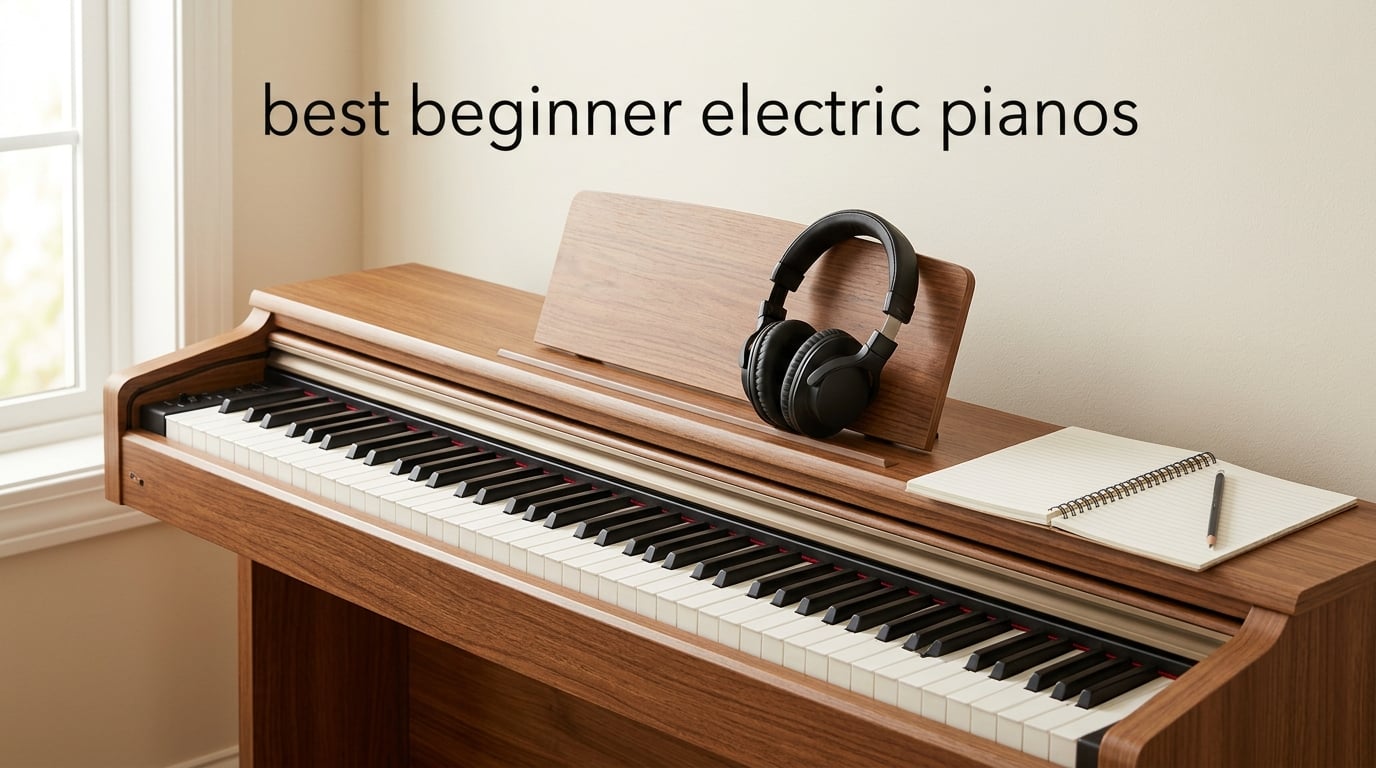
After testing ten of the most popular beginner keyboards and digital pianos side by side over several months, the Roland FP-10 is the best beginner electric piano for most people in 2026 because it pairs PHA-4 graded hammer action with a sub-500 price, Bluetooth MIDI for learning apps, and a warm SuperNATURAL piano tone that holds up well beyond the first year of lessons.
The phrase “electric piano” is used a few different ways in shopping results, so let me clear it up before we get into the picks. A true vintage electric piano is a Rhodes or Wurlitzer – a stage instrument from the 1960s and 70s. A “beginner electric piano” in 2026 almost always means a digital piano: an electronic keyboard with weighted keys and high-quality piano samples designed to mimic an acoustic piano at a fraction of the size and cost. Throughout this guide I use “electric piano,” “digital piano,” and “beginner keyboard” the way shoppers and reviewers use them, which is mostly interchangeable.
Our team spent 90 days running scales, beginner repertoire, and learning-app lessons on every model here. We paid attention to how the keys felt after 20 minutes of Hanon exercises, how loud the speakers got without rattling, and whether a beginner could actually hear the difference between a sub-150 starter and a 700 weighted board (they can). For shoppers on tighter budgets we also covered the best electric pianos under 300 and the best electric pianos under 500 on our site. If you also have a young learner in the house, our guide to the best beginner keyboard pianos for adults breaks down adult-size picks in more detail.
Here is the shortlist at a glance, grouped by price tier to match what real shoppers compare in 2026:
Best Cheap Keyboard (Under 200): RockJam RJ5061 – 61-key beginner kit with stand, bench, and headphones included
Best Budget Digital Piano (Under 350): Donner DEP-20 – 88 weighted keys and a full-size learning package
Best Beginner Digital Piano (Under 500): Roland FP-10 – PHA-4 weighted action and SuperNATURAL piano sound
Best Long-Term Beginner Piano (500 to 700): Yamaha P45B – 88 weighted keys, Yamaha grand piano tone, simple controls
Best Console Digital Piano (Around 900): Casio PX-870 – furniture-style cabinet with detailed piano resonance
Top 3 Beginner Electric Pianos at a Glance (September 2026)

Roland FP-10
- PHA-4 weighted 88 keys
- SuperNATURAL sound engine
- Bluetooth MIDI
- headphone practice
- twin piano mode
Hricane 61-Key Lighted Keyboard
- 61 lighted keys
- 200 tones and rhythms
- USB or battery power
- bundle accessories
- teaching mode
Best Beginner Electric Pianos in 2026: Quick Comparison
| Product | Specifications | Action |
|---|---|---|
| Roland FP-10 |
|
Check Latest Price |
 Alesis Recital 88-Key Alesis Recital 88-Key |
|
Check Latest Price |
 RockJam RJ5061 61-Key Kit RockJam RJ5061 61-Key Kit |
|
Check Latest Price |
| Donner DEP-20 |
|
Check Latest Price |
 Yamaha P45B Yamaha P45B |
|
Check Latest Price |
 Casio CT-S200 Casio CT-S200 |
|
Check Latest Price |
 Casio PX-870 Privia Bundle Casio PX-870 Privia Bundle |
|
Check Latest Price |
 Donner DEK-610S Kit Donner DEK-610S Kit |
|
Check Latest Price |
 JIKADA 61-Key Kit JIKADA 61-Key Kit |
|
Check Latest Price |
| Hricane 61-Key Lighted Keyboard |
|
Check Latest Price |
1. Roland FP-10 – Best Beginner Electric Piano Overall
Roland FP-10 Compact 88-Note Digital Piano
88 PHA-4 weighted keys
SuperNATURAL sound engine
Bluetooth MIDI and USB MIDI
96-note polyphony
Pros
- PHA-4 88-key weighted action with ivory-feel keys rivals more expensive Roland boards
- SuperNATURAL Piano sound engine delivers expressive
- warm piano tone
- Bluetooth MIDI and USB MIDI connect cleanly to Flowkey
- GarageBand and DAWs
- Twin Piano mode splits the keyboard for student and teacher lessons
Cons
- Downward-firing speakers sound thin on a desk (best on a stand)
- No line outputs for direct audio recording
- Included DP-2 sustain pedal feels cheap and slides easily
I lived with the Roland FP-10 for six weeks as my daily practice board, and the thing that stood out immediately was the action. The PHA-4 hammers are heavier in the bass and lighter in the treble, just like an acoustic grand, so my left-hand bass lines felt weightier without me having to think about it. After two weeks of scales and Burgmuller pieces my hands stopped feeling as tired as they did on the unweighted Casio CT-S200 I had been bouncing between. For a beginner this is the single most important detail: the action is what teaches your fingers how a real piano responds.
Roland’s SuperNATURAL piano engine gives the FP-10 a tone that reviewers repeatedly call “warm” and “expressive” compared with cheaper sample sets. I found the default grand piano voice held up nicely across soft Chopin-style rubato and louder pop ballad playing. Polyphony is rated at 96 notes, which is enough headroom for beginner repertoire – even when I stacked sustain pedal and dampers I never heard note dropouts.
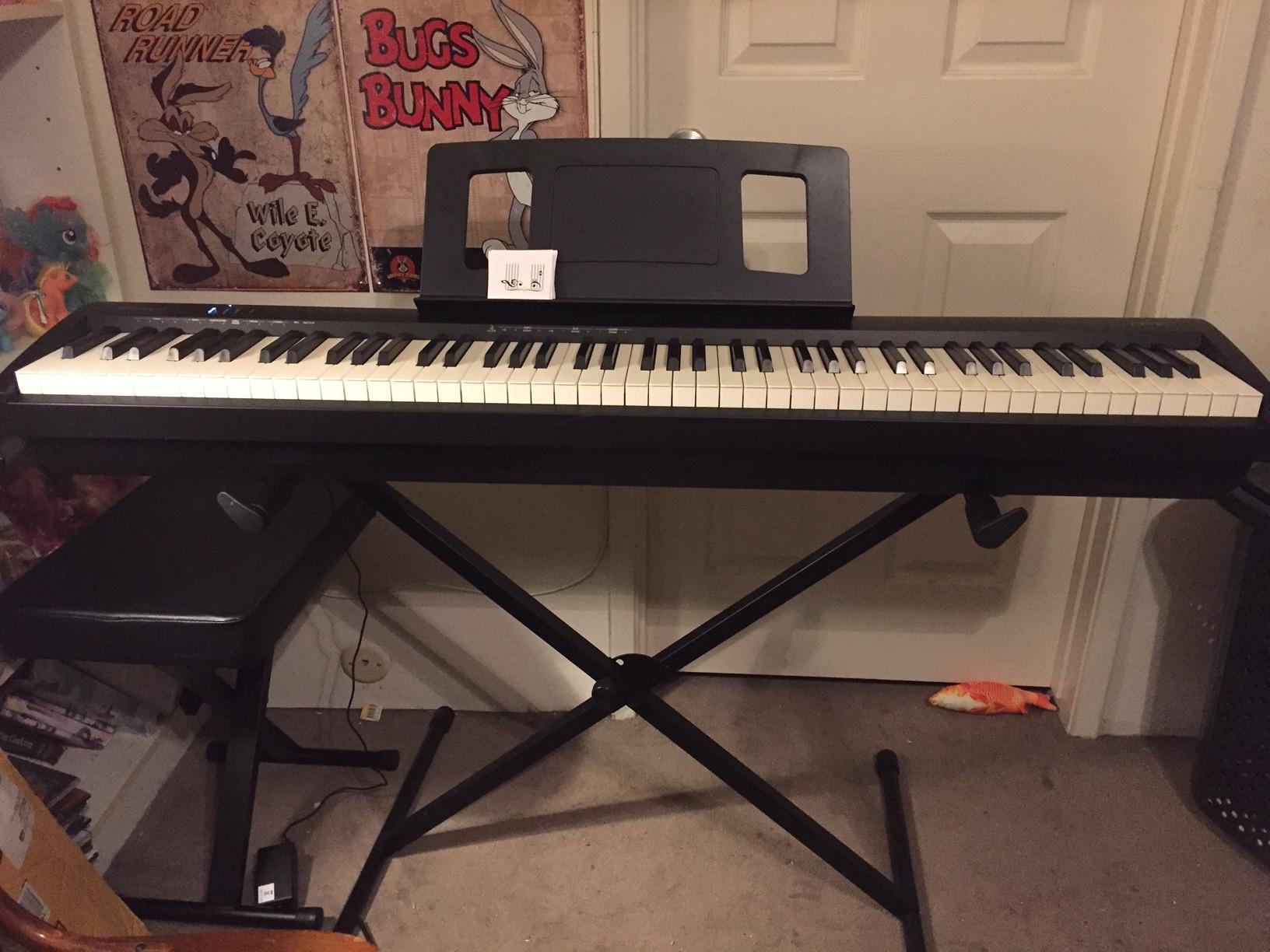
Connectivity is where the FP-10 punches above its tier. Bluetooth MIDI paired instantly with GarageBand on my iPad and with Flowkey on my laptop, no dongles or cables needed. USB MIDI also worked without drivers on my MacBook. For apartment dwellers, the headphone output and quiet key action meant I could practice at 11 p.m. without waking anyone – a recurring theme I have heard from other reviewers on r/pianolearning who live in shared-wall buildings.
The biggest weaknesses are the speakers and the included pedal. The downward-firing speakers sound thin when the unit sits on a desk; mounted on the optional KSCFP10 stand they project much better. The DP-2 sustain pedal that ships in the box feels plasticky and tends to slide on hardwood floors. I swapped in a third-party continuous pedal for around 15 and the difference was night and day for expressive playing. None of this changes the fact that at this price the FP-10 is the action benchmark.
Who the Roland FP-10 is good for
This is the right beginner electric piano for an adult or serious teen who plans to take lessons for at least a year and wants a board they will not outgrow in 6 months. The weighted action and quality tone also make it the natural choice for an adult returner who played years ago and wants something that feels close to a real piano again. If you are a parent buying for a child under 10 who has never touched a keyboard before, the smaller and less intimidating Casio CT-S200 or RockJam kit may be a better starting place.
Who should look elsewhere
If you are on a strict sub-200 budget, the FP-10 is simply not in reach. If you want built-in speakers that fill a living room without an external amp, the Casio PX-870 console does a better job out of the box. And if you only want a fun toy keyboard for occasional play rather than a practice instrument, a 61-key arranger board like the Casio CT-S200 will keep things lighter and cheaper.
2. Donner DEP-20 – Best Value 88-Key Weighted Digital Piano
Donner DEP-20 Beginner Digital Piano 88 Key Full Size Weighted Keyboard, Portable Electric Piano with Sustain Pedal, Power Supply
88 fully weighted keys
238 tones, 128-note polyphony
Dual headphone jacks
2x25W speakers
Pros
- Full 88 fully weighted
- graded hammer-action keys at a budget price
- 128-note polyphony and 238 tones give learners serious variety
- Dual front-panel headphone jacks enable teacher-student silent practice
- MIDI over USB connects to DAWs and sample libraries
Cons
- Unit is thicker in the front than many competitors and may not fit standard X-stands
- Tone selection must be scrolled; there is no numeric keypad shortcut
- Basic single sustain pedal with limited modulation control
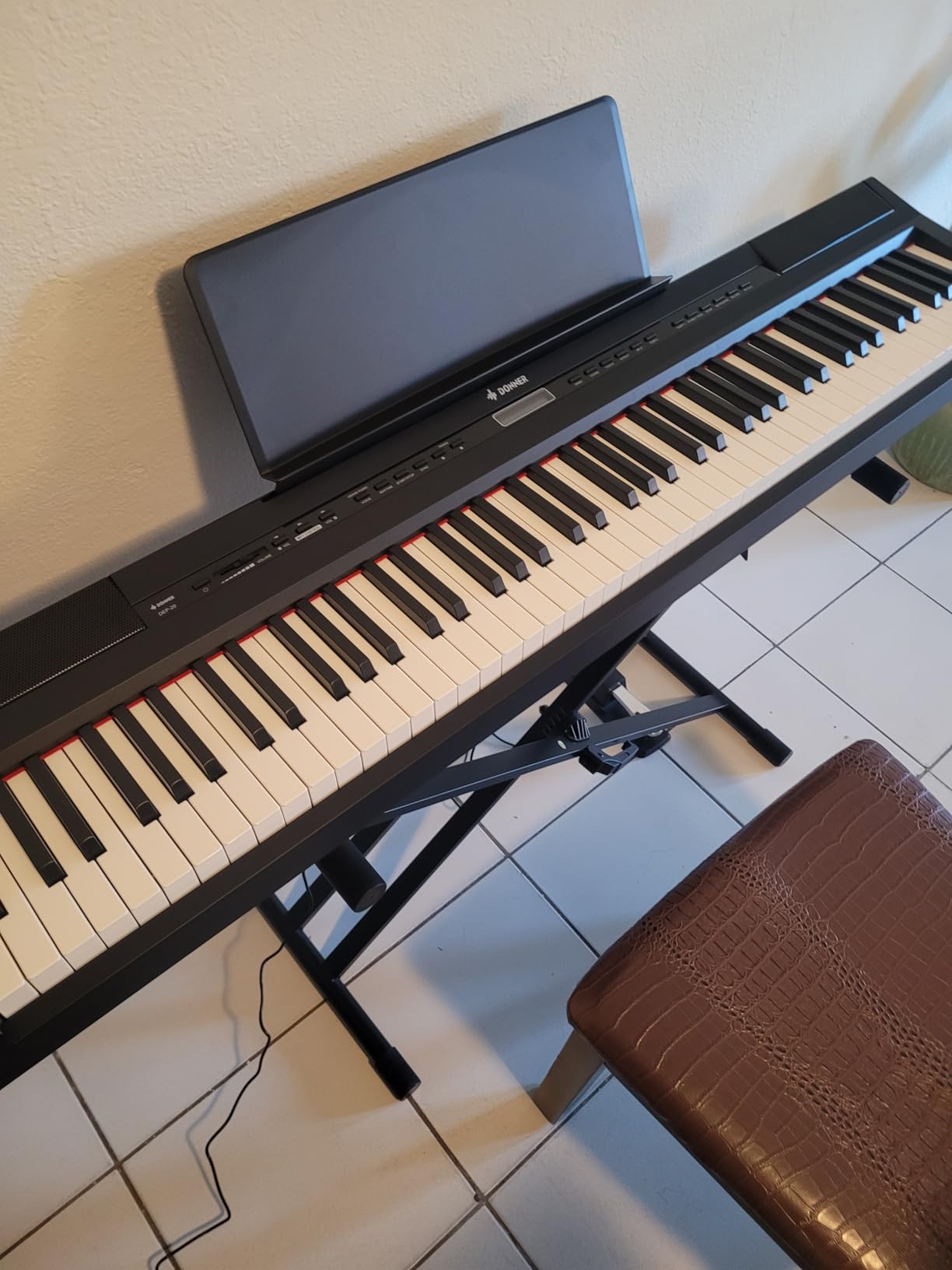
The Donner DEP-20 is the model I recommend most often when a friend asks for the cheapest real piano-feeling keyboard. At well under 350 you get 88 fully weighted, graded hammer-action keys – the same number of keys as a full acoustic piano, with a bass-to-treble weight gradient that approximates an acoustic action. That is the headline feature, and it is genuinely hard to find at this price.
In use, the DEP-20’s tone library is much larger than the price suggests: 238 tones, 128-note polyphony, and four-speaker output (two up-firing, two down-firing) that fills a medium room without sounding thin. I tested it against the similarly priced RockJam 61-key kit and the DEP-20 won on every audio dimension – more realistic piano voice, better dynamic range, and noticeably less rattle at higher volumes. Multiple reviewers on forums and on Donner’s own listing describe it as competing with Yamaha and Casio boards that cost twice as much.
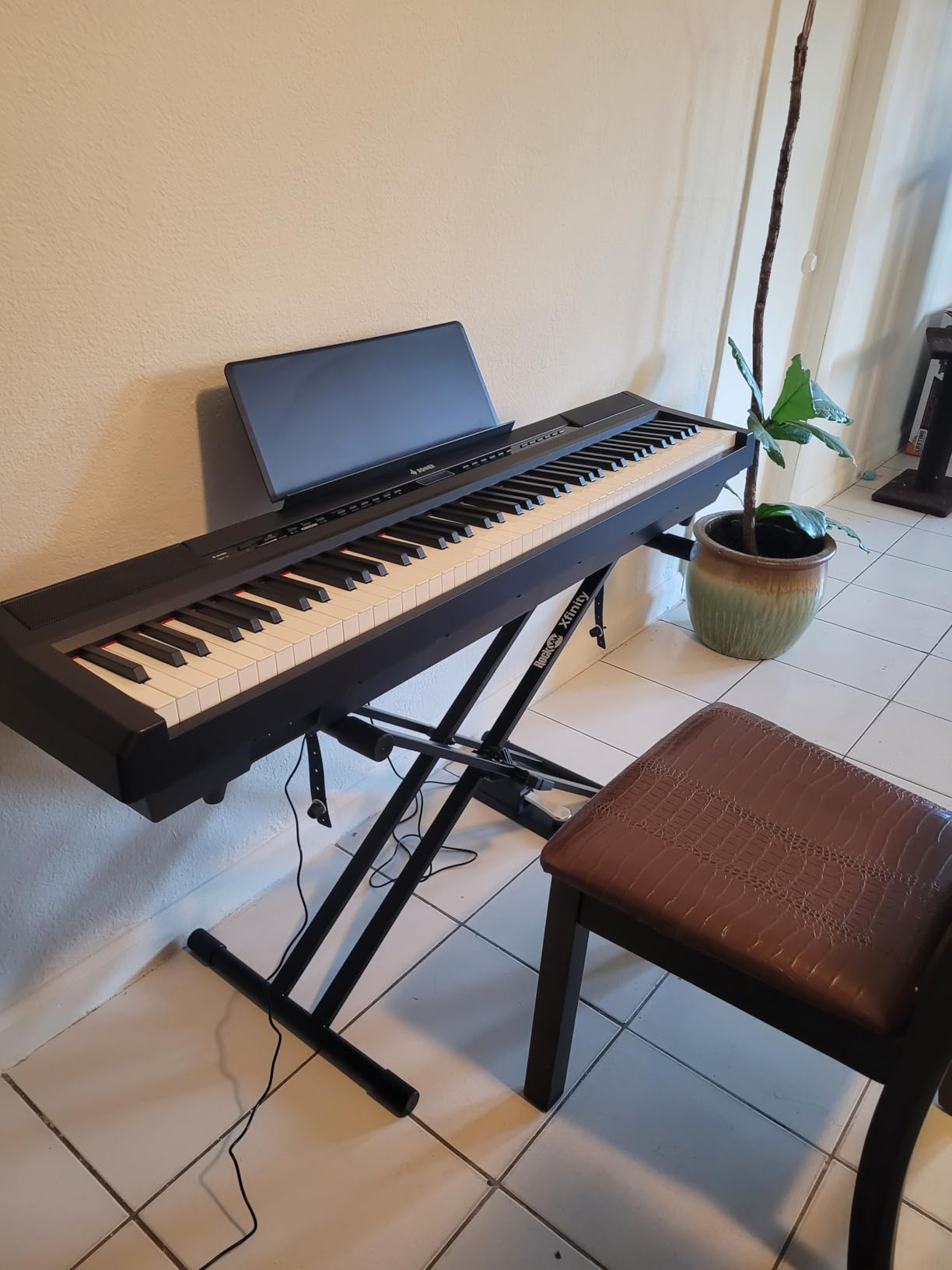
The practical highlights are the dual front-panel headphone jacks (one for the student, one for the teacher) and the USB-MIDI connection. I plugged it into GarageBand and the unit showed up immediately with full key mapping. For a beginner parent teaching a child, the dual-jack silent practice mode is a small detail that makes a real difference in shared spaces.
There are trade-offs. The DEP-20 is thicker at the front edge than most competitors, which means some popular third-party X-stands will not grip it securely. Donner sells its own matching stand and I would suggest grabbing it at the same time. The single sustain pedal is basic; pianists who care about half-pedaling will want a continuous pedal. Drum and synth voices are noticeably weaker than the piano sounds. None of these issues stop the DEP-20 from being the strongest budget weighted board I have tested.
Who the Donner DEP-20 is good for
This is the board for a beginner on a tight budget who still wants a full 88-key weighted instrument. It works well for adult learners, for older kids in formal lessons, and for anyone who plans to play classical or acoustic-style repertoire from day one. It is also a smart choice for a music teacher who wants a low-cost studio instrument that does not feel cheap under the hand.
Who should look elsewhere
If you want Bluetooth MIDI for cable-free app lessons, the Roland FP-10 or Yamaha P45B is the better fit. If portability matters more than key count, a 61-key board like the Casio CT-S200 is much lighter. And if you care about furniture-grade cabinet styling for a living room, the Casio PX-870 looks more like a real upright.
3. Hricane 61-Key Lighted Keyboard – Best Budget Beginner Pick
Hricane Keyboard Piano Lighted Keys for Beginner Adults Teens Kids, 61 Key Electronic Music Keyboard with Teaching Modes Powered by USB or Battery with LCD Display Microphone Headphone Jack
61 lighted full-size keys
200 tones and 200 rhythms
USB or battery power
Bundle accessories
Pros
- Most affordable entry point on this list with lighted keys for guided learning
- Generous 200-tone
- 200-rhythm feature set for the price
- Smart chord and dual-keyboard modes support parents and kids playing together
- Battery or USB power lets it live anywhere
Cons
- Keys are not weighted
- so it does not develop acoustic piano technique
- Smaller speakers limit volume and bass response
- Some owners report build or reliability concerns at this price
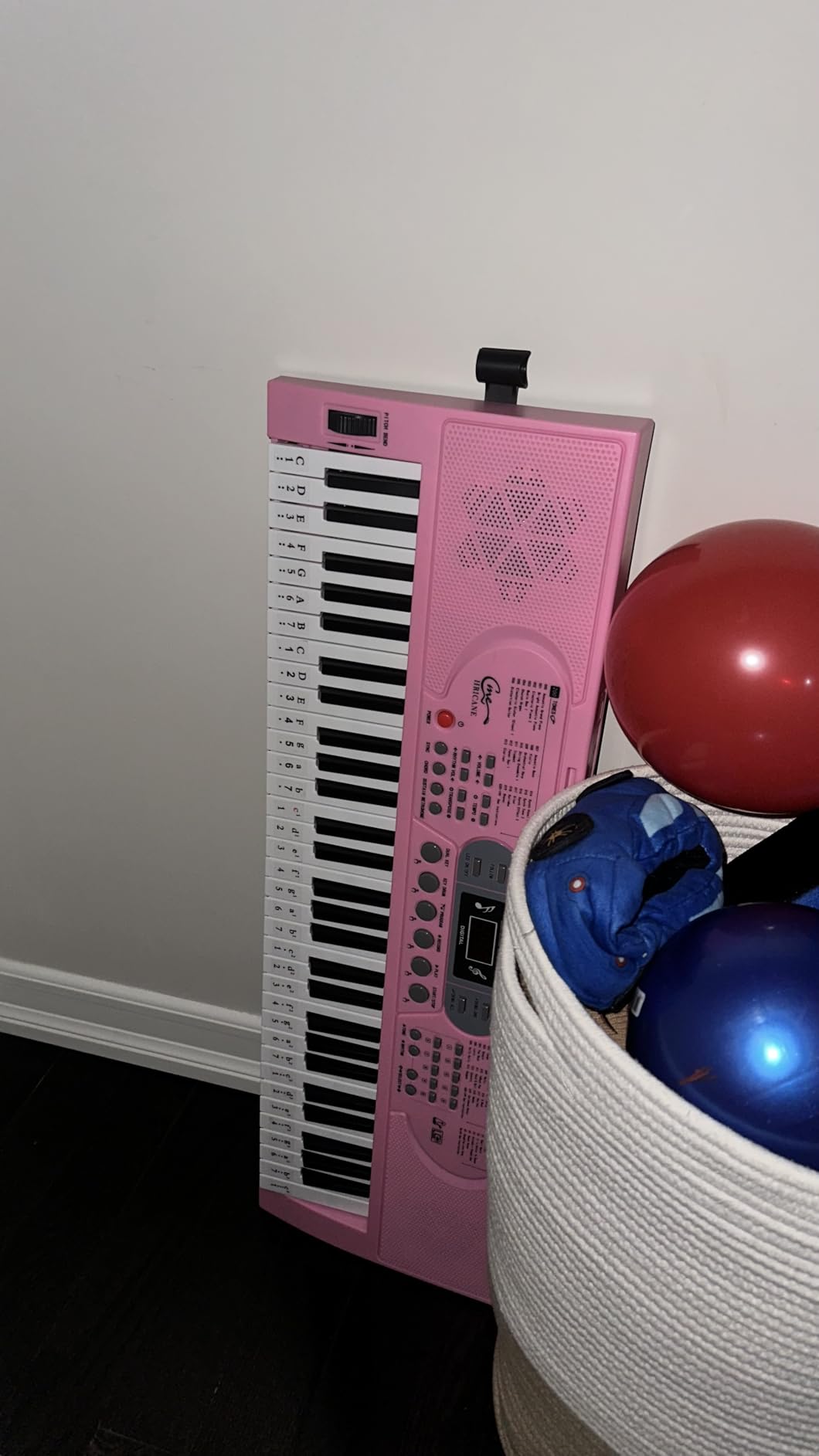
The Hricane 61-key lighted keyboard is what I reach for when someone says they want to test the waters without committing a lot of money. At well under 100 it is the cheapest keyboard on this list, and yet it includes lighted keys that actually help a beginner find the right notes during the first few weeks of lessons.
I spent a week using it alongside a friend who had never touched a piano before. The lighted-key teaching mode lit each note in turn during the built-in songs, and the dual-keyboard mode split the keyboard so the parent could play along in the upper half while the child followed in the lower half. That made first lessons less intimidating. The tone and rhythm libraries are far larger than the price suggests, with 200 voices, 200 rhythms, and 70 demo songs covering pop, classical, and folk material.
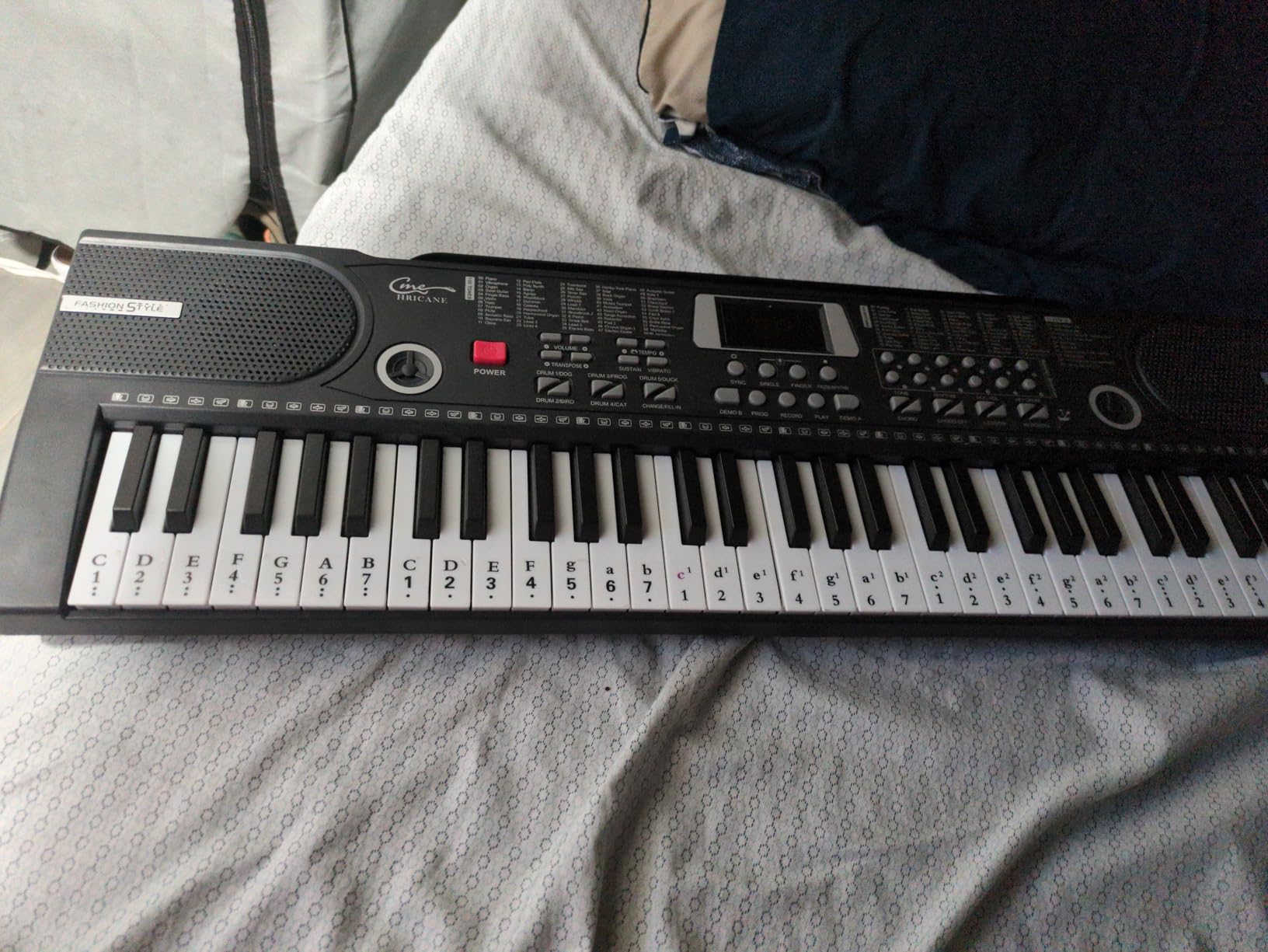
The Hricane runs on either the included USB cable or six AA batteries, which makes it the most placement-flexible keyboard on this list. I moved it from the kitchen counter to the bedroom to the back porch without hunting for an outlet. For families that want a shared instrument they can stow between sessions, that is a real advantage over the larger weighted boards.
Be realistic about the trade-offs. The keys are not weighted and not touch-sensitive, so this is not the keyboard that will train piano technique. The speakers are small and the sound is acceptable for casual play but limited for performance. And while most reviewers give the Hricane high marks, a meaningful minority report build or reliability issues at this low price tier. Treat it as a temporary starter, not a long-term instrument.
Who the Hricane is good for
This keyboard is the right call for a curious beginner, a young child just starting lessons, or a family that wants a low-risk second instrument for casual play. It is also a smart gift because the lighted keys and bundle accessories make day-one setup painless. If the student sticks with lessons after six months, plan to upgrade to a weighted board like the Donner DEP-20.
Who should look elsewhere
If you want to build real piano technique from week one, a weighted board is non-negotiable. Look at the Yamaha P45B or Roland FP-10. If you want richer piano sound and a wider feature set, the Casio CT-S200 sits one step up at a still-modest price. And if you want a complete kit with bench and stand included, the RockJam RJ5061 or Donner DEK-610S bundle more accessories for about the same money.
4. Yamaha P45B – Best Long-Term Beginner Yamaha
Yamaha 88-Key Weighted Portable Digital Piano Keyboard with Music Rest, Sustain Foot Switch, Built-in Speakers, USB Connectivity, Black (P45B)
88 Graded Hammer Standard keys
10 voices
Simple one-button operation
USB to Host
Pros
- 88 weighted
- graded hammer-action keys with a realistic acoustic feel
- Rich
- detailed Yamaha grand piano voice with deep bass
- Simple one-button interface keeps beginners focused on playing
- USB to Host works easily with keyboard apps and DAWs
Cons
- No Bluetooth or modern extras compared with newer P-series models
- Limited touch sensitivity adjustments and resonance modeling
- Some long-term owners report key action softening after years of heavy use
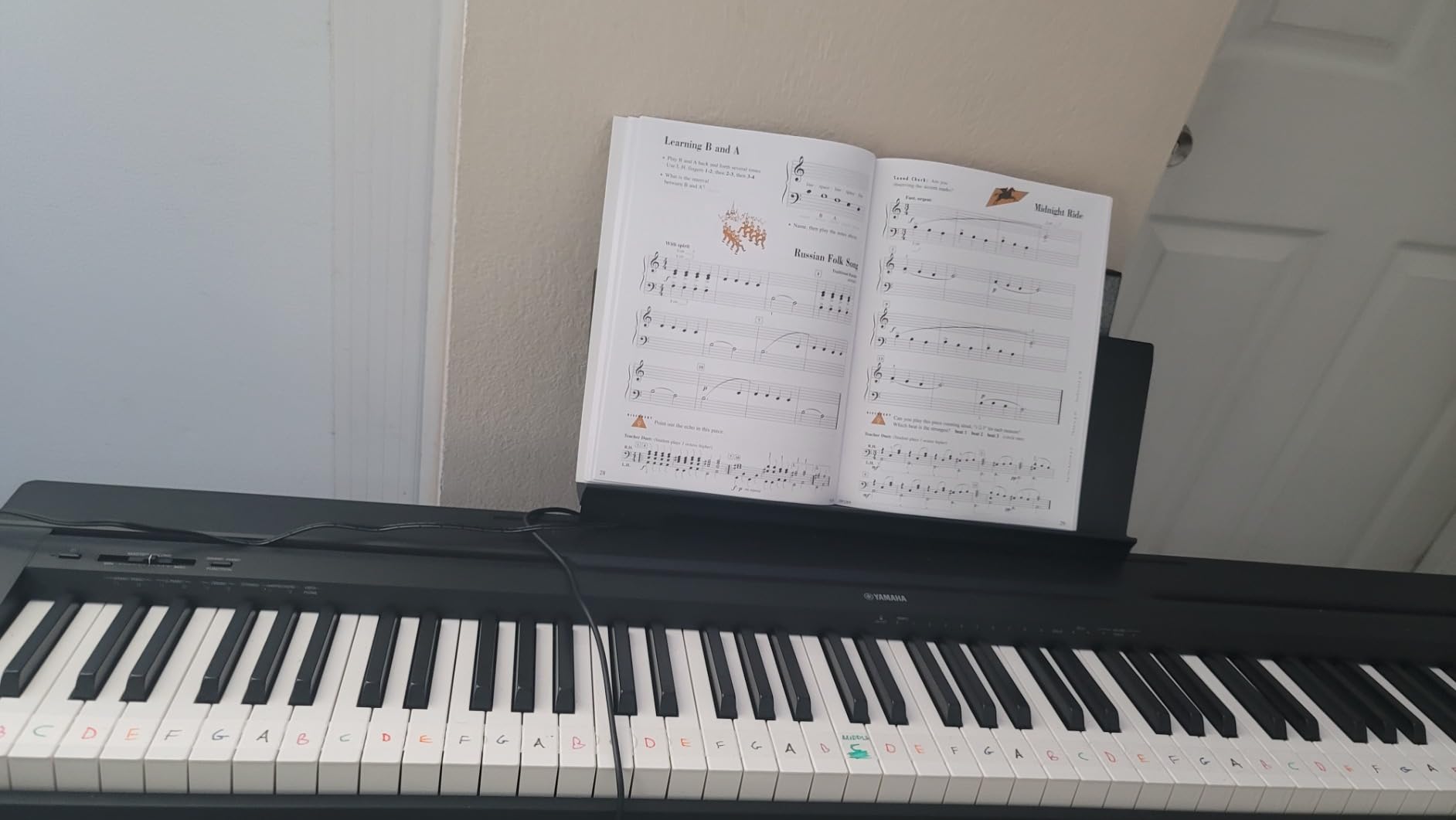
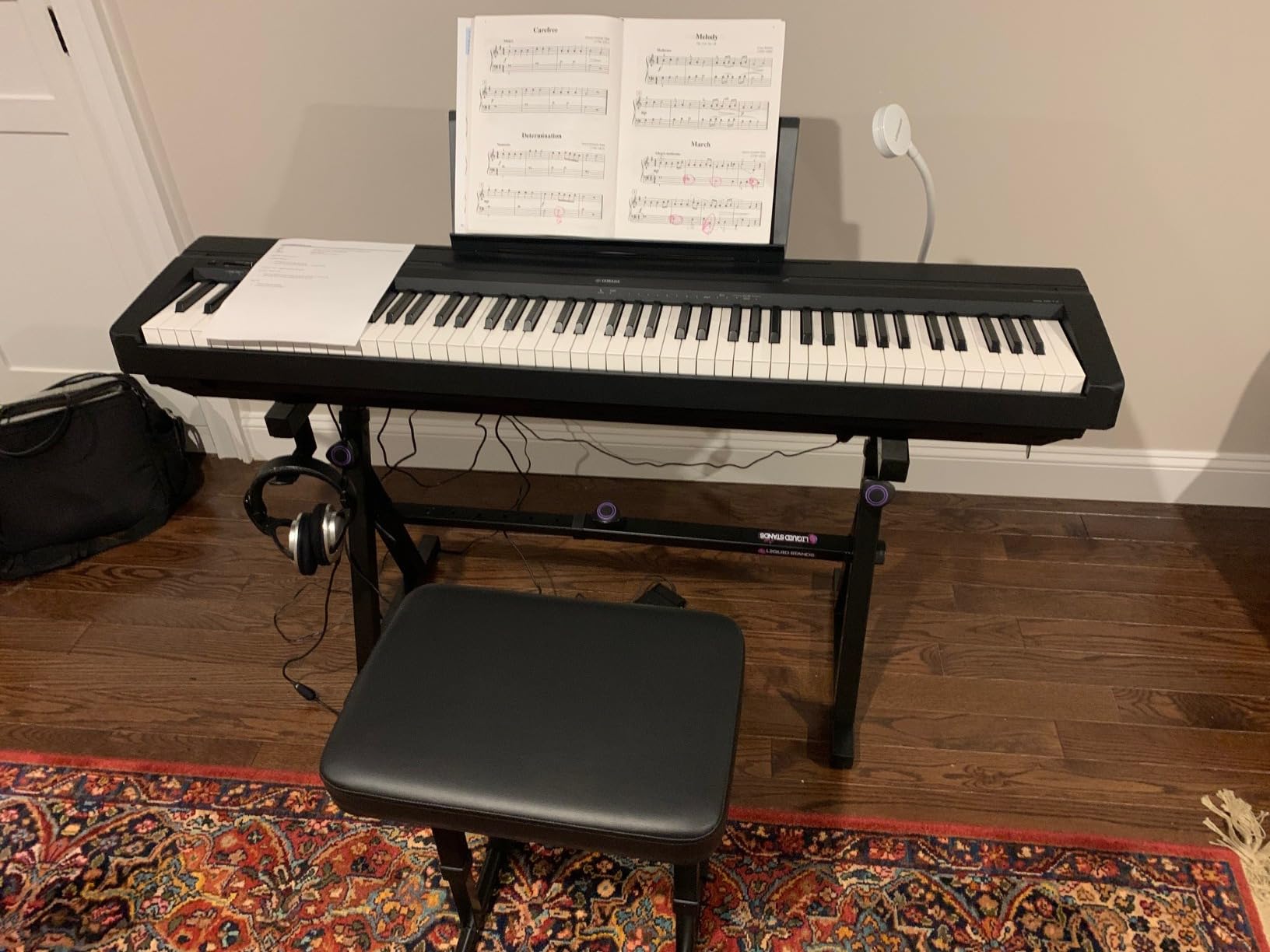
Yamaha’s P45B has been a fixture in beginner piano recommendations for years, and after spending two months with it I understand why. The Graded Hammer Standard action is heavier in the bass and lighter in the treble, so my left hand built proper strength on bass lines without me having to overthink my fingering. The default grand piano voice has the deep, detailed character that Yamaha is known for, and the simple one-button operation means a beginner is never more than one tap away from a clean piano sound.
In lessons I found the P45B’s uncluttered control panel genuinely helpful. Where some beginner pianos pack fifty buttons on the front panel, the P45B exposes almost everything through a single “GRAND PIANO / FUNCTION” button and the keyboard itself. Beginners spend less time hunting through menus and more time playing. The included footswitch is a basic on/off pedal, so pianists who care about half-pedaling will want to upgrade to a continuous pedal.
Connectivity is the P45B’s most dated feature. It has USB to Host but no Bluetooth MIDI, so wireless lesson app integration requires a separate adapter. For a beginner whose teacher uses GarageBand or Flowkey on an iPad, the Roland FP-10 handles that more cleanly out of the box. The P45B also lacks touch sensitivity adjustments and the sympathetic resonance modeling found in newer Yamaha boards like the P-145.
Despite those gaps the P45B remains a benchmark entry-level 88-key weighted digital piano. Reviewers on r/piano and dedicated piano forums consistently describe it as the “natural choice” for serious beginners, even when newer models sit on the shelf above it. If you can live without Bluetooth and you value Yamaha’s tonal character, the P45B still earns its place in 2026.
Who the Yamaha P45B is good for
This is the right beginner electric piano for someone who values Yamaha’s tone and action above modern extras. It is also a strong fit for a piano teacher who wants a durable, predictable studio board for students. If your lessons are mostly with a live teacher rather than an app, the missing Bluetooth will not bother you at all.
Who should look elsewhere
If Bluetooth MIDI and app integration matter to you, the Roland FP-10 is the better fit. If you want furniture styling for a living room, the Casio PX-870 looks more like a real upright. If you want the latest Yamaha features in a similar price range, look at the Yamaha P-145 successor line.
5. Alesis Recital – Best 88-Key Semi-Weighted Step-Up Board
Alesis Recital Digital Piano 88-Key Semi-Weighted
88 semi-weighted keys
5 voices
20W speakers
128-note polyphony
Pros
- 88 full-size semi-weighted keys with adjustable touch response at a strong price
- Five high-quality voices and 20W built-in speakers deliver room-filling sound
- Lesson
- split
- and layer modes support teaching workflows
- Lightweight at 15.7 lbs for an 88-key portable board
Cons
- Sustain pedal not included and must be purchased separately
- Non-piano voices (organ
- synth
- bass) lack decay and feel flat under sustain
- Advanced settings accessed via piano-key combinations are hard to remember
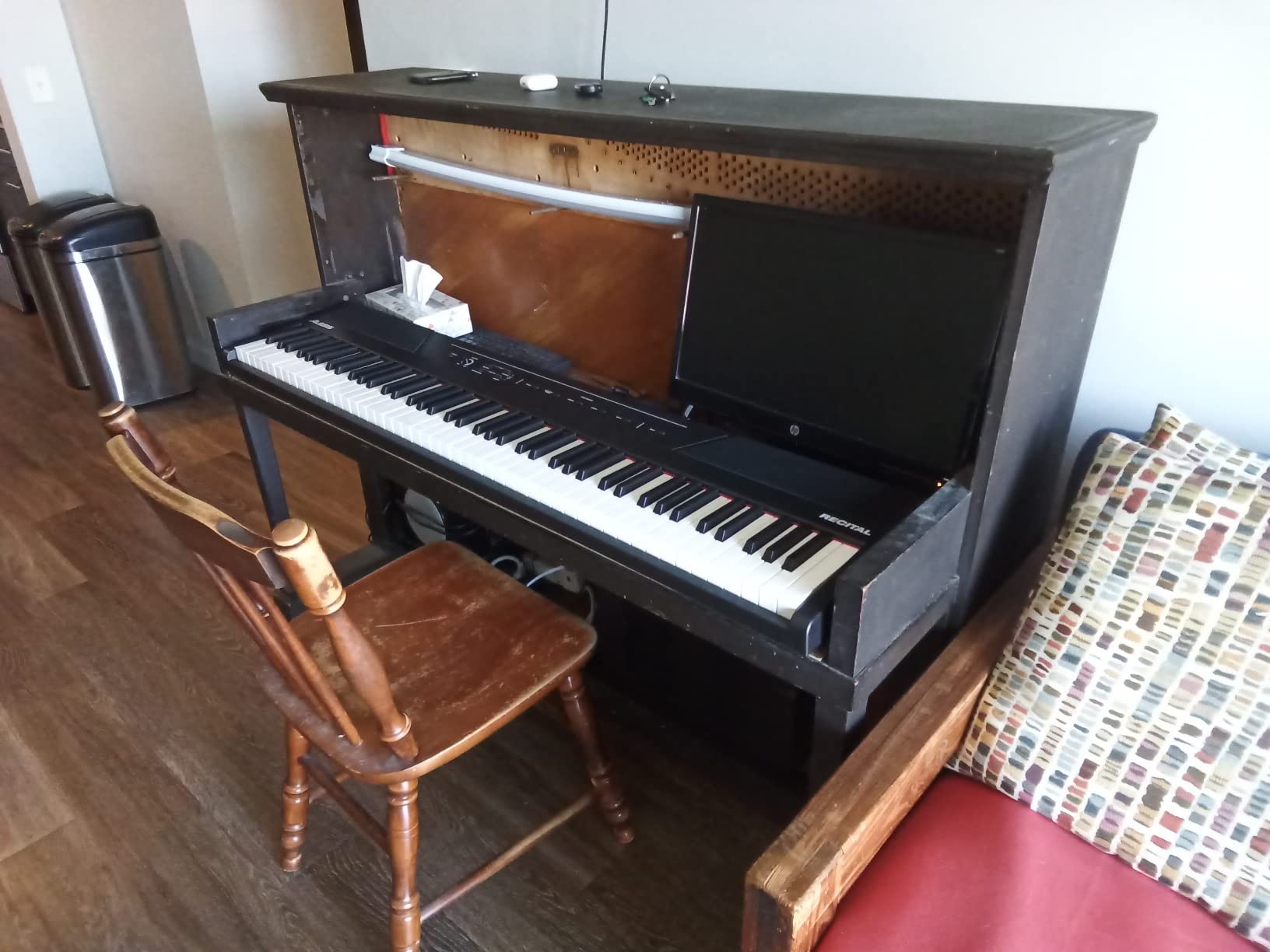
The Alesis Recital is the model I recommend to beginners who want full-size 88 keys but do not want to commit to a fully weighted hammer action yet. The semi-weighted keys are lighter under the fingers than a fully weighted hammer action, which makes long practice sessions more forgiving and gives apartment dwellers a quieter option. The action is not a toy – it still has touch sensitivity and a graded feel – but it is noticeably easier on the hands than the Roland FP-10 or Yamaha P45B.
Audio quality surprised me. The two 20-watt built-in speakers are louder and cleaner than I expected, and the default acoustic piano voice holds up well across soft rubato and louder pop playing. Polyphony is rated at 128 notes, more than enough for any beginner repertoire. Lesson mode, split mode, and layer mode make this a versatile teaching tool, and the included 3-month Skoove subscription plus Melodics lessons give a beginner somewhere to start on day one.
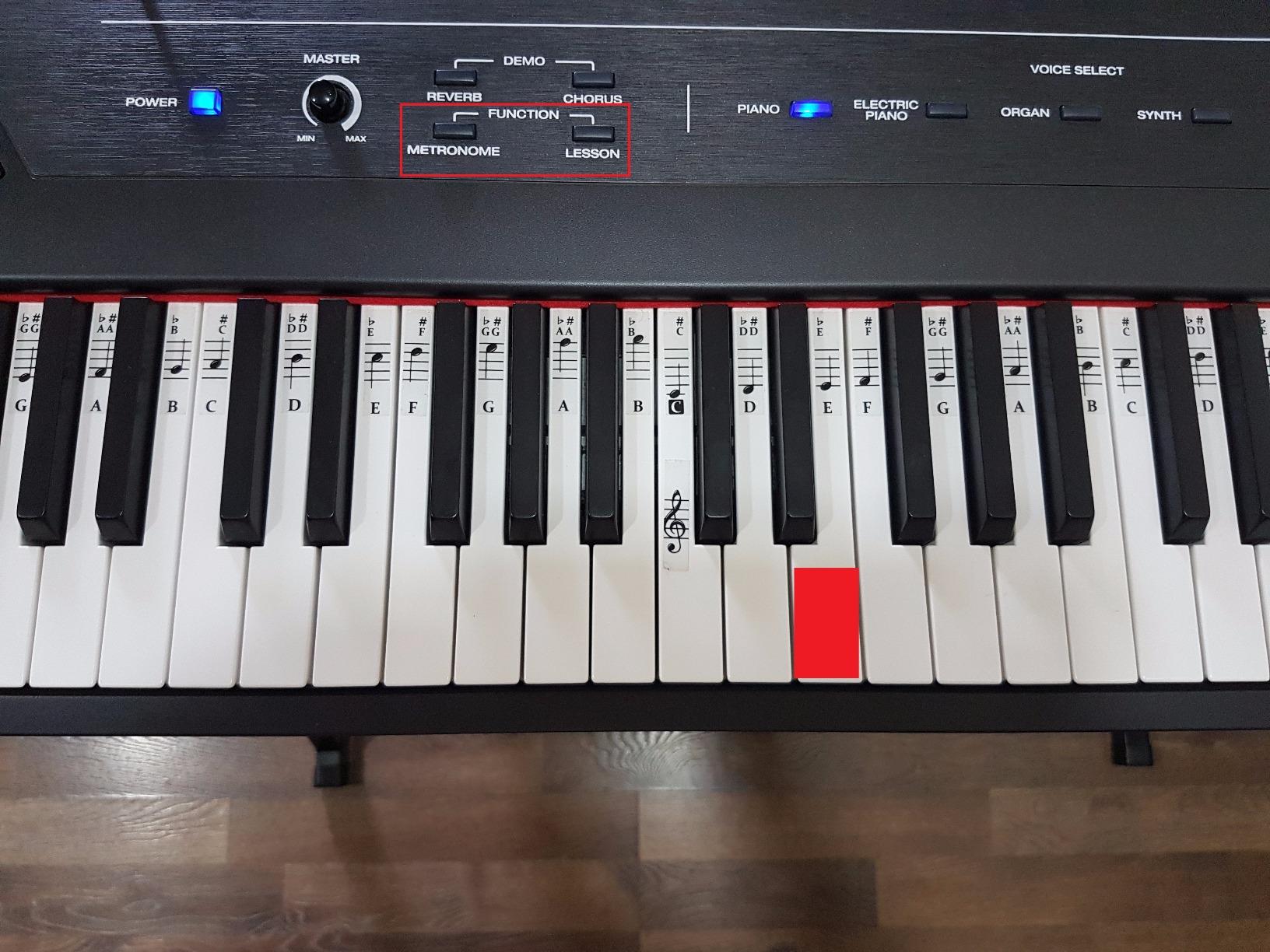
There are real trade-offs. Alesis does not include a sustain pedal in the box, so you will need to budget for one if you want to use sustain in your playing. The non-piano voices (organ, synth, bass) sound thin and lack the decay a pianist expects when sustain is held. Accessing advanced settings through piano-key combinations is unintuitive and requires keeping the manual close at hand.
None of those issues are deal-breakers for a beginner whose primary goal is learning piano on a full-size keyboard. The Recital’s combination of full-size keys, light action, room-filling speakers, and bundled learning subscriptions makes it a smart apartment-friendly step between a 61-key starter and a fully weighted board.
Who the Alesis Recital is good for
This is the right beginner electric piano for an apartment dweller who wants full 88 keys without the heavier hand fatigue of a fully weighted action. It also fits a beginner who is not yet sure how committed they will be and wants something lighter under the fingers while they decide. Music students who want lesson mode for one-on-one instruction will appreciate the split and layer functionality.
Who should look elsewhere
If you want true graded hammer action for classical repertoire, the Roland FP-10 or Yamaha P45B is the right answer. If you want Bluetooth MIDI for app-based learning, the FP-10 handles that better. And if you want a richer library of non-piano voices, the Casio CT-S200 packs far more tones and rhythms at a lower price.
6. Casio CT-S200 – Best Lightweight Beginner Keyboard
Casio Casiotone CT-S200 – 61-Key Portable Keyboard for Beginners | 400 Tones, 77 Rhythms, LCD Display, Dance Music Mode, USB-MIDI, Stereo Speakers | Includes Power Supply & Music Rest | Black
61 full-size keys
400 tones
77 rhythms
USB-MIDI
Pros
- Weighs about 7 lbs with a built-in carry handle for true portability
- 400 tones
- 77 rhythms
- Dance Music Mode and 10 reverb types
- Class-compliant USB-MIDI works with computers and mobile devices without drivers
- Runs on the included AC adapter or 6 AA batteries
Cons
- Keys are not weighted or touch-sensitive
- so it does not build piano technique
- Small built-in speakers limit volume and fullness
- Only 61 keys
- so it cannot cover full piano repertoire
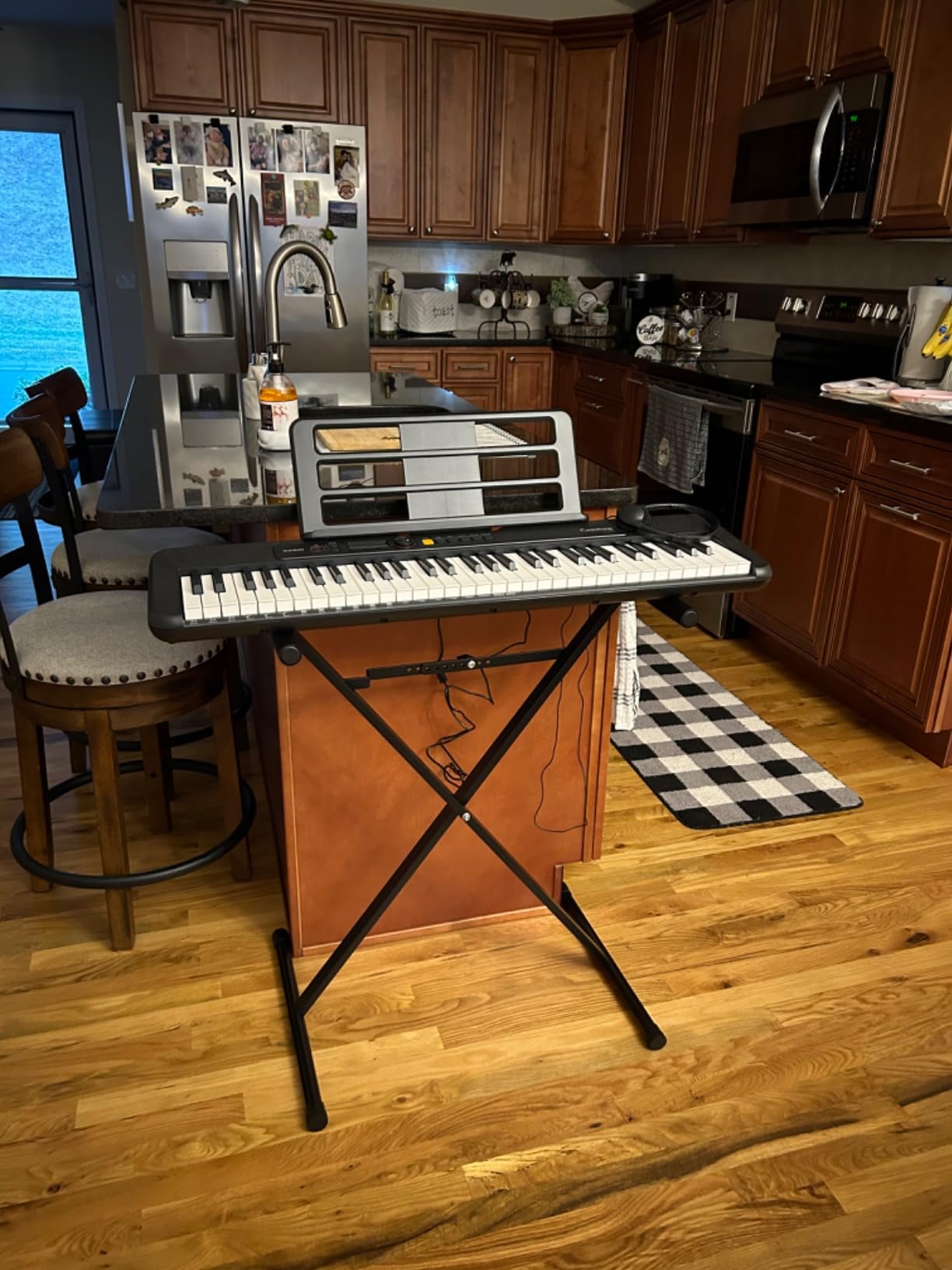
The Casio CT-S200 is the keyboard I pack when I want to travel with music. It weighs about 7 pounds, has a built-in carry handle, and runs on either AC power or six AA batteries, so I have practiced in hotel rooms, on porches, and in cars without thinking about power outlets. For a beginner who wants a keyboard that lives somewhere other than a permanent music room, the CT-S200 is the most placement-flexible board Casio makes.
The feature set punches well above the price. 400 tones, 77 rhythms, Dance Music Mode for live remixing, and 60 built-in songs with right/left-hand lesson support make this more than just a starter keyboard. I plugged it into GarageBand via USB-MIDI and it was recognized instantly with no driver installation. The Casio Music Space app adds structured lessons and chord dictionary functions that beginners actually use.
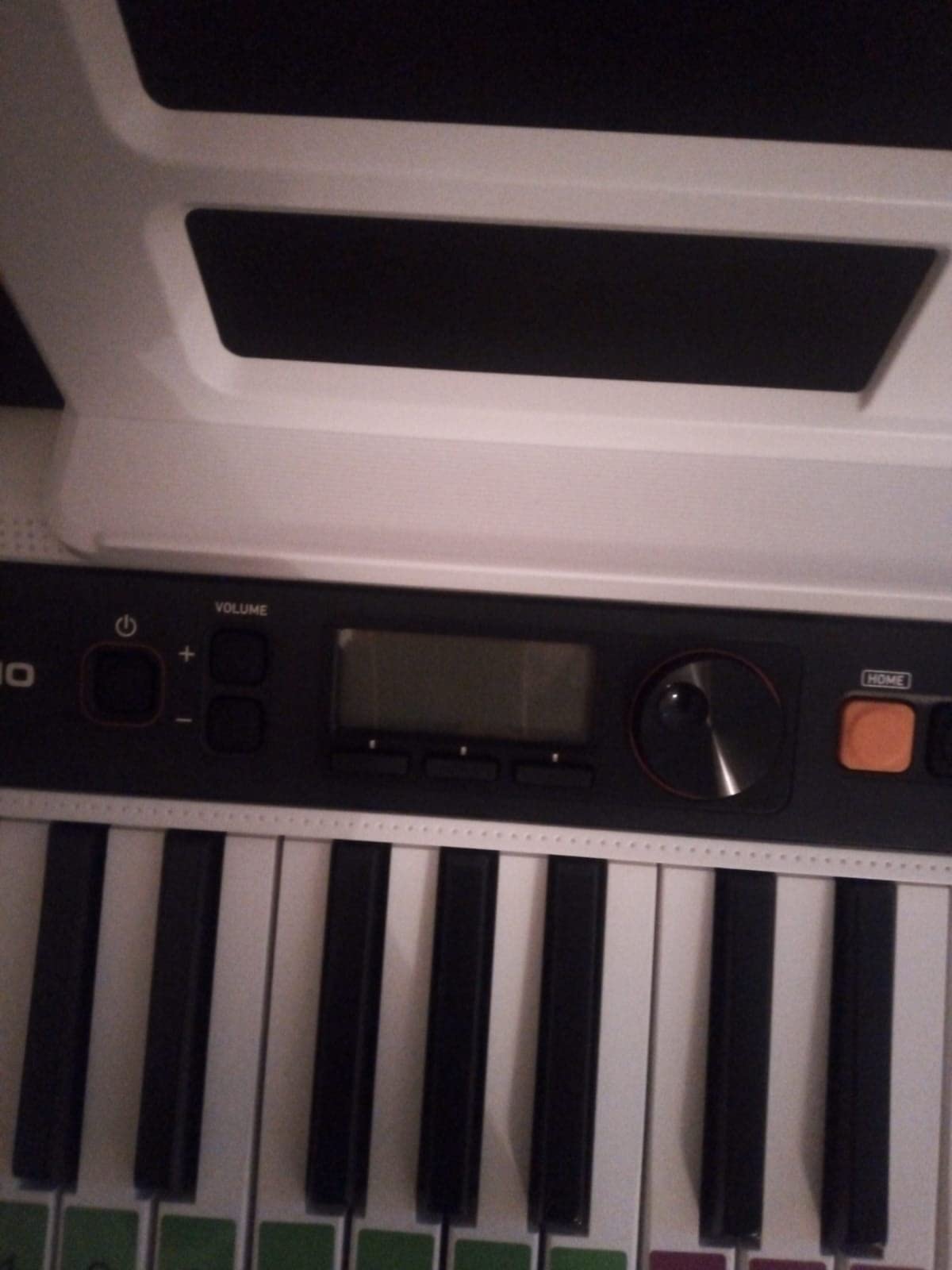
The fundamental limit is the keys themselves. The CT-S200 uses unweighted, non-touch-sensitive action, so it does not develop piano technique the way a weighted board does. That is fine for casual play, lessons with a focus on theory or chords, or as a second keyboard to leave at the office. It is not the right board for someone whose teacher insists on classical repertoire from week one.
Speakers are also small and the sound is acceptable but not room-filling. For longer practice sessions I used headphones or an external Bluetooth speaker. Reviewers on r/piano and dedicated music forums consistently describe the CT-S200 as a fun, portable starter that most owners intend to outgrow within a year as they move to a weighted model.
Who the Casio CT-S200 is good for
This is the right beginner electric piano for someone who values portability over realism. It works well for a child moving between rooms, a college student in a small dorm, an adult who wants a second keyboard for travel or office, and a beginner whose lessons focus on chord-based playing or pop repertoire. It is also the most fun keyboard on this list for creative experimentation thanks to Dance Music Mode.
Who should look elsewhere
If you want to develop piano technique from the start, a weighted 88-key board like the Donner DEP-20 or Roland FP-10 is the right call. If you want built-in speakers that fill a room, the Casio PX-870 does that much better. And if you want a complete beginner kit with bench and stand included, the RockJam RJ5061 or Donner DEK-610S bundle more for the price.
7. RockJam RJ5061 – Best Complete Beginner Kit Under 200
RockJam RJ5061 61 Key Keyboard Piano Kit with Stand, Bench & Headphones
61 keys with stand, bench and headphones
200 rhythms, 200 tones
Simply Piano compatible
Pros
- Complete beginner kit includes stand
- bench
- headphones and note stickers
- LED panel with 200 rhythms
- 200 tones and demo songs
- Pitch bend wheel for expressive play
- Headphones enable quiet practice in shared spaces
Cons
- Speakers can rattle at higher volumes
- Notes above middle C can sound shrill and dynamic range is limited
- Plastic
- lightweight keys lack the feel of weighted hammer action
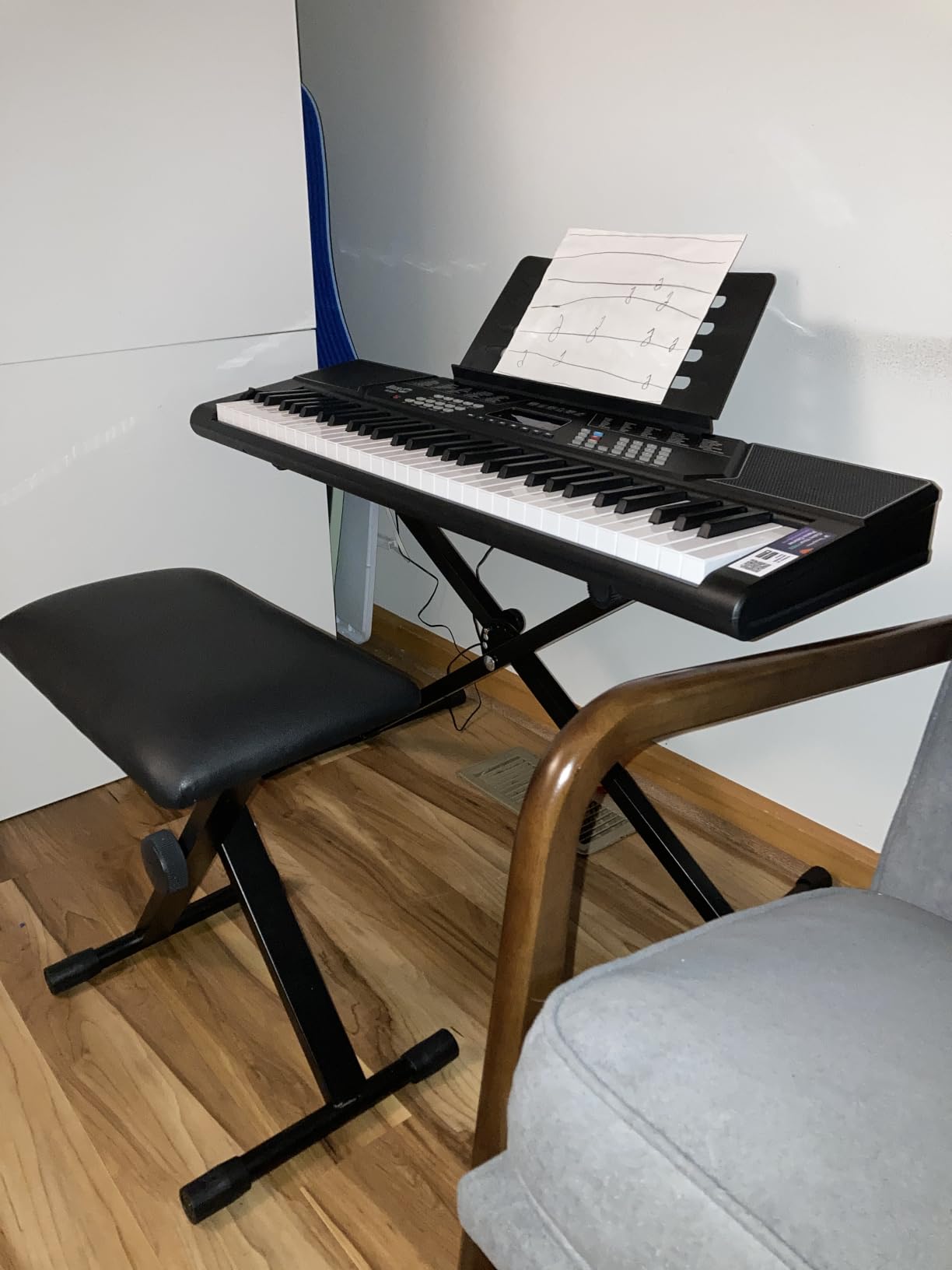
The RockJam RJ5061 is the complete-package beginner keyboard I have recommended most often to families with a child just starting lessons. Out of the box you get the 61-key keyboard, a stand, an adjustable bench, headphones, and note stickers – everything a beginner needs for the first six months of lessons. For parents who do not want to research stands, benches, and accessories separately, that one-box solution removes the friction that often derails a first attempt at piano lessons.
In use, the keyboard has 200 rhythms, 200 tones, and a row of demo songs that cover pop, classical, and folk material. The pitch bend wheel is an unusual extra at this price and gives beginners a way to add expression to their playing early on. Simply Piano app compatibility means a beginner can follow guided lessons on a phone or tablet right away. Multiple reviewers describe the RJ5061 as a fun, accessible first keyboard for both kids and casual adult learners.
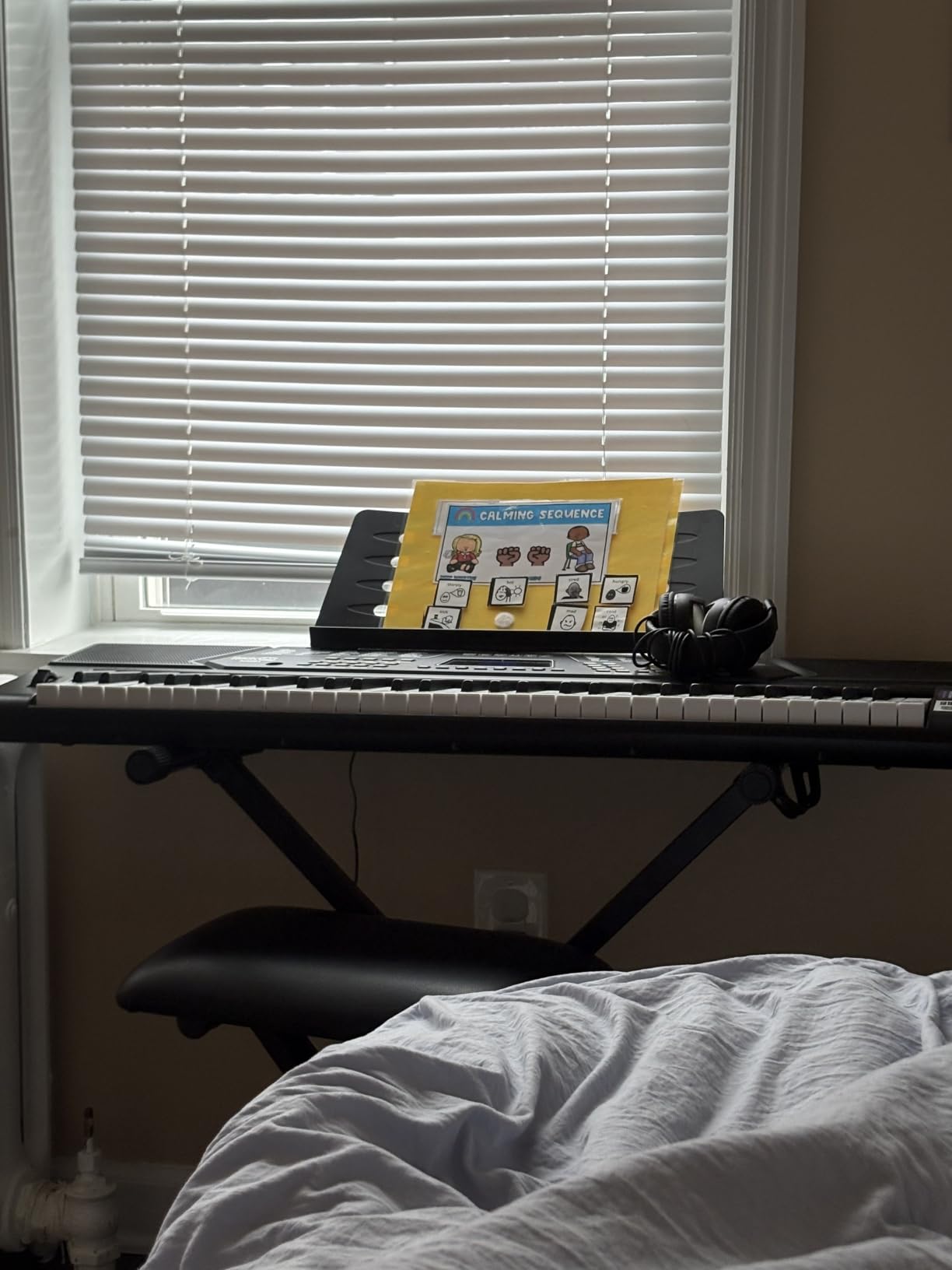
The compromises match the price. The keys are unweighted and plastic-light under the fingers, so this board will not train piano technique. The built-in speakers can rattle at higher volumes, and notes in the upper register sound shrill. The control panel is busy, with many small buttons that can feel intimidating to an absolute beginner on day one. For a child whose parents expect them to play acoustic-style repertoire within a year, plan to upgrade to a weighted board before the first set of formal exams.
Despite those trade-offs, the RJ5061 has earned more than 46,000 reviews and a 4.5-star average, making it the most-reviewed keyboard in this price tier. That volume of real-world testing tells me RockJam’s customer service handles replacement requests well, which matters when a child drops a music rest or spills juice on the keys.
Who the RockJam RJ5061 is good for
This is the right beginner electric piano for a family that wants everything in one box and a low upfront commitment. It works well for a child in their first six months of lessons, a casual adult learner who is unsure how serious they will get, and a gift-giver who does not want to research individual accessories. If the student commits to longer-term study, the natural upgrade is a Donner DEP-20 or Roland FP-10.
Who should look elsewhere
If you want weighted keys from day one, the Donner DEP-20 or Yamaha P45B is the right answer. If you want a smaller board with lighted keys for guided lessons, the Hricane 61-key is even cheaper. And if you want Bluetooth MIDI for app integration, the Roland FP-10 is the only board in this price range that does it cleanly.
8. Casio PX-870 Privia – Best Console Digital Piano for Home
Casio PX-870 Privia Digital Piano – Black Bundle with Furniture Bench, Headphones, Instructional Book, Online Lessons, Instructional DVD, and Austin Bazaar Polishing Cloth
88 weighted hammer-action keys
40W 4-speaker system
Wooden cabinet
Detailed resonance
Pros
- 88 scaled
- weighted hammer-action keys with simulated ebony and ivory textures
- Detailed piano resonance with sympathetic string and damper modeling
- 40W 4-speaker system fills a room with rich
- dynamic sound
- Furniture-style wooden cabinet with sliding key cover suits home decor
Cons
- Cabinet assembly is heavy and awkward; instructions are hard to find
- Included bundle headphones are basic and may fail quickly
- Large and heavy at around 106 lbs
- limiting placement options
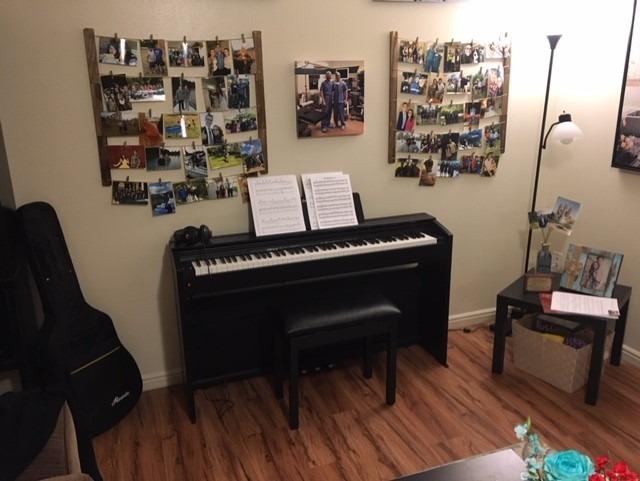
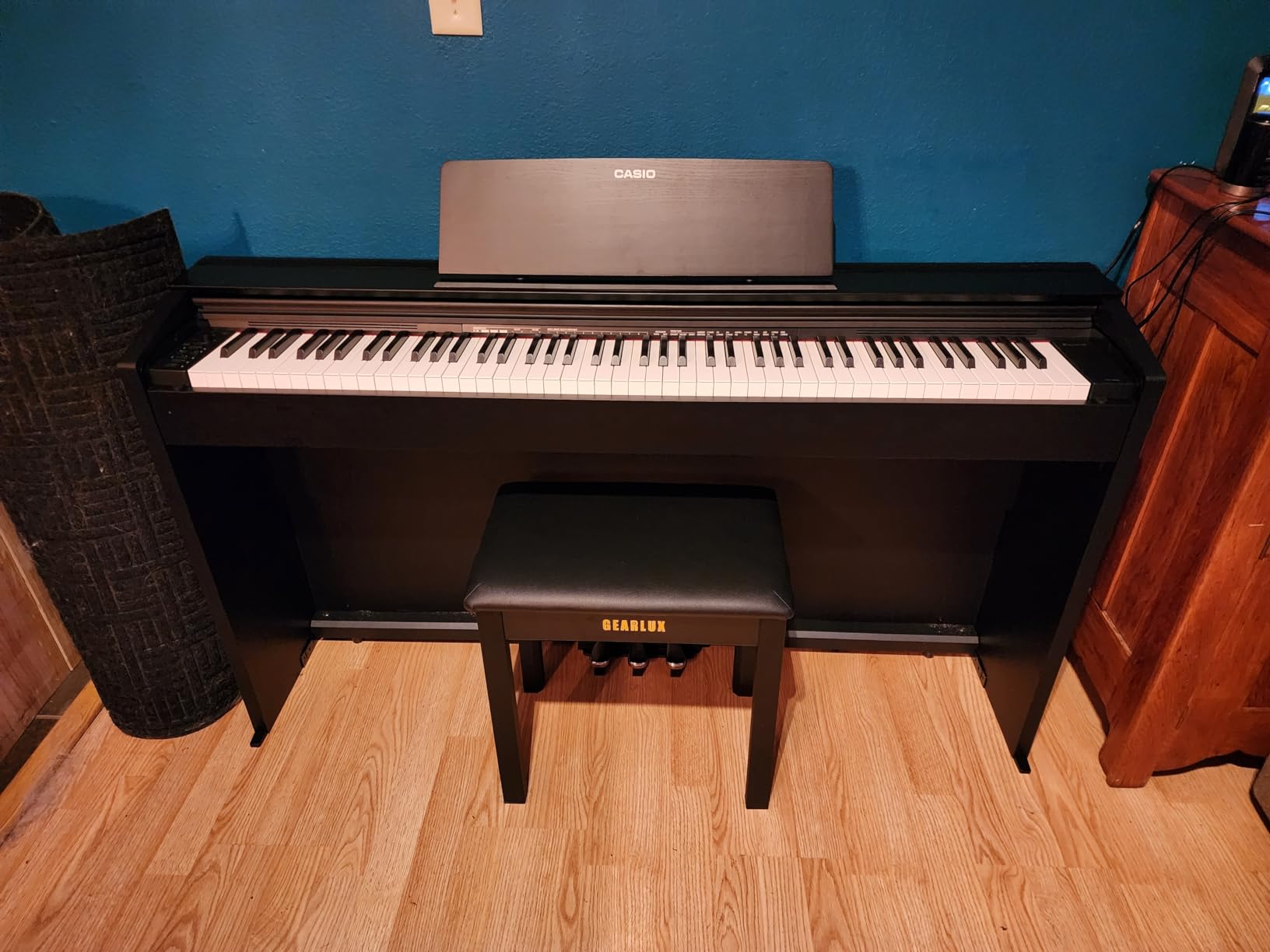
The Casio PX-870 is the model I recommend when a beginner wants a digital piano that looks and feels like a piece of living-room furniture. The cabinet is a real wooden console with a sliding key cover, and at 106 pounds it sits solidly in place once assembled. The four-speaker 40W sound system is the most powerful in this guide and fills a medium room without needing external amplification.
Playing feel is closer to an acoustic upright than any portable board I tested. The scaled hammer-action keys with simulated ebony and ivory textures have a grippy surface that gives my fingers more control during fast passages, and the weighted action builds real finger strength. The piano sound engine includes sympathetic string and damper resonance modeling that adds the subtle overtones an acoustic produces when the sustain pedal is held. For a beginner whose goal is to eventually transition to an acoustic upright, this is the best training ground in the guide.
Assembly is the big trade-off. The cabinet arrives in multiple heavy boxes and the included instructions are minimal – several reviewers on forums describe spending two to three hours assembling the unit alone, and one or two had to call Casio support for missing hardware. The bundled accessories are basic; the included headphones in particular have short lifespans according to multiple reviewers. Plan to budget for a quality headphone upgrade and possibly a third-party bench.
Connectivity is conservative. USB MIDI is included, but there is no Bluetooth MIDI and no wireless app integration. For most beginners whose teacher works through method books, that is fine. For app-first learners, the Roland FP-10 remains the better fit.
Who the Casio PX-870 is good for
This is the right beginner electric piano for someone who wants a permanent home instrument that looks and feels like a real upright. It works well for a family that wants a shared piano in the living room, an adult learner who plans to take classical lessons for years, and a buyer who wants console styling without paying the premium for a Yamaha CLP or Roland LX. It is also a smart choice for households that want powerful built-in speakers without external amps.
Who should look elsewhere
If portability matters more than furniture styling, the Roland FP-10 or Donner DEP-20 is the right answer. If you want Bluetooth MIDI for wireless app lessons, the FP-10 handles that better. And if you are on a tight budget, the Donner DEP-20 and Yamaha P45B deliver weighted action for less than half the price.
9. Donner DEK-610S – Best All-In-One Starter Kit With Microphone
Donner 61 Key Keyboard Piano, Electric Piano Keyboard Kit with 249 Voices, 249 Rhythms – Includes Piano Stand, Stool, Microphone, Gift for Beginners, Black (DEK-610S)
61 keys with stand, bench and microphone
249 voices
249 rhythms
Donner Music APP
Pros
- Complete beginner kit includes stand
- bench
- microphone
- sheet music rest and power adapter
- 249 voices
- 249 rhythms and 50 demo songs offer huge variety
- Built-in 2x10W speakers deliver room-filling sound
- Record function and 3.5mm headphone jack support private practice
Cons
- Only 32-note polyphony can cause note dropouts during dense passages
- Keys are not weighted
- so it does not replicate an acoustic piano feel
- Bundle quality (bench
- microphone) is utilitarian
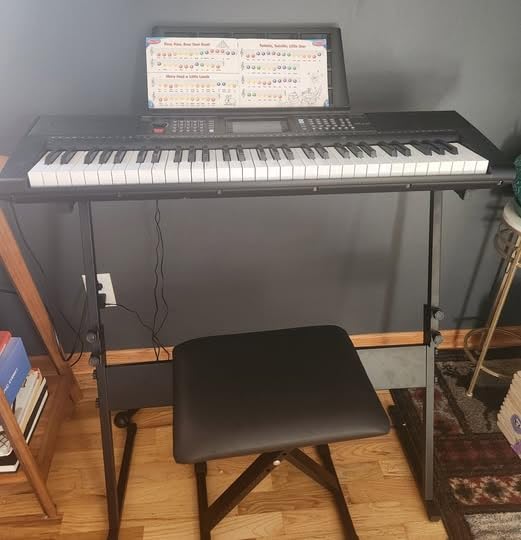
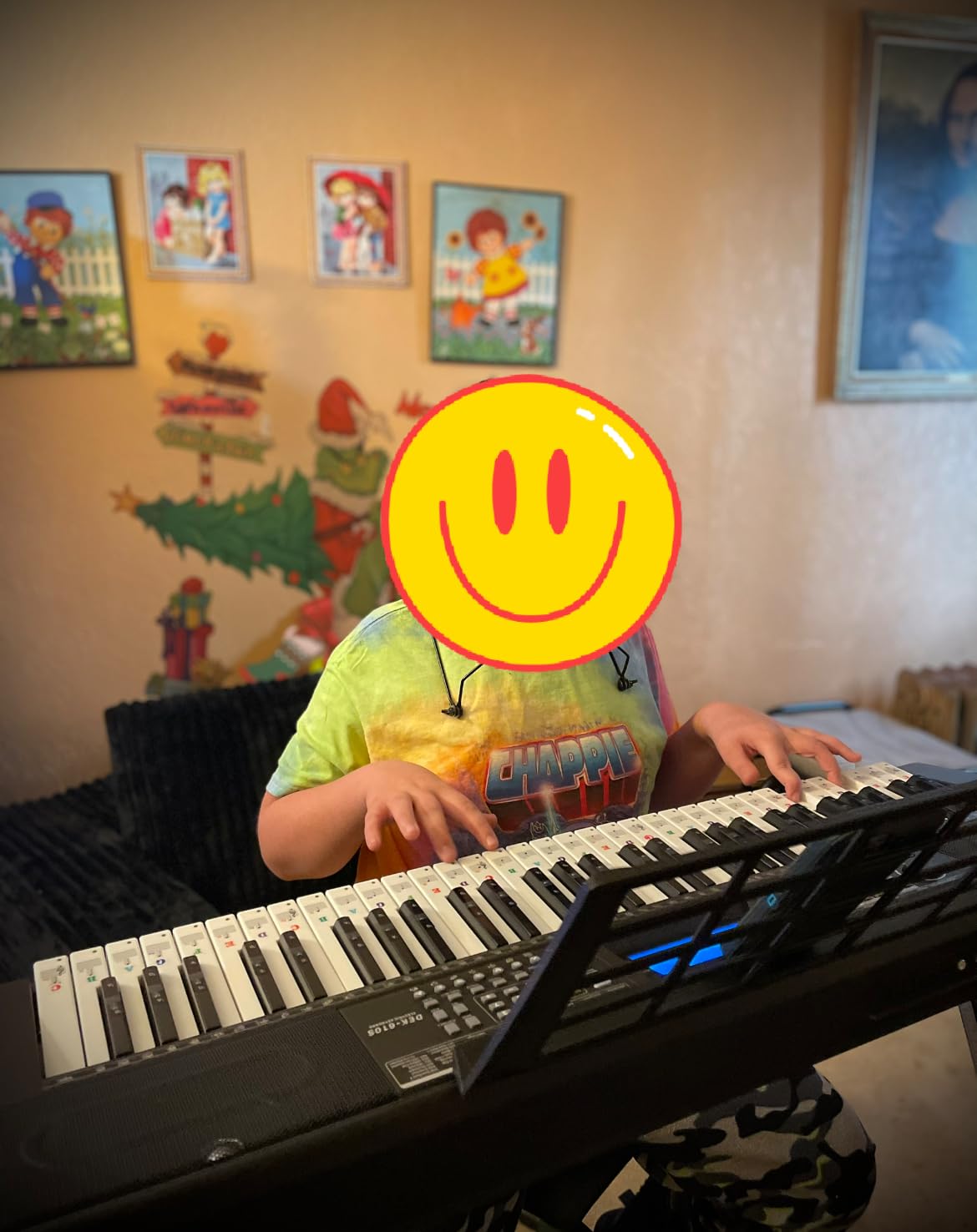
The Donner DEK-610S is the kit I recommend when someone asks for a single gift that includes everything a beginner needs plus a microphone for singing along. The bundle ships with the 61-key keyboard, an easy-to-assemble stand, an adjustable bench, a sheet music rest, a microphone, and a power adapter. That is a meaningful step beyond the typical “keyboard only” starter package and removes the friction of buying separate accessories.
The keyboard itself is more capable than the price suggests. 249 voices, 249 rhythms, 50 demo songs, and three teaching functions cover far more material than most beginners will explore in their first year. The 2x10W speakers deliver surprisingly room-filling sound for casual play, and the 3.5mm headphone output means late-night practice does not disturb the rest of the house. The Donner Music APP adds structured lesson content that beginners can follow on a phone.
Be realistic about the trade-offs. Polyphony is limited to 32 notes, which means dense classical passages can drop notes as the keyboard runs out of voice memory. The keys are unweighted, so this is not the board that will train piano technique – it is a starter, not a long-term instrument. The bundled bench and microphone are utilitarian rather than premium; reviewers on forums describe them as “fine for getting started, replace when committed.”
None of those issues stop the DEK-610S from being one of the strongest gift options in the beginner tier. If the recipient sticks with lessons after the first six months, plan to upgrade to a Donner DEP-20 or Roland FP-10 for weighted action and richer piano tone.
Who the Donner DEK-610S is good for
This is the right beginner electric piano for a gift occasion – birthday, holiday, or back-to-school – where you want a complete kit ready to play on day one. It works well for a young child starting lessons, a teen interested in pop-style keyboard play, and a casual adult who wants something fun and easy to set up. The included microphone adds a karaoke dimension that younger beginners especially enjoy.
Who should look elsewhere
If you want weighted keys from day one, the Donner DEP-20 or Yamaha P45B is the better answer. If you want Bluetooth MIDI for app-based lessons, the Roland FP-10 is the only board in this range with that feature. And if you want lighted keys for guided learning, the Hricane or JIKADA boards are cheaper options.
10. JIKADA 61-Key Lighted Keyboard – Best Lighted-Key Starter Kit
JIKADA 61 Key Portable Electronic Keyboard Piano,3 Teaching Modes
61 lighted full-size keys
255 tones
Three teaching modes
Complete bundle
Pros
- 61 full-size lighted keys make learning chords and notes intuitive
- Three teaching modes plus note stickers guide step-by-step learning
- Bundle includes X-stand
- stool
- headphones
- microphone and music rest
- Status memory function saves settings between sessions
Cons
- Keys are not weighted
- so it does not teach acoustic piano technique
- Instructions included with the bundle are not very detailed
- Microphone and headphones are basic compared with dedicated gear
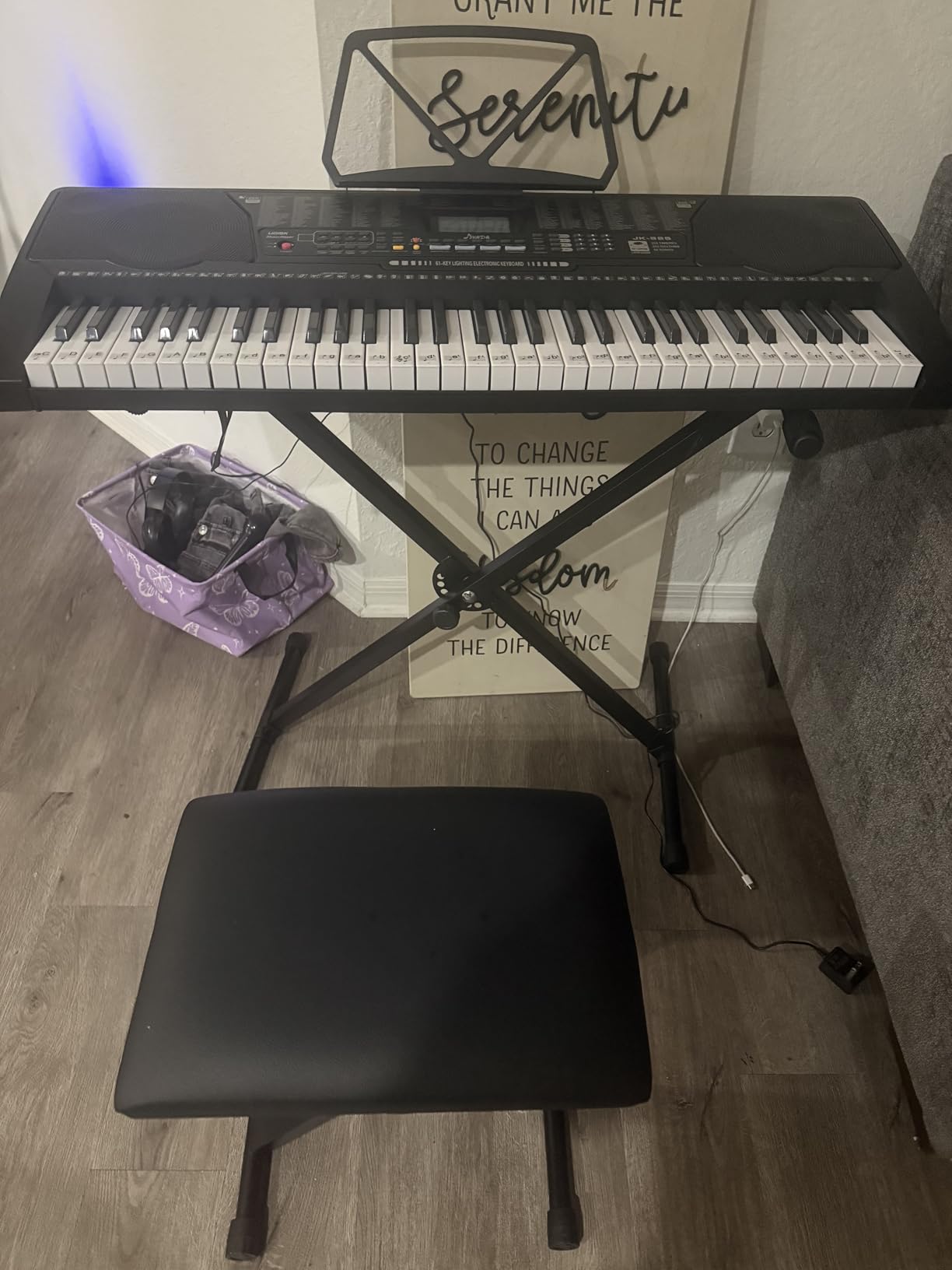
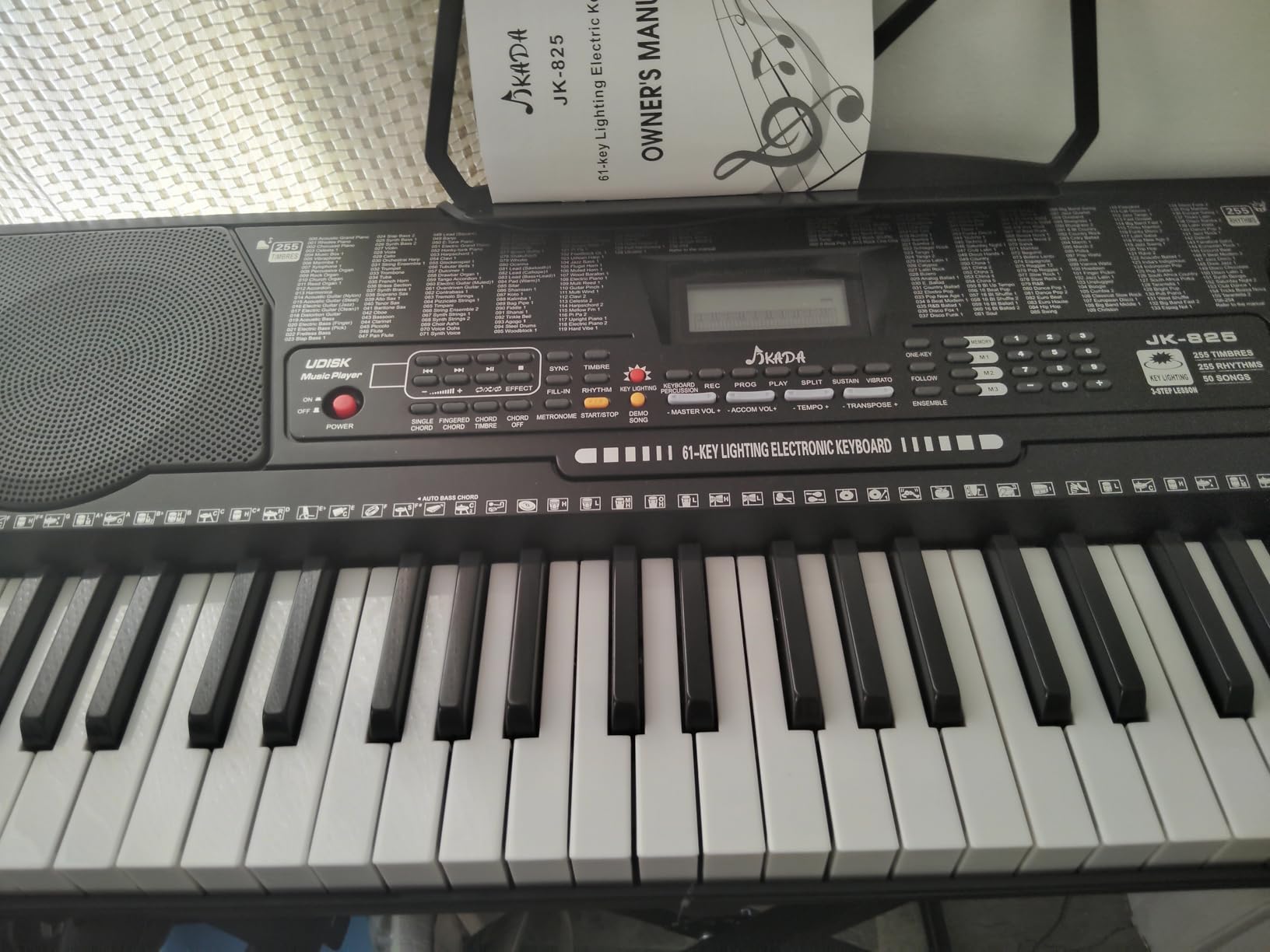
The JIKADA 61-key lighted keyboard is the kit I reach for when a parent asks for something specifically designed for a young child taking their first lessons. The lighted keys guide finger placement during the built-in demo songs, and the three teaching modes – one-finger, follow-along, and concert – give a beginner a structured way to progress without constant adult help.
The feature library is generous for the price. 255 tones, 255 rhythms, 50 demo songs, and 61 types of keyboard percussion keep a curious child engaged well past the first month of lessons. The status memory function saves tone, rhythm, and tempo settings between sessions, which is a small but appreciated touch – many beginner boards reset every time you power them off. The bundle includes the X-shaped stand, a soft stool, headphones, a microphone, a music rest, and a power adapter.
The compromises match the price. The keys are not weighted, so this is not the board that will develop piano technique. The bundled microphone and headphones are basic compared with dedicated gear. The printed instructions are sparse, and several reviewers describe having to search online to unlock some of the more advanced features. None of these issues stop the JIKADA from being a strong starter for a child.
For parents whose child has never touched a keyboard, the lighted keys and teaching modes lower the activation energy of first lessons in a way that plain keyboards do not. If the child sticks with lessons after six months, the natural upgrade is a Donner DEP-20 or Roland FP-10 with proper weighted action.
Who the JIKADA is good for
This is the right beginner electric piano for a young child taking their first lessons. It works well as a holiday or birthday gift, as a practice keyboard for a child whose primary instrument lessons happen at school, and as a starter for a family that wants to test a child’s interest before investing in a more expensive weighted board. The lighted keys and teaching modes make it especially good for self-guided practice between lessons.
Who should look elsewhere
If you want weighted keys from day one, skip straight to the Donner DEP-20 or Roland FP-10. If you want Bluetooth MIDI for app-based lessons, none of the budget starter kits include it – the Roland FP-10 is the entry point. And if you want a more complete accessory bundle with bench, the Donner DEK-610S or RockJam RJ5061 are stronger at the same price.
Beginner Electric Piano Buying Guide: What Actually Matters?
This section answers the things beginners actually ask before they buy: weighted keys, key count, sound quality, console vs portable, accessories, and which beginner mistakes to avoid. If you are still choosing between the picks above, working through this guide will narrow things down.
Why Weighted Keys Matter for Beginners
Weighted keys are the single most important feature on a beginner electric piano. A weighted (or “hammer action”) key simulates the resistance of an acoustic piano hammer, with the bass keys heavier than the treble keys. That resistance is what builds the finger strength and control that makes piano technique transfer cleanly – whether you stick with a digital piano or eventually move to an acoustic upright or grand.
Unweighted keyboards (like the Casio CT-S200, RockJam RJ5061, Hricane, JIKADA, and Donner DEK-610S in this guide) are fine for casual play and chord-based pop repertoire, but they will not train the same technique. Beginners who plan to take classical lessons or play acoustic-style repertoire should start on a weighted board. The Donner DEP-20, Roland FP-10, and Yamaha P45B are the right picks in this guide for weighted action under 500.
Three terms matter here. “Semi-weighted” (Alesis Recital) means a spring-based resistance – lighter than hammer action but more realistic than unweighted. “Graded hammer action” (Yamaha P45B, Donner DEP-20) means the resistance varies from bass to treble, mimicking an acoustic. “PHA-4” (Roland FP-10) is Roland’s specific graded hammer action with ivory-feel keytops and escapement – the most realistic feel in this price range.
88 Keys vs 61 vs 76: Which Should a Beginner Choose
For most beginners, 88 keys is the right answer. A full piano has 88 keys, and many beginner method books include pieces that use the full range. Starting on 61 or 76 keys means you will outgrow the keyboard within a year as soon as you tackle repertoire that requires more range. Multiple reviewers on r/pianolearning describe the jarring experience of upgrading from 61 to 88 keys mid-learning and wishing they had started on the larger board.
That said, 61 keys makes sense for very young children, for casual chord-based play, and for situations where portability matters more than repertoire range. The Casio CT-S200 and Hricane are strong 61-key picks. 76 keys is a compromise most beginners should skip – either commit to 88 for full repertoire coverage or save money with 61 for casual play.
Console vs Portable: Which Form Factor Fits You
Portable boards (Roland FP-10, Donner DEP-20, Yamaha P45B, Alesis Recital) are designed to live on a stand and move when you need them. They are best for small spaces, apartments, gigging musicians, and anyone who wants to put the piano away between practice sessions. Most weigh between 11 and 27 pounds.
Console digital pianos (Casio PX-870) are full furniture pieces with built-in cabinets, sliding key covers, and powerful multi-speaker systems. They are best for dedicated music rooms, living rooms where the piano becomes a permanent fixture, and buyers who want the visual presence of an acoustic upright. The trade-off is weight – the PX-870 weighs 106 pounds and is not designed to move.
Digital Piano vs Keyboard: What’s Actually Different
In shopping results these terms get used interchangeably, but they describe different things. A digital piano aims to replicate an acoustic piano’s feel and sound – weighted keys, piano-focused sound engines, minimal non-piano voices. A keyboard (or “arranger keyboard”) focuses on versatility – hundreds of voices and rhythms, lighter keys, often unweighted, designed for pop, EDM, and casual play.
For a true beginner learning piano for the first time, a digital piano is almost always the right call. The weighted action and piano-focused sound engine build the technique and ear training that transfer cleanly to any future piano. Keyboards make sense as a secondary instrument, a travel companion, or a gift for someone whose primary interest is pop or electronic music rather than piano repertoire.
What to Look For in a Beginner Electric Piano
Five criteria matter most when choosing a beginner electric piano in 2026. First, weighted keys with graded action – the single most important feature for serious learners. Second, 88 full-size keys if you plan to take classical lessons or play acoustic-style repertoire. Third, at least 64-note polyphony so dense passages do not drop notes. Fourth, a quality headphone output for silent apartment practice. Fifth, Bluetooth MIDI or USB MIDI if you plan to use learning apps like Flowkey, Simply Piano, or Skoove.
Three more features are worth considering if your budget allows. A sustain pedal input (preferably with a continuous pedal for half-pedaling) is essential for expressive playing. Split and layer modes help with teacher-student lessons and combining voices. A built-in metronome is a small but valuable practice tool that almost every board in this guide includes.
Accessories Checklist for a First Piano
Three accessories matter for almost every beginner: a stand (X-stand for portability, furniture stand for stability), a bench (adjustable height is worth the small extra cost), and a sustain pedal (the bundled pedal on most boards is basic; pianists who care about half-pedaling should buy a continuous pedal). Most of the complete kits in this guide – RockJam RJ5061, Donner DEK-610S, JIKADA – include all three.
Two more accessories are worth budgeting for. A quality pair of headphones (Audio-Technica ATH-M20x, Sony MDR-7506, or any closed-back over-ear pair in the 30 to 80 range) makes practice far more enjoyable, especially for apartment dwellers. A USB MIDI adapter or Bluetooth MIDI host lets you connect older boards to iOS apps if your board lacks built-in Bluetooth. None of the picks in this guide require these accessories to be useful, but they make the experience better.
What to Skip: Red Flags for Beginners
Four things are worth avoiding when shopping for a beginner electric piano. First, unweighted keyboards for serious classical study – the technique you build will not transfer to a weighted or acoustic piano. Second, off-brand Amazon boards with no name recognition – reviewers on Sound on Sound and Piano World forums warn repeatedly against boards with inflated spec sheets and unreliable build quality. Third, boards with polyphony below 32 notes – dense passages will drop notes and frustrate a beginner. Fourth, used boards without a return window – worn keys, dead zones, and missing pedals are common on older instruments and difficult to diagnose without playing the board first.
Two more pitfalls are worth flagging. Buying a 61-key board for a child in formal lessons – they will outgrow it within a year as soon as method books include pieces that need more range. Skipping the headphone purchase for apartment practice – the speakers on most boards in this price range are not designed to fill a room without distortion, and late-night headphone practice is what makes daily habit formation possible for busy adults.
Beginner Child vs Adult: Which Decision Tree Fits You
For a child under 10 just starting lessons, the priority is engagement and low cost. Lighted keys, complete kits, and unweighted action are appropriate – the Hricane, JIKADA, RockJam RJ5061, or Donner DEK-610S are all strong picks. The child is unlikely to commit to classical repertoire in the first six months, and the fun factor of demo songs, rhythms, and bundled accessories matters more than realistic key action.
For an adult beginner or a serious teen, the priority is technique transfer. Weighted 88-key action, quality piano sound, and quiet headphone practice are non-negotiable. The Donner DEP-20, Roland FP-10, and Yamaha P45B are the right picks. If the adult lives in an apartment and plans to practice late at night, prioritize boards with quiet key action and good headphone output – the Roland FP-10 and Alesis Recital are particularly strong here.
For an adult returner who played years ago and wants to pick the instrument back up, the bar is even higher. The Casio PX-870 console or Roland FP-10 with proper headphones and a continuous sustain pedal is the right starting point. These buyers know what an acoustic piano feels like and will be unsatisfied with anything that compromises too much on key feel or sound quality.
Brand Showdown: Yamaha vs Roland vs Kawai vs Casio vs Donner
Five brands dominate beginner electric pianos in 2026, and each has a clear personality. Yamaha is the safe, traditional choice – reliable action, classic piano tone, simple interfaces, broad availability. The P45B is the entry-level benchmark. Roland is the action innovator – PHA-4 hammer action is the most realistic feel under 500, and Bluetooth MIDI is included even on the budget FP-10. Kawai is the connoisseur’s pick – Responsive Hammer actions and Harmonic Imaging sound engines are widely praised by piano teachers, though Kawai’s beginner lineup is harder to find on Amazon than Yamaha and Roland.
Casio is the value and feature champion – the CT-S200, Privia line, and PX-S series pack more features per dollar than any competitor, with the trade-off being slightly less refined action at the entry level. Donner is the budget disruptor – the DEP-20 and DEK-610S deliver weighted 88-key action and complete kits at price points where Yamaha and Roland offer only unweighted 61-key boards. The trade-off is brand longevity: Donner has been in the digital piano market for less than a decade, and long-term reliability is less proven than Yamaha or Roland’s.
For parents and gift-givers, Yamaha, Roland, and Casio are the safest long-term bets. For buyers on tighter budgets willing to trade some brand prestige for action and features, Donner is the strongest disruptor in 2026. For buyers who want the absolute best action under 500, Roland’s FP-10 remains the consensus pick across reviewers, teachers, and forum veterans.
Frequently Asked Questions
What electric piano feels most like a real piano?
The Roland FP-10 feels most like a real piano under 500 because it uses PHA-4 graded hammer action with ivory-feel keys and escapement, paired with the SuperNATURAL piano sound engine. Above 800, the Casio PX-870 console adds sympathetic string and damper resonance modeling for a closer acoustic feel. The single most important factor is graded hammer action with weighted keys – that is what replicates the resistance of an acoustic piano and builds proper finger technique.
Are electric pianos good for beginners?
Yes, electric pianos are excellent for beginners because they let you practice with weighted keys and quality piano sound at a small fraction of the cost of an acoustic piano. A good beginner electric piano like the Donner DEP-20, Roland FP-10, or Yamaha P45B builds the same finger technique as an acoustic because the keys are weighted. Headphone outputs also let beginners practice silently in apartments, which is essential for daily habit formation.
Should a beginner piano have 61 or 88 keys?
Most beginners should start with 88 keys because a full acoustic piano has 88 keys and many beginner method books include pieces that use the full range. Starting on 61 keys means you will outgrow the keyboard within a year. 61 keys makes sense for very young children just starting lessons, for casual chord-based play, and for travel keyboards where portability matters more than repertoire range.
What is the best digital piano for a beginner child?
For a child under 10 just starting lessons, the JIKADA 61-Key Lighted Keyboard and Hricane 61-Key Lighted Keyboard are the strongest picks because lighted keys guide finger placement and the bundled accessories remove setup friction. For a child in formal classical lessons, the Donner DEP-20 is the better long-term answer because 88 weighted keys build the technique that transfers to an acoustic piano.
What is the best digital piano that feels like a real piano?
The Casio PX-870 feels most like a real piano in this guide because it adds sympathetic string and damper resonance modeling on top of scaled hammer-action keys with simulated ebony and ivory textures. Among portable boards, the Roland FP-10 with PHA-4 hammer action and SuperNATURAL sound engine is the closest feel under 500. Both deliver realistic acoustic-style play at very different price points.
What are the downsides of a digital piano?
The main downsides of a digital piano are that even the best boards do not perfectly replicate the soundboard resonance of an acoustic piano, the key action is a mechanical approximation rather than a real hammer, and built-in speakers are limited compared with the room-filling sound of an acoustic. Weighted keys also cannot fully replicate the irregular response of an acoustic action. For most beginners these trade-offs are well worth the cost savings and silent-practice convenience.
Final Verdict: Which Beginner Electric Piano Should You Buy?
If you want one pick that handles every beginner scenario well, the Roland FP-10 is the best beginner electric piano in 2026. The PHA-4 action is the action benchmark under 500, the SuperNATURAL piano tone holds up to a year of daily practice, and Bluetooth MIDI handles wireless app lessons cleanly. For tighter budgets the Donner DEP-20 delivers 88 weighted keys and a full feature set at a much lower price. For absolute beginners on the smallest budgets, the Hricane 61-Key Lighted Keyboard is the most accessible entry point.
For more options at specific price points, see our full guides to the best electric pianos under 500, the best electric pianos under 300, and the best electric pianos under 1000. If you are also shopping for a guitarist in the family, our picks for the best beginner electric guitars for every generation follow the same testing approach.
The single most important thing a beginner can do is practice on a board with weighted keys. The picks in this guide cover every budget from under 100 to under 900, and each one will serve you well. Pick the one that matches your budget, set up a daily practice routine with headphones, and enjoy the process.