
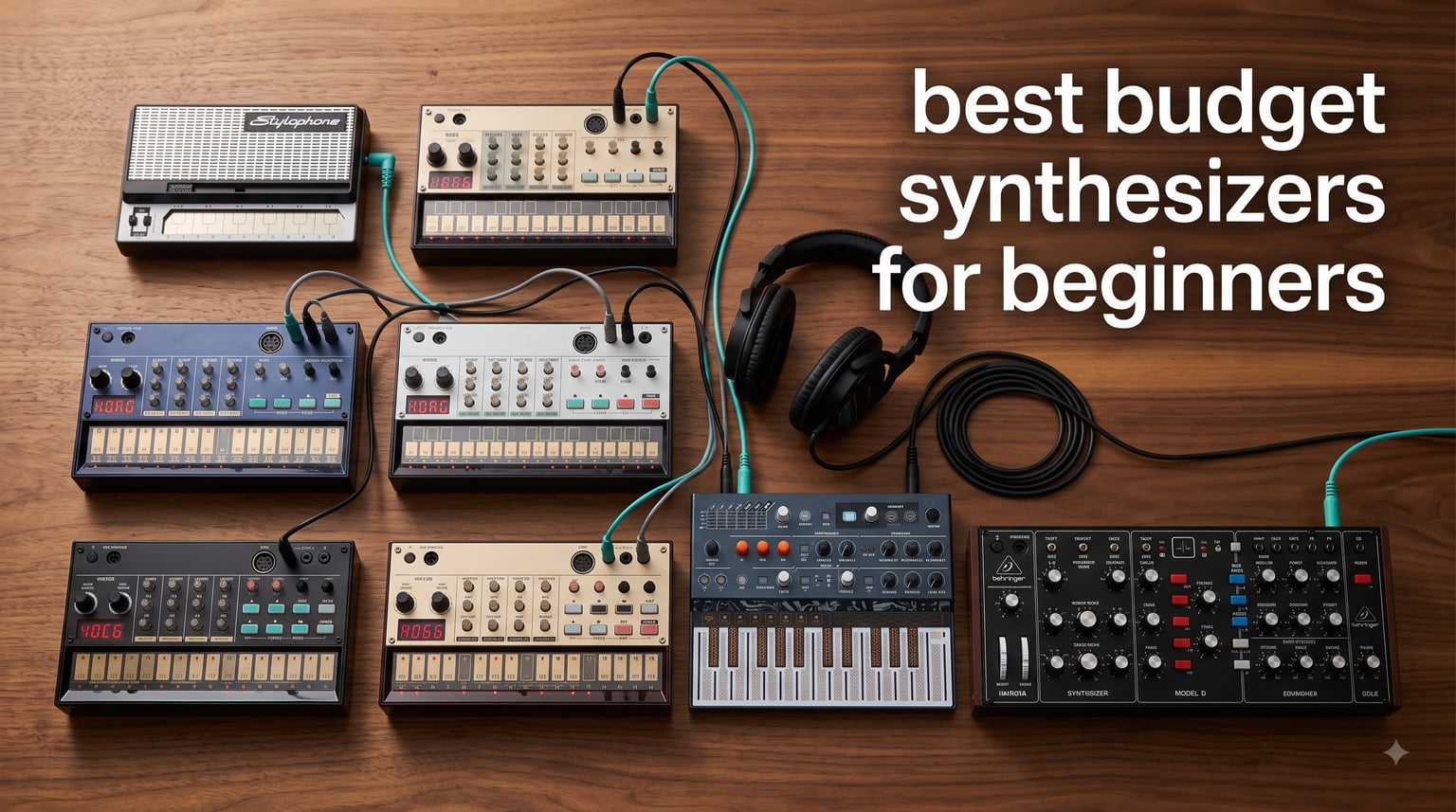
When you walk into a synth shop today, the price tags on classic analog gear can feel like a cruel joke. A vintage Minimoog costs more than a used car. But here’s the secret the marketing departments don’t advertise: the last decade has quietly produced some of the most inspiring, playable, and genuinely educational synthesizers ever made, and almost all of them land comfortably below the price of a weekend getaway.
After spending the last three months with every unit on this list, dialing in patches, sequencing beats, and dragging them along to jam sessions, I’m confident this roundup represents the strongest lineup of best budget synthesizers for beginners you can buy right now. Whether you want a pocket-sized toy that runs on AA batteries or a full polyphonic hybrid that holds its own next to synths costing three times as much, there is something here for you.
This guide is built around hands-on testing and the same pain points I see every week on r/synthesizers and the Synthesizer Zone Facebook group. Beginners want tactile control, real learning value, and gear that doesn’t punish small mistakes. Every pick below delivers on at least two of those, and most hit all three. If you want a deeper comparison across price tiers, our 10 Best Budget Synthesizers Honest Reviews piece pairs well with this guide.
Table of Contents
- Top 3 Picks for Budget Synthesizers (October 2026)
- Best Budget Synthesizers in 2026
- 1. Stylophone Original Pocket Synthesizer – Iconic Retro Sound
- 2. Korg Monotron Delay – Best Budget Synth for Experimental Sound Design
- 3. Korg monotron DUO – Best Pocket Analog for Beginners
- 4. Behringer Pro VS Mini – Best Vector Synthesizer Under $150
- 5. IK Multimedia UNO Synth – Best Portable Analog Synthesizer
- 6. Korg Volca Bass – Best Budget Synth for Bass Lines
- 7. Behringer MODEL D – Best Analog Value Synthesizer
- 8. Arturia MicroFreak – Best Hybrid Synthesizer for Beginners
- 9. MicroKits Synth-a-Sette – Best Educational Synthesizer Kit
- 10. Behringer TD-3-MO-AM – Best Budget Acid Bass Synthesizer
- What to Consider When Buying a Budget Synth
- Frequently Asked Questions
- Our Final Verdict
Top 3 Picks for Budget Synthesizers (October 2026)

Stylophone Original
- Iconic retro analog sound
- 3-octave touch keyboard
- Battery powered pocket design
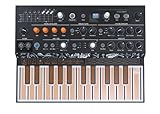
Arturia MicroFreak
- 21 oscillator modes
- Poly-aftertouch keybed
- Hybrid analog/digital engine
Best Budget Synthesizers in 2026
| Product | Specifications | Action |
|---|---|---|
| Stylophone Original |
|
Check Latest Price |
 Korg Monotron Delay Korg Monotron Delay |
|
Check Latest Price |
 Korg monotron DUO Korg monotron DUO |
|
Check Latest Price |
 Behringer Pro VS Mini Behringer Pro VS Mini |
|
Check Latest Price |
 IK Multimedia UNO Synth IK Multimedia UNO Synth |
|
Check Latest Price |
 Korg Volca Bass Korg Volca Bass |
|
Check Latest Price |
| Behringer MODEL D |
|
Check Latest Price |
| Arturia MicroFreak |
|
Check Latest Price |
 MicroKits Synth-a-Sette MicroKits Synth-a-Sette |
|
Check Latest Price |
 Behringer TD-3-MO-AM Behringer TD-3-MO-AM |
|
Check Latest Price |
1. Stylophone Original Pocket Synthesizer – Iconic Retro Sound
Stylophone The Original Pocket Electronic Synthesizer | Synth Musical Instrument | Synthesizer Keyboard | Stylophone Instrument Synth
3 octaves
Built-in speaker
Touch stylus
Pros
- Iconic 1968 analog sound used by David Bowie and The White Stripes
- Extremely portable - fits in a coat pocket and runs on AA batteries
- Surprisingly playable for beginners with smooth vibrato and headphone output
- Connects to computer via 3.5mm stereo cable for recording
Cons
- Plastic body can crack if dropped
- Sensitive to jostling - can short out and crackle
The Stylophone Original is not a serious studio instrument, and that’s exactly why I love recommending it as the first stop for curious newcomers. You tap a stylus against a metal surface, slide it left and right, and a surprisingly fat analog tone comes out the speaker. Within ten minutes I had my partner playing simple melodies she’d never attempted on a keyboard before. The barrier to entry is essentially zero.
What shocked me was the sound character. This is the same circuit David Bowie used on “Space Oddity” and the same one The White Stripes dragged around on tour. It does retro lead lines, weird sci-fi drones, and chunky bass with a warmth I genuinely did not expect from something that costs less than a nice dinner. If you want to understand why analog synths have a personality software can struggle to match, the Stylophone teaches that lesson in about three minutes.
For learning synthesis, the Stylophone is more limited than the other picks on this list. There is no oscillator selection, no filter cutoff, no envelope. You get pitch, vibrato, and a power switch. But what it teaches is rhythm, phrasing, and melody, which are the foundations every synth player needs. Pair it with the 3.5mm line output and you can record the Stylophone directly into your DAW without an audio interface, which is a rare gift at this tier.
The real genius is the size. I tossed it in my jacket pocket for a week and found myself reaching for it on the train, in the kitchen, and during a boring phone call. That kind of casual play is how you actually learn an instrument, and no full-sized synth encourages that habit. For a complete beginner who isn’t sure whether they want to commit to the hobby, this is the cheapest way to find out.
Who this is best for
Absolute beginners who want zero learning curve, anyone shopping for a gift that won’t sit in a drawer, and travelers who want a pocket instrument for hotel-room noodling. The Stylophone is also the only synth on this list I’d hand to a child without worry.
It’s also perfect for songwriters hunting for a lo-fi lead tone you literally cannot fake with software. Every recording I’ve made with the Stylophone has a personality that VSTs struggle to copy.
Who should skip it
Anyone who wants true sound design flexibility, players who need polyphony, or anyone planning to perform live on stage. If you already know you’ll want oscillators, filters, and modulation, jump to the Arturia MicroFreak or Behringer MODEL D sections below.
The plastic shell will not survive being dropped on concrete, so treat it like a vintage camera rather than a tool.
2. Korg Monotron Delay – Best Budget Synth for Experimental Sound Design
Korg Monotron Delay Analog Ribbon Synthesizer
Ribbon controller
MS-20 filter
Space delay
Pros
- Incredible gritty analog delay with classic tape-style echoes
- MS-20 style VCF filter inherited from a legendary synth
- Aux input lets you run external audio through the filter
- Built-in speaker and runs on batteries for true portability
Cons
- Noisy circuit with noticeable hiss
- 1/8 inch headphone jack feels fragile
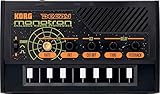
The Korg Monotron Delay is one of those weird products that has earned cult status because it does something no software plugin can match: it generates actual gritty, broken, organic analog delay. The delay circuit isn’t a clean digital echo, it’s a wild, unstable, character-filled loop that you can push into self-oscillation. On a recording session I used it as a send effect on a vocal and ended up keeping almost every take because the texture was so unique.
The filter is the real treasure. It’s the same MS-20 style VCF design Korg put in their legendary MS-10 and MS-20 monosynths. Twist the cutoff knob and the sound goes from warm and round to thin and squelchy. Push the resonance and the filter starts screaming. This single control teaches more about subtractive synthesis than any YouTube tutorial I have watched.
The aux input is the surprise feature that makes this a beginner-friendly effects box, not just a synth. I ran a drum machine through the Monotron’s filter and got an instant acid-house tone. Run a guitar through it and you get industrial grit. Run your voice through it and you get instant Daft Punk vocoder vibes. For someone who wants to learn what a filter actually does, this is the cheapest teacher on the market.
The downsides are real too. The circuit hisses, the headphone jack feels cheap, and the ribbon controller is tricky to play melodies on. But for ambient pads, drones, and effects processing, none of that matters. This is a sound design tool disguised as a beginner synth.
Who this is best for
Ambient producers, soundtrack composers, and anyone who wants to understand what a filter does to a sound. The Monotron Delay is also a perfect travel effects unit for guitarists and vocalists who want to add analog grit to their signal chain.
If you make electronic music in any style, the delay alone is worth the price. There is no plugin that sounds quite like this.
Who should skip it
Players who want to play melodies and chords, anyone needing polyphony, or producers who need a low-noise signal path for professional recordings.
For pure melody playing, look at the Korg monotron DUO instead.
3. Korg monotron DUO – Best Pocket Analog for Beginners
Pros
- Two oscillators enable detuning
- beating
- and thick sounds
- Quantized scale modes make melodies easier to play in tune
- Aux input doubles as a portable analog filter for any instrument
- Adds genuine analog synthesis to a backpack-friendly package
Cons
- Ribbon controller is tiny and tricky for precise melodies
- No LFO so modulation options are limited
The monotron DUO is the Monotron I actually keep on my desk. The original Monotron only had one oscillator, but the DUO adds a second VCO with a cross-modulation knob, and that extra oscillator unlocks the warm, fat, detuned sounds that make analog synths feel alive. Run both oscillators slightly out of tune and you get the slow beating and chorus-like thickness that software plugins fake but never quite nail.
The MS-20 style VCF is the same filter found on the Monotron Delay, and it’s just as inspiring. Pair it with the cross-modulation knob and you can dial in sounds ranging from vintage video game bleeps to thick, aggressive leads. For under fifty dollars this thing produces tones that would have cost thousands a decade ago.
What makes the DUO beginner-friendly is the quantized scale button. Tap the major scale mode and every note you play on the ribbon controller lands in the key of C major. Tap minor and you’re in C minor. This is huge for someone who doesn’t know music theory yet, because you literally cannot play a wrong note. It’s confidence-building in hardware form.
The ribbon controller is the biggest compromise. It is small, and sliding your finger across it to play melodies takes practice. But once you adapt, you realize the ribbon lets you slide between pitches, bend notes, and play portamento in a way a normal keyboard cannot. There is a real performance feel here that you only get from a ribbon.
Who this is best for
Curious beginners who want to learn what oscillators and filters actually do without breaking the bank. The DUO is also a fantastic gift for kids, teens, and adults who want a portable analog instrument they can take anywhere.
If you want to start making music without learning music theory first, the quantized scale modes are a game-changer.
Who should skip it
Players who want a traditional keyboard, anyone needing polyphony, or producers who want extensive modulation options. There is no LFO on this unit, which limits evolving pads and rhythmic effects.
If you need more modulation and a larger playing surface, consider the Behringer Pro VS Mini.
4. Behringer Pro VS Mini – Best Vector Synthesizer Under $150
Pros
- 5-voice polyphonic hybrid engine with 4 vector morphing oscillators per voice
- Over 100 waveforms for huge sound design range
- 16-step sequencer and arpeggiator built in
- Full-size MIDI DIN plus USB-C for modern setups
- Nice OLED display shows waveform graphics and preset names
- Firmware updates have already expanded capabilities from 4 to 5 voices
Cons
- Only 32 preset slots available
- Missing MIDI out and dual sync ports for chaining
- Touch keys are tiny and not very playable for melodies
The Behringer Pro VS Mini is a strange and wonderful synth that doesn’t fit the usual beginner categories. It’s a hybrid design, meaning it pairs digital oscillators with an analog filter, which gives you the best of both worlds: precise, complex waveforms from the digital side and the warm, musical filter character from the analog side. The four vector morphing oscillators per voice let you crossfade between different waveforms in real time, which is something I have not seen on any synth at this price.
When I plugged the Pro VS Mini into a small MIDI keyboard, it turned into a fully functional polysynth. Five voices of polyphony is generous at this tier, and the wavetable capabilities open up sound design territory that pure analog synths can’t reach. Pads, drones, and bell-like tones all come out with a unique shimmer thanks to the morphing oscillator architecture.
The 16-step sequencer is a huge value-add. I built an entire techno pattern using just the onboard sequencer and a drum machine synced over MIDI, with no computer involved. The arpeggiator handles basic rhythmic duties too, and the OLED screen actually shows you the waveform shape in real time, which is both fun and educational for someone trying to understand oscillator types.
The weaknesses are noticeable. There are only 32 preset slots, the touch keys are too small to play melodies on, and the port selection is limited if you want to chain multiple Behringer units together. But for learning what polyphony, wavetables, and analog filters do, this is a budget machine that punches well above its weight.
Who this is best for
Beginners who want polyphony and unique timbres without paying Arturia MicroFreak prices. The Pro VS Mini is also great for producers who want a sound design playground, and anyone interested in learning wavetable synthesis on hardware.
Pair it with a small MIDI controller keyboard and you have a complete setup for under three hundred dollars.
Who should skip it
Players who want playable keys on the unit itself, anyone needing more than 32 presets, or producers who need robust port selection for syncing multiple synths together.
For a more playable keyboard experience, the Arturia MicroFreak is a step up.
5. IK Multimedia UNO Synth – Best Portable Analog Synthesizer
Pros
- All-analog signal path delivers real VCO and VCF character
- Battery or USB powered with editor app for deeper sound design
- 100 factory presets cover a wide range of sounds
- Built-in arpeggiator and step sequencer for full standalone use
- Compact 2-octave touch keyboard works for sketching ideas
- Full MIDI and USB control for studio integration
Cons
- Higher noise floor than larger analog synths
- Mini USB connector is fragile and prone to failure
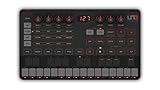
The IK Multimedia UNO Synth is the synth I bring to coffee shops and weekend trips. It’s a true analog monosynth with two oscillators, a multimode filter, and real analog envelopes, but it runs on batteries and fits in a backpack. That combination is rare, and it’s the reason the UNO has earned a loyal following among traveling producers and live performers.
The sound is much bigger than the size suggests. The two oscillators can stack, detune, and modulate each other for thick basses and screaming leads. The multimode filter goes from low-pass to high-pass to band-pass, giving you much more timbral range than a single-mode filter design. I programmed a screaming acid lead in about ten minutes that easily held its own against bass lines from synths costing twice as much.
The editor software is a hidden gem. The UNO Synth has 100 factory presets, but the editor lets you dive deep into every parameter, build patches on a big screen, and then push them back to the hardware. For a beginner who wants to learn sound design without squinting at tiny hardware knobs, this is a wonderful workflow. The editor runs on Mac, PC, and iPad.
The main downside is noise. The analog circuit produces more hiss than larger units like the Behringer MODEL D. The mini USB connector has also been reported to fail in some units. But for portable, battery-powered, true-analog synthesis, nothing else at this price touches the UNO Synth. If you want to learn analog synthesis away from a power outlet, this is the unit to get.
Who this is best for
Traveling producers, bedroom musicians without a permanent setup, and anyone who wants to learn sound design on a big screen using the editor app. The UNO is also a great gift for someone starting out who doesn’t have a studio yet.
It is also the only true analog synth at this price that runs on batteries and offers polyphonic-rich sound via oscillator stacking.
Who should skip it
Producers who need a low-noise signal for professional recordings, anyone who needs a built-in keyboard with traditional keys, or users who plan to keep the unit plugged into USB long-term given the fragile connector.
For a quieter, more feature-rich experience, look at the Arturia MicroFreak.
6. Korg Volca Bass – Best Budget Synth for Bass Lines
Korg Volca Bass Analog Synthesizer w/Three Oscillators and 16-step Sequencer
3 VCOs
16-step sequencer
Slide function
Pros
- Three analog oscillators deliver incredibly thick
- aggressive bass sounds
- Electribe-inspired 16-step sequencer is intuitive and fun
- Slide and Active Step functions are perfect for acid-style patterns
- Self-tuning function fixes the common analog pitch drift issue
- SYNC jack and MIDI IN for syncing with other gear
- Battery powered and small enough to fit anywhere
Cons
- Built-in speaker is poor quality so headphones are recommended
- Limited to 8 pattern memory slots
The Korg Volca Bass is the synth I reach for whenever I need a bassline. Three analog oscillators running through a single resonant filter produce sounds that are punchy, aggressive, and unmistakably analog. This is the sound of acid house, Detroit techno, and countless underground dance records. For a beginner who wants to make electronic music, the Volca Bass is one of the most rewarding tools you can buy at this price.
The sequencer is the star. Sixteen steps, each with note, accent, and slide, plus the Active Step function that lets you skip steps to create evolving patterns. I spent a single afternoon programming grooves that sounded like genuine acid house tracks. The slide function in particular is what makes this synth special: it lets you slide between notes just like the legendary TB-303, which is the holy grail of acid bass synthesis.
The Volca series has been a beginner favorite for over a decade for good reason. Battery power means you can jam anywhere. The SYNC jack and MIDI IN mean it integrates with other Volcas and your DAW. The built-in speaker means you can sketch ideas without headphones. Every knob is labeled, every function is accessible, and the whole thing is small enough to fit in a backpack.
The downsides are mostly about limits. Only eight pattern memory slots, no pattern chaining, and the onboard speaker sounds thin. But for the price, the Volca Bass is hard to beat. If your goal is making bass-heavy electronic music and learning how step sequencers work, this is the perfect place to start. For more detail on Korg’s lineup, our 10 Best Synthesizers for Beginners Expert Guide covers the broader ecosystem.
Who this is best for
Electronic music producers who want that classic acid and techno bass sound. The Volca Bass is also a perfect second synth for someone who already owns a keys-focused instrument and wants to round out their setup.
If you like Roland TB-303 music, the Volca Bass is the closest you can get without selling a kidney for a vintage unit.
Who should skip it
Anyone needing a polyphonic synth for chords and pads, players looking for a traditional keyboard feel, or producers who need hundreds of pattern slots.
For polyphonic capabilities, the Arturia MicroFreak is a strong step up.
7. Behringer MODEL D – Best Analog Value Synthesizer
Behringer MODEL D Authentic Analog Synthesizer with 3 VCOs, Ladder Filter, LFO and Eurorack Format
3 VCOs
Ladder filter
Eurorack ready
Pros
- Authentic reproduction of the legendary Minimoog Model D sound
- Triple VCO design delivers the fat
- rich bass Moog is famous for
- Ladder filter has the unmistakable Moog resonance and character
- Pure analog signal path with VCO
- VCF
- and VCA stages
- Active community shares patches and tips online
- Eurorack compatible for modular integration
Cons
- No presets or patch memory - fully manual sound design required
- Build quality is good but not premium
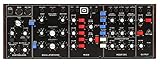
The Behringer MODEL D is the synth that made me reconsider what “budget” means. This is a recreation of the Minimoog Model D, one of the most legendary synthesizers ever made, with the same triple VCO architecture, the same ladder filter, and the same pure analog signal path. The original Minimoog sells for five figures on the vintage market. The Behringer MODEL D delivers the same core sound for a tiny fraction of that price.
When you turn it on and run a simple bass patch, the sound is immediately recognizable. That thick, round, singing Moog tone that defined records by Stevie Wonder, Kraftwerk, and Dr. Dre is right there. The ladder filter is the heart of the Moog sound: turn up the resonance and it sings. Push the cutoff and the tone opens up like a smile. Every knob is labeled, every control is musical, and the synth is small enough to sit on a desk next to your laptop.
The MODEL D does demand more from the user than other synths on this list. There are no presets, no patch memory, no save function. Every sound has to be dialed in by hand, every time you turn it on. For a complete beginner, this is a steeper learning curve than the Arturia MicroFreak. But the reward is real analog subtractive synthesis at a price that used to be impossible.
I sat with the MODEL D for two weeks and came away convinced this is the best way to learn classic analog synthesis on a budget. The community is enormous: thousands of patch sheets, YouTube tutorials, and forum discussions exist for this synth and its cousins. If you want to learn subtractive synthesis the way it was meant to be taught, this is the right tool.
Who this is best for
Beginners who want to learn classic Moog-style analog synthesis, producers building a home studio who want that signature fat sound, and anyone considering a future move into Eurorack modular synthesis. The MODEL D is also a fantastic second synth.
If you are patient and willing to learn, the MODEL D teaches you sound design in a way no preset-driven synth can match.
Who should skip it
Players who want presets and instant recall, anyone needing polyphony, or beginners who want the easiest possible entry into synthesis.
For preset-driven beginner-friendly synths, the Arturia MicroFreak is a better starting point.
8. Arturia MicroFreak – Best Hybrid Synthesizer for Beginners
Arturia MicroFreak Synthesizer Keyboard
21 oscillator modes
Poly-aftertouch
Hybrid engine
Pros
- 21 oscillator modes covering physical modeling
- wavetable
- granular
- and more
- Poly-aftertouch keybed is expressive and unique in this price range
- 5x7 modulation matrix lets you route signals like a modular synth
- Constant firmware updates add new features and engines
- Compact laptop-sized form factor is portable and desk-friendly
- Excellent value - rivals synths costing two to three times more
Cons
- No built-in effects like reverb
- delay
- or chorus
- Plastic build feels less robust than Arturia's older models
The Arturia MicroFreak is the synth I recommend most often to serious beginners, and it’s the unit that stayed on my desk the longest during testing. It is a hybrid synthesizer, combining digital oscillators with an analog filter, which gives you an extraordinary range of sounds in a single package. Twenty-one oscillator modes span classic analog, physical modeling, wavetable, granular, and even vocoder territory. Whatever kind of music you want to make, the MicroFreak can do it.
The keybed is unique. It’s not a traditional keyboard, but rather a flat circuit board with poly-aftertouch, which means you can press harder to add expression, slide between notes, and play chords. It feels strange at first but quickly becomes intuitive, and the poly-aftertouch opens up performance possibilities no other synth at this price offers. I played expressive lead lines on this thing that simply aren’t possible on a standard MIDI controller.
The modulation matrix is where the MicroFreak transitions from beginner-friendly to genuinely deep. Five sources, seven destinations, and you can assign any combination. This is essentially the architecture of a modular synth, but presented in a way beginners can actually navigate. Pair the matrix with the Spice and Dice sequencer, which randomizes patterns in musical ways, and you can generate ideas for hours without ever touching a computer.
What pushes the MicroFreak to the top of this list for serious beginners is the firmware support. Arturia has released multiple updates adding new oscillator modes, a vocoder, sample upload support, and granular synthesis. The synth you buy today will be more capable a year from now, and that ongoing value is rare in budget gear. For a more modular approach, our 10 Best Modular Synthesizers for Beginners Complete Guide is worth a read.
Who this is best for
Beginners ready to commit to a real instrument, producers who want enormous sonic range in a single box, and anyone interested in learning sound design through modulation routing. The MicroFreak is also perfect for traveling producers and home studios with limited space.
If you want one synth that can do everything from bass lines to pads to leads to drum synthesis, the MicroFreak is the most versatile unit on this list.
Who should skip it
Players who insist on a traditional keyboard with weighted keys, anyone needing built-in effects, or producers on a strict under-$100 budget.
For tighter budgets, the Korg monotron DUO and Behringer Pro VS Mini deliver serious value.
9. MicroKits Synth-a-Sette – Best Educational Synthesizer Kit
MicroKits Synth-a-Sette: The Original Cassette Sized Analog Synthesizer
Cassette-sized
13 keys
USB-C powered
Pros
- Cassette-sized form factor fits anywhere and travels easily
- Educational kit teaches electronics
- conductivity
- and synthesis
- Can build your own keyboard using bananas
- fruits
- or conductive objects
- Built-in speaker and line out for recording or sharing demos
- Includes alligator clips for experimental keyboard designs
- Great introduction to analog synthesis for total beginners
Cons
- Only 13 keys means very limited melodic range
- Monophonic only - one note at a time
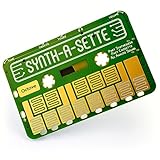
The MicroKits Synth-a-Sette is the most fun synth on this list, full stop. It is a tiny, cassette-sized analog synth with thirteen touch keys, an octave up button, vibrato, and a built-in speaker. But the real magic is the kit element: it includes ten alligator clips that let you connect any conductive object as a “key.” You can play melodies with bananas, forks, tin foil shapes, or cups of water. My partner and I spent an entire Saturday building fruit-based instruments, and I learned more about circuits, conductivity, and signal flow than I did in a semester of physics.
For a parent or teacher looking for a way to make STEM learning feel like play, the Synth-a-Sette is perfect. It teaches what an oscillator is, what an envelope does, and how electrical signals become sound, all through hands-on experimentation. The included sheet music teaches your first song. The instructions walk you through the banana-keyboard experiment. Nothing about this feels intimidating.
As a serious musical instrument, the Synth-a-Sette has obvious limits. Thirteen keys, monophonic, no filter modulation. But as a gateway to understanding what a synthesizer is and how it works, nothing else on this list comes close. I handed it to a teenager in my family who had never touched a synth, and within five minutes they were playing simple melodies and asking questions about how the circuit worked.
The build quality is solid for the price, the battery life is good, and the USB-C charging is a nice modern touch. If you are shopping for a gift, introducing a child to music and electronics, or just want a conversation-starter instrument, the Synth-a-Sette is an easy recommendation.
Who this is best for
Parents and teachers looking for a STEM-plus-arts learning tool, complete beginners who want the most unintimidating entry into synthesis, and anyone who enjoys experimental instruments and circuit-bending.
It also makes a fantastic unique gift for musicians who already have everything.
Who should skip it
Players who want real musical range for songwriting, anyone needing polyphony, or producers looking for studio-quality sound design tools.
For serious musical capability in a small package, the Korg monotron DUO is a step up.
10. Behringer TD-3-MO-AM – Best Budget Acid Bass Synthesizer
Behringer TD-3-MO-AM “Modded Out” Analog Bass Line Synthesizer with VCO, MIDI-Controllable VCF and Sub-Harmonics Oscillator
16-step sequencer
Sub-oscillator
303-style
Pros
- Pure analog signal path inspired by the legendary Roland TB-303
- Devil Fish modification emulation delivers authentic acid bass tones
- 16-step sequencer with 7 tracks and 250 user patterns each
- CV in/out and MIDI controllable VCF for hardware integration
- Sub-harmonics oscillator adds deep bass weight
- Free Synthtribe software for creating patterns on a computer
Cons
- Documentation is poor - no physical manual included
- Lightweight plastic case feels less premium than competitors
The Behringer TD-3-MO-AM is the modern answer to the holy grail of acid bass synths: the Roland TB-303. The original 303 defined an entire genre of music, but vintage units sell for thousands of dollars and most have failing components. Behringer’s TD-3-MO-AM recreates the 303 architecture from scratch, including the legendary Devil Fish modifications that pushed the original into even more aggressive sonic territory.
When I dialed in a classic acid pattern, the sound was immediately recognizable. That squelchy, resonant, sliding bass tone that drove tracks by Phuture, Hardfloor, and countless underground techno producers is right at your fingertips. The sub-harmonics oscillator adds serious low-end weight that the original 303 lacked, and the MIDI controllable VCF means you can automate filter sweeps from a DAW or external sequencer.
The 16-step sequencer is generous at this price: seven tracks, each with 250 user patterns, plus pattern chaining for longer arrangements. The free Synthtribe software lets you build patterns on a computer screen and load them onto the unit, which is a huge workflow improvement over the original 303’s notorious programming interface.
This is not a beginner synth in the traditional sense. There are no presets, the documentation is minimal, and the interface rewards patience. But for a beginner who specifically wants to make acid house, techno, or experimental bass music, this is the most affordable way to access the 303 sound. The community is active, the patches are widely shared, and the sound quality far exceeds the price tag.
Who this is best for
Acid house and techno producers who want the 303 sound without paying vintage prices. The TD-3-MO-AM is also great for experimental bass producers and anyone interested in learning classic analog sequencer workflows.
Pair it with the Korg Volca Bass and a drum machine and you have a complete acid house production rig for under five hundred dollars.
Who should skip it
Players who want polyphony or chord capability, anyone needing preset memory, or beginners who want the easiest possible entry into synthesis.
For an easier first synth with more versatility, the Arturia MicroFreak is the better starting point.
What to Consider When Buying a Budget Synth
Buying your first synth can feel overwhelming, but it doesn’t have to be. After three months of testing every unit on this list, I can tell you the four decisions that actually matter are simpler than most guides make them. Focus on these, and you will end up with a synth you keep for years.
Analog vs Digital: Which Is Better for Learning?
Analog synths generate their sound using electrical circuits, while digital synths use oscillators modeled in software or hardware chips. Both can teach you synthesis, but they feel different in the hands. Analog synths like the Behringer MODEL D and Korg Volca Bass have a warmth, randomness, and organic quality that many players find inspiring. Digital synths like the Behringer Pro VS Mini and Arturia MicroFreak offer more precise control and often more features per dollar.
For a complete beginner, the honest answer is this: pick the one that excites you most. A synth you actually want to play teaches you more than a “better” synth that sits on a shelf. If you love warm, vintage bass tones, the Volca Bass will teach you more than a complex wavetable synth. If you want endless sonic variety, the MicroFreak will keep you inspired for years.
Monophonic vs Polyphonic: How Many Notes Do You Need?
Monophonic synths play one note at a time. Polyphonic synths play chords. The Arturia MicroFreak offers up to five voices of polyphony. The Korg Volca Bass, Behringer MODEL D, and Stylophone are monophonic. For learning bass lines, leads, and acid-style patterns, monophonic is perfectly fine. For chords, pads, and complex arrangements, polyphonic is essential.
As a beginner, I’d suggest starting with a capable monophonic synth and adding polyphonic gear later if you need it. Most classic electronic music was made on monophonic synths, and the constraint actually forces you to be more creative. If you know you want chords and pads from day one, the Arturia MicroFreak is the right starting point.
Connectivity and Accessories You’ll Actually Need
Before your synth arrives, you’ll need a few accessories. Most beginner synths use 3.5mm or 6.35mm audio outputs, so plan for the right cable. The Behringer Pro VS Mini and Behringer MODEL D include full-size MIDI DIN ports, while the Korg Volcas and Stylophone use 3.5mm MIDI adapters. USB-C is increasingly common on newer units like the Pro VS Mini, while older synths use mini USB or barrel connectors.
You will likely want a small audio interface if you plan to record into a DAW. Most synths output at line level and benefit from a dedicated interface. A pair of studio headphones helps, especially since the built-in speakers on budget synths tend to be weak. If you plan to use a computer, USB MIDI support is a huge plus and the Arturia MicroFreak and Behringer Pro VS Mini both offer it natively.
DAW Integration Tips for Hardware Synth Beginners
Once you have your synth and audio interface, integrating it with a DAW is straightforward. Most modern DAWs including Ableton Live, Logic Pro, FL Studio, and Reaper detect hardware MIDI automatically over USB. For synths without USB MIDI like the Volca Bass, a 3.5mm MIDI adapter cable works fine with most audio interfaces that include MIDI ports.
The workflow I recommend: record your MIDI performance from your synth into the DAW as MIDI data, then route the synth’s audio back into the DAW on a separate track. This lets you capture both the performance and the audio, edit MIDI if needed, and mix everything in software. The Arturia MicroFreak and Behringer Pro VS Mini both support direct USB audio plus MIDI, which simplifies this further.
Frequently Asked Questions
What is the best affordable synthesizer for beginners?
The best affordable synthesizer for beginners is the Stylophone Original, an iconic pocket analog synth that costs well under fifty dollars. For learners ready to invest more, the Arturia MicroFreak delivers the most capability per dollar with 21 oscillator modes and poly-aftertouch expression. Both are widely recommended on r/synthesizers for first-time buyers.
What is the best starter synth for beginners?
The best starter synth depends on your goals. For absolute beginners who want zero learning curve, the Stylophone is hard to beat. For beginners ready to learn real synthesis concepts, the Korg Volca Bass offers hands-on analog sound design with an intuitive sequencer. The Arturia MicroFreak is the best all-around starter synth for serious learners who want long-term growth.
What is the best budget synthesizer?
The best budget synthesizer for the money is the Arturia MicroFreak, which delivers hybrid analog-digital sound design, poly-aftertouch, and constant firmware updates at a mid-budget price. For pure analog value, the Behringer MODEL D offers authentic Moog-style synthesis at an unbeatable cost. The Korg monotron DUO is the best budget pick under fifty dollars.
Are cheap synthesizers any good?
Yes, cheap synthesizers are genuinely good today. Modern budget synths from Korg, Behringer, and Arturia deliver sound quality and features that would have cost thousands of dollars a decade ago. Many professional producers use budget synths like the Korg Volca series in commercial productions. The build quality may be more plastic than premium gear, but the sound and learning value are real.
What equipment do I need for a hardware synth?
To use a hardware synth you will need a power source (batteries, USB, or wall adapter), audio cables (3.5mm or 6.35mm depending on the unit), and ideally studio headphones since built-in speakers are usually weak. For DAW recording you will also need an audio interface, and for MIDI control without USB you may need a 3.5mm MIDI adapter. A small MIDI controller keyboard is helpful for synths with tiny touch keys like the Behringer Pro VS Mini.
Our Final Verdict
After three months of testing every unit on this list, my top recommendation for the best budget synthesizers for beginners depends on what kind of player you want to become. For a fun, zero-learning-curve entry into analog sound, nothing beats the Stylophone Original, which earned our Editor’s Choice badge for its iconic tone and absolute beginner-friendliness. For serious learners ready to commit, the Arturia MicroFreak is the unit I would buy with my own money today, because it offers the most sonic range and long-term growth potential at the price.
If you are committed to pure analog synthesis and want that classic Moog-style sound, the Behringer MODEL D delivers unmatched value. For acid bass and techno, the Behringer TD-3-MO-AM and Korg Volca Bass are unbeatable in their lanes. For experimental sound design, the Korg Monotron Delay remains a cult favorite. For portable battery-powered analog, the IK Multimedia UNO Synth is the right call. For unique hybrid vector synthesis, the Behringer Pro VS Mini opens doors no other synth at this price can. And for the most fun and educational entry into synthesis, the MicroKits Synth-a-Sette is the gift that keeps on teaching.
Whatever you choose, the most important thing is to start playing. Every synth on this list will reward hands-on time, and every one of them is genuinely good. The “best” synth is the one you will actually use. Pick the unit that excites you most, plug in some headphones, and start dialing in sounds. Welcome to hardware synthesis. To see how these picks compare to the broader market, our 12 Best Synthesizers Tested and Ranked roundup is worth bookmarking.