
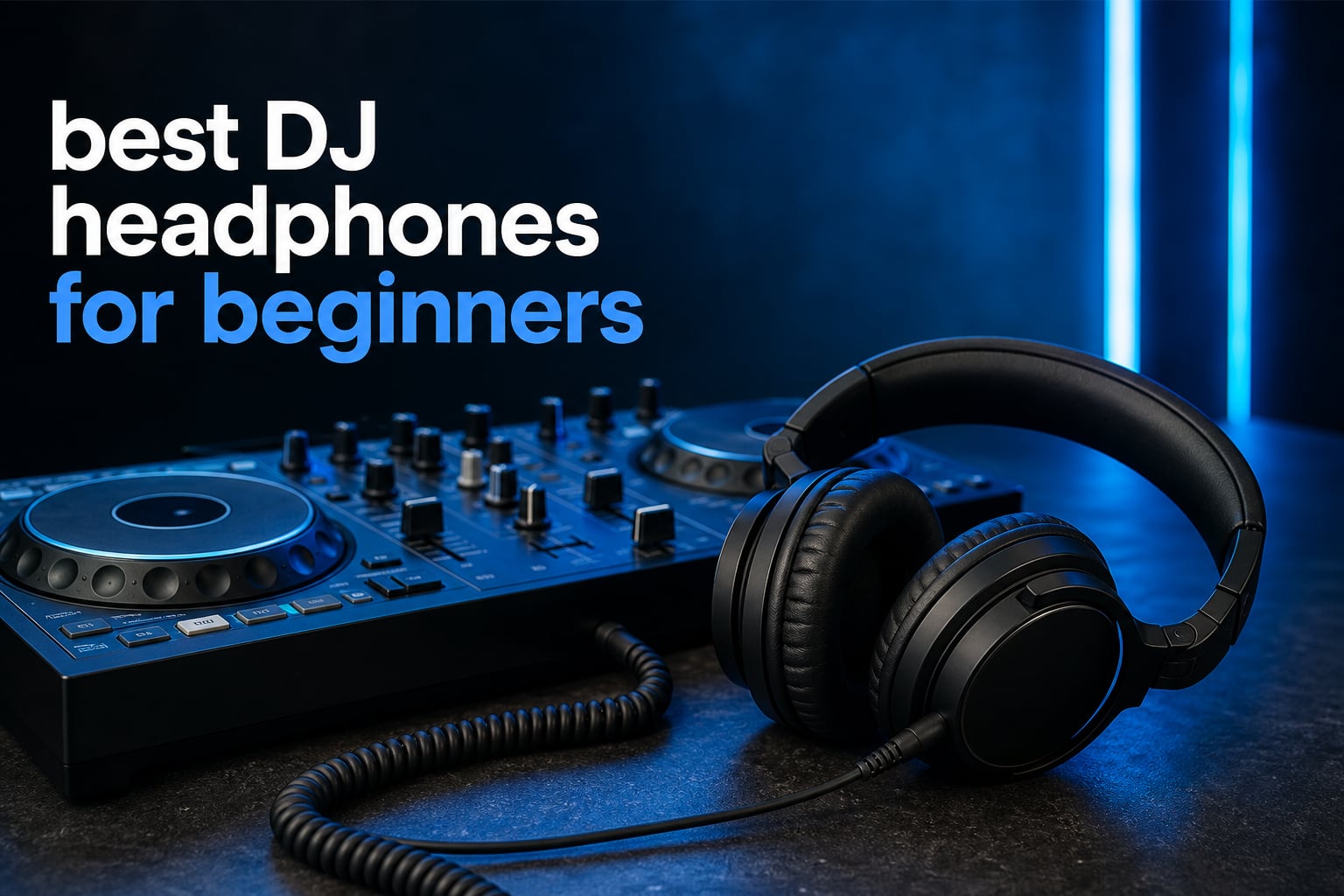
The best DJ headphones for beginners are wired, closed-back headphones that let you cue the next track without losing the room or main mix. My first recommendation is the Pioneer DJ HDJ-CUE1 because its 90-degree earcups, folding body, 40 mm drivers, and DJ-focused controls make the basic one-ear technique easier to learn.
Regular listening headphones can play music well, but DJing asks more of them. You need to hear a cue track clearly against speakers, move one cup away from an ear, and live with a cable that connects directly to a controller or mixer.
This guide compares ten real products from the analyzed catalog, from dedicated Pioneer DJ headphones to established studio-monitor designs. I focus on what a beginner can verify: fit, cup movement, cable setup, stated isolation, driver size, and parts that may matter after many practice sessions.
Start with a wired connection for beatmatching. Wireless listening is convenient away from the decks, while a wired signal avoids the delay that can make it harder to line up kick drums by ear.
A closed-back seal is also more useful than a wide, open soundstage when you are practicing beside speakers or playing a small gig. It reduces outside noise, so you can keep the cue level more restrained rather than turning it up to fight the room.
There is no need to buy the most complicated beginner DJ equipment first. Pick a comfortable wired pair with a 3.5 mm plug or supplied adapter, practice headphone cueing at home, and learn how one-ear monitoring feels before deciding whether you need a more specialized model.
Table of Contents
The top three beginner DJ picks make choosing simple
Choose the HDJ-CUE1 for direct DJ ergonomics, the ATH-M50x for a more studio-oriented detachable-cable setup, or the TH-02 when you want the simplest closed-back starting point. All three are wired options, which is the sensible foundation for cueing and learning beatmatching.
The practical difference is not a score alone. The Pioneer puts cup rotation and a lightweight folding design at the center, the Audio-Technica adds 45 mm drivers and three detachable cables, and the Tascam supplies an adapter with a plain closed-back design.
These DJ headphones for beginners cover ten wired choices in 2026
The overview below includes every analyzed model. Use it to narrow the field, then read the matching review for cable, fit, and monitoring details that matter at your controller.
| Product | Specifications | Action |
|---|---|---|
 Pioneer DJ HDJ-CUE1 Pioneer DJ HDJ-CUE1 |
|
Check Latest Price |
 Audio-Technica ATH-M50x Audio-Technica ATH-M50x |
|
Check Latest Price |
 TASCAM TH-02 TASCAM TH-02 |
|
Check Latest Price |
 Sennheiser HD 25 Sennheiser HD 25 |
|
Check Latest Price |
 Pioneer DJ HDJ-X5 Pioneer DJ HDJ-X5 |
|
Check Latest Price |
 Audio-Technica ATH-M40x Audio-Technica ATH-M40x |
|
Check Latest Price |
 Sennheiser HD 280 Pro Sennheiser HD 280 Pro |
|
Check Latest Price |
 Sony MDR-7506 Sony MDR-7506 |
|
Check Latest Price |
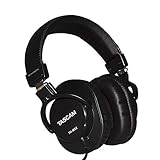 TASCAM TH-MX2 TASCAM TH-MX2 |
|
Check Latest Price |
 OneOdio Pro-10 OneOdio Pro-10 |
|
Check Latest Price |
Pioneer DJ HDJ-CUE1 is the best first DJ-focused choice
Pioneer DJ HDJ-CUE1 On-Ear Wired DJ Headphones, Foldable, Dark Silver
40 mm drivers
90 degree cups
215 g folding body
Pros
- 90 degree earcups
- Metal headband sliders
- Replaceable cable and pads
- Folding design
Cons
- On-ear fit may tire some listeners
- Not water resistant
The HDJ-CUE1 is the most straightforward pick here for someone learning DJ habits rather than only listening to playlists. Its cups turn a full 90 degrees, so moving one cup off an ear for cueing feels like a built-in part of the design rather than a workaround.
Pioneer DJ lists 40 mm dynamic drivers, 32 ohms impedance, 104 dB sensitivity, and a 215 g weight. Those numbers point to a relatively easy-to-drive wired headphone for a controller headphone output, provided you begin with its level control low.
The product listing calls out metal sliders in the headband and says moving parts passed in-house durability tests. It also states that the cable and earpads can be swapped for colored replacements, a worthwhile practical detail when daily use eventually wears contact surfaces.
The HDJ-CUE1 works best for learning one-ear cueing
A beginner who wants to practice the classic one-ear position should start here. The flexible cushioned headband and rotating cups support trying several positions while you cue the incoming track, then check the room sound with the free ear.
For home practice, fold the headphones after each session instead of leaving the cable and hinges under tension on the controller. That small routine is kinder to any folding DJ headphone.
The HDJ-CUE1 is less suited to listeners who dislike on-ear pressure
On-ear models sit on the ears rather than around them, and forum discussions repeatedly flag ear fatigue during long sessions as a common concern. Try shorter practice blocks first and pay attention to pressure before assuming a lighter model will automatically feel better.
This is a wired model by title, so make the cable connection your default for DJ mixing. A wired path keeps the relationship between your cue button, jog-wheel movement, and what you hear easy to judge.
Audio-Technica ATH-M50x is the premium studio-to-DJ crossover
Audio-Technica ATH-M50X Professional Studio Monitor Headphones, Black, Professional Grade, Critically Acclaimed, with Detachable Cable
45 mm drivers
38 ohms
90 degree swiveling cups
Pros
- 45 mm drivers
- Three detachable cables
- Sound-isolating over-ear design
- Foldable
Cons
- Not water resistant
- Less DJ-specific cup design
The ATH-M50x fits beginners who want one wired pair for DJ practice, recording, and general monitoring. Audio-Technica specifies 45 mm large-aperture drivers, 38 ohms impedance, 99 dB sensitivity, and a circumaural design that contours around the ears.
Its stated 90-degree swiveling earcups make one-ear monitoring possible, though the overall approach is studio-monitor first rather than a pure club-headphone layout. The listed extended response and emphasis on deep, accurate bass are useful when you are trying to identify the kick and bass relationship in a cue track.
Three detachable cables are included, plus a 6.3 mm adapter. That is unusually helpful for a beginner who may move between a controller with a smaller headphone jack and equipment that accepts the larger connector.
The ATH-M50x is best for DJs who also monitor or record
Choose this model if you want a closed-back over-ear fit and plan to listen critically away from the decks. Its 0.29 kg listed weight and professional-grade earpad and headband materials make it a plausible long-session option, although comfort remains personal.
The detachable-cable arrangement also reduces a common ownership worry: a damaged cable does not have to mean the whole headphone is finished. Disconnect cables by the plug, not by pulling the wire.
The ATH-M50x is not the simplest choice for pure club technique
The swivel is 90 degrees, which is enough for basic one-ear monitoring, but new DJs who want the most obviously DJ-shaped routine may prefer the HDJ-CUE1. The M50x is also not water resistant, so wipe it with a dry soft cloth after a humid session and keep it away from drink spills.
Use the supplied adapter only when the mixer requires it, and support the plug when removing it. Adapters that stick far out of a controller can get knocked during an energetic practice session.
TASCAM TH-02 is the simplest budget starting point
TASCAM TH-02 Professional Studio Monitor Headphones, Wired, Over Ear — for Recording, Podcast, DJ, Music and Guitar, with 1/4 Inch Jack Adapter
50 mm drivers
32 ohms
Closed-back folding design
Pros
- 50 mm drivers
- Closed-back build
- Foldable
- Supplied adapter
Cons
- Not water resistant
- No stated swivel cups
The TH-02 gives a new DJ the basic requirements: a wired closed-back dynamic design, 50 mm drivers, and 32 ohms impedance. It does not pretend to be a highly specialized club headphone, which can be a benefit when you only need a simple pair to start practicing cues.
Tascam lists an 18 Hz to 22 kHz frequency range, 98 dB sensitivity, padded headband and ear pads, and a foldable body. A snap-on adapter is included for gear that uses the larger headphone socket.
The product data describes rich bass response and crisp highs. For beatmatching, do not judge a headphone solely by the amount of bass; what matters is whether you can repeatedly locate the kick pattern and tell when two records are drifting apart.
The TH-02 is best for building a first practice routine
This pair is a sensible no-frills tool for cueing tracks at home and learning where the headphone cue and cue/master blend controls sit on your controller. The folding design is handy if your decks share space with a desk or bedroom setup.
Begin with low headphone volume, then raise it only enough to distinguish the incoming track. This habit is more valuable for a beginner than chasing maximum loudness.
The TH-02 is not the pick for dedicated one-ear mechanics
The analyzed listing does not state a swiveling or rotating cup mechanism, so it is not the natural choice if single-ear monitoring is your highest priority. You can still use one ear by moving a cup, but it may be less secure or comfortable than a purpose-designed rotating cup.
The TH-02 is not water resistant. Keep the pads dry, store the headphone away from direct sun, and never use household sprays on the drivers or inside the cups.
Sennheiser HD 25 is the lightweight long-term DJ reference
Sennheiser Pro Audio Professional HD 25 On-Ear DJ Headphones Black
140 g on-ear
70 ohms
Detachable single-sided cable
Pros
- Very light
- High sensitivity
- Detachable cable
- Handles high sound pressure
Cons
- On-ear pressure may fatigue users
- Not water resistant
The Sennheiser HD 25 is the most recognizable dedicated DJ reference in this group, and community discussions often point to it as an industry standard. The listing specifies a very light 140 g body, 70 ohms impedance, 120 dB sensitivity, and a tough detachable single-sided cable.
Sennheiser says its lightweight aluminium voice coils contribute to high sensitivity and that the headphone can handle very high sound pressure levels. That capability is not a reason to listen louder; it means the headphone is intended for demanding environments while your own listening level still needs restraint.
Forum users report HD 25 pairs lasting five to ten years with regular use, and experienced DJs value replaceable parts over a disposable design. Those are community experiences rather than a guarantee, but they explain why this model remains a frequent recommendation.
The HD 25 is best for DJs who value low weight and repair-minded ownership
Pick it if you want a compact, light on-ear model with a detachable cable and you expect to carry headphones frequently. A single-sided cable can also keep one side of your body clearer when you turn toward a mixer or booth monitor.
Inspect the cable connection and pads periodically. Replaceable contact parts make sense once pads lose their seal or flake, because that seal affects comfort and the amount of outside sound you hear.
The HD 25 is not best for every long home session
Its on-ear format is exactly why some DJs love its compact feel and why others report ear fatigue. Do a real seated session before deciding that the community standard is automatically your personal fit.
Set the cue level conservatively when practicing near speakers. The HD 25 can handle high sound pressure, but your ears do not become less vulnerable because the headphone is capable.
Pioneer DJ HDJ-X5 is the sturdier dedicated DJ step-up
Pioneer DJ HDJ-X5 Professional DJ Headphones – Black
40 mm driver
32 ohms
5 Hz to 30 kHz response
Pros
- DJ-focused construction
- 40 mm driver
- Reduced head pressure
- Folding pouch
Cons
- Wired only
- Listed weight is substantial
The HDJ-X5 is for beginners who already know they want a dedicated Pioneer DJ design and prefer a model described as handling severe conditions. Its analyzed product details list a 40 mm dynamic driver, 32 ohms impedance, 102 dB sensitivity, a 3.5 mm jack, and a 5 Hz to 30 kHz stated frequency range.
Pioneer DJ highlights a housing design intended to reduce pressure on the head, plus an outside texture for grip and a compact carrying pouch. Those features address the physical parts of DJing that spec sheets often miss: repeated cup movement, transport, and taking the headphones on and off between transitions.
The product data identifies the HDJ-X5 as wired, and its review data specifically calls wired-only operation a limitation. That is not a problem for cueing, where a direct cable is normally the preferred connection.
The HDJ-X5 is best for a beginner planning regular gigs
This is a sensible progression choice for someone who wants to practice at home and then carry the same headphones to small events. The stated road-use durability and included pouch support that portable routine.
Use the pouch after the cable is coiled loosely. Tight knots around the earcup or controller can stress a cable long before the headphone itself looks worn.
The HDJ-X5 is not the lightest option in the group
The analyzed listing gives a 2.1-pound weight, so do not assume it will disappear on your head the way the 140 g HD 25 can. Fit and clamp should come before brand loyalty when you expect lengthy sessions.
If you also need a headphone for quiet studio editing, compare it with the ATH-M40x or ATH-M50x. Those models place more emphasis on circumaural monitoring and detachable cable options.
Audio-Technica ATH-M40x is the balanced monitor for beginner mixing
Audio-Technica ATH-M40x Professional Studio Monitor Headphone, Black, with Cutting Edge Engineering, 90 Degree Swiveling Earcups, Pro-Grade Earpads/Headband, Detachable Cables Included
40 mm drivers
35 ohms
90 degree swiveling cups
Pros
- Detachable cables
- Over-ear isolation
- 90 degree swivel
- Foldable
Cons
- Not water resistant
- Studio-monitor focus
The ATH-M40x is a practical middle path for beginners who want a closed-back over-ear monitor and need one-ear flexibility. Audio-Technica lists 40 mm drivers, 35 ohms impedance, 98 dB sensitivity, 0.24 kg weight, and 90-degree swiveling earcups.
Its circumaural fit is designed to contour around the ears for sound isolation in loud environments. That makes it more attractive than an open-back model for home practice beside speakers, as long as the pads form a comfortable seal around your ears.
Detachable cables and a folding design make storage less fussy. The listing also calls out professional-grade ear pad and headband material, which matters because those contact points take the daily friction of DJing headphones.
The ATH-M40x is best for over-ear comfort and basic cue control
This model suits a DJ who wants to alternate between focused home practice and music monitoring. The 90-degree cups allow the standard one-ear technique without forcing you into an on-ear design.
At 35 ohms, it should be a manageable load for typical controller headphone outputs, though each controller has its own output strength. Start with the headphone knob down, connect fully, and bring the level up gradually.
The ATH-M40x is not a waterproof club tool
The listing says it is not water resistant, so treat sweat and spilled drinks as risks rather than normal wear. Dry the headband and exterior pads after a warm room, then let the headphones air out before closing them in a bag.
Replacement pads may eventually improve fit on any over-ear model, but only buy parts confirmed for the exact model. A loose replacement pad can reduce the seal you rely on for cue isolation.
Sennheiser HD 280 Pro is the isolation-first over-ear option
Sennheiser HD 280 Pro Headphone, Black
Up to 32 dB attenuation
64 ohms
Replaceable pads
Pros
- Strong stated attenuation
- Replaceable pads and cable
- Collapsible cups
- Over-ear padding
Cons
- Wired only
- Heavier listed build
The HD 280 Pro is the best match in this list for a beginner whose biggest issue is outside sound. Sennheiser states up to 32 dB attenuation, an 8 Hz to 25 kHz frequency range, 64 ohms impedance, collapsible earpieces, and replaceable earpads, headband padding, and audio cord.
That parts list is unusually useful for long ownership. Pads flatten and headband padding wears, so the ability to replace them can keep a familiar headphone usable instead of treating it as disposable gear.
The over-ear padded construction may appeal to DJs who dislike on-ear contact. Its listed 1.28-pound weight means you should still judge it by comfort on your own head rather than assuming the larger cups make it effortless.
The HD 280 Pro is best for noisy rooms and focused cueing
Choose it when sound isolation is your top priority for practice in a shared space or near speakers. A stronger seal can help you hear the cue at a lower level, which is the safer goal.
Do not confuse attenuation with active noise cancellation. The stated reduction comes from the physical closed-ear design and fit, so worn or poorly seated pads can reduce the result.
The HD 280 Pro is not the most DJ-specific cup design
The analyzed data emphasizes isolation and collapsible earpieces, not rotating single-ear cups. You can learn cueing with it, but a model with clearly stated 90-degree movement may feel more natural if you use one-ear monitoring constantly.
Because it is wired-only, it stays aligned with a controller-first practice setup. Check whether your controller needs the included screw-type adapter before connecting, and avoid forcing any plug.
Sony MDR-7506 is the light folding monitor with a long fixed cable
Sony MDR7506 Professional Large Diaphragm Headphone
40 mm drivers
63 ohms
0.5 lb folding design
Pros
- Lightweight
- 40 mm drivers
- Closed-ear isolation
- Folds into case
Cons
- Fixed 9.8 foot cable
- Not water resistant
The Sony MDR-7506 is a long-running professional monitor that can also cover beginner DJ duties. Sony specifies 40 mm dynamic drivers with neodymium magnets, a closed-ear design, 63 ohms impedance, 10 Hz to 20 kHz response, and a 0.5-pound listed weight.
Its key practical feature is the 9.8-foot fixed cord, which ends in a gold-plated plug and includes a 6.3 mm adapter. That length can be useful when your controller and seating position are separated, but it also creates more cable to manage around chair wheels and mixer controls.
The MDR-7506 folds into a supplied soft case. For a beginner who takes lessons, records at a friend’s setup, or travels with a controller, that compactness is a real advantage.
The MDR-7506 is best for DJs who need a long reach
Choose this Sony if the fixed cable’s reach solves a genuine layout problem in your setup. Route the cable behind the controller or away from the crossfader and performance pads so it does not snag while you work.
The closed ear design is intended to reduce external noise, which helps with cueing. Keep the ear pads clean and seated evenly, since the seal is part of how passive isolation works.
The MDR-7506 is not the repair-friendly cable choice
Unlike several other picks here, its cable is not detachable. A fixed cable calls for more care: unplug by the connector, coil it in broad loops, and avoid shutting it in a drawer or case lid.
It is also not water resistant. Treat it as a dry indoor monitor and use a dry cloth only on the outer surfaces after use.
TASCAM TH-MX2 is the closed-back adapter-ready alternative
Tascam TH-MX2 Closed-Back Studio Mixing Headphones
40 mm drivers
32 ohms
18 Hz to 22 kHz
Pros
- Closed-back design
- Retractable cable
- Screw-on adapter
- Leatherette bag
Cons
- No stated cup rotation
- Not listed as water resistant
The TH-MX2 is a wired closed-back monitor with a clear set of beginner-friendly basics. Tascam lists a 40 mm neodymium driver, 32 ohms impedance, an 18 Hz to 22 kHz response, a retractable cable, and a screw-on 3.5 mm to 6.3 mm adapter.
It also comes with a leatherette bag and has a listed weight of 298 g. The closed-back construction and padded headband address the core issue for a beginner: getting an audible cue without relying on an open room sound.
The approximately 9.8-foot fully extended cable has the same benefit and caution as other long cords. It gives room to move, but you should route it intentionally rather than letting it loop under your feet.
The TH-MX2 is best for beginners who need both common plug sizes
The screw-on adapter is useful when you move between a controller’s smaller jack and a mixer or audio interface with a larger socket. Screw it on straight and only until secure; cross-threading an adapter makes a simple accessory difficult to use.
The 32-ohm specification is also controller-friendly on paper. Still, test your actual output at a restrained level, because the headphone knob and cue/master mix setting both affect what you hear.
The TH-MX2 is not built around rotating-cup technique
The product details do not claim a swivel or flip mechanism. If you know you will cue with one ear uncovered at every transition, buy a model that explicitly supports that motion.
The retractable cable should be extended and retracted gently. Never pull it hard at the end of its travel, since the cable mechanism is a moving part rather than a free-hanging lead.
OneOdio Pro-10 is the flexible dual-jack practice option
OneOdio Pro 10 Over-Ear Headphones Wired 50mm Driver 6.35 & 3.5mm Jack DJ Monitor Headphones Recording Mixing Studio Monitoring Guitar Podcast Cell Phone PC MP3/4 Black
50 mm drivers
32 ohms
90 and 180 degree cup movement
Pros
- Large 50 mm drivers
- Dual-jack source sharing
- Wide cup movement
- Foldable
Cons
- Lower 4.0 rating
- No stated water resistance
The OneOdio Pro-10 has one of the most explicitly flexible monitoring layouts in this list. Its product details state 50 mm drivers, 32 ohms impedance, 110 dB sensitivity, a 20 Hz to 20 kHz range, and cup movement that flips 90 degrees forward and 180 degrees up and down.
It also supports two audio sources simultaneously through 6.35 mm and 3.5 mm jacks. That is a distinct feature for practice, but beginners should keep the signal path simple at first: one controller, one cue source, and a clear understanding of which channel they are hearing.
The over-ear pads, folding body, removable cable, and stated sound isolation make it a useful feature-heavy option. Its 4.0 rating is lower than the other highlighted picks, so weigh those features against the broader feedback reflected in that score.
The Pro-10 is best for learners who want generous cup movement
The wide flip range makes it easy to experiment with a cup on, a cup off, or a cup held behind one ear. That can help you discover a monitoring position that lets you compare the cue track with the room or master output.
The dual-jack arrangement also gives it broad compatibility with 3.5 mm and 6.35 mm equipment. Keep unused connections clear and do not assume a second source is needed to beatmatch.
The Pro-10 is not the most confidence-inspiring feedback pick
The catalog reports a 4.0 rating from 3,026 reviews, below the other selections here. That does not erase its useful feature set, but it is a reason to inspect fit, hinge movement, and cable operation carefully during the return period.
For a beginner who wants community-backed long-term ownership, the HD 25 has stronger forum consensus. For a beginner who wants a simple closed-back setup, the TH-02 removes the extra connection features altogether.
Choose DJ headphones by cue control, fit, and serviceable parts
The right first pair is the one that lets you hear a cue clearly and practice without pain. Start with the connection and cup movement, then compare fit, isolation, cables, and parts you can replace.
Choose wired headphones because timing is easier to judge
For beatmatching headphones, a cable is the baseline. A wired connection from the controller or mixer gives you direct monitoring, while wireless audio can add delay that makes it harder to hear whether the kicks are aligned.
Check the headphone output on your controller before you buy. Some use a 3.5 mm jack, some use a 6.3 mm jack, and some setups need an adapter; models such as the ATH-M50x, Sony MDR-7506, TH-02, and TH-MX2 include an adapter in their listed accessories.
Do not buy a headphone based on wireless marketing when your real goal is mixing. A cable may feel old-fashioned, but it is the reliable tool for previewing a track and reacting to the jog wheel in real time.
Choose closed-back cups because they help you hear the cue
Closed-back DJing headphones use the cup and pad seal to reduce external sound. That matters when speakers are playing the current track and you need to hear the next track’s beat in the cue channel.
Over-ear designs, such as the ATH-M50x, ATH-M40x, HD 280 Pro, Sony MDR-7506, Tascam models, and Pro-10, surround the ear. On-ear models, including the HDJ-CUE1 and HD 25, rest on the ear and are often compact, though some users find them tiring over longer sessions.
Fit is not a minor detail. If the headband gives you a headache or the pads fail to seal around glasses, you may turn the cue volume up unnecessarily and stop practicing sooner.
Choose rotating cups because one-ear monitoring is a learned skill
Single-ear monitoring means listening to the cue in one ear while the other ear hears the main mix or room. DJs do it to compare timing and phrasing before they bring the new record in.
The HDJ-CUE1, ATH-M50x, and ATH-M40x each state 90-degree cup rotation. The OneOdio Pro-10 states 90-degree forward and 180-degree vertical movement, while the other models should be judged by their fit instead of assuming the same motion.
Practice this at modest levels: cue a track, remove one cup, and listen for the two kick drums to blend rather than flutter. When the beats drift, nudge the incoming track and listen again rather than simply making the headphones louder.
Choose impedance with your controller output in mind
Impedance is measured in ohms and describes part of the electrical load a headphone presents. It does not tell you whether a headphone sounds better, and it should not be read as a simple quality ranking.
Most choices here list 32 to 38 ohms, including the HDJ-CUE1, HDJ-X5, TH-02, TH-MX2, Pro-10, ATH-M40x, and ATH-M50x. The HD 25 lists 70 ohms, the Sony lists 63 ohms, and the HD 280 Pro lists 64 ohms.
A controller can differ greatly in headphone-output power, so use your actual hardware as the deciding test. Connect the headphone fully, turn the level down first, set cue/master blend deliberately, and increase volume only until the cue is intelligible.
Protect your hearing by lowering level before raising isolation
Hearing protection starts with your habits, not with a maximum-volume specification. If the cue is unclear, first improve the pad seal, move farther from speakers when possible, and use the cue/master mix control instead of immediately raising the headphone knob.
Take short quiet breaks during extended practice, especially after a loud room or gig. Ringing, muffled hearing, or discomfort is a signal to stop and rest rather than push through another transition.
Sweat and humidity also matter. Forum users often recommend velour pads for sweaty club conditions, but compatibility varies by model; only use pads made for your exact headphones, and dry the originals after each session.
Maintain pads and cables because small parts shape daily comfort
Replace earpads when they crack, flatten, smell, or no longer seal properly. The HD 280 Pro specifically lists replaceable earpads, headband padding, and audio cord; the HD 25 and several Audio-Technica and Pioneer options also list detachable cables or replaceable pad-related options.
Clean exterior pad surfaces with a soft dry cloth and follow the manufacturer’s care instructions. Avoid soaking pads, spraying cleaner into a cup, or storing headphones damp in a closed bag.
Coil a cable loosely in circles, not in tight bends around the headband. When a cable is detachable, pull the connector body rather than the wire, and pack adapters where they cannot scratch the cups.
Use the rule of 32 to phrase transitions before you mix
The rule of 32 in DJing is a common way to think about musical phrasing: many dance tracks change in blocks of 32 beats, often eight bars in 4/4 time. It is a guide, not a law, but it gives a beginner a predictable place to prepare the next track.
In headphones, count the beat blocks in the cue track, then start or adjust it so its phrase change lands with the current track’s phrase change. Your headphones help you hear alignment; the rule of 32 helps you choose a musical moment for the transition.
Try this drill at home: pick two tracks with clear drums, count four groups of eight beats in the playing track, then launch the cue track at the next block. Listen with one cup moved away and make small jog adjustments until the kicks stop fighting.
Buy only the features that match your actual practice setup
For a compact controller at home, a 32-ohm closed-back model with a 3.5 mm plug and rotating cups is a sensible target. The HDJ-CUE1, ATH-M40x, and Pro-10 make that starting checklist easy to see in their listed specs.
For louder shared rooms, prioritize a secure over-ear seal or stated attenuation, making the HD 280 Pro, ATH-M50x, or ATH-M40x worth a closer look. For frequent travel and one-ear club technique, the HD 25 and HDJ-CUE1 are the more purpose-shaped choices.
Do not treat a beginner purchase as permanent identity. Build timing and cueing skills first; later, you can decide whether your own ears prefer a lighter on-ear model, a more isolating over-ear monitor, or a different cup mechanism.
These beginner DJ headphone answers cover the common questions
What headphones do most DJs use?
Many working DJs use dedicated on-ear models such as the Sennheiser HD 25 or Pioneer DJ headphones because they are compact and support one-ear monitoring. Studio-monitor headphones such as Audio-Technica models are also common when DJs want an over-ear fit, closed-back isolation, and recording use. Fit, cue clarity, and a wired connection matter more than copying one model.
What is the rule of 32 in DJing?
The rule of 32 is a phrasing guide: many dance tracks make noticeable changes every 32 beats, often eight bars in 4/4 time. Count those blocks in the track you are cueing and aim to begin a transition where a new phrase starts. It helps a beginner make mixes sound intentional rather than random.
What should a beginner DJ buy?
A beginner DJ should buy a controller or mixer setup, wired closed-back headphones, and a way to play and organize music. Choose headphones with a compatible plug or adapter, a comfortable fit, and cup movement if you want one-ear monitoring. Learn cueing and beatmatching before adding extra accessories.
Can I practice DJing with just headphones?
Yes, you can practice DJing with headphones if your controller or software supports headphone cueing. You can beatmatch, set cue points, count phrasing, and rehearse transitions privately. Listening to a master output alongside the cue channel is still useful when available because it teaches you to compare the incoming track with the mix.
Why do DJs only wear one headphone?
DJs use one headphone so one ear hears the cue track while the other hears the main mix or room sound. Comparing both helps them match timing, choose a phrase for the transition, and check how the cue will sit with the playing track. Rotating earcups make this position easier, but moderate volume is still important.
The Pioneer DJ HDJ-CUE1 is the clearest starting recommendation
For most readers comparing the best DJ headphones for beginners, choose the Pioneer DJ HDJ-CUE1 when you want a purpose-built wired pair with 90-degree cups, folding portability, and replaceable style components. Choose the Audio-Technica ATH-M50x or ATH-M40x if a closed-back over-ear monitor and detachable cables fit your setup better.
The Sennheiser HD 25 is the light, community-respected path for DJs who accept an on-ear fit, while the HD 280 Pro puts stated isolation and replaceable wear parts first. Whatever you select in 2026, connect by cable, keep cue volume restrained, and spend the saved attention on counting phrases and matching beats.
Compare the current product details, confirm the plug on your controller, and choose the model you will actually wear for regular practice. Consistent cueing with comfortable headphones will teach more than an overcomplicated first purchase.
1 thought on “10 Best DJ Headphones for Beginners (September 2026) Experts Guide”