
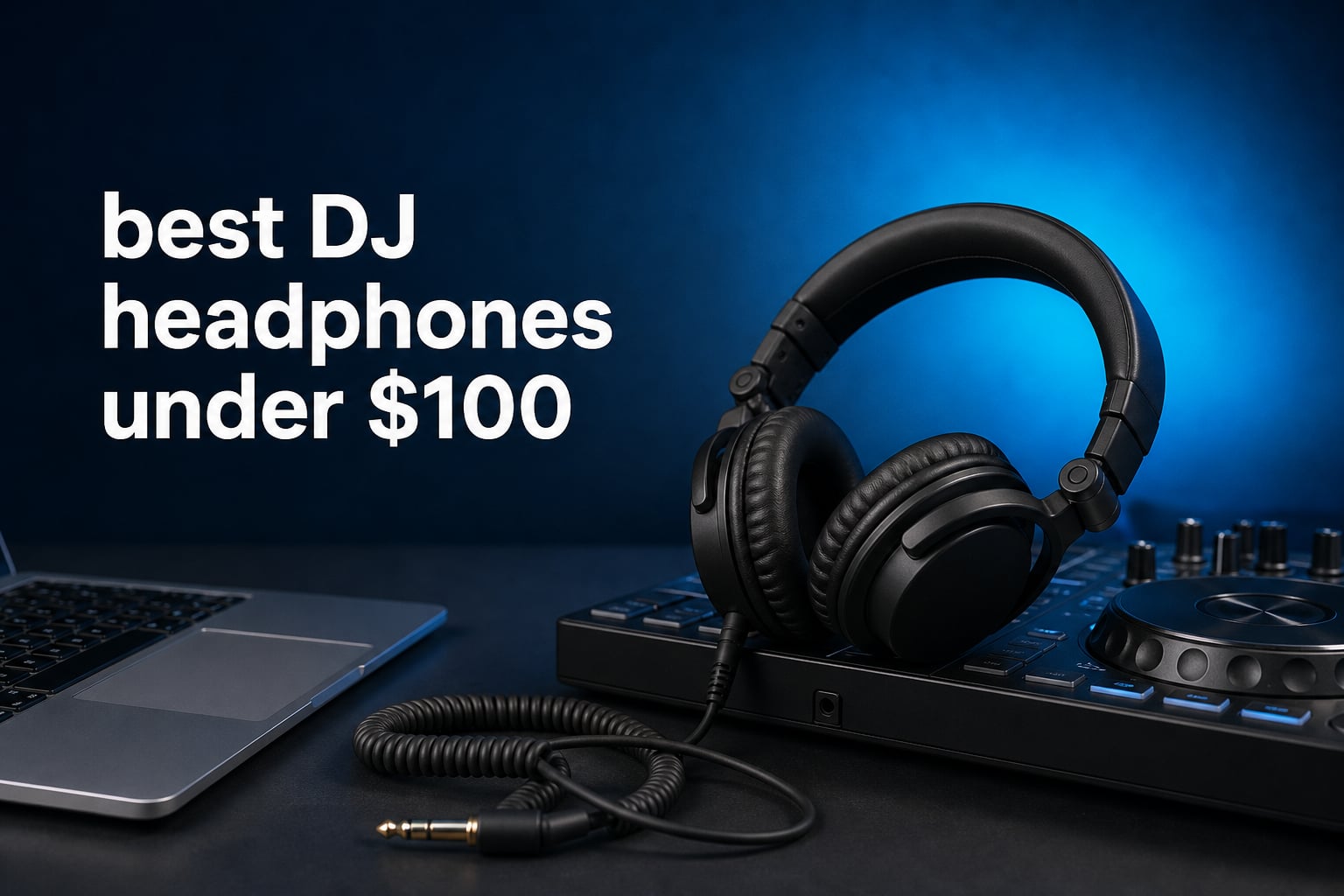
The best DJ headphones under $100 give a new DJ what matters at the controller: a wired connection, enough isolation to cue a track, and a fit you can tolerate through a long practice session. I ranked ten current models using their published driver, impedance, cable, monitoring, comfort, durability, rating, and review-count data rather than treating every budget pair as interchangeable.
A closed-back design is the practical starting point for DJ mixing headphones because it limits the sound around you while you line up the next record. Forum discussions repeatedly point to the same frustrations—ear pressure after two hours, a cable that catches, weak bass cues, and not enough isolation in a loud room—so those issues shape the recommendations below.
Most working DJs gravitate to purpose-built, closed on-ear or over-ear models with a secure fit and one-ear monitoring options. For home practice, a studio-oriented pair can work very well; for loud venues, sensitivity, passive isolation, a dependable cable, and a cup that pivots deserve more weight.
The top 3 picks are Pioneer, MAONO, and TASCAM in 2026
Choose Pioneer for direct DJ-focused cup rotation and a light folding frame, MAONO for flexible cables and over-ear isolation, or TASCAM if you need a simple closed-back starter pair. Each is wired, so cue audio reaches your ears without wireless delay.
The best DJ headphones under $100 in September 2026 are compared below
This overview separates DJ-specific pivoting designs from studio-monitoring alternatives. Ratings and review totals are useful signals, but fit and the way you work—single-ear cueing, long home sessions, or a noisy dance floor—should decide the final pick.
| Product | Specifications | Action |
|---|---|---|
 Pioneer DJ HDJ-CUE1 Pioneer DJ HDJ-CUE1 |
|
Check Latest Price |
 MAONO MH700 MAONO MH700 |
|
Check Latest Price |
 RØDE NTH-50 RØDE NTH-50 |
|
Check Latest Price |
 Hercules HDP DJ60 Hercules HDP DJ60 |
|
Check Latest Price |
 OneOdio Pro-50 OneOdio Pro-50 |
|
Check Latest Price |
 OneOdio A70 OneOdio A70 |
|
Check Latest Price |
 Numark HF125 Numark HF125 |
|
Check Latest Price |
 Mackie MC-100 Mackie MC-100 |
|
Check Latest Price |
 TASCAM TH-02 TASCAM TH-02 |
|
Check Latest Price |
 Sennheiser HD 25 LIGHT Sennheiser HD 25 LIGHT |
|
Check Latest Price |
1. Pioneer DJ HDJ-CUE1 is the best all-round DJ-focused pick
Pioneer DJ HDJ-CUE1 On-Ear Wired DJ Headphones, Foldable, Dark Silver
40mm dynamic drivers
90-degree ear cups
32 ohms
Detachable cable
Pros
- 90-degree rotating cups
- Metal headband sliders
- Folding design
- Clear bass mids and highs
Cons
- On-ear fit will not suit everyone
- Wired model only
I put the HDJ-CUE1 first because its feature set speaks directly to cueing at a controller. The cups turn a full 90 degrees, which gives a straightforward route to single-ear monitoring while the other ear stays on the room or booth sound.
Its 40mm dynamic drivers cover a published 5 Hz to 30 kHz frequency range, with 32-ohm impedance and 104 dB sensitivity. That is a sensible combination for a DJ controller or mixer headphone output without asking for a separate amplifier.
The monitoring setup is made for cueing and beatmatching
The folding chassis and cushioned headband make this a logical bag-friendly choice for regular practice and gigs. Pioneer says the sliders use extra-strong metal and its moving parts pass durability tests, which addresses a common worry around budget hinges.
The fit is best for DJs who like on-ear contact
This is an on-ear design, so people who dislike pressure directly on the ears may prefer an over-ear option such as the MAONO or OneOdio. The detachable cable is a useful serviceability point, and the 4.6 rating from more than 2k reviews gives the model a substantial user base.
2. MAONO MH700 is the most flexible over-ear monitoring choice
MAONO MH700 Wired Studio Headphone for Podcast Recording DJ Mixing Monitor
50mm drivers
Closed-back
180-degree cups
3.5 and 6.35mm cables
Pros
- Over-ear noise isolation
- Two included cables
- 180-degree reversible cups
- Foldable with storage bag
Cons
- Heavier 400g build
- Smaller review base
The MH700 makes sense when over-ear padding and connector flexibility matter more than a classic compact DJ silhouette. Its closed-back cups, soft cushions, and 180-degree reversible movement tackle both isolation and one-side listening.
MAONO lists 50mm dynamic drivers, 32-ohm impedance, 100 dB sensitivity, and a 20 Hz to 20 kHz response. It also includes both a 1.2 m straight 3.5 mm cable and a 3 m coiled 3.5-to-6.35 mm cable, so it can connect to portable gear and larger mixer sockets.
The cable package covers controllers and mixer headphone jacks
The included 6.35 mm connection removes one small but irritating setup problem for beginners. A coiled cable is particularly handy at a booth because it gives you room to lean toward controls without a loose run of cable underfoot.
The comfort case favors long home sessions
At 400 g, it is not the lightest pair here, so weight-sensitive DJs should account for that. Still, the 4.6 rating across 496 reviews and reports of extended-wear comfort make it a strong home mixing and studio-monitoring candidate.
3. RØDE NTH-50 is the detailed on-ear pick with a lifetime warranty
RØDE NTH-50 Professional On-Ear Wired DJ Headphones | Durable, Comfortable
40mm driver
20Hz to 35kHz
220g aluminum build
Locking cable
Pros
- Low distortion
- Passive noise isolation
- Light 220g frame
- Lifetime warranty
Cons
- Only 109 reviews
- On-ear pressure is personal
The NTH-50 is for the DJ who wants a compact, on-ear headphone but also cares about monitored detail. RØDE describes a custom-matched 40mm driver, a resonant chamber, low distortion, and a tuning intended to keep bass balanced with clear mids and treble.
It is rated at 32 ohms, 102 dB sensitivity, and 20 Hz to 35 kHz, while the aluminum construction keeps its listed weight to 220 g. Dual TRRS attachment points and a locking detachable cable give you cable-routing options at the desk or controller.
The build is designed for repeated transport and setup
A lifetime warranty is unusual in this group and makes the NTH-50 stand out for someone thinking beyond the first season of practice. The aluminum frame is another welcome contrast to the all-plastic construction common in entry-level pairs.
The sound profile suits DJs who want clear mids with bass
Its published acoustic goal is detail rather than exaggerated low end, which can help when separating a kick from the rest of a busy mix. The 4.6 rating is encouraging, though the 109-review total is much smaller than the long-established models here.
4. Hercules HDP DJ60 is the loud-room wired DJ option
Hercules HDP DJ60 – High-Performance DJ Headphones with 40mm Drivers
15Hz to 22kHz
105dB sensitivity
Closed-back
3m spiral cable
Pros
- High 105dB sensitivity
- Closed-back isolation
- Soft padding
- Adapter included
Cons
- Only 18 reviews
- Listed weight looks unreliable
The HDP DJ60 earns attention for its DJ-ready details: a closed-back circumaural shape, pivoting cups, and a one-sided spiral cable that extends to 3 m. That cable design speaks to the tangled-cable complaint that comes up often in DJ communities.
Its published 105 dB sensitivity is among the stronger figures in this list, alongside 32-ohm impedance and a 15 Hz to 22 kHz response. Those specifications suggest a focus on audibility from common DJ outputs, though loud monitoring should still be managed carefully.
The isolation and sensitivity suit noisy practice spaces
Closed-back circumaural cups create a physical barrier around the ear, and Hercules pairs that with soft padding on both cups and headband. This is the feature mix I would prioritize for cueing when speakers or a crowd make the room less forgiving.
The limited review history calls for a fit check
The 4.6 rating is positive, but it comes from only 18 reviews, so it carries less broad user evidence than the Pioneer, Numark, or TASCAM. Also, the stated 0.6 g weight is clearly implausible, so I would not use that listing field in a buying decision.
5. OneOdio Pro-50 is the proven studio-to-controller hybrid
OneOdio Hi-Res Over Ear Headphones for Studio Monitoring and Mixing, Sound Isolation, Protein Leather Earcups, 50mm Driver Unit, Wired Headphones for AMP Guitar Keyboard (Pro-50 Black)
50mm neodymium drivers
20Hz to 40kHz
Swivel cups
Dual-plug cable
Pros
- 50mm drivers
- Swivel monitoring
- 3.5 and 6.35mm plugs
- Memory foam cushions
Cons
- Heavier 400g design
- No water resistance
The Pro-50 is one of the safer choices if you want a budget pair with a very large review base. It combines 50mm neodymium drivers, swiveling cups, foldable storage, and a cable with both 3.5 mm and 6.35 mm plugs.
Its published specifications include a 20 Hz to 40 kHz range, 32-ohm impedance, and 110 dB sensitivity. The protein-leather memory-foam cushions make the over-ear layout appealing for long mixing sessions, not just quick track checks.
The connection system avoids carrying a separate adapter
Having both plug sizes on the dual-duty cable is useful for DJs who move between an interface, controller, keyboard, and mixer. It removes a small point of failure from the setup, while the swivel cups support a familiar one-ear cueing posture.
The review base makes it easier to assess its track record
The 4.5 rating is backed by more than 6.5k reviews, far more feedback than many newer models in this roundup. It is a practical pick for home production as well as DJing, although the 400 g listed weight may be noticeable during a long standing set.
6. OneOdio A70 is the wired-and-wireless convenience pick
OneOdio A70 Bluetooth Over-Ear Headphones, Hi-Res Wired DJ Studio – Black
Wired and wireless
72-hour battery
40mm drivers
3.5 and 6.35mm cables
Pros
- Works wired for cueing
- 72-hour wireless battery
- Foldable rotatable fit
- Audio sharing
Cons
- Bulky for some users
- Wireless is not for live cueing
The A70 is the versatile option for someone who listens casually away from the decks but wants a cable available for mixing. For actual cueing, I would use its wired connection, because a physical cable avoids the timing delay that wireless monitoring can introduce.
OneOdio lists 40mm neodymium drivers, 32-ohm impedance, 110 dB sensitivity, Bluetooth 5.3, and a claimed 72-hour battery life for wireless listening. It also ships with 3.5 mm and 6.35 mm cable support plus a locking auxiliary connection.
The two listening modes fit mixed home and DJ use
Wired mode fits a controller, mixer, guitar amp, or interface, while wireless mode and the built-in microphone support general listening and calls. The audio-sharing feature is a distinctive extra if two people need to hear the same source.
The larger over-ear frame favors comfort over minimal bulk
Rotatable, foldable cups with memory cotton and protein leather are built around comfort and portability. More than 18k reviews give this 4.4-rated model unusually broad feedback, but dedicated DJs may still prefer a purpose-built cup pivot for fast cue work.
7. Numark HF125 is the straightforward compact starter set
Numark HF125 Closed-Back DJ Headphones
40mm drivers
Closed-back
6-foot cable
Seven fit positions
Pros
- Very light design
- Seven adjustment positions
- 6-foot cable
- Adapter included
Cons
- Hard-wired cable
- Plastic construction
The HF125 is a no-frills choice for learning the basic mechanics of cueing and beatmatching. Its closed-back design, 40mm drivers, padded contact points, and seven independently adjustable positions put the emphasis on access and fit adjustment.
Numark specifies a 6-foot tangle-resistant hard-wired cable with a 3.5 mm TRS connector and includes a 6.35 mm adapter. The published 20 Hz to 20 kHz response and 32-ohm impedance cover ordinary controller and mixer duties.
The adjustable frame helps first-time buyers find a usable fit
Seven position settings are useful when a DJ is still working out whether a compact on-ear fit feels natural. The lightweight design is another benefit for short home sessions or as a spare pair kept with a small controller.
The fixed cable is the trade-off for its simple design
A fixed cord cannot be swapped if it is damaged, which matters for people who pack and unpack gear frequently. Still, its 4.4 rating from nearly 15k reviews shows that this uncomplicated design has stayed popular with budget DJ headphone shoppers.
8. Mackie MC-100 is the simple closed-back studio monitor
Mackie MC Series, Professional Closed-Back Headphones (MC-100)
Closed-back
15Hz to 22kHz
32 ohms
Retractable cable
Pros
- Closed-back monitoring
- Soft adjustable headband
- Conforming ear pads
- Retractable cable
Cons
- No stated cup rotation
- Only 95dB sensitivity
The MC-100 is less DJ-specialized than the Pioneer or Hercules, but it fits a beginner who needs a closed-back monitor for recording, editing, home mixing, and occasional controller use. Its padded adjustable headband and conforming pads put comfort at the center of its basic design.
Mackie lists a 15 Hz to 22 kHz frequency response, 32-ohm impedance, 95 dB sensitivity, and a retractable cable. That sensitivity is lower than several DJ-oriented choices here, so this is best viewed as a quieter home-studio pick rather than a noisy-venue specialist.
The closed-back pads help when monitoring at a desk
The MC-100 can keep click tracks, cue audio, and editing work more contained in a home recording setting. Its stated uses also include content creation, field recording, and personal listening, which gives a beginner one pair for several tasks.
The feature set suits studio practice more than fast one-ear work
No rotating or reversible cup feature is listed, so users who cue with one ear should look to the Pioneer, MAONO, Pro-50, or Hercules first. The 4.4 rating across 625 reviews is solid, but the use-case match matters more than that number.
9. TASCAM TH-02 is the basic closed-back practice pick
TASCAM TH-02 Professional Studio Monitor Headphones, Wired, Over Ear — for Recording, Podcast, DJ, Music and Guitar, with 1/4 Inch Jack Adapter
50mm drivers
18Hz to 22kHz
Closed-back
Foldable design
Pros
- 50mm drivers
- Foldable transport
- Rich bass and crisp highs
- 1/4 inch adapter
Cons
- Plastic build
- Durability reports vary
The TH-02 is the entry-level answer for a DJ who needs an over-ear, wired, closed-back pair for early practice sessions. TASCAM lists 50mm dynamic drivers, a foldable frame, padded headband and pads, and a snap-on 6.35 mm adapter.
Its published frequency response is 18 Hz to 22 kHz, with 32-ohm impedance and 98 dB sensitivity. TASCAM describes the sound as clean with rich bass and crisp highs, traits that can make kick and timing cues easier to follow while learning.
The folding form works for a small mobile setup
Being able to fold the headphones makes a difference when the controller, laptop, cables, and headphones all share one bag. The over-ear pads also offer a more enclosing fit than compact on-ear designs, which some beginners find easier to wear.
The durability question matters for frequent travel
The 4.3 rating from more than 10k reviews shows wide adoption, but the product data also flags plastic construction and mixed long-term durability reports. Treat it as a sensible practice pair, and pack it with care if it will travel to sessions often.
10. Sennheiser HD 25 LIGHT is the light high-noise DJ specialist
Sennheiser Professional HD 25 LIGHT On-Ear DJ Headphones,Black
Closed on-ear
16Hz to 22kHz
60 ohms
114dB sensitivity
Pros
- Light 120g build
- High-noise focus
- Rugged construction
- Detachable cable
Cons
- On-ear design
- 4.1 rating
The HD 25 LIGHT is the most explicitly high-noise-focused model in this lineup. Sennheiser describes it as a closed supra-aural DJ mixing headphone designed for demanding environments, with emphasized bass, lifted treble, and high sound-pressure handling.
At 120 g, it is also the lightest clearly specified model here by a wide margin. Its 60-ohm impedance, 114 dB sensitivity, 16 Hz to 22 kHz response, detachable cable, and two-year warranty make it a distinct option for DJs who value low weight and tough daily handling.
The low weight can reduce fatigue during active sets
Lightweight on-ear headphones are popular with DJs who keep a cup on and off repeatedly rather than wearing an over-ear pair continuously. That format can make movement feel less cumbersome, especially when working around a booth or controller.
The sound and fit target venue monitoring rather than plush isolation
Its on-ear build will not feel as enclosing as a circumaural pair, and the 4.1 rating from 206 reviews is the lowest in this guide. Even so, the rugged, high-noise design brief and 114 dB sensitivity make it worth considering for its specific job.
The right buying approach starts with isolation, fit, and cable type
Pick closed-back headphones first if you will cue in a room with speakers, conversation, or a busy venue. Closed cups do not cancel all outside sound, but their passive isolation makes it easier to hear the incoming track without raising volume unnecessarily.
Over-ear DJ headphones generally spread pressure around the ear and can feel easier during extended home sessions. On-ear pairs are smaller and lighter, and some DJs prefer them for active, repeated one-ear checks; neither form is automatically better, so fit is a real deciding factor.
The driver and impedance figures matter in practical ways
Driver diameter tells you the size of the sound-producing element, not whether the headphone will sound better. The 40mm and 50mm drivers in this list are both common sizes; tuning, cup seal, and the rest of the design shape what you hear.
Most picks use 32-ohm impedance, a controller-friendly figure that tends to work from ordinary headphone outputs. The Sennheiser is 60 ohms, which is still a normal wired headphone load, but testing it with your own controller is sensible if maximum output is a concern.
The cueing workflow needs a wired path and usable cup movement
For live DJ monitoring, use a wired connection rather than Bluetooth to avoid latency between the cue and what reaches your ear. The Pioneer’s 90-degree cups, MAONO’s 180-degree reversible cups, OneOdio Pro-50 swivels, and Hercules pivoting cups are the clearest choices if single-ear monitoring is part of your routine.
A detachable cable makes replacement simpler after a snag or accidental pull. If your mixer has a large headphone socket, choose a model with a 6.35 mm plug or included adapter, then check that the cable reaches your normal stance without creating a loop at your feet.
The venue and home-studio choices should be different
For home practice and production, comfort, cable options, and a balanced monitoring presentation can outweigh extreme output. The MAONO MH700, OneOdio Pro-50, Mackie MC-100, and TASCAM TH-02 all fit that broader studio-and-controller role.
For loud rooms, lean toward closed construction, solid sensitivity, and purposeful cueing mechanics. The Pioneer HDJ-CUE1, Hercules HDP DJ60, and Sennheiser HD 25 LIGHT put those characteristics front and center, though hearing protection still matters at every volume level.
The answers below cover common DJ headphone questions
What headphones do most DJs use?
Most DJs use wired closed-back on-ear or over-ear headphones with good passive isolation and a way to monitor with one ear. Purpose-built DJ models often add swivel or rotating ear cups, a durable cable, and strong bass definition for cueing and beatmatching.
Is $100 an hour good for a DJ?
Whether that hourly rate is good depends on the DJ’s experience, event type, travel, preparation time, equipment, and local demand. A useful comparison accounts for every hour spent planning, traveling, setting up, performing, and packing down, not only the set itself.
What are the best headphones under $100 for mixing?
For mixing and DJ cueing, Pioneer DJ HDJ-CUE1 is the direct DJ-focused choice, MAONO MH700 is a flexible over-ear monitor, and OneOdio Pro-50 combines swiveling cups with 3.5 mm and 6.35 mm connectivity. Use wired mode for live cueing to avoid wireless latency.
What is the rule of 32 in DJing?
The rule of 32 refers to phrasing: many dance tracks organize sections in 32 beats, often eight bars in 4/4 time. DJs count those beats to anticipate when a breakdown, chorus, drop, or new phrase will arrive and start transitions at natural points.
The final choice is Pioneer for DJ mechanics and MAONO for over-ear flexibility
For the best DJ headphones under $100, I would start with the Pioneer HDJ-CUE1 if one-ear cueing, folding portability, and direct DJ controls are your priorities. Pick the MAONO MH700 for closed-back over-ear comfort and cable variety, or the OneOdio Pro-50 for a widely reviewed studio-to-controller alternative.
Check your controller’s jack, decide whether on-ear or over-ear pressure suits your sessions, and use wired monitoring when timing matters. The right pair is the one that lets you hear the next track clearly and stay comfortable enough to practice the transition again.