
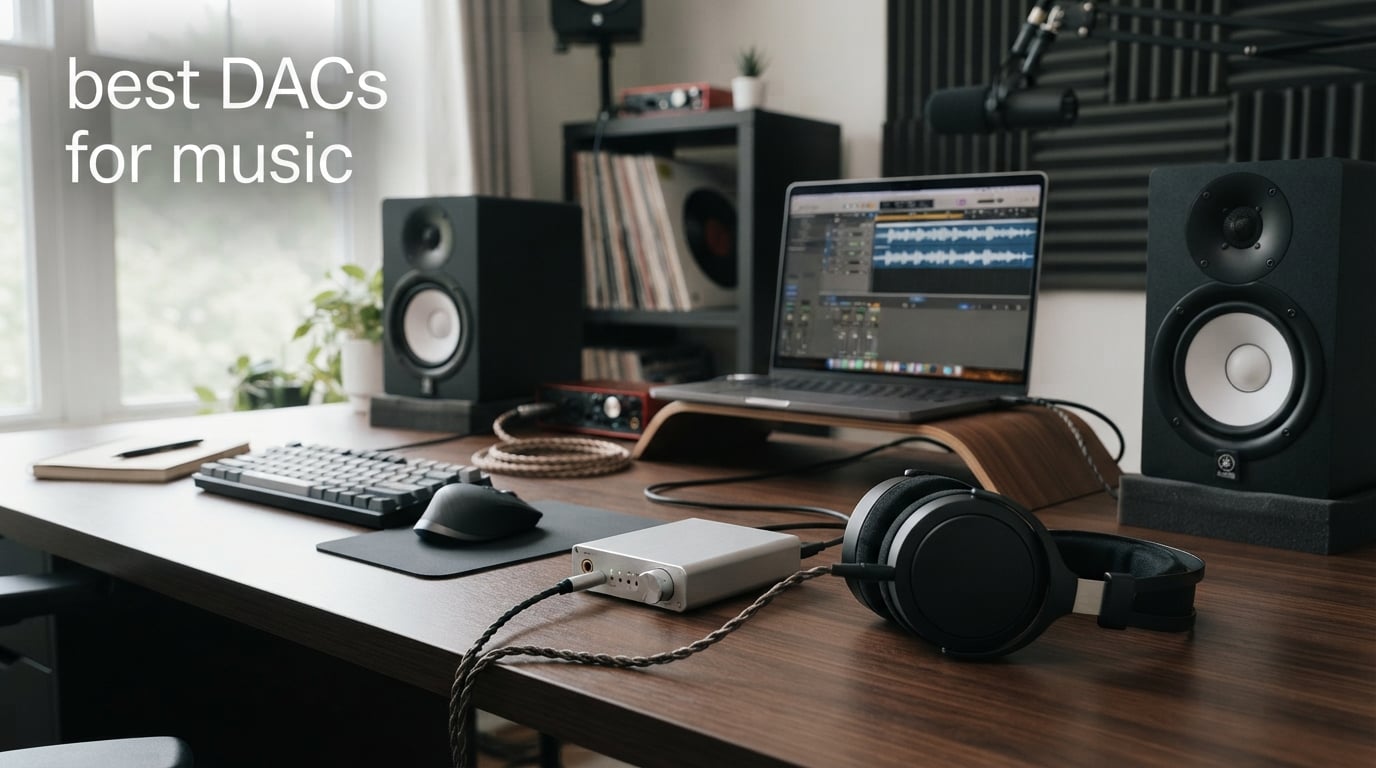
The best DACs for music are the TANCHJIM LUNA for balanced portable listening, the Fosi Audio Q6 Mini for a compact speaker or separate-amp system, and the FiiO K11 for a properly powered desktop headphone station. Those three cover the most common listening paths without pretending every setup needs the same box.
A DAC, short for digital-to-analog converter, turns the digital information from a phone, computer, streamer, TV, or CD transport into the analog signal that headphones, powered speakers, or an amplifier can reproduce. An external DAC can lower noise, add better connections, and give demanding headphones more usable output when it is paired with an amplifier.
I sorted these ten models by the job they actually suit: portable IEM listening, desktop headphones, active speakers, a home stereo, and music production. That matters more than chasing an impressive sampling-rate figure, because community discussions repeatedly make the same sensible point: a clean basic setup is often enough, and compatibility should come before spec-sheet anxiety.
For this guide, I used the supplied product specifications, customer-rating summaries, stated outputs, and supported formats rather than making listening claims that the data cannot prove. Every recommendation below says where the hardware fits, what it connects to, and where its limits begin.
Table of Contents
These are the top 3 DAC picks for music listening
The LUNA is the focused pick for IEM owners who want both 3.5mm and 4.4mm outputs; the Q6 Mini is the straightforward source component for a stereo chain; and the K11 is the practical answer for full-size headphones. Pick the form factor first, then choose the input and output set your system needs.
The best DACs for music in 2026 cover ten distinct setups
This overview puts every model in one place, from phone-sized DAC amplifiers to source components that feed XLR or RCA systems. A DAC without a headphone stage belongs with powered speakers or an external amplifier, while a DAC/amp combo can connect straight to headphones.
| Product | Specifications | Action |
|---|---|---|
 TANCHJIM LUNA TANCHJIM LUNA |
|
Check Latest Price |
 Fosi Audio Q6 Mini Fosi Audio Q6 Mini |
|
Check Latest Price |
 FiiO K11 FiiO K11 |
|
Check Latest Price |
 Fosi Audio ZD3 Fosi Audio ZD3 |
|
Check Latest Price |
 Fosi Audio ZH3 Fosi Audio ZH3 |
|
Check Latest Price |
 FiiO K7 FiiO K7 |
|
Check Latest Price |
 Fosi Audio DS2 Fosi Audio DS2 |
|
Check Latest Price |
 MOONDROP Dawn PRO 2 MOONDROP Dawn PRO 2 |
|
Check Latest Price |
 Fosi Audio DS1 Fosi Audio DS1 |
|
Check Latest Price |
 Luxury Precision W2 Ultra Luxury Precision W2 Ultra |
|
Check Latest Price |
Portable DACs are best when your phone or laptop is the source
Portable DACs make sense when a standard headphone output is missing, noisy, or unable to work with the plug on your headphones. The important distinction is power: sensitive IEMs need a quiet low-noise output, while full-size or planar headphones often need substantially more current than a tiny dongle can provide.
1. TANCHJIM LUNA is the portable audiophile pick for IEMs
TANCHJIM Luna Portable Headphone Amplifier High-Resolution USB DAC Decoder
Dual CS43198
32-bit/768kHz, DSD256
3.5mm and 4.4mm outputs
Pros
- Dual DAC design
- Class AB and H modes
- Balanced and single-ended outputs
Cons
- Small review base
- Best suited to IEMs
- No separate desktop inputs
The TANCHJIM LUNA is the most specialized portable choice here, aimed at people who already use good in-ear monitors and want a higher-spec USB-C DAC/amp. Its dual CS43198 arrangement, independent left and right op-amps, and support for 32-bit/768kHz PCM plus DSD256 give it a serious decoding foundation in a pocketable aluminum body.
What makes the LUNA easy to place is the pair of headphone outputs. A 3.5mm single-ended socket covers ordinary cables, while the 4.4mm balanced output gives owners of compatible IEM cables another connection path without adding a desktop unit.
The supplied review summary reports a 4.8 rating from 28 reviews, with praise centered on clean output, the switchable amplification modes, and the solid chassis. That is an encouraging result, but I would treat the small review count as context rather than assume it has the same long-term user record as the larger-volume models below.
Its switchable Class AB and Class H modes are a useful practical detail. Class AB favors conventional linear amplification behavior, whereas Class H is intended to manage efficiency; the point is choice between two stated operating modes, not a promise that either will transform every recording.
The TANCHJIM LUNA fits balanced and single-ended IEM cables
Choose the LUNA if your music travels with an Android phone, tablet, laptop, or compatible iPhone or iPad and you want a dedicated USB Type-C connection. Its stated 16-ohm minimum impedance and 8Hz to 80kHz frequency response make the intended audience clear: IEM users, not owners of unusually difficult full-size headphones.
I would especially favor it when both compact size and a 4.4mm balanced connector matter. The supplied single-crystal copper silver-plated Type-C cable and aircraft-grade aluminum chassis also make it more complete than a bare adapter.
The TANCHJIM LUNA is less suitable for power-hungry over-ear headphones
Do not select this model just because its decoding numbers are high if your main headphones need a powerful desktop amplifier. The listing positions it around portable IEM use, and the product data does not present it as a replacement for the high-output FiiO and Fosi desktop units.
It also has only wired USB Type-C input, so it does not replace a multi-input home-stereo DAC. For a phone-first or laptop-first IEM setup, that limitation is sensible; for a TV, console, or turntable system, it points you elsewhere.
2. Fosi Audio DS2 is the quiet budget portable DAC for sensitive IEMs
Fosi Audio DS2 USB C to AUX Headphone Amp DAC Dongle 3.5mm Jack Audio Portable Amplifier Dual Output DSD256 4.4mm Balanced High Resolution CS43131 for iPhone 15 Pro Max Plus iPad Android Phone
Dual CS43131
32-bit/384kHz, DSD256
3.5mm and 4.4mm outputs
Pros
- Very low stated noise
- Two headphone outputs
- Broad USB-C compatibility
Cons
- 170mW output
- Device-button volume
- Extra cable for some devices
The Fosi Audio DS2 is the practical entry point when you want a USB-C headphone DAC that stays small but does not abandon balanced output. It uses two Cirrus Logic CS43131 DAC chips, supports DSD256 and 32-bit/384kHz PCM, and includes both 3.5mm single-ended and 4.4mm balanced jacks.
Its stated 1 microvolt noise floor and 130dB signal-to-noise ratio are the standout specifications for sensitive IEMs. Low background noise is often more useful to this audience than headline power, since a hiss-free connection helps quiet passages remain quiet.
The product summary shows a 4.5 rating from 449 reviews and a strong category position among headphone amplifiers. Those user figures make it one of the better-supported portable choices in this set, particularly for listeners who do not need a larger desktop chassis.
The DS2 offers 170mW per channel at 32 ohms, which is meaningful for a dongle but still frames its job correctly. It should be matched to IEMs, efficient portable headphones, and moderate loads rather than treated as a solution for every high-impedance headphone.
The Fosi Audio DS2 works best with current USB-C devices
The stated compatibility covers recent USB-C phones, tablets, computers, laptops, and Mac hardware. That makes it an easy fit for commuting, office listening, or a compact travel kit where the source device has no analog headphone socket.
The metal body weighs 1.92 ounces, so it is still manageable in a mobile chain. Its 60-step volume control is handled with the source-device buttons and remembers the selected level, a behavior worth checking if you prefer a separate hardware wheel.
The Fosi Audio DS2 is not the right tool for difficult headphones
Owners of high-impedance or inefficient planar headphones should look at the FiiO K11, Fosi ZH3, FiiO K7, or W2 Ultra instead. They provide substantially higher stated output or are designed as fixed desktop amplification solutions.
Some non-USB-C sources need an additional cable, which is normal for a USB-C DAC but should be planned before a trip. This is a compact audio converter, not a universal connection hub with optical, coaxial, or RCA sockets.
3. MOONDROP Dawn PRO 2 is the portable pick for DSP tuning
MOONDROP Dawn PRO 2 Decoder Headphone Amplifier 3.5/4.4 Phone Out Dual CS43198 32Bit/384KHz DSD256 Portable USB DAC/AMP
Dual CS43198
32-bit/384kHz, DSD256
App-controlled DSP tuning
Pros
- App DSP and EQ
- Separate 100-level volume
- Dual headphone outputs
Cons
- 124mW output
- App is needed for DSP
- Less suited to demanding headphones
The MOONDROP Dawn PRO 2 separates itself from the average dongle with app-based DSP controls rather than raw output claims. Its dual CS43198 DAC chips support 32-bit/384kHz PCM and DSD256, and its stated 3.5mm and 4.4mm outputs keep it compatible with common single-ended and balanced headphone cables.
Three independent LDO power chips and an independent crystal oscillator are part of its supplied design. In plain terms, those components are intended to give the digital and analog sections controlled power and timing, though the reason to choose this unit remains its configurable listening workflow.
The review summary shows a 4.5 rating from 197 reviews, with customer interest in the app-driven tuning functions. That is useful for listeners who want to adjust an IEM or headphone response carefully instead of relying only on the tonal balance supplied by the source.
A separate 100-level DAC volume control avoids making every adjustment through the phone or computer. For IEM listeners, finer volume steps can be more helpful than excess wattage because a small level change may otherwise be too large.
The MOONDROP Dawn PRO 2 suits listeners who want an adjustable response
The MOONDROP app offers a parameterized equalizer with filter type, frequency point, gain, and Q-value settings, plus a headphone frequency-response database. That gives technically curious listeners a defined way to experiment instead of using a vague “sound mode.”
I would choose it for a portable setup built around efficient headphones or IEMs, especially when the owner will actually use the app. Its aluminum housing has heat-dissipation vents, and the form factor remains appropriate for a phone or laptop bag.
The MOONDROP Dawn PRO 2 needs realistic power expectations
The specified output is 124mW plus 124mW with a 4Vrms output voltage. That is ample context for the product’s intended role, but it is not a reason to pair it blindly with every hard-to-drive over-ear model.
DSP setup also adds a step that a plug-and-play buyer may not want. If you want a compact DAC with fewer settings, the Fosi DS2 is the simpler portable alternative; if you need forceful output, move to the W2 Ultra or a desktop model.
4. Fosi Audio DS1 is the portable high-resolution option with added power
Fosi Audio DS1 USB C DAC Headphone Amp DSD512 ES9038Q2M HiFi Mini Audio Adapter Supports 32bit/768kHz with 4.4MM and 3.5MM Dual Headphones Outputs Compatible with Smartphones/Laptop/PC/Music Players
ES9038Q2M DAC
32-bit/768kHz, DSD512
220mW and dual outputs
Pros
- DSD512 support
- 220mW output
- 3.5mm and 4.4mm jacks
Cons
- Larger dongle
- Some volume reports
- Lower rating than rivals
The Fosi Audio DS1 is for a portable listener who puts format support and a stronger stated output ahead of the smallest possible dongle. Its ESS ES9038Q2M DAC is specified for 32-bit/768kHz PCM and DSD512, the highest listed resolution support among these ten products.
It also specifies 220mW of output and support for headphones up to 200 ohms, which places it above the DS2 and Dawn PRO 2 on its stated power figure. The 3.5mm and 4.4mm outputs mean one unit can work across conventional and balanced cables.
The DS1 has a 4.3 rating from 502 reviews, so it has a much larger feedback pool than some boutique portable options but a lower average score. I see that as a reason to read its connection and volume behavior carefully rather than assume a high-resolution format list settles the decision.
Fosi lists THD+N below 0.0006%, signal-to-noise above 120dB, and noise below 1.6 microvolts. These are reassuring low-noise figures, but a stable fit with your source device and headphones will still matter more in everyday listening.
The Fosi Audio DS1 works for listeners with high-resolution libraries
Choose the DS1 if you actively play PCM files at high sampling rates or DSD files and want the decoder to accept those formats. It is also a sensible compact candidate for headphones that need more than the modest output of the smallest portable adapters.
OTG support is listed when an appropriate Lightning-to-USB-C cable is added, broadening its potential source compatibility. That said, cable choice is part of the setup, so do not assume every older mobile device will connect directly.
The Fosi Audio DS1 needs a source-volume compatibility check
The supplied customer summary notes reports of independent volume-control issues with certain sources. That does not describe every setup, but it is a specific limitation worth considering if you need predictable volume behavior across several phones, players, and computers.
It is also larger and heavier than a typical dongle, which is the trade-off for a more ambitious portable specification. If your priority is a featherweight travel device, the DS2 or Dawn PRO 2 may be the more natural match.
5. Luxury Precision W2 Ultra is the premium portable power pick
Luxury Precision W2 Ultra Portable USB DAC/AMP Headphone AMP
Dual CS43131
860mW balanced output
3.5mm, 4.4mm, SPDIF
Pros
- Very high balanced power
- SPDIF output
- Separate supply sections
Cons
- Small review base
- Older iPhones need extra hardware
- No desktop inputs
The Luxury Precision W2 Ultra is the portable model to consider when your headphones demand much more output than a conventional dongle can offer. Its specified 860mW at 32 ohms from the balanced output is the largest portable power figure in this group, and it uses two CS43131 DAC chips.
It retains 3.5mm and 4.4mm headphone connections but adds SPDIF output, a rare feature among the portable products here. That output can send a digital signal to another compatible component, making the W2 Ultra more than a phone-to-headphone adapter.
The product record shows a 4.3 rating from 32 reviews. The small review base and boutique category rank make this a more specialized recommendation, so I would buy it for the stated output and connection requirements rather than for broad-market reassurance.
Luxury Precision also specifies separate power supplies for the USB and DAC sections. The stated purpose is noise reduction, which aligns with its positioning as a portable DAC/amp for listeners who want a more substantial chain without moving to a desk-bound device.
The Luxury Precision W2 Ultra can suit demanding headphones away from a desk
This is the portable option for high-impedance or planar-style headphones when the owner needs strong balanced output in a three-by-one-by-half-inch body. It has enough stated power to sit in a very different category from lightweight IEM dongles.
I would pair it with a laptop, modern USB-C phone, or dedicated digital player only after confirming the cable and power arrangement. Its low-power-consumption design is intended to preserve source-device battery life, but high-output portable listening still deserves practical battery planning.
The Luxury Precision W2 Ultra is not the simplest mobile setup
Older iPhones may need a camera kit with external power, according to the supplied product data. That additional hardware reduces the appeal for someone who wants a one-cable mobile solution.
It also lacks the optical, coaxial, RCA, XLR, and HDMI ARC connections used in a home-stereo hub. Choose it for portable headphone power and SPDIF output, not as a replacement for a full desktop preamp.
Desktop DACs are best for headphones, speakers, TVs, and studio desks
A desktop digital-to-analog converter has room for connection options that a dongle cannot carry: optical and coaxial inputs, RCA or XLR line outputs, a remote, a display, and sometimes a headphone amplifier. Start by deciding whether you need only a line-level DAC for speakers or a combined DAC amplifier for headphones.
6. Fosi Audio Q6 Mini is the budget desktop DAC for a separate amp or speakers
Fosi Audio Q6 Mini Desktop DAC, USB-C Digital to Analog Audio Converter for Home Stereo Amplifier & Headphone Amp, AK4493S XMOS XU316, Optical/Coaxial-in, RCA/Sub-Out, High-Res 32Bit/768kHz DSD512
AK4493S and XMOS XU316
32-bit/768kHz, DSD512
USB, optical, coaxial
Pros
- Three digital inputs
- RCA and sub-out
- Compact aluminum case
Cons
- No headphone amplifier
- Needs powered speakers or amp
- No balanced outputs
The Fosi Audio Q6 Mini is the cleanest choice for a listener who already has powered speakers, a stereo amplifier, or a separate headphone amp. It is a dedicated desktop DAC rather than a DAC/amp combo, using an AKM AK4493S chip, XMOS XU316 processor, and OPA1612 op-amp.
Its connection set is unusually flexible for a compact source component: USB Type-C, optical Toslink, and coaxial S/PDIF inputs feed RCA stereo outputs and a dedicated sub-out. That makes it useful when a computer, TV, CD player, or streamer needs to join a simple 2.1 or stereo setup.
The Q6 Mini has a 4.7 rating from 110 reviews, and the review summary describes it as clean sounding with flexible connectivity. Its stated 121dB signal-to-noise ratio, 121dB dynamic range, and 0.00012% THD+N reinforce its role as a low-distortion line-level source.
It handles PCM to 32-bit/768kHz and DSD512, though format support should not distract from the central point: it does not include a headphone amplifier. The right companion is an external amp or active speakers, not a pair of headphones plugged directly into the DAC.
The Fosi Audio Q6 Mini works well in a simple home stereo chain
Use the Q6 Mini when you need optical from a TV, coaxial from a digital player, or USB from a computer and want a small box that sends analog audio to an existing system. The dedicated sub-out gives powered-subwoofer users a useful option without adding another splitter.
Windows, macOS, Linux, PCs, Macs, TVs, CD players, and tablets are listed as compatible sources. Its two-year manufacturer warranty also adds some confidence for a component that may stay connected to a desk or rack for a long time.
The Fosi Audio Q6 Mini requires separate headphone amplification
Do not buy the Q6 Mini if your main goal is driving headphones from a desk. There is no headphone jack or built-in headphone amplifier, so you would need to add another component between it and your headphones.
It also offers RCA rather than balanced XLR outputs. If your active monitors or amplifier are set up for XLR, the Fosi ZD3 gives you a more direct balanced-output path.
7. FiiO K11 is the desktop headphone all-rounder with clear status controls
FiiO K11 DAC and Headphone Amplifier for Home Audio or PC, 6.35mm and Balanced 4.4mm, RCA, Coaxial, Optical, 1400mW, 384kHz/24Bit DSD256 (Silver)
1400mW output
4.4mm and 6.35mm outputs
USB, optical, coaxial
Pros
- Drives up to 350 ohms
- Useful VA display
- Large review base
Cons
- No sub-out
- No 768kHz support
- No balanced line-out
The FiiO K11 is the sensible desktop answer for a listener who wants one compact unit to decode digital audio and power headphones. It supports USB, optical, and coaxial inputs, then offers 4.4mm balanced and 6.35mm single-ended headphone outputs alongside RCA line-out and coaxial output.
Its key stated figure is 1400mW of maximum output for headphones from 8 to 350 ohms. That range gives it a much broader headphone role than the portable units, while the VA display shows sampling rate, volume, gain, and output mode without asking you to guess what the box is doing.
With a 4.6 rating from 738 reviews and a strong headphone-amp category rank, the K11 has the broadest user feedback of the models with this type of desktop layout. The supplied review insight specifically credits its clean output, display, and ability to work with varied headphones.
Its PCM specification tops out at 384kHz/24-bit with DSD256 support. That is lower than a few rivals on paper, but it remains far beyond the resolution of many practical music libraries and should not outweigh the K11’s output, inputs, and easier monitoring.
The FiiO K11 makes desktop headphone setup straightforward
The K11 suits a PC or TV desk where headphones are the main listening device and a real gain setting is helpful. I would choose it for a first serious desktop DAC amplifier because the display makes sampling rate, volume, and output mode visible at a glance.
The supplied Type-C-to-Type-A cable covers a typical computer connection, while optical and coaxial inputs leave room for a console, TV, or digital transport. RCA line-out also lets the K11 feed another amplifier or set of powered speakers later.
The FiiO K11 does not cover every speaker-system feature
There is no dedicated subwoofer output, so a 2.1 speaker system may need a different routing arrangement. The Fosi Q6 Mini has a stated sub-out if that is the deciding feature, while the ZD3 adds XLR and HDMI ARC for a more complex living-room system.
It also does not list 32-bit/768kHz PCM support. Listeners who need that exact capability should look at the ZH3, ZD3, Q6 Mini, or portable models that explicitly state it.
8. Fosi Audio ZD3 is the desktop DAC preamp for TV and balanced stereo systems
Fosi Audio ZD3 Desktop DAC Preamp, Fully Balanced Digital to Analog Audio Converter with ES9039Q2M for Home Stereo Amplifier, Bluetooth/USB/Optical/Coax/TV HDMI ARC Input, XLR/RCA Output with Remote
ES9039Q2M DAC
HDMI ARC and Bluetooth
XLR and RCA preamp outputs
Pros
- HDMI ARC input
- Balanced XLR outputs
- Remote and 12V trigger
Cons
- No headphone output
- Requires separate amp
- Niche source component
The Fosi Audio ZD3 is a source component for a fixed stereo system, not a headphone DAC. Its ES9039Q2M DAC, XMOS XU316 processor, QCC3031 Bluetooth chip, and LME49720 op-amp are paired with XLR and RCA preamp outputs, so it can feed active monitors, a power amplifier, or an integrated amplifier.
HDMI ARC is the unusual connection that gives the ZD3 a clear job. It can accept TV audio over ARC while also accepting Bluetooth 5.1, USB, optical, and coaxial sources, which makes a single stereo system easier to share between screen viewing and music playback.
The 4.6 rating from 390 reviews provides a larger feedback base than many dedicated stereo DACs. The supplied review summary highlights HDMI ARC, high-resolution decoding, and XLR connectivity, all of which support its role as the central digital source for a home setup.
It supports 32-bit/768kHz PCM and DSD512, includes a 1.5-inch OLED display, remote control, and 12V trigger input and output. The trigger matters in a multi-box system because compatible equipment can switch on or off together.
The Fosi Audio ZD3 connects a television and music sources to one stereo
Choose the ZD3 if you want a TV, computer, streamer, and Bluetooth source going into the same powered speakers or amplifier. HDMI ARC avoids relying only on an optical connection and is the reason this model stands apart from the Q6 Mini.
The XLR output is useful for a balanced signal path to compatible active speakers or amplifiers, while RCA keeps it compatible with ordinary unbalanced gear. The included remote and front display are practical for a listening room rather than a laptop-only desk.
The Fosi Audio ZD3 cannot directly power headphones
There is no headphone amplifier or headphone jack in the ZD3’s stated design. Headphone listeners need to add a separate amplifier or select a DAC/amp combo such as the K11, ZH3, or K7.
It is also a source-focused component, so it cannot replace a recording interface with microphone inputs and recording drivers. For music production monitoring, it works only on the playback side of a system with suitable powered monitors or an external amplifier.
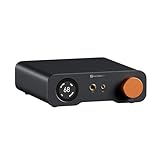
9. Fosi Audio ZH3 is the full-featured desktop DAC amplifier for headphones and speakers
Fosi Audio ZH3 DAC Headphone Amp, Fully Balanced Preamp with AKM4493SEQ XMOS XU316 PCM 768kHz for Amplifiers, USB/Optical/COAX/RCA/12V Trigger Input, XLR/RCA/4.4mm/6.35mm Output with Remote
AKM4493SEQ DAC
2570mW balanced output
EQ, XLR, RCA, 4.4mm, 6.35mm
Pros
- Very high balanced output
- EQ and filter controls
- Preamp and console modes
Cons
- EQ only affects headphones
- Balanced output matters most
- Many settings to learn
The Fosi Audio ZH3 is the do-most-things desktop choice, combining a DAC, headphone amplifier, and preamp in one chassis. Its AKM4493SEQ DAC, XMOS XU316 processor, and four OPA1612 op-amps feed 4.4mm balanced and 6.35mm single-ended headphone outputs as well as XLR balanced pre-out and RCA line-out.
Power is its defining specification: 2570mW at 32 ohms through the balanced 4.4mm output and 640mW at 32 ohms from the 6.35mm output. With a three-level gain switch for 16- to 300-ohm headphones, it gives both sensitive IEM users and full-size headphone owners a clear adjustment path.
The ZH3 holds a 4.6 rating from 308 reviews, with the supplied review summary calling it the most feature-rich and powerful desktop DAC/amp in this selection. Its stated ultra-low 1.9 microvolt noise floor helps explain why it is positioned for both sensitive and more demanding headphones.
It also adds bass and treble EQ, six filter types, bypass mode, and two swappable op-amps. Those controls provide genuine choices, but they are not mandatory; the bypass option lets a listener keep the signal path simple if tuning is not wanted.
The Fosi Audio ZH3 supports a flexible desk for music, gaming, and speakers
Use the ZH3 when one desk has headphones for focused listening and active speakers or an amplifier for room playback. USB, optical, coaxial, and RCA inputs cover common source types, while its 12V trigger can join compatible equipment in a larger system.
Its UAC mode switching is listed for PS5, Xbox, and Switch compatibility, which gives it a practical gaming path as well. That does not replace a console’s own chat features, but it can make one DAC/amp serve music and game-audio duties.
The Fosi Audio ZH3 rewards owners who will use its balanced output and controls
The largest power figure is available through the 4.4mm balanced output, so a listener with only 6.35mm headphones will not access the same headline specification. The single-ended 640mW figure is still substantial, but cable and headphone choice matter.
Its EQ settings apply only to the headphone output, not the RCA or XLR preamp outputs. If you need speaker-side tone control, use controls on the speakers, amplifier, software, or a separate processor rather than expect the ZH3 headphone EQ to do that work.
10. FiiO K7 is the high-output desktop option for full-size headphones
FiiO K7 Desktop DAC and Amplifier
Dual AK4493SEQ DACs
Dual THX AAA 788+ amps
2000mW balanced output
Pros
- High balanced output
- Many analog and digital connections
- Large review base
Cons
- Fixed desktop chassis
- Separate power supply
- No portable use
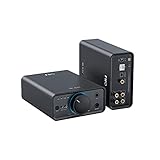
The FiiO K7 is the desktop alternative for listeners who want high stated headphone output with a familiar FiiO DAC/amp layout. It combines two AKM AK4493SEQ DAC chips with dual THX AAA 788+ amplifier stages and specifies 2000mW of stable balanced output power.
Its inputs include USB, optical, coaxial, and AUX, while the output list includes 4.4mm balanced, 6.35mm single-ended, and 3.5mm single-ended headphone connections. That three-jack arrangement is especially convenient for a desk shared by different headphones without constantly changing adapters.
The K7 has a 4.5 rating from 770 reviews and a strong category standing among headphone amplifiers. The supplied review summary points to balanced output, connection variety, and sufficient power for full-size headphones as its main reasons to consider it.
FiiO lists RGB indicator lights for working state and sampling-rate display, two gain levels, three output levels, and a six-stage audio circuit adapted from higher-end FiiO equipment. It requires a 12V supply, which is normal for a desktop amplifier but confirms that portability is not part of the brief.
The FiiO K7 is suited to a permanent headphone listening station
Choose the K7 for a home office, studio desk, or stereo shelf where full-size headphones remain connected most of the time. Its balanced and single-ended outputs, multiple digital inputs, and AUX input make it flexible for a computer, TV, console, or other source chain.
I would put it on the shortlist when a desktop DAC amplifier needs enough stated power for a broad selection of headphones without moving into a separate DAC and separate amp stack. Its aluminum-alloy construction also fits the role of a unit that will stay in one place.
The FiiO K7 is not a compact answer for mobile listening
The K7 is physically a desktop component and depends on a separate power supply. If your main source is a phone or tablet, the DS2, Dawn PRO 2, LUNA, DS1, or W2 Ultra is more appropriate.
The product data does not state a maximum PCM or DSD resolution, so buyers who require a published format ceiling should check the model documentation before deciding. Its documented strengths are power, amplifier topology, and connection variety rather than a stated resolution headline.
The right DAC depends on your connections, headphones, and listening job
The best buying decision begins with the gear you already own. A low-noise USB-C dongle is enough for many IEM owners, a dedicated line DAC is better for powered speakers, and a DAC/amp combo is the cleaner route when headphones need both conversion and amplification.
A DAC converts digital data while an amplifier supplies headphone power
A DAC turns PCM or DSD data into an analog signal, while an amplifier raises that signal to a level that can drive headphones or speakers. One box may perform both jobs, which is why the K11, ZH3, K7, LUNA, DS2, Dawn PRO 2, DS1, and W2 Ultra have headphone outputs while the Q6 Mini and ZD3 are intended to feed other equipment.
Do not assume a DAC/amp combo is automatically better for speakers, or that a separate DAC is automatically better for headphones. The right arrangement is the one that gives your existing speakers, amplifier, or headphones the inputs and power they need.
USB-C is simplest, while optical, coaxial, HDMI ARC, RCA, and XLR solve fixed-system needs
USB is the usual connection from a computer or compatible mobile device, and USB-C is the common connector on the portable group. Optical and coaxial are useful when a TV, console, CD player, or digital transport needs to send audio to a desk or stereo DAC.
HDMI ARC is the ZD3’s differentiator for TV audio, while RCA and XLR are analog outputs that feed speakers or amplifiers. RCA is standard for most consumer stereo gear, whereas XLR is used when a balanced connection is available on both pieces of equipment.
Headphone sensitivity and impedance decide how much amplifier output you need
Power ratings only become meaningful beside the headphone’s sensitivity, impedance, and connector. Sensitive IEMs can reveal background noise, so a low stated noise floor such as the DS2’s 1 microvolt matters; difficult full-size headphones call for models with higher stated output such as the ZH3, K7, or W2 Ultra.
Balanced does not automatically mean better music, but it can provide a different connector path and, on some products, much more output. The ZH3 is a clear example because its stated balanced figure is far higher than its stated single-ended figure.
Budget DACs are enough when the basic connection problem is the real problem
Start with a simple portable DAC when your phone lacks a headphone jack, your laptop output is noisy, or you need a 4.4mm cable connection for efficient headphones. The DS2 and Dawn PRO 2 focus on portable IEM listening, while the Q6 Mini is a straightforward desktop converter for speakers or a separate amplifier.
Forum discussions are right to warn buyers not to overthink this category. If your current source is already quiet, your headphones are easy to drive, and you do not need extra inputs, an external unit may bring convenience rather than a dramatic audible change.
Premium DAC features matter when they solve a specific system limitation
A premium-oriented choice makes sense when it brings a needed feature such as stronger balanced output, HDMI ARC, XLR preamp outputs, SPDIF output, hardware controls, or app-based DSP. The W2 Ultra, ZD3, and ZH3 each earn their more specialized roles through those connection and power differences.
Build quality, support, and firmware behavior also belong in the decision, as audio forums often point out. A more complicated device is only a good purchase when you will use the extra features and can keep the setup stable.
Music production playback needs a clean monitor path, not a recording interface substitute
For electronic music production, a DAC can feed active monitors or a headphone amplifier during editing, arranging, and reference listening. The ZD3 is suited to a monitor chain through XLR or RCA outputs, while the ZH3 can cover headphones and line-level playback from one desktop unit.
A DAC does not replace an audio interface when you need microphone inputs, instrument inputs, recording drivers, or low-latency recording workflow. For Ableton, FL Studio, or another DAW, treat this category as a playback-monitoring choice unless the device is explicitly an interface.
Streaming quality only helps when the rest of the playback chain can use it
Lossless streaming and local high-resolution files can be sent over USB from a computer or compatible streamer to these DACs. The relevant question is not only whether a DAC accepts a high sampling rate, but whether the source, app settings, cables, and output path are all configured for the intended signal.
For a simple streaming desk, the K11 or ZH3 can centralize computer playback and headphones. For a living-room system, the ZD3’s HDMI ARC, Bluetooth, USB, optical, and coaxial inputs make it the more adaptable hub.
These DAC questions have direct answers
What is the best DAC for music production?
The best DAC for music production playback is one that matches the monitor path. The Fosi Audio ZD3 is the strongest fit here when active monitors or an amplifier use XLR or RCA inputs, while the Fosi Audio ZH3 adds a headphone amplifier and preamp outputs. Neither replaces an audio interface when recording inputs or low-latency recording drivers are required.
What is a DAC and do I need one?
A DAC converts digital music data into the analog signal that headphones, speakers, and amplifiers can play. You may need one when a phone lacks a headphone output, a computer output is noisy, your setup needs optical, coaxial, HDMI ARC, RCA, or XLR connections, or your headphones need more power. If the current system is quiet and compatible, an external DAC may be optional.
What’s the difference between a DAC and an amplifier?
A DAC converts digital audio into analog audio. An amplifier provides the power needed to drive headphones or speakers. Some products combine both functions, such as the FiiO K11, Fosi Audio ZH3, and FiiO K7, while the Fosi Audio Q6 Mini and Fosi Audio ZD3 are DAC or preamp components that require powered speakers or a separate amplifier.
How much should I spend on a DAC?
Spend according to the connection or power problem you need to solve, not because a specification looks impressive. A compact USB-C DAC is appropriate for IEMs and portable listening, a basic desktop DAC works with active speakers or a separate amp, and a more feature-rich desktop model is justified when you need higher headphone output, XLR, HDMI ARC, or several source inputs.
Do DACs really improve sound quality?
A DAC can improve a setup when it reduces noise, gives a cleaner analog output, provides the right connection, or pairs with enough amplification for the headphones. The change is not guaranteed to be dramatic when an existing source is already quiet and capable. Match the DAC to your headphones, speakers, and inputs before expecting a difference.
The best DAC choice is the one that fits your current music system
For most portable IEM listeners, the TANCHJIM LUNA is the strongest balanced choice, while the Fosi Audio DS2 and MOONDROP Dawn PRO 2 make more sense for straightforward mobile listening. For a desktop headphone setup, the FiiO K11 is the easy all-rounder, the Fosi Audio ZH3 has the broadest set of controls and outputs, and the FiiO K7 is built around high balanced power.
The best DACs for music in 2026 are not a single winner for every listener. Choose the smallest model that gives you the inputs, outputs, and headphone power you genuinely need, then spend time enjoying the music rather than chasing specifications you will never use.