
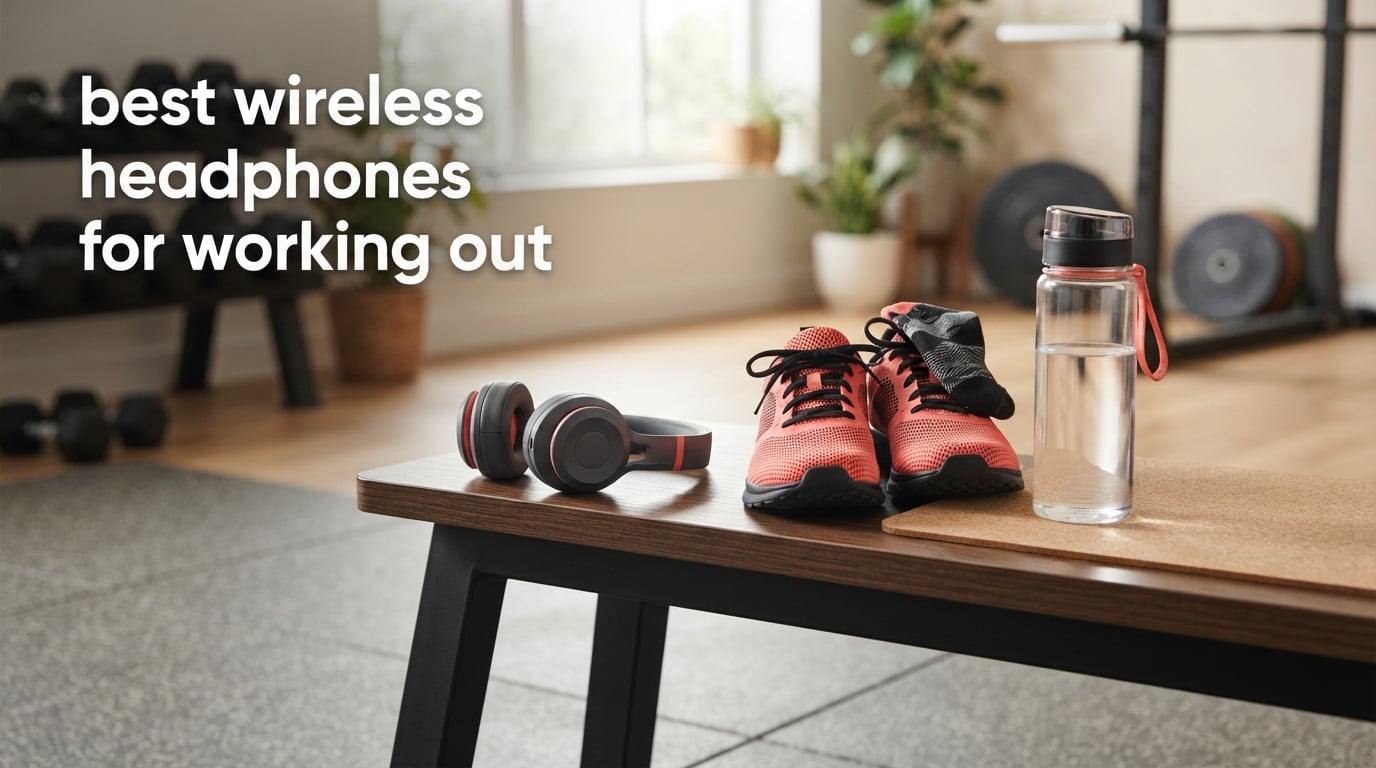
The best wireless headphones for working out do two jobs at once: they stay comfortable when you move and keep playing after sweat, motion, and a rushed trip to the gym. A good pair is not defined by bass alone. Fit security, sweat protection, controls you can use with wet hands, and enough battery for your actual routine matter just as much.
I would start with the shape of your training, not a feature checklist. Runners who need traffic awareness have a different problem from lifters who want to block clanging plates, and a person doing high-impact intervals needs more retention than someone taking a yoga class.
These 10 workout headphones cover open-ear bone-conduction frames, hook-style exercise earbuds, and over-ear models. The short version is simple: choose ear hooks for maximum hold, open-ear models for awareness, and over-ear cups when gym isolation and bigger sound outweigh heat and bulk.
The top 3 picks answer the most common workout needs in 2026
My all-round pick is the Beats Powerbeats Pro 2 because its nickel-titanium earhooks, IPX4 protection, physical controls, ANC, and heart-rate monitoring address the major gym-use questions in one design. The JBL Endurance Peak 4 is the tougher choice for rain, dust, and intense sweat thanks to IP68 protection and its TwistLock fit, while the SHOKZ OpenRun is the practical outdoor-running choice at just 26 grams with an open-ear frame.
Best all-round workout earbuds: Beats Powerbeats Pro 2 — secure earhooks, ANC, transparency mode, and up to 45 hours with the case.
Best for hard conditions: JBL Endurance Peak 4 — IP68 water and dust protection, memory-wire hooks, and up to 48 hours total playback.
Best for outdoor awareness: SHOKZ OpenRun — an IP67 open-ear bone-conduction design with an 8-hour battery.

The best wireless headphones for working out in 2026 are easier to compare side by side
The table below puts each model’s format, protection, battery claim, and standout workout trait in one place. It is a quick filter, not a substitute for checking how a given hook, tip, or headband feels on your own ears and head.
| Product | Specifications | Action |
|---|---|---|
| Beats Powerbeats Pro 2 |
|
View on Amazon |
 JBL Endurance Peak 4 JBL Endurance Peak 4 |
|
View on Amazon |
 SHOKZ OpenRun SHOKZ OpenRun |
|
View on Amazon |
 Soundcore Sport X10 Soundcore Sport X10 |
|
View on Amazon |
 bmani T16 bmani T16 |
|
View on Amazon |
 SHOKZ OpenRun Pro 2 SHOKZ OpenRun Pro 2 |
|
View on Amazon |
 Soundcore V20i Soundcore V20i |
|
View on Amazon |
 Skullcandy Crusher 540 Active Skullcandy Crusher 540 Active |
|
View on Amazon |
 Raycon Fitness Raycon Fitness |
|
View on Amazon |
 TREBLAB Z2 TREBLAB Z2 |
|
View on Amazon |
Our methodology prioritizes stability, sweat readiness, and usable controls
I screened the analyzed product records for the things that change a workout first: a stated water-resistance rating or sweat-resistant coating, a retention system, battery capacity, and control type. I also checked the listed weight, wireless version where supplied, microphone setup, and whether a model supports awareness or noise control.
Fit got the greatest weight because fitness communities repeatedly describe earbuds falling out during sprints, burpees, and rapid direction changes as the deal-breaker. Ear hooks, wraparound frames, memory wire, and an adjustable headband are not guarantees of comfort, but they offer more mechanical support than a smooth, standard earbud shell.
I also treated the customer feedback in the product records as a useful warning system rather than a lab result. Reports of sensitive touch controls, hot earcups, tight clamp force, unreliable multipoint switching, or fit trouble on smaller ears show where a strong feature list may not suit every athlete.
No headphone is risk-free simply because it is called sport-ready. I would match the protection rating to the session, clean the contact surfaces after use, and never assume a water-resistant model is suitable for swimming unless its product information explicitly says so.
1. Beats Powerbeats Pro 2 is the strongest all-round pick for intense training
Beats Powerbeats Pro 2 – Wireless Noise Cancelling Workout Earbuds with Secure- Fit Earhooks, Up to 45-Hour Battery with Charging Case, Sweat & Water Resistant, Heart Rate Monitoring – Jet Black
IPX4
Secure earhooks
ANC
45-hour total battery
Pros
- Nickel-titanium earhooks
- Physical buttons and volume rockers
- ANC plus transparency
- Heart-rate monitoring
Cons
- May not suit smaller ears
- ANC may feel pressurized
The Powerbeats Pro 2 is the pair I would put first for people who alternate between treadmill runs, strength work, and interval sessions. Its secure-fit nickel-titanium alloy earhooks are 20 percent lighter than the prior generation according to the supplied record, and five ear-tip sizes give more chance of finding a seal that does not shift.
Workout control is unusually well considered here. Each earbud has on-ear buttons and volume rockers, so you do not have to depend on a sweaty finger landing correctly on a touch panel during a hard set.
The Apple H2 chip supports Adaptive EQ and Personalized Spatial Audio on compatible Apple devices, while Android users can access features through the Beats app. ANC is useful when a busy gym is distracting, and Transparency Mode is the safer switch when you move outside or need to hear an instructor.
The main limitation is fit variability. Some customer feedback says the hooks and tips can feel too large for smaller ears, and others find ANC pressure uncomfortable, so I would give fit priority over the heart-rate feature if you have a history of earbud discomfort.
Secure earhooks make this pair suit running and high-impact circuits
The earhook architecture is the reason this model ranks highly for movement. Customers in the analyzed feedback specifically praise it for holding through HIIT, running, and heavy lifting, while the IPX4 rating covers sweat and water exposure from typical exercise.
The case provides up to 45 hours of total playback, and Fast Fuel adds 1.5 hours after a five-minute charge. That makes a forgotten charge less likely to derail a planned session.
Heart-rate monitoring is useful as a convenience rather than a primary metric
The built-in sensors are a differentiator if you prefer fewer devices during training. Still, one customer report describes inconsistent readings against a chest strap, so I would treat the result as an extra reference point rather than the number that sets your training zones.
Six microphones, Qi case charging, and automatic device switching add day-to-day convenience. The case is relatively substantial, but it supports the longer total battery claim.
2. JBL Endurance Peak 4 is the toughest choice for wet and dusty training
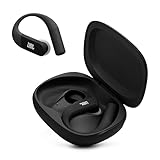
JBL Endurance Peak 4 – Cancelling Sport Earbuds – Black/Grey
IP68
TwistLock hooks
ANC
48-hour total battery
Pros
- IP68 water and dust protection
- Memory-wire hooks
- Adaptive ANC and ambient mode
- Fast charging
Cons
- Large charging case
- Touch controls may trigger accidentally
The JBL Endurance Peak 4 is built around the concern that ruins many gym earbuds: sweat and grime getting where they should not. IP68 is the strongest explicit protection rating in this group, and the product record describes it as waterproof and dustproof, which makes it a serious candidate for outdoor runners, trail sessions, and heavy sweaters.
Its TwistLock design combines JBL OvalTubes with liquid-silicone ear hooks and memory wire. That is a stronger physical retention approach than relying on ear tips alone, and it is why I would consider this model first when “won’t fall out” is the non-negotiable requirement.
Adaptive Noise Cancelling is paired with Smart Ambient, so the listener can choose concentration for indoor training or awareness for outside movement. The 10 mm dynamic driver, JBL Pure Bass with Spatial Sound, and Personi-fi 3.0 app profile add a broad set of listening adjustments.
There are trade-offs worth knowing before committing. The analyzed feedback mentions an oversized case and accidental touch actions, neither of which affects the IP68 story but both can be annoying when you are changing tracks mid-workout.
IP68 protection makes this pair fit demanding sweat and weather exposure
IP ratings matter more than a general “sweatproof” label. An IP68 designation covers dust as well as water exposure under the maker’s stated conditions, making it more reassuring than models that only list a coating or lower water rating.
That does not remove the need to dry the earbuds and charging contacts before putting them in the case. A clean, dry case is part of keeping any true-wireless set healthy over repeated sessions.
TwistLock support makes this pair fit runners who dislike readjusting earbuds
The flexible hook and TwistLock arrangement are designed to resist the rotational movement that works a normal bud loose. It should also suit explosive gym movements where a standard in-ear design can gradually unseat.
Battery is listed at up to 48 hours in total or 32 hours with ANC on, with 10 minutes of charging supplying four hours of playback. Six microphones and a lanyard hole on the case round out an athlete-focused setup.
3. SHOKZ OpenRun is the lightest open-ear option for awareness-first running
SHOKZ OpenRun Bone Conduction Open-Ear Bluetooth Sport Headphones, Black
Open-ear
IP67
26 g
8-hour battery
Pros
- Very light 26 g frame
- IP67 rating
- Open-ear traffic awareness
- Quick charge
Cons
- No noise control
- Ambient noise affects sound
The SHOKZ OpenRun solves a different workout problem from sealed earbuds: it leaves the ear canal open. The bone-conduction driver sends sound through the cheekbone area while your ears remain available for traffic, training partners, and approaching cyclists.
At 26 grams, its wraparound frame is substantially less present on the head than an over-ear model. I would put it near the top of a shortlist for long outdoor runs, walking routes, or group fitness settings where hearing the environment is part of staying comfortable and alert.
The stated IP67 rating offers strong sweat and water protection, and the manufacturer information specifically says it is not for swimming. Multipoint pairing, a built-in microphone, and eight hours of playback make it viable beyond one short jog.
Open-ear audio involves a real compromise: the sound is exposed to the environment rather than sealed into the ear. The supplied customer feedback notes that sound quality can vary in noisy surroundings, so I would not choose it for a loud gym if isolation is your main goal.
Open ears make this model suit roads, parks, and coached sessions
Awareness is the entire point of the design. You can hear cues and nearby sound without lifting an earbud out, a practical safety benefit for outdoor runners and a convenience during classes.
The secure wraparound fit also avoids the repeated pressure changes that can happen when silicone tips move in and out of the canal. Some helmet users report fit issues, so cyclists should check their helmet clearance.
Quick charging makes this model suit regular but unplanned exercise
The OpenRun claims 1.5 hours of playback from 10 minutes of charging. That is useful for the person who notices a low battery just before leaving, though the full eight-hour figure is shorter than case-equipped earbuds.
Its moisture-detection alert is designed to protect charging after wet use. I would still wipe the charging points dry and let the headset air out after a sweaty workout.
4. Soundcore Sport X10 is the adjustable-hook option for gym isolation
Soundcore by Anker, Soundcore Sport X10 True Wireless Bluetooth 5.2 Workout Headphones
Rotatable hooks
ANC
32-hour battery
Waterproof
Pros
- 210-degree rotatable hooks
- ANC
- Lightweight build
- Fast charging
Cons
- Case is bulky
- Some reliability complaints
The Soundcore Sport X10 focuses on custom positioning. Its 210-degree rotatable ear hooks allow the hook angle to be changed instead of asking every ear to conform to one fixed curve, a feature I would prioritize if ordinary sport buds tend to push against your glasses or outer ear.
The record lists active noise cancellation, a lightweight 0.1-pound build, Bluetooth 5.2, and up to 32 hours of battery life. These are useful traits for indoor gym headphones, particularly if treadmill noise and background music make it hard to focus.
One customer calls out the hooks for staying in place in intense cardio, and another mentions good comfort in longer gym sessions. That matches the design logic, but the customer feedback also includes a report of an earbud failing and another that questions the full case battery claim.
Its waterproof listing does not specify an IPX number in the analyzed specifications. I would regard it as a workout-focused water-resistant choice, while selecting a model with a precise rating such as IP68 if protection is the deciding factor.
Rotatable hooks make this pair suit ears that need a custom angle
A hook that can rotate has a simple advantage: it can be adjusted until the earbud sits more securely without forcing the nozzle deeper. That can reduce the urge to keep touching and resetting a bud between intervals.
The in-ear seal and ANC favor a focused indoor experience rather than outdoor awareness. Use only one earbud or reduce isolation where hearing your surroundings is necessary.
Fast charging makes this pair suit frequent gym sessions
The total battery claim is up to 32 hours, and fast charging is listed in the product record. A case can cover several workouts, but it is wise to charge it before a busy training week rather than assume every claimed hour will match your own volume and ANC use.
Touch controls keep the exterior simple, but fitness forums often flag accidental activation with sweaty fingers. Pause briefly before using the controls rather than brushing the surface during a lift.
5. bmani T16 is the long-battery hook-earbud choice for routine gym use
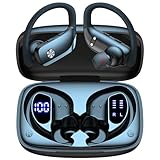
bmani Ear Buds Wireless Earbuds Bluetooth Headphones with 80H Playtime LED Display Case, Over-Ear Hook with Mic, Stereo Sound, Easy Button Controls, Sports Earphones for Running Workout Gym Black
Ear hooks
80-hour case battery
LED display
Buttons
Pros
- 80-hour total playtime
- Adjustable ear hooks
- Clear LED battery display
- Separate buttons
Cons
- Audio dropout reports
- No stated IP rating
The bmani T16 is notable for endurance: eight hours per earbud and a stated 80 hours with the charging case. For someone who wants gym earbuds that can be left in a locker bag and used through a long string of sessions, that capacity and the dual LED display are compelling practical features.
Adjustable over-ear hooks and a low two-ounce listed weight give the T16 a sport-oriented physical setup. It also uses separate main and volume button controls, which I prefer to a touch-only interface for hard workouts because a deliberate press is less likely to be mistaken for a swipe.
The 10 mm dynamic drivers cover the usual stereo-sound role, while dual microphones serve calls. Automatic reconnection to the last device can make the start of a home-gym or gym workout less fussy.
The protection description is “sweat and dust resistant,” without a formal IP rating in the supplied record. There are also customer reports of occasional audio dropouts, so this is best viewed as a feature-rich option for everyday indoor use rather than the one I would choose for rain and extreme conditions.
The LED case display makes this pair suit people who forget to charge
A visible display removes the guesswork that comes with a tiny status light. You can check the case and earbud battery before leaving instead of discovering a depleted earbud after the warm-up.
Its listed 80-hour total playback is the largest case-based claim in this roundup. Individual results vary with volume, but the extra capacity is meaningful for a regular gym schedule.
Physical buttons make this pair suit sweaty hands and glove users
The T16 includes separate main and volume controls. That separation should make it easier to change volume without cycling through a sequence of tap gestures, which is welcome during lifting, cycling, or cold-weather exercise.
The hooks should be adjusted before the workout starts, then left alone. Repeatedly twisting any hook-style earbud mid-session can loosen the chosen position and interrupt concentration.
6. SHOKZ OpenRun Pro 2 is the open-ear choice for deeper bass and longer runs
SHOKZ OpenRun Pro 2 Bone Conduction Bluetooth Sport Headphones, Black
Open-ear
Dual drivers
12-hour battery
Reflective strip
Pros
- Bone and air dual drivers
- Secure memory-wire frame
- 12-hour battery
- Reflective visibility strip
Cons
- No stated IP rating
- Higher rating for a smaller review base
The OpenRun Pro 2 takes the open-ear idea and adds a dual-driver system that combines bone conduction with air conduction. Its stated aim is fuller bass and more powerful 3D audio than a bone-conduction-only headset, which matters for listeners who like the safety of open ears but do not want a thin workout soundtrack.
The secure Ni-Ti alloy memory-wire frame is designed to keep the headset in place, and the listed weight is 30.3 grams. That is still light enough for long training sessions while giving the frame more structure than a loose earbud.
Battery rises to 12 hours, and dedicated EQ modes are available in the Shokz app. Dual wind-resistant microphones with AI noise reduction and a reflective strip make the feature mix particularly relevant for early-morning or evening running.
Unlike the standard OpenRun, the supplied product data here describes the water protection only as water resistant, not with a stated IP number. I would not infer a rating that is not listed, especially for athletes who train in heavy rain or sweat heavily.
Dual drivers make this model suit open-ear listeners who want more low end
Bone-conduction frames can feel less weighty than sealed in-ear models because the ear canal remains open. Adding an air-conduction driver is intended to improve bass while keeping ambient sound available.
That creates a useful middle path for people who want rhythm and punch on a run without losing track of their surroundings. Loud environments will still compete with the music because the ear is not sealed.
The reflective strip makes this model suit low-light outdoor routines
The reflective element is a small but relevant workout feature when your route overlaps with roads, paths, or shared spaces. It does not replace lights or reflective clothing, but it adds visibility to gear already worn on the head.
The product record also states that the AI microphone system filters 96.5 percent of background noise. Call performance depends on wind and surroundings, so I would treat that figure as a manufacturer feature claim rather than a promise for every route.
7. Soundcore V20i is the flexible open-ear option for two-device routines
Soundcore V20i by Anker Open Ear Earbuds, Open Ear Headphones True Wireless
IP55
Open-ear hooks
36-hour total battery
Multipoint
Pros
- Four hook positions
- IP55 sweat protection
- Bluetooth 5.4 multipoint
- Four-mic calls
Cons
- No noise isolation
- Ambient sound affects calls
The Soundcore V20i is an open-ear sport model with four adjustable hook positions, which is more customization than many fixed open-ear designs offer. That makes it a sensible choice if you want surroundings audible but have found that a one-size hook sits too high or too low around your ear.
It pairs a 16 mm driver with titanium-coated domes and BassUp technology, while the open design keeps your ear canal clear. Bluetooth 5.4 and multipoint connection to two devices suit a routine where you switch between a phone playlist and a laptop training video.
The listed IP55 rating covers sweatproof use and offers some dust protection, an appropriate level for ordinary gym sessions and outdoor movement. Battery is stated as eight hours in the earbuds and 36 hours with the case.
There is no active noise cancellation because that would conflict with the open-ear purpose. The trade-off is transparent: outside noise comes through, and one customer concern in the supplied data is that ambient sound can enter calls.
Four hook positions make this pair suit comfort-focused open-ear buyers
Changing the hook position lets you balance stability against pressure around the outer ear. I would set the position during a walk or easy warm-up, then make any adjustment before starting faster intervals.
The frame is designed for a snug fit, not isolation. That makes it a natural fit for outdoor running, commuting to the gym, or a home environment where you need to hear a doorbell or family member.
Multipoint makes this pair suit mixed work and training days
Multipoint can save time when your fitness video is on a computer and calls arrive on a phone. It is useful only if you regularly move between two sources, so a single-device user should give more weight to fit and sound.
The four microphones have AI noise reduction for calls, and the product includes customizable lights that sync to music. Those lights are optional flavor rather than a core athletic benefit.
8. Skullcandy Crusher 540 Active is the bass-first over-ear pick for lifting
Skullcandy Crusher 540 Active Wireless Sensory Bass Headphones – True Black
Over-ear
Crusher bass
40-hour battery
Breathable cushions
Pros
- Multi-sensory bass
- Breathable ear cushions
- 40-hour battery
- Secure clamp fit
Cons
- Listed at 0.5 kg
- Clamp may feel tight
The Crusher 540 Active is for people who want the physical impact of bass during strength training and do not mind an over-ear format. It uses two 40 mm full-range drivers plus dual bass drivers for the brand’s Multi-Sensory Crusher Bass, a very different listening approach from the small drivers in workout earbuds.
Skullcandy lists breathable ear cushions, a sweat- and water-resistant nano-coating, a secure over-ear clamp fit, and 40 hours of playback. The combination is more gym-friendly than many ordinary over-ear headphones, especially for lifting or machine work where a headband stays relatively stable.
I would be cautious about choosing it for long, high-bounce runs. The listed 0.5-kilogram weight and customer reports of a tight clamp force point to a design that prioritizes hold and impact over disappearing on your head.
Noise isolation is passive rather than ANC, and the headphones can also connect with a 3.5 mm auxiliary cable. Personal Sound through the Skullcandy app adds a route to tune playback to your preference.
Heavy bass makes this model suit motivation-driven strength sessions
The extra bass drivers are the headline feature. If a forceful low end helps you lock into a lifting rhythm, the Crusher format has a more physical presentation than open-ear frames or compact earbuds.
For precise podcast listening or a neutral sound signature, that same character may be less appealing. Audio preference is personal, so bass emphasis should be a deliberate choice rather than an assumed upgrade.
Breathable cushions make this model suit shorter indoor workouts
Breathable pads address one common over-ear complaint: trapped heat. They will not make closed cups as airy as an open-ear headset, but they may be more comfortable during weights or moderate cardio than non-breathable padding.
After each workout, wipe the cushions with a soft cloth and let them dry in open air. Sweat left in ear pads is both a comfort issue and a long-term maintenance concern.
9. Raycon Fitness is the over-ear pick with washable workout cushions
Raycon Fitness Bluetooth Headphones – Over The Ear Running Headphones, Active Noise Cancelling Wireless Headphones + Awareness Mode, Bluetooth Headset with Mic, 45 Hours of Battery Life (White)
IPX4
Washable cushions
ANC
45-hour battery
Pros
- Removable washable cushions
- ANC and awareness mode
- 45-hour battery
- Foldable design
Cons
- Listed at 0.57 kg
- Multipoint complaints
The Raycon Fitness addresses an ignored but important gym-headphone issue: what happens to ear pads after weeks of sweat. Its removable, washable ear cushions offer a clearer cleaning path than sealed pads, and that alone makes it a strong consideration for people who regularly sweat in over-ear headphones.
It also includes IPX4 water resistance, active noise cancellation, Awareness Mode, a foldable frame, and up to 45 hours of stated battery life. The adjustable headband can help establish a stable fit for gym equipment and lifting, while awareness mode is more appropriate than ANC when heading outdoors.
The listed 0.57-kilogram weight is substantial, so I would frame this as a gym and home-workout headphone rather than a dedicated running companion. One customer report says it bounces too much for serious running, even though the fit works well for cardio in the gym.
Customer feedback also flags voice controls and multipoint connection as inconsistent for some users. Those extras should not drive the choice; the washable pads, sound modes, and over-ear comfort are the more meaningful reasons to consider it.
Washable cushions make this pair suit hygiene-conscious over-ear users
Fitness communities regularly mention discomfort and hygiene concerns when sweat stays on earbuds or pads. Being able to remove and wash the cushions gives the owner a practical care routine instead of relying only on surface wiping.
Follow the maker’s care directions and wait for pads to dry completely before reattaching them. A clean pair of cushions also helps preserve a consistent seal for noise control.
Awareness mode makes this pair suit people who leave the gym wearing headphones
ANC can help reduce gym distractions, while Awareness Mode helps you hear the world again without removing the headset. That flexibility is useful for moving from a noisy indoor floor to a walk outside.
Its foldable format is convenient for a bag, but the weight still matters. People sensitive to headband pressure should favor a lighter earhook model for high-motion training.
10. TREBLAB Z2 is the button-controlled over-ear option for long sessions
TREBLAB Z2 Wireless Over Ear Headphones Bluetooth, Hybrid ANC, 58H
IPX4
Hybrid ANC
58-hour battery
Multipoint
Pros
- Up to 58-hour battery
- Physical button controls
- Hybrid ANC
- Foldable case included
Cons
- Cushion durability concerns
- ANC pressure for some users
The TREBLAB Z2 is another over-ear route, but it stands out for a listed 58 hours of battery life, or 35 hours with ANC on. That long claim, together with foldability and an included carrying case, makes sense for a person who uses the same headphones for training videos, work calls, commuting, and gym sessions.
It uses 40 mm dynamic drivers, hybrid ANC rated to reduce noise by up to 25 dB, IPX4 water resistance, and button controls. For a workout, the buttons are a genuine strength: they are easier to find by feel than a capacitive surface when you are moving or wearing gloves.
At 243 grams, it is lighter than the other two over-ear entries in this group by their listed weights. Still, closed cups are likely to feel warmer than earbuds or open-ear frames during hard cardio, so I would reserve it for lifting, steady-state work, and moderate sessions.
The analyzed feedback has useful caution signs. Some users describe ear cushions wearing out and replacement pads being hard to find, while others report multipoint instability or an uncomfortable ANC pressure sensation after about an hour.
Long battery life makes this model suit mixed exercise and daily listening
A large battery is helpful when one device serves many jobs. Multipoint pairing can switch between a phone and laptop, and the 65 ms gaming mode may help if you follow workout content where timing matters.
Battery figures are always affected by volume and ANC use. The 35-hour ANC-on claim is the more relevant comparison number for people who intend to block a noisy gym.
Button controls make this model suit reliable in-workout adjustments
Physical buttons give a clear press instead of asking for a precise gesture. That can reduce accidental skips and pauses, a pain point workout users often report with touch-controlled earbuds.
The detachable 3.5 mm cable offers a wired fallback outside the workout context. For exercise, Bluetooth and the IPX4 rating are the features that matter most.
The buyer’s guide starts with the headphone shape that matches your movement
For most people, earbuds with hooks are the strongest answer for running, HIIT, CrossFit-style movement, and any workout that repeatedly jolts the head. The hooks give the bud a second point of contact, while a choice of tips helps create the in-ear seal needed for sound and passive isolation.
Open-ear bone-conduction and air-conduction designs suit outdoor runners, cyclists, walkers, and instructors who need awareness. They do not seal out a busy gym, but the ability to hear traffic, cues, and conversation is often more useful than maximum bass.
Over-ear headphones work best for lifting, machines, mobility work, and indoor sessions where you want bigger drivers, longer battery life, and more isolation. Their downsides are heat, pad maintenance, headband pressure, and a greater chance of movement during fast running.
A secure fit matters more than an impressive feature list
Start by asking what failed on your last pair. If earbuds slid out, look for adjustable hooks, memory wire, or a wraparound frame; if a headband bounced, a compact earhook design may solve the problem better than a tighter clamp.
Fit should feel secure without pain. Pressure at the ear canal, sore outer ears, headaches from clamping force, or a headset that touches a helmet are signs to change the style rather than try to tolerate it.
An IP rating gives a clearer sweat-protection signal than marketing language
IPX4, found on models such as the Powerbeats Pro 2, Raycon Fitness, and TREBLAB Z2, indicates water resistance suited to splashes and sweat. IP55, used by the Soundcore V20i, adds dust protection and a stronger water-resistance designation for regular exercise use.
IP67 on the SHOKZ OpenRun and IP68 on the JBL Endurance Peak 4 are more protective explicit ratings in this lineup. The OpenRun record specifically says not for swimming, which is a useful reminder that you should follow each maker’s stated limits instead of treating every high rating as permission for every water activity.
A product that only says “sweat resistant” or “waterproof” without a formal rating can still be good for gym use, but the exact exposure it handles is less clear from the data. For heavy sweat, rain, dust, or outdoor training, I would lean toward the model with the strongest clearly stated rating.
Noise cancellation helps indoors while awareness matters outside
ANC can make a loud gym less tiring by reducing background sound. The Beats Powerbeats Pro 2, JBL Endurance Peak 4, Soundcore Sport X10, Raycon Fitness, and TREBLAB Z2 all list active or hybrid noise cancellation.
Use Transparency, Smart Ambient, or Awareness Mode when leaving the gym or exercising near vehicles. Open-ear models are the simplest awareness option because they are designed not to block the canal in the first place.
Noise isolation is not the same as ANC. The Skullcandy Crusher 540 Active lists passive sound isolation, while ANC uses microphones and processing to reduce selected ambient sound; both can help focus, but they work differently.
Battery claims should be read as planning numbers rather than guarantees
Case-based earbuds show a total number that includes recharges from the case, while open-ear neckband frames quote the headset itself. Compare like with like: the OpenRun claims eight hours on its own, whereas the Powerbeats Pro 2 and JBL Endurance Peak 4 quote 45 and 48 hours total with their cases.
ANC, volume, calls, and repeated quick connections can lower actual runtime. For short daily workouts, a quick-charge figure can be more useful than the biggest total claim; examples here include the OpenRun’s 10 minutes for 1.5 hours and JBL’s 10 minutes for four hours.
Cleaning after every workout protects comfort and charging contacts
Wipe earbuds, hooks, and over-ear pads with a soft dry or lightly damp cloth after sweat-heavy sessions, then let them air dry before returning them to a case. Do not charge wet earbuds, and keep case contacts free of residue.
Clean ear tips regularly and replace them if they no longer seal well. For over-ear users, removable washable pads such as those on the Raycon Fitness are a tangible advantage, while non-removable cushions deserve extra care because sweat and heat can shorten their comfort life.
The 60 60 habit protects listening comfort during frequent training
The 60 60 rule is a common listening guideline: use around 60 percent of maximum volume for no more than 60 minutes at a time before taking a break. It is not a substitute for personal medical advice, but it is a sensible check when loud gym music tempts you to keep turning your headphones up.
A better seal or effective ANC can help you listen more comfortably at a lower volume indoors. Outdoors, do not turn up a sealed headset so far that it removes awareness of hazards.
The FAQ answers the practical questions gym-goers ask before choosing
Why are athletes ditching Bluetooth headphones?
Athletes are not broadly abandoning Bluetooth headphones. Some choose wired options for specific latency or charging needs, while others choose open-ear Bluetooth models because they want to hear traffic, coaches, or training partners. For most workouts, a secure fit and the right awareness level matter more than whether the connection is wireless.
What is the 60 60 rule for headphones?
The 60 60 rule is a common hearing-comfort guideline: listen at about 60 percent of maximum volume for no more than 60 minutes at a time, then take a break. A good ear-tip seal or noise cancellation can reduce the urge to raise volume in a loud gym.
Is it better to work out with headphones or earbuds?
Earbuds with hooks are usually better for running, HIIT, and fast movement because they are light and mechanically secure. Over-ear headphones suit lifting and indoor sessions when you want bigger sound and isolation, while open-ear headphones are better when awareness of roads, coaches, or other people is important.
Which type of headphones are best for the gym?
Hook-style wireless earbuds are the best general gym choice because they combine stable fit, sweat resistance, and compact size. Choose open-ear frames for awareness, or choose over-ear headphones for lifting when heat and headband movement will not be a problem. Look for at least a stated sweat-resistance rating and controls you can use during exercise.
The right workout headphones depend on your movement, not just your music
The best wireless headphones for working out are the Beats Powerbeats Pro 2 for a broad mix of gym training, the JBL Endurance Peak 4 for the most demanding sweat and weather exposure, and the SHOKZ OpenRun for open-ear running awareness. Every other choice here has a clearer niche, from the bmani T16’s battery display to the Raycon Fitness washable cushions.
For 2026, choose the retention system and protection level first, then decide how much isolation you want. Check your preferred model’s fit options, clean it after training, and select the pair that helps you focus without asking you to keep readjusting it.